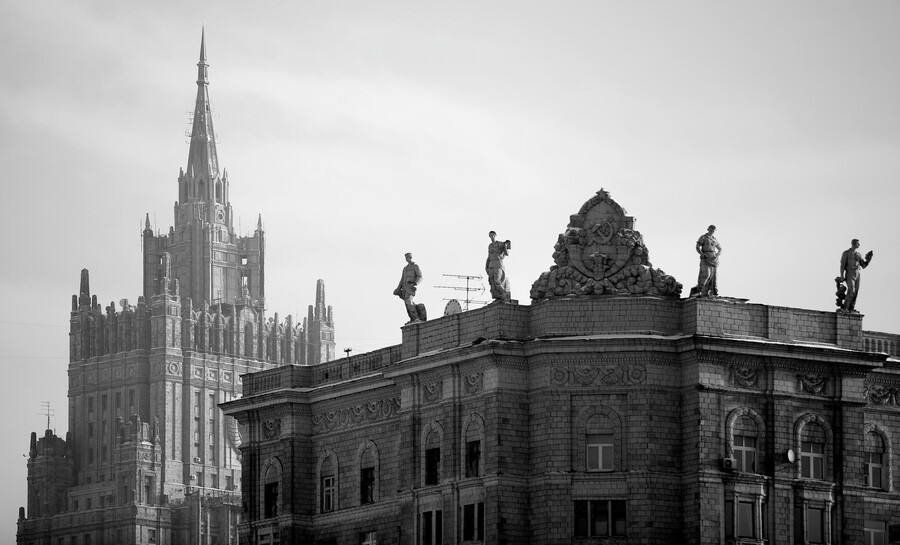
Ministry of Foreign Affairs Building // Residential Building on Smolenskaya Embankment Photographer Nikolay Titkov / 2010
Visual Research Concept
Soviet architecture served as a primary propaganda tool, demonstrating the ideology, values, and scope of the Soviet state. If these elements changed, the architecture changed with them. During the Constructivism era, the architect’s main goal was to create something new; during Stalin’s rule, it was to create the best. While the concept of «the best» is straightforward, «the new» is far more complex, because creating something entirely novel is impossible. Even innovative art does not spring from a vacuum; every image is derived from the surrounding world—from natural forms, patterns, and historical monuments. Here, the critical element is not a new image, but a new approach and a considered selection of motifs from the past that will fulfill the function established by the architect.
This raises a question:
Where did Soviet architects derive their forms?
Why did they turn to these specific images? What ideas are embedded in these references? How does this reinterpretation function within the new architecture?
To answer these questions, three Soviet architectural landmarks were selected: Vladimir Tatlin’s Tower of the Third International, Lenin’s Mausoleum, and the Stalinist skyscrapers. Each has a different function, ideology, and form. Consequently, they demonstrate varied approaches to reinterpreting historical heritage.
The unbuilt Tatlin Tower represents the genesis of Constructivism—an attempt to completely redefine architectural language. Lenin’s Mausoleum showcases the solution to an extremely complex challenge: creating a monumental, eternal structure. The Stalinist skyscrapers demonstrate not a rejection of historical heritage, but its adaptation to state objectives. Thus, the study covers diverse approaches to working with past architectural forms.
In this research, I will analyze each object individually, determine the origins of its form-making, and explain why this particular motif was chosen. The study is built on comparing Soviet architecture with historical structures and architectural styles that may have influenced the formation of the selected objects. In this case, what matters is not only visual similarity but also the meaning embedded in those forms, as well as the context of their creation.
While preparing the research, I utilized lectures by E. S. Likhacheva (former director of the A. V. Shchusev Museum of Architecture), the works of Soviet art critic S. O. Khan-Magomedov, as well as the writings and articles of contemporary art critics focused on Soviet architecture.
The primary sources of imagery were Wikipedia, the online service «Pastvu,» and the internet resource «History of Russia in Pictures.» All photographs are presented in monochrome to focus the reader’s attention on form.
Categories
- Concept
- Index
- Monument to the Third International of the Communist Party
- Lenin’s Mausoleum
- Stalinist Skyscrapers
- Conclusion
- Sources
Monument to the Third International
Visualization of «Monument to the Third International» / Vladimir Tatlin / 1919
«Corner Relief» / Vladimir Tatlin / 1915
«Undoubtedly, the initial powerful creative impulse for the entire formative process within Constructivism was provided by Tatlin’s counter-reliefs and his Tower III International.» — S. O. Khan-Magomedov, Soviet art historian. [7]
Vladimir Tatlin is considered the father of Russian Constructivism.
Of course, constructive architectural forms were already widely used in construction at that time. The difference was merely that these were purely technical objects. For example, Shukhov’s television tower was created as «a purely engineering structure and was aesthetically hardly perceived by contemporaries.» [7]
Tatlin’s tower, however, appeared differently in the eyes of the public. It possessed not only engineering significance but also monumental weight, serving as a monument to the Third Communist International.
«Shukhov Tower» / Vladimir Shukhov / 1919–1922
«In the search for the fundamental bases of modern style, leaders of the most authoritative creative concepts attempted to reach foundational principles of form-making that were free from traditional cultural layers.» — S. O. Khan-Magomedov, Soviet art critic. [7]
Tatlin extended a four-hundred-meter structure outward, leaving the glass volumes of the interior spaces within. Furthermore, the design called for the stereometric bodies to rotate. These were new, progressive solutions. The project made a significant impression at the time, showcasing the new possibilities of Soviet architecture.
«Monument to the Third International» / Vladimir Tatlin / 1919 Model Execution: D. Dimakov, E. Lapshina, I. Fedotov / 1987–1991
«The Tatlin Tower marked a new phase in interpreting the image of the Tower of Babel.» — Ayrat Bagautdinov, architectural historian. [1]
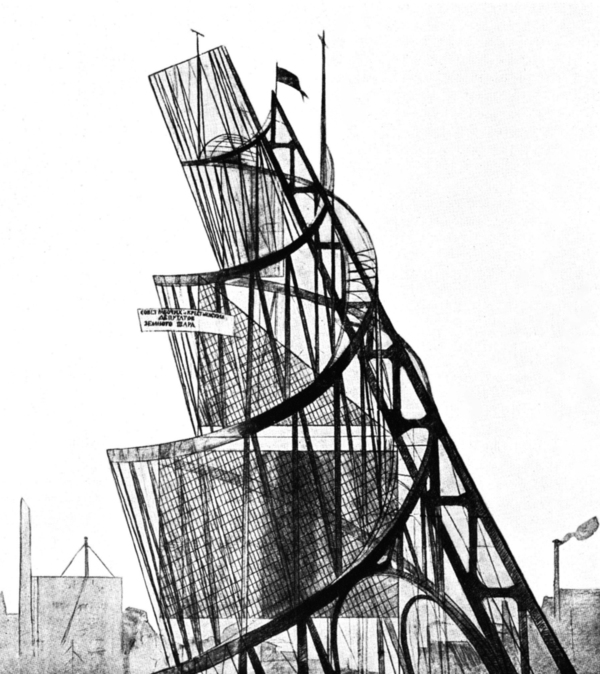
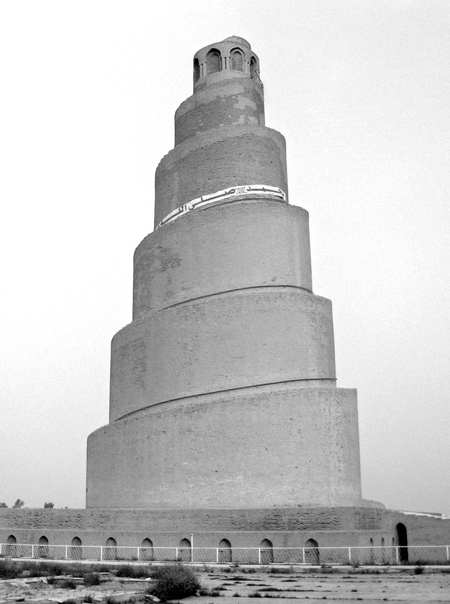
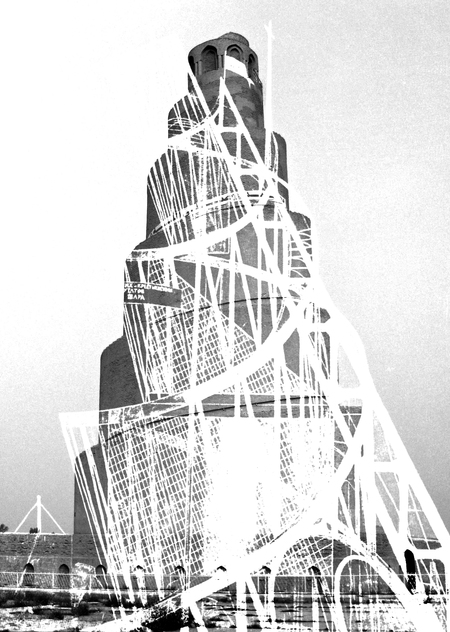
Tower III of the International Project / V. Tatlin / 1919 Malwiya Minaret (prototype for the Tower of Babel form) / Samarra / 19th century
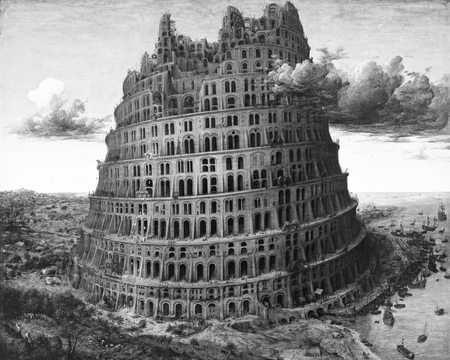
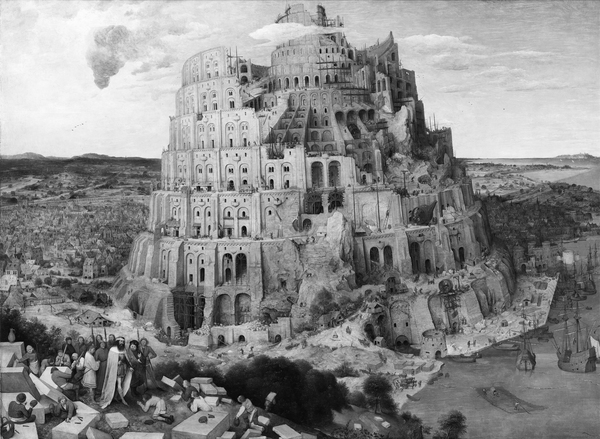
«Tower of Babel» / Pieter Bruegel the Elder / 1563
Although the Tatlin Tower initiated a new artistic form—Constructivism—we can compare the Monument to the Third International with the Tower of Babel both visually and ideologically.
Both structures feature an asymmetrical, spiral form. However, the Tower of Babel is massive and stone-like, whereas the Tatlin Tower is dynamic and light. Furthermore, in the biblical narrative, people were divided, but here all nations were intended to unite in a single International. Tatlin references Babel, yet pits his monument against it.
Even though the tower was never built, it remains a symbol of 20th-century Constructivism.
Lenin Mausoleum
Lenin Mausoleum / Architect Alexey Shchusev / 1929–1930
Lenin’s Mausoleum is one of the most significant architectural monuments of the Soviet period. It was a complex challenge for architects to create an image of the mausoleum that fully reflected the monument’s importance to the people honoring the memory of the great leader.
«Honor Guard at Lenin’s Mausoleum» / 1982
«Red Square» / Photographer Valentin Khukhlaev / 1981
The stone mausoleum we see today did not appear overnight; it was preceded by two temporary wooden versions. The principal architect for all three structures was A. V. Shchusev, who, after the completion of the construction, was the first to be awarded the title of Honored Architect of the USSR.
The core concept for the project was first proposed by Shchusev on January 23rd during a meeting of specialists convened by the Lenin Memory Commemoration Commission:
«Vladimir Ilyich is eternal. His name has forever been inscribed in the history of Russia, in the history of humanity. How can we honor his memory? How can we commemorate his grave?
In architecture, the cube is eternal. All—all the diversity of architectural creativity—stems from the cube. Let the mausoleum we are about to erect in memory of Vladimir Ilyich also derive from the cube.» [2]
Lenin Mausoleum / Architect Alexey Shchusev / 1929–1930
In search of a suitable concept, Shchusev looks to the history of architecture. He understands that in this case, he cannot simply adopt a specific architectural style as a foundation. In the monuments of the past, he seeks only the compositional idea—one that he will recontextualize into something new. After all, such an important historical structure must be unique and recognizable.
It was decided to turn to the most ancient form—the stepped pyramid. After all, pyramids and ziggurats most accurately embody the idea of eternity, being among the first architectural structures.
«The appearance of mausoleums not only reflected the national characteristics of a particular people’s architecture and testified to the skill of the builders, but also clearly demonstrated the social and ideological role of architecture. Is it any coincidence, for example, that Egyptian pharaohs rushed to build grand tombs for themselves during their lifetimes, when the size of the pyramids was not always commensurate with the role of that pharaoh in the history of Egypt?» — S. O. Khan-Magomedov, Soviet Art Historian. [6]