Concept I. Readymade and the transformation of an object into an artwork II. Surrealism and object fetishism III. Post-war art: clothing as memory and trace of catastrophe IV. New approaches: Kapoor, Arte Povera, performance V. Consumer art and the transformation of clothing into a brand VI. New typologization: the costuming environment Conclusion Bibliography
Concept
In contemporary art over the past few decades, there has been an increasing and insistent turn toward clothing and textiles as autonomous vehicles of meaning—functions that extend beyond mere decorative, utilitarian, or fashionable purposes. In these practices, clothing transcends being a «garment for the body» to become an extension of it, a trace, an archive of experience, and simultaneously a political and social statement. Crucially, clothing never exists here as a neutral medium; it is always already imbued with biography, labor, economy, and memory—both individual and collective.
The relevance of this research stems from several interconnected processes within contemporary art and culture: the renewed interest in materiality following the dominance of digital practices, which reestablishes fabric and clothing as vital mediums that return corporeality, tactility, and the experience of physical wear to art; the heightened significance of global social and ecological issues—migration, the crisis of overproduction, and fast fashion—where clothing functions as a material testament to the global economy, labor, and the uneven distribution of resources; the blurring of boundaries between sculpture, performance, design, and fashion in contemporary art, where clothing assumes the status of a hybrid medium; and the necessity of theoretically understanding clothing as an independent artistic object that operates beyond its conventional definition as merely an element of performance or scenography.
The novelty of this study lies in its first comprehensive tracing and systematization of the chronology of perceiving clothing as material for art objects—from early integrations of textiles into avant-garde practices to contemporary artistic strategies where clothing functions as a standalone medium.
The chronological scope of this research covers the period from the early 20th century to the 2020s, allowing us to trace the transformation of clothing from a functional item into an independent artistic object. The study begins with the historical avant-garde and the readymade, subsequently examining neo-avant-garde, happening, Arte Povera, performance, and body art from the 1960s–70s, consumer art of the 1980s–90s, and contemporary art of the 21st century, where clothing becomes a medium for discussing memory, the body, gender, migration, ecology, and global consumption.
The research structure consists of six chapters. The first chapter is dedicated to the avant-garde premises for incorporating everyday objects into art. The second examines the readymade, assemblage, and new forms of objecthood. The third analyzes postwar sculpture and accumulation practices. The fourth chapter explores the practices of Allan Kaprow, Arte Povera, performance, and body art, where clothing becomes part of the environment and corporeal experience. The fifth is devoted to consumer art and the relationship between fashion and contemporary art. The sixth introduces the concept of the «costume environment» and examines modern textile installations and wearable art.
The research draws upon manifestos, interviews, exhibition catalogs, performance documentation, and the artwork itself. Sources include the texts of Allan Kaprow, Germano Celant, Joseph Beuys, as well as the scholarship of Rosalind Krauss, Hal Foster, Jean Baudrillard, and Walter Benjamin concerning the object, materiality, and consumer culture.
Key Research Question and Hypothesis
The core question of this research is how clothing and textile in 20th and 21st-century art transformed from a functional and decorative element into an autonomous artistic medium connected to themes of the body, memory, identity, consumption, and social critique. The research hypothesis posits that the use of clothing as an art object reflects shifting understandings of artistic material and the status of art in contemporary art. As avant-garde, neo-avant-garde, and postmodern practices developed, clothing ceased to be merely an object of daily life or a costume; it evolved into a carrier of bodily experience, memory, traces of labor, trauma, and global economic processes. Through the materiality of the fabric, contemporary art reinterprets the relationship between the body, the object, space, and the social environment.
Chapter 1. Readymade and Transforming an Object into an Artwork
Clothing has always functioned as a social code: demonstrating the wearer’s status, gender, race, or religious beliefs. Textiled goods, originally created for the utilitarian purpose of «covering the body,» have increasingly become a distinct statement with each era of history.
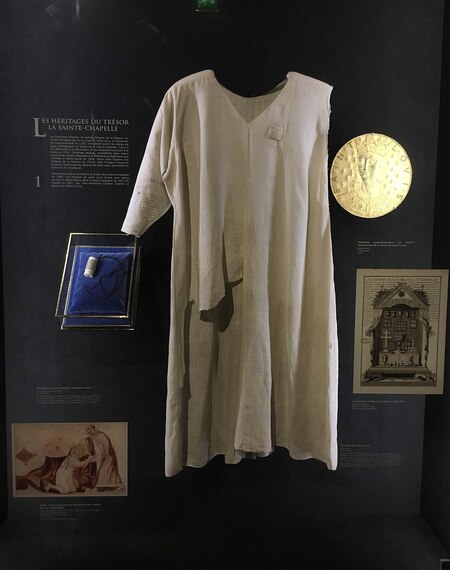
In religious and courtly culture, the clothing of the deceased or a saint often became a relic—an object whose value transcended its function of wear. For instance, the shirt of Saint Louis IX (pictured) is preserved and venerated as a relic; the chalice of Saint Thomas Becket is displayed in a church museum and connected to his cult; and the Turin Shroud has been regarded for centuries as the burial cloth of Christ and an object of reverent contemplation. Today, people also preserve objects belonging to deceased loved ones—as a «silent reproach, ” as a „pulse of memory.“ In these cases, clothing or fabric is important not as a status symbol, but as a material trace of the body, of sanctity, and of absence; it is no longer „clothing for life, ” but almost a sacred remnant after death.
The exhibition potential of costume was gradually recognized, but it solidified particularly clearly in the 20th century when clothing began to be collected, classified, and displayed as an independent cultural form. It is illustrative that the Costume Institute at the Metropolitan Museum of Art originated in 1946 and became a curatorial department in 1959; however, due to the fragility of the garments, it does not maintain a permanent exhibition but instead organizes temporary shows. Most recently, this led to the Costume Art project, which will open in 2026 and will directly connect wardrobes with works of art from the museum’s collection. Following the same logic, the V&A houses not only fashion in its collection but also ancient liturgical vestments—clothing that originally possessed sacred status and thus easily transitioned into a museum display setting. This is precisely where clothing ultimately becomes an object of study, rather than merely an indicator of ownership.
The emergence of the ready-made—a new practice introduced by Marcel Duchamp—marked a turning point in 20th-century art, including the development of clothing as an art material. Duchamp rejected the traditional notion of artisanal craftsmanship, shifting focus from the act of making objects to the act of choosing them. Duchamp’s diaries from the early 1910s contain notes such as: «Is it possible to make something that is not a 'work' of art?» and «A kind of pictorial nominalism.» Cumulatively, this meant that the artist considered «the naming of art—that is, calling a particular image or object art—to be equivalent to creating art» [2].
He exhibited commonplace everyday objects—a bicycle wheel, a drying rack, a sink–urinal—as «ready-made» works of art. «It doesn’t matter if Mr. Mutt made the fountain with his own hands or not. He made the CHOICE. He took a standard, utilitarian product, placed it in an unusual setting, so much so that in the new environment its usual meaning disappeared. Thanks to a new perspective and a new name, he created a new idea for the object, ” Duchamp wrote on behalf of Beatrice Wood in the magazine The Blind Man regarding his 1917 art object, the urinal „Fountain.“
The term „ready-made“ itself refers to mass-produced clothing („ready-made“ means ready for use, like factory-made apparel). This emphasized the idea that any utilitarian object could become art. Thanks to Duchamp, the familiar functional item loses its function and acquires a new status—it transforms into a sign, an idea, a concept. The very act of displaying a simple iron or a sink in a museum forces us to ask: „What exactly makes an object art?“
Thus, the ready-made initiated a long chain of object-based practices. Following Duchamp, artists realized that an object becomes an artistic statement not because of its „beautiful form,“ but because of its context, its idea, and its „name.“
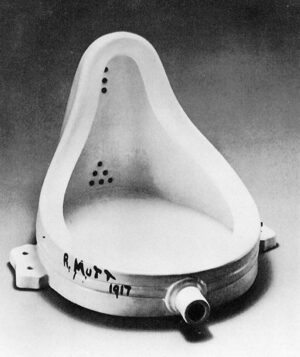
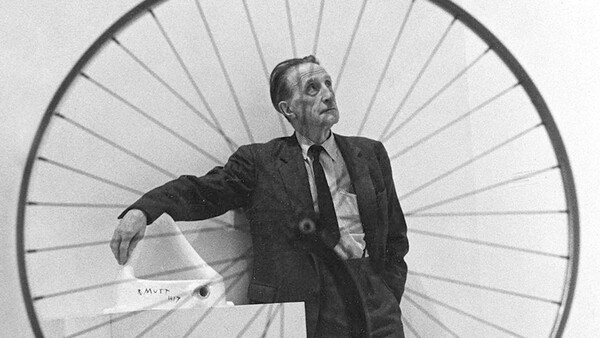
Marcel Duchamp «Fountain» 1917
Chapter 2. Surrealism and the Fetishization of the Object
Surrealists pushed further—they turned to the psyche and the subconscious. For them, the object was not a neutral thing, but a carrier of desires, fears, and repressed feelings. Influenced by Sigmund Freud’s psychoanalysis, objects came to be perceived as fetishes—symbols of lost presence and hidden desires.
Despite the fundamental difference between a ritual artifact and a factory-produced item, both types of objects were perceived as fetishes—things imbued with a special power over humans. However, while a tribal artifact was conceived as a sacred object possessing its own life and cultic energy, the ready-made revealed a different nature of the fetish—a commercial one. Karl Marx wrote that in capitalist society, the commodity conceals the traces of human labor and begins to be perceived as an independent, almost animate entity. It was this mechanism of «commodity fetishism» that Duchamp exposed with his objects, showing that a work of art is included in the same systems of display, exchange, and consumption as any commercial product. But unlike Duchamp’s coolly detached ready-mades, the surrealist object usually carried a strong emotional and psychological charge.
André Breton was particularly interested in things that seemed to slip out of modernity: outdated items, objects found at flea markets, things marked by signs of human use and the passage of time. In his novel Insane Love, he describes a wooden spoon found at a market, whose shape reminded him simultaneously of a women’s shoe and a symbol of desire. This object becomes important not only because of its form, but because it retains the imprint of another life and a vanished mode of production.
The empty clothing and mannequins become a key motif for the surrealists—"bodies without a body.» Unlike Duchamp, who aimed for the «visual neutrality» of the object, the surrealist item always retained emotional and psychological tension. Duchamp emphasized that he chose objects without personal attachment, almost in a state of «aesthetic anesthesia» [2]. Surrealists, conversely, sought the trace of the unconscious within the object. This is why their art so frequently features shoes, gloves, fur, mannequins, and empty clothing—objects that simultaneously evoke the body and testify to its absence.
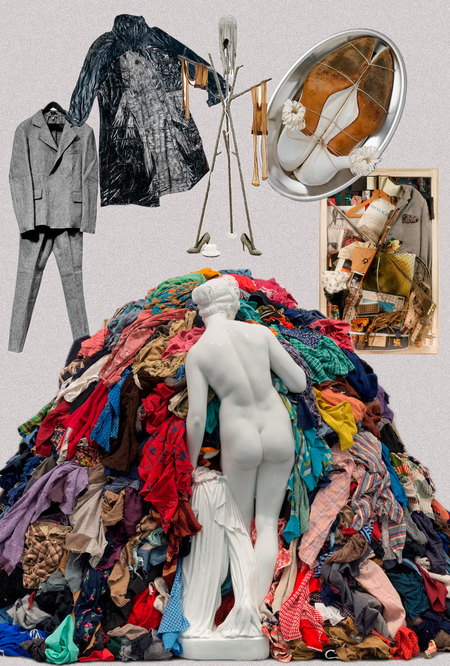
Let’s consider the piece Ma gouvernante — My Nurse — Mein Kindermädchen (1936) by Meret Oppenheim. It presents a pair of women’s shoes tied with string and served on a silver platter like a prepared dish. Here, the footwear transforms into a complex symbol of submission, desire, and the woman’s social role. Surrealists frequently used shoes as fetish objects because they simultaneously retain the imprint of the body while existing separately from it. It is in such objects that the uncanny effect arises—the «eerie,» as Freud wrote in his essay The Uncanny. The uncanny is what seems familiar yet suddenly reveals a hidden strangeness. Empty shoes, mannequins, or clothing evoke anxiety precisely because they retain the form of human presence without the human itself.
M. Oppenheim «My Nanny» 1936
Chapter 3. Post-War Art: Clothing as Memory and the Mark of Disaster
After World War II and the Holocaust, the relationship with objects changed: clothing and personal items became archives of memory and lost presence. A passive, ready-made object transforms into a testament to historical trauma. Images of piles of shoes and empty suits in war memorials demonstrated that an object is humanity’s closest «trace.»
New artists leveraged this power: they imbued clothing and textiles with symbolic meaning. The French artist Christian Boltanski, for instance, creates installations from stacks of old coats and shirts. As the Guardian critic notes, thousands of rusted jackets scattered on the floor in «camps without people» are perceived as «mute death camps»: «we wander among stuffy cloaks and worn jeans, as if trying to read the remains of those who vanished… These piles of clothing can signify mass graves, and without bloodstains or plaques, Boltanski’s proof of loss requires no words.» In his work, clothing is not fashion—it is a prayer for memory: every item seems to hold the image of a specific person who is no longer present. It remains an «indexical» sign—it does not depict a person; it is the actual imprint of their life.
In this context, Arman operates—one of the key representatives of French New Realism and a close associate of Yves Klein. In 1953, he abandons pictorial prints and turns to the direct presentation of objects as artistic material. While continuing the line of Duchamp’s ready-mades, Arman shifts focus from the singular object to accumulation and repetition.
His famous «accumulations» consist of groupings of uniform objects—shoes, clocks, musical instruments, clothing, household items. While the influence of modernist composition and cubist structure can still be felt in these works, the objects no longer possess the Duchampian neutrality or surrealistic mystery. They appear as products of an endless conveyor belt, as elements of an anonymous consumer culture.
If Duchamp’s ready-made posed the question of how an ordinary thing becomes art, Arman illustrates a different stage in an object’s existence—its infinite reproduction and transformation into waste. Repetition becomes the primary artistic principle: the objects lose their individuality and are perceived as part of a continuous flow of goods.
Arman was one of the first to realize that postwar sculpture was increasingly linked to the logic of the shop window and the public display of goods. The museum space began to resemble a store or a warehouse. This idea was most vividly expressed in the installation Le Plein («Fullness, ” 1960), where the artist completely filled the gallery with trash and domestic refuse. The gallery simultaneously became a display case, an archive, and a dump, marking an important turning point in art in the second half of the 20th century.
Over time, Arman’s works began to evoke not only consumption but also memory of catastrophe. Piles of clothing, shoes, and personal belongings recall scenes from Alain Resnais’s film Night and Fog [2], which is dedicated to Nazi concentration camps. After World War II, a mundane object can no longer be perceived neutrally: clothing and personal effects become testaments to lost human lives.
Thus, Arman’s objects speak simultaneously to the memory of the past and anxiety about the future. His accumulations of things look like a warning about a world of overproduction, where items quickly lose value and become garbage. Consequently, the artist’s work is today perceived not only as a critique of consumer culture but also as an early premonition of ecological disaster.
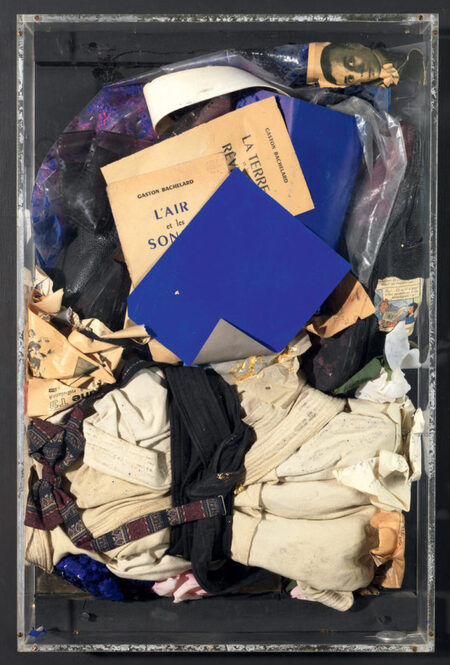
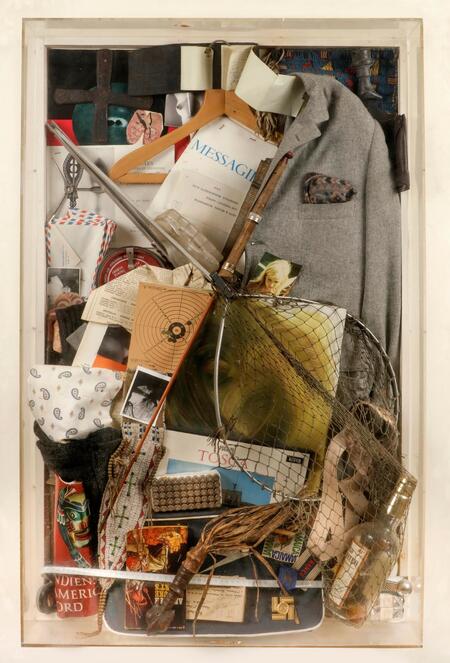
Left to right: 1. Arman «First Robot Portrait by Ivan Klein» 1960 2. Arman «First Robot Portrait by André Schüller» 1968
Empty clothing plays a distinct role in the specific perception of the postwar era. An empty jacket or dress elicits a sense of unease in the viewer: we see the shape of a body, but the body is absent. Freud termed this the «uncanny”—a disturbing combination of the familiar and the alien. Clothing on a hanger or suits without a person sound like the „ghost of a body.“ Clothing exists on the boundary of „animation“: it retains traces of wear (wrinkles, stains, smells) yet remains an inanimate object. Old trousers, a faded sweater—they are like the fingerprints of a person who has lived their journey.
Therefore, artists conceptualize empty suits as discrete objects: whether it is an installation of hung coats, an abstract silhouette on a wall, or „cybernetic“ performance costumes, the form of the clothing itself serves as a meditation on loss. The quantity of „impersonal“ clothing in installations evokes a sense of mass annihilation—as in Boltansky’s work—yet simultaneously, each item remains a witness to its singular history. In any case, the clothing sets a mental resonance: every viewer subconsciously „completes“ the invisible owner. This is the core phenomenon: through empty clothing, we feel both the „presence and absence“ of a human being.
Thus, in postwar art and beyond (from conceptualism to contemporary performance), clothing acts not as a „fashion accessory, ” but as a medium for thought and memory. It becomes a vessel for collective and personal experience: a memory without names, a prophetic „artifact“ of vanished time. It is this dual nature—between the living and the inanimate, the personal and the historical—that makes empty clothing a powerful and poignant theme in contemporary art. It embodies the eternal paradox: the form remains, but the owner is gone—a „creepy“ reminder of ephemerality and memory.
K. Boltansky «Personnes» 2010
Chapter 4. Capra’s New Approach, Arte Povera, Performance
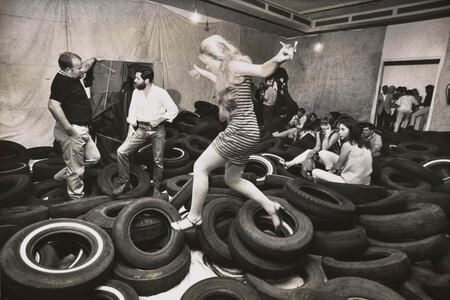
In the late 1950s, Allan Kaprow was one of the first to realize that the radical nature of Jackson Pollock lay not just in his new painting technique, but in the dismantling of the very idea of the painting as a self-contained art object. In his essay «The Legacy of Jackson Pollock» (1958), Kaprow wrote that Pollock «didn’t just create several great canvases—he destroyed painting.» For Kaprow, what mattered were not isolated formal discoveries—gesture, scale, or abstraction—but rather that painting began to break out of its own boundaries and dissolve into the surrounding space.
Kaprow believed that after Pollock, art could no longer exist solely within the rectangle of the canvas. Everyday reality itself became the artistic material: bodies, clothing, rooms, streets, noises, trash, and random events. He wrote that the new art should use «light, sound, movement, people, smells, touch, ” and its material could be „anything: paint, chairs, food, electric bulbs, water, old socks, or a dog.“ This idea effectively anticipated the major artistic practices of the 1960s—happenings, performance, environment, and installation.
What was particularly crucial was Kaprow’s elimination of the boundary between art and life. In his happenings, clothing ceased to be a secondary detail and transformed into part of the action and environment. Everyday attire, work uniforms, random fabrics, or worn objects functioned as elements of the event, connected to the body and movement. Art no longer separated itself from the domestic sphere—quite the opposite; it was assembled from its fragments.
(Photo: A. Kaprow, „Yard, ” 1961)
Art Povera emerged in Italy in the late 1960s as a radical reaction against industrial aesthetics, minimalism, and the logic of technological production. The critic Germano Celant, who coined the term, described this art as a rejection of «rich» materials in favor of poor, unstable, everyday substances—earth, wood, scrap metal, fabric, and clothing. In this logic, the material no longer serves as a carrier of form; it itself becomes a carrier of history, decay, and social memory.
Textiles and clothing take on particular significance in this context. Unlike marble or bronze, fabric does not aspire to permanence; it wears out, tears, and absorbs the traces of the body. Therefore, in Art Povera, clothing becomes a «living» material—it preserves imprints of presence, scent, wear, and the marks of time. Artists use it not as a decorative element, but as a trace of daily life and social experience. Just as Surrealism imbued old objects with psychological and symbolic energy, Art Povera restores historical and sensory tension to outdated materials.
The materials lack the utopian potential of modernism: they do not promise a future, but rather document a process of degradation. The desire to transform what is breaking down into new artistic energy creates a tense equilibrium between craft and industry, tradition and modernity. On one hand, artists return to manual labor (as seen in Luciano Fabro’s marble works); on the other, they inevitably find themselves within the sphere of design and commodity aesthetics, where even «poor materials» can acquire a refined formal quality.
Thus arises the fundamental dilemma of «art povera»: the pursuit of anti-modernist critique of industrial production simultaneously converges with the logic of contemporary design, where uniqueness and marketability can coincide.
Michelangelo Pistoletto’s work, Venus in Rags, vividly demonstrates this duality: the classic form of ancient sculpture confronts a pile of discarded clothing, merging high tradition with the material detritus of everyday life.
Pistoletto himself later articulated the logic of the work with almost disarming simplicity: «Venus embraces the rags and gives them new life {regenerate}, fills them with color and form, and they become a pile of wonders.» In this phrase, the word regenerate is key—it is not annihilation, nor is it purification, but precisely transformation. The rags are neither negated nor masked; instead, they are incorporated into a new form, where loss is inverted into energy. This accounts for the dual sensibility the work evokes: it speaks simultaneously of decay and assembly, of trash and renewal, of beauty and its historical underside.
In this sense, Venus in Rags is not merely a critique of consumption, but also a critique of the very notion of «pure» sculpture. Pistoletto places side-by-side what typically should not meet: the idealized ancient form and the amorphous mass of used clothing. The classic body seems to be enveloped by an archive of other bodies, and the rags begin to function as a collective memory of life, labor, and wear. This is why the work resonates so clearly today: it speaks not only of the 1960s but of the contemporary world, where fabric, object, and waste increasingly emerge as different phases of the same cycle.
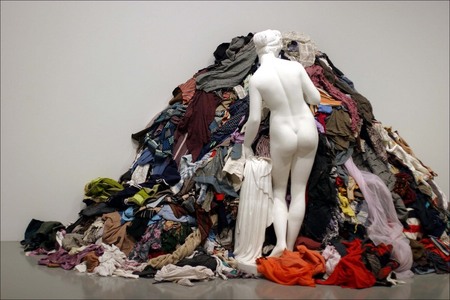
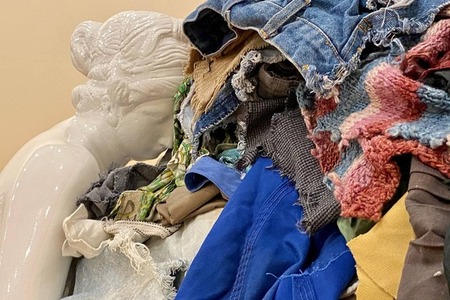
M. Pistoleto «Venus in rags» 1967
During the 1960s and 70s, textiles and clothing moved definitively beyond mere decorative or utilitarian functions. They began to become integral to performance art, body art, and spatial installation. Artists started to be interested not in clothing as ornamentation, but in clothing as an extension of the body—as a form of restriction, protection, or transformation of movement.
For Joseph Beuys, felt, textiles, and clothing are linked to memory, warmth, and trauma. Beuys constructed an almost mythological narrative around these materials, asserting that felt has the ability to retain warmth and protect the body. Particularly compelling is the observation by art historian Gene Ray, who points to a connection between felt and the memory of the Holocaust: «Felt has another historical reference—the history of the Holocaust, which cannot be erased or avoided.»
This is crucial for understanding why Beuys’s objects made from clothing and felt are often perceived as evidence of an absent body. An empty felt costume retains a human presence even without a person inside. In the analysis of the art object Felt Suit, it is stated: «Even without Beuys’s physical body, his presence is still felt.» In his practice, fabric transformed into a symbol of collective memory and the post-war experience. His objects made of felt and clothing preserved the trace of an absent human, simultaneously evoking protection and vulnerability.
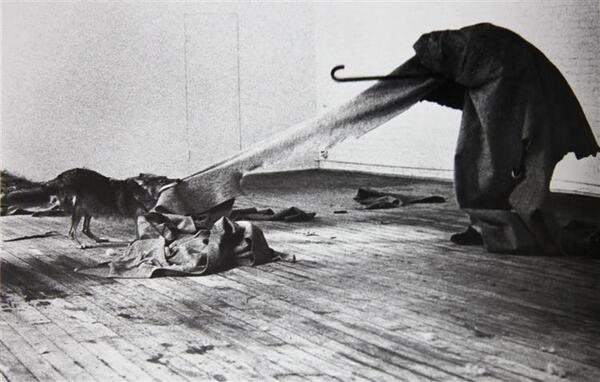
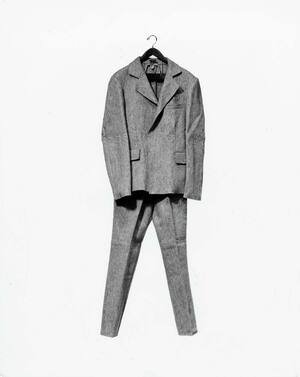
Left to right: 1. Y. Boles «Coyote: I love America and America loves me» 1974 2. Y. Boles «Felt Suit» 1970
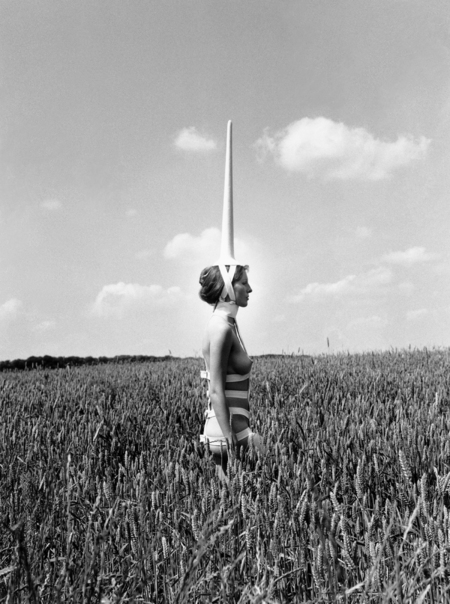
A different approach emerges with Rebecca Horn. In her early performances, the costume becomes an extension of the body and a mechanism for altering movement. In her 1970 work, «Einhorn» (pictured), a long fabric horn attached to the body changes the person’s posture and manner of locomotion. In other projects, Horn creates prosthetics, textile structures, and mechanical extensions of the body that simultaneously restrict and amplify physical presence.
Through such practices, clothing ceases to be merely a shell. It transforms into an independent artistic object and a tool for investigating the relationship between the body, space, and society. Fabric begins to be perceived as a material of memory, vulnerability, social experience, and political statement. It is during this period that the contemporary understanding of costume as an art form takes shape. It no longer solely serves to represent an individual’s status or identity but becomes a means to speak about collective memory, violence, consumption, gender, and corporeality.