Where is sleep located?
It is quite easy to recognize a sleeping person. Usually, a few details suffice: they are lying down, their eyes are closed, and their head rests on a pillow or stone. The dream itself is more complicated. What the sleeper is seeing is not present in the room with them and is inaccessible to other characters, but the artist still needs to somehow convey this to the viewer.
If one gathers images of dreams from the 13th to 15th centuries side-by-side, it quickly becomes apparent that there was no single common approach. Sometimes the content of the dream simply appears next to the sleeper. Other times, the page is divided into several sequential scenes. In other cases, an angel or allegorical figure is situated in the same space as the bed, furniture, and ordinary people. There are also instances where the sleeper is absent from the image, and we know it is a dream only through the preceding scene.
For the medieval viewer, a dream was not necessarily a private fantasy of an individual. There were various understandings regarding the origin and veracity of dreams. For example, in Macrobius’s well-known classification, some dreams held no prophetic meaning, others could convey truth directly, and a third category required interpretation. This system was influential, though by no means the only one.
Therefore, what interests me is not so much the content of the dreams as a more specific question: how does the image communicate that what we are witnessing is, in fact, a dream?
I hypothesize that in images from the 13th to 15th centuries, dreams were most often defined not by the appearance of the vision itself, but by its relationship to the sleeper. As long as the composition includes a bed, a specific body posture, or a sequence beginning with falling asleep, even a completely ordinary scene can be read as a dream. When this connection is lost, drawing the line between dream and reality becomes significantly more difficult.
In subsequent examples, I will primarily examine how the artist connects the sleeper to the events within the dream. This connection can be established through their placement on the page, the sequence of scenes, architectural divisions, the direction of light, or simply the context set by the preceding image. It is these details that allow us to understand where the boundary between sleep and reality lies—even if the vision itself is not explicitly delineated.
1. Sleep near the bed
One of the clearest examples is found in the German manuscript Morgan MS M.739, created between 1204 and 1219, possibly in Bamberg.
On fol. 13v are depicted two dreams of Joseph. He lies in a four-poster bed. Above him are the Sun, Moon, and stars, and on the right, sheaves of grain.
The most interesting aspect here is not the symbols of the dream themselves, but how they are positioned relative to Joseph. The vision is not separated from the rest of the image in any way. There is no frame, cloud, or distinct field around the stars and sheaves. They simply appear next to the bed.
Because of this, it is the figure of the sleeper that dictates the meaning of the entire scene. If we mentally remove Joseph, we are left with a collection of symbols. But placed next to the reclining figure, these same elements begin to be perceived as the content of his dream.
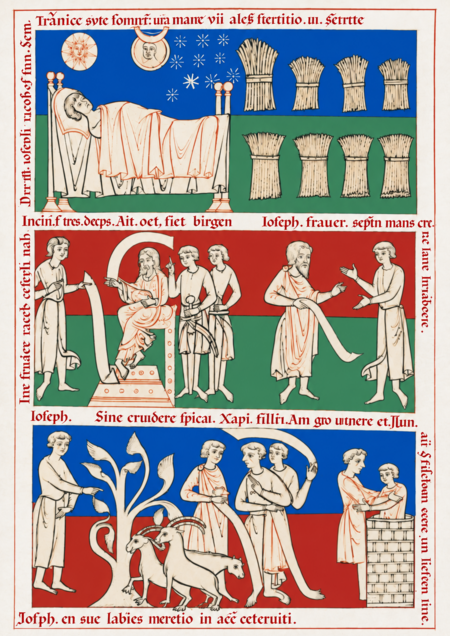
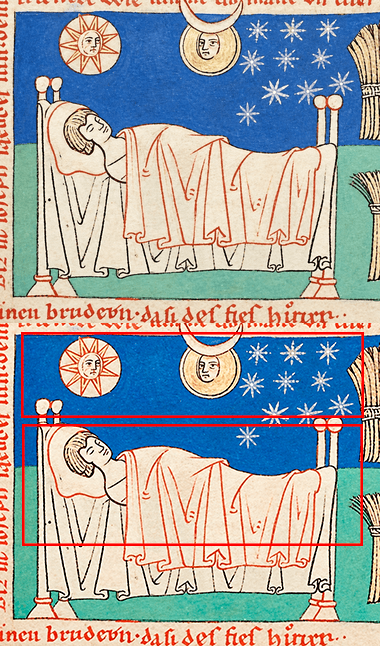
Unknown master, «Joseph’s Dreams, ” 1204–1219
On fol. 14v, the Pharaoh’s dream is depicted in a similar manner. The Pharaoh lies in bed while fat and thin cows appear nearby. The composition differs slightly, but the principle remains the same: the artist does not create a separate space for the dream, but places what is seen next to the sleeper.
This results in a quite simple technique. To convey a person’s internal experience, you do not need to place them «inside» the head. It is sufficient to place two things side-by-side—the sleeper and what they are seeing.
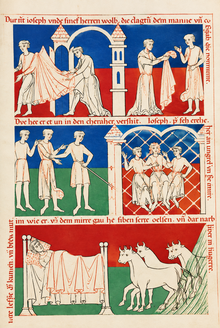
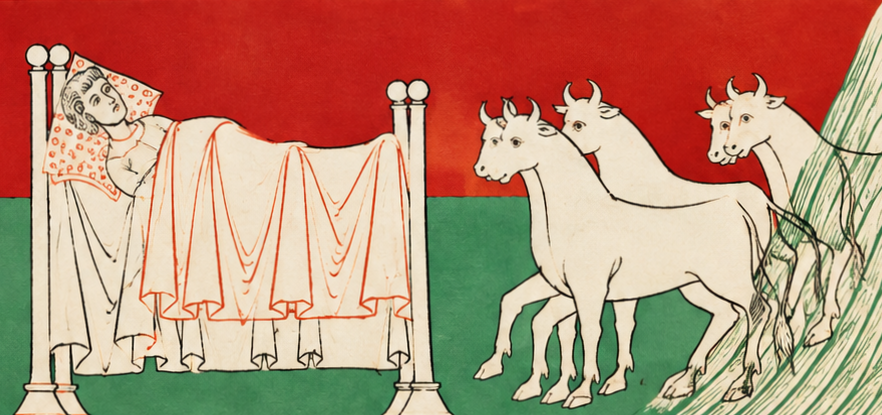
Unknown Master, «Pharaoh’s Dream,» 1204–1219
2. Sleep and Awakening on a Single Page
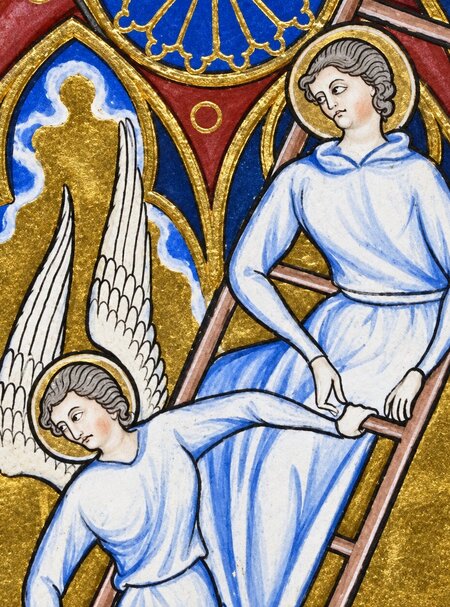
In the Psalter of Saint Louis, created in Paris between 1270 and 1274, the dream of Jacob is depicted on fol. 13v.
The leaf is divided into two scenes. On the left, Jacob sleeps while a ladder with angels rises beside him. On the right, the same Jacob has awakened and is anointing the stone where he received the revelation.
A slender architectural support stands between the two episodes. It is easy to mistake it for a finished boundary between dream and reality, but the depiction is structured more intricately.
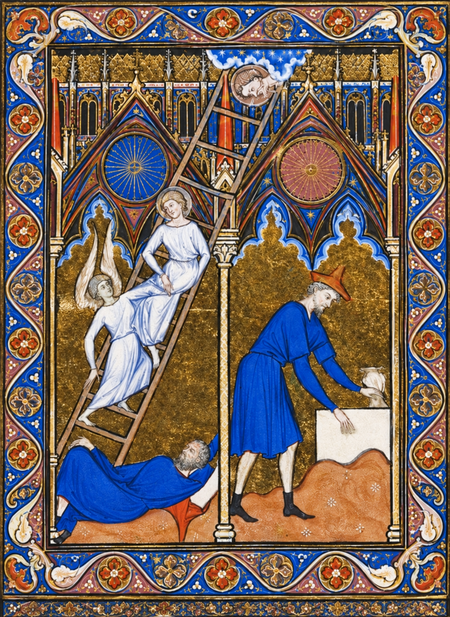
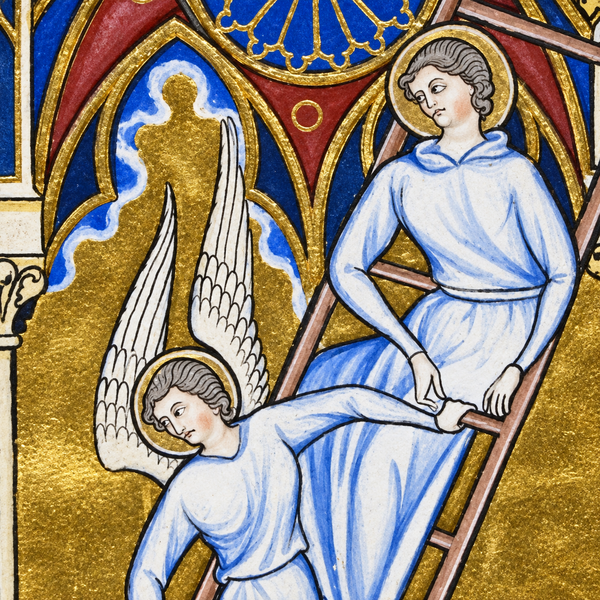
Unknown Master, «The Dream of Jacob,» 1270–1274
The golden background remains consistent. The angels do not become transparent or less material. The ladder is depicted in the same manner as Jacob’s figure after he awakens. When transitioning from dream to reality, the artist does not alter the language of the image itself.The difference is most easily perceived by the body positioning. Jacob lies on the left. He stands and acts on the right. The same individual appears twice, and it is his posture that helps us interpret the sequence of events.The architectural support here rather separates two consecutive moments. Similar divisions appear in other manuscript scenes, so it is unlikely to be interpreted as a specific symbol of a dream.It follows that the ladder with the angels itself does not appear less real than what happens after the awakening. We classify it as a dream primarily because Jacob is depicted as asleep beside it.
3. Dream Character in Bed
Roman de la Rose offers a wide array of possibilities. The poem begins as a dream narrative, requiring artists to somehow signify the transition from the reclining hero to the allegorical world where the action progresses.
In Morgan MS M.372, around 1320, a hero lies on a bed while Danger—the personification of Danger—stands before him.If one momentarily forgets the narrative, the composition appears quite strange. Danger is not enclosed in a separate frame, nor is he placed in a cloud or set apart from the bed. He simply stands next to the sleeping person.
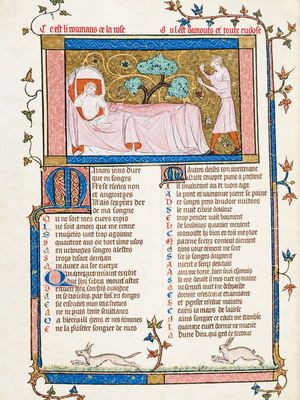
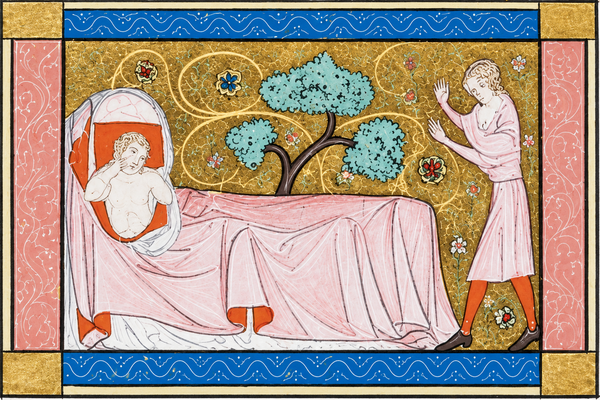
Unknown master, «The Sleeping Lover and Danger,» c. 1320
In Morgan MS M.120, around 1370, the scene is even more complex. On the left, the hero lies in bed, and Danger stands nearby with a club. On the right, in the same miniature, Cupid is already striking the hero with an arrow.
As a result, one character is present in two states at once: he is lying down while simultaneously participating in the events of his dream.
It is not necessary to interpret this literally as the separation of the soul from the body. It is far simpler to see this as a connection between two parts of the narrative. The sleeping figure conveys what is happening to the hero physically, while the other characters illustrate the content of his dream.
The position of Danger is particularly interesting. In M.120, he stands directly next to the bed, even though he belongs to the allegorical world. This suggests that the boundary between the bedroom and the dream exists primarily in our interpretation of the scene, rather than in the composition itself.
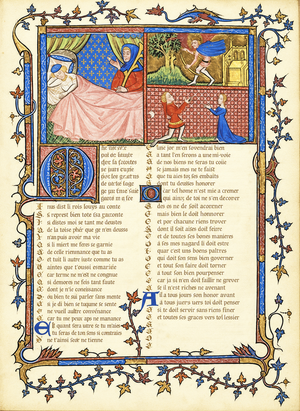
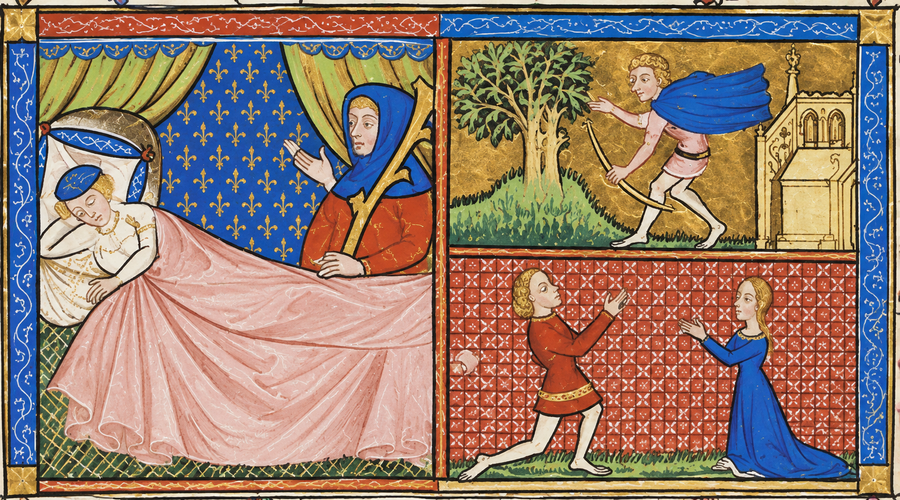
Roman de la Rose, Morgan MS M.120, fol. 1r, France, c. 1370
4. The Dream That Holds the First Frame
In other manuscripts, Roman de la Rose addresses the same problem differently.
In the Morgan MS M.185, dated to 1340–1350, the initial miniature is divided into four sections. First, the hero sleeps. Then, he sits and puts on his shoes. Next, he finds himself among the trees. In the final scene, he approaches the garden wall.
The most intriguing elements are the last three images. On their own, they bear almost no connection to sleep. The man puts on his shoes, walks, and approaches the garden. Nothing in their space or composition suggests that what is happening is unreal.
If you remove the first fragment showing the sleeping figure, the connection to a dream virtually disappears.
This suggests that the first scene sets the meaning for all that follows. We continue to perceive the hero’s actions as a dream only because we already know: he is asleep.
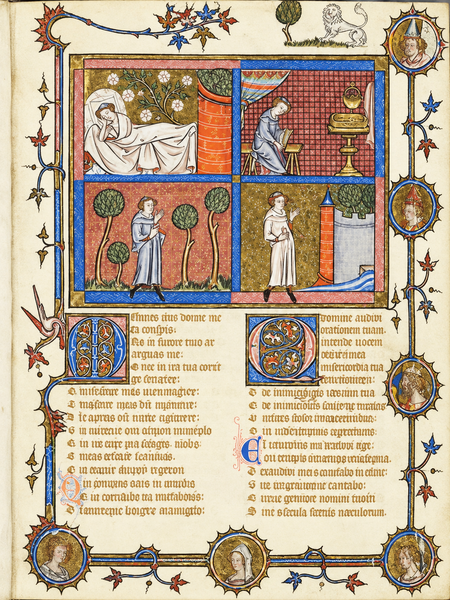
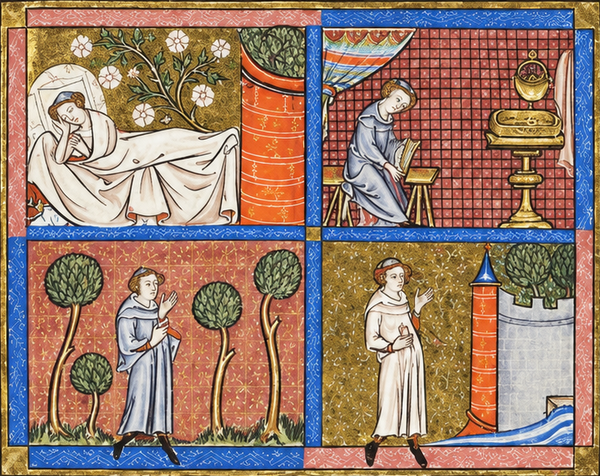
Roman de la Rose, Morgan MS M.185, fol. 1r, France, 1340–1350
A similar principle is used in Morgan MS M.132, created in Paris around 1380. First, the hero lies in bed, then gets dressed, and after that, leans toward a stream before arriving in the garden.
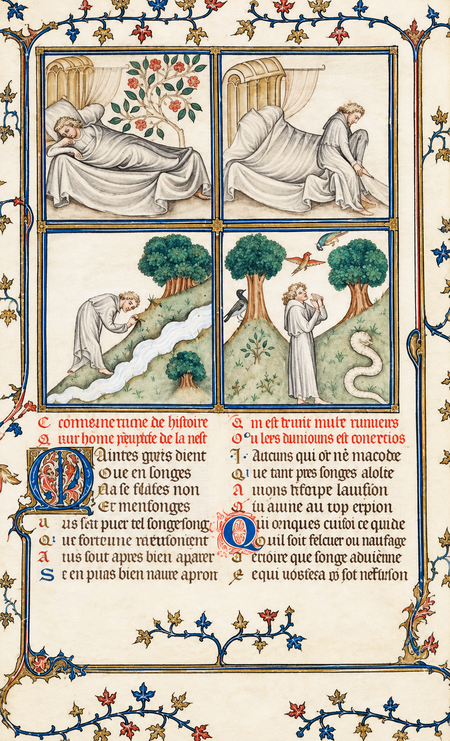
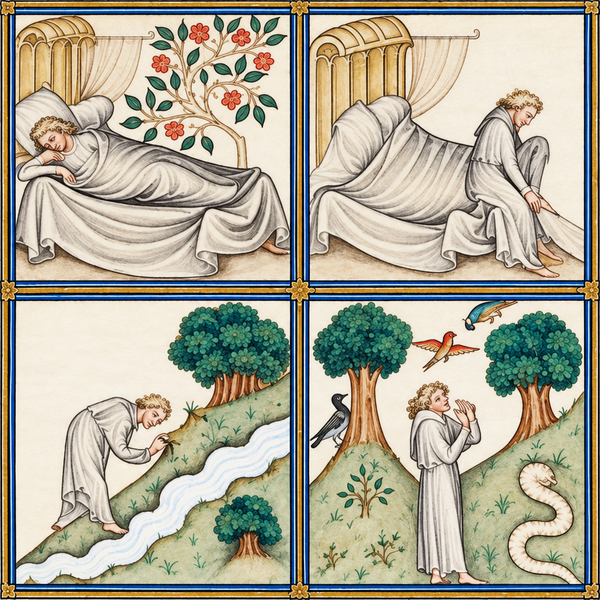
Roman de la Rose, Morgan MS M.132, fol. 1r, Paris, c. 1380
Jennifer Owen discovered four-part isopsephy in 30 of the 190 illuminated manuscripts of Roman de la Rose she examined. These compositions did not displace other variations, nor did they form a distinct next stage of development. Various methods continued to coexist in parallel.
5. Sleeping within a shared space
Another version can be seen in Giotto’s Predella of St. Francis receiving the stigmata. The Louvre currently dates the entire altarpiece to the first quarter of the 14th century, 1300–1325.
The first scene of the predella depicts the dream of Pope Innocent III. The Pope lies in bed and sees Francis, who is supporting the Latin Basilica, which is about to collapse.