Theoretical Introduction
Contemporary sound art cannot be understood without considering the history of artistic movements that blurred the lines between music, noise, poetry, and visual art. In the 20th century, the Dadaists were the first to propose a radical idea: sound does not necessarily have to be «musical, ” words do not necessarily have to have meaning, and the voice can be not just a carrier of text, but material that can be used like paint or fabric. This fundamental shift in the perception of artistic materials laid the groundwork for the entire subsequent development of the avant-garde.
Their sonic poetry, noise performances, and visual collages opened up new horizons for how we perceive sound and images. They introduced principles of rupture, non-linearity, fragmentation, and play with chance—principles that now seem absolutely natural to us. The rejection of traditional harmony and linear narrative was a pivotal moment for the development of fields such as sound art, experimental music, performance, and multimedia practices in the late 20th and 21st centuries. Without this rebellion against conventions, modern sound art would have had an entirely different, far more impoverished palette of expressive means.
What is this research about?
The presented study examines the transformation of avant-garde heritage within the context of contemporary culture, using the work of Björk and her audiovisual pieces as a case study. The uniqueness of her approach lies in synthesizing musical, performative, scientific, and visual elements into a cohesive artistic system. In her view, sound is not merely melody, but also texture, a biological process, and a physical environment; visual imagery is not simply an image, but a significant stratum of meaning; and technology is not a tool, but an organic component of the composition. Björk operates at the intersection of art, sound design, science, fashion, and engineering, making her work a compelling example for studying contemporary sound art. Her creations serve as a link between the bold experiments of preceding generations and the digital world of modernity.
The objective of this work is to demonstrate how the principles of Dadaism (collage, noise effects, deconstruction of language, performance) are reflected in the digital and technological reality of the 21st century through the lens of Björk’s creativity. The research identifies the relationship between historical avant-garde movements and Björk’s innovative musical ecosystem, analyzes her major albums and visual projects, examines her techniques for working with vocals, noise, modern instrumentation, and multimedia, and concludes on her contribution to sound art. We will analyze how the principle of collage has transformed into digital sampling, and how noise music has taken form within complex sound design.
This is not a biography nor is it music criticism—it is an art historical, visual-auditory investigation that analyzes forms, methods, aesthetic strategies, and historical influences, as well as their materialization in video, scenography, music videos, and live performances. This interdisciplinary approach allows us to view every Björk project as an integrated whole, where sound and image are inseparable and mutually enrich each other, creating a unique sensory experience for the viewer and listener.
Research Index
- Dada: Historical and Theoretical Context 1.1 What is Dada? 1.2 Key Dada Techniques (Relevant for Analyzing Björk) 1.3 Why Björk is a Successor to Dada
- BJÖRK: Biography, Work, and Aesthetics 2.1 Who is Björk? 2.2 Björk’s Creative Work
- Analysis of Björk’s Key Works 3.1 «Debut» (1993) 3.2 «Post» (1995) 3.3 «Homogenic» (1997) 3.4 «Vespertine» (2001) 3.5 «Medúlla» (2004) 3.6 «Biophilia» (2011) 3.7 «Utopia» (2017) 3.8 «Fossora» (2022)
- Björk’s Contribution to Contemporary Sound Art
- Conclusion
Dada: History and Key Techniques
1.1 What is Dada?
Dada or Dadaism in music—this movement inspired composers to abandon established musical conventions and explore unconventional techniques and sounds.
Emerging after World War I, Dadaism became a response to the disillusionment and chaos of that era. Rejecting reason and logic, Dadaists employed nonsense, randomness, and absurdity as a means to counteract the absurdity of the surrounding world. In music, Dadaism inspired composers to break away from established musical conventions and explore nontraditional techniques and sounds.
One of the central figures of Dadaism in music was Erik Satie, whose works often combined humor, irony, and unconventional notation. Satie’s «Vexations”—a brief piano sketch intended for 840 repetitions—is a vivid example of the Dadaist perception of absurdity and the principle of repetition.
Music was an integral companion to Dadaist performances, playing a crucial role in creating their unique atmosphere and character. Within the realm of Dada music, there were numerous forms: ranging from pieces written in academic and jazz traditions to spontaneous sound improvisations and sonic experiments embodied in poems.
1.2 Core Dadaist Techniques (Relevant to Björk’s analysis)
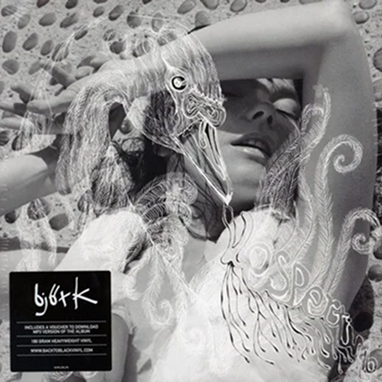
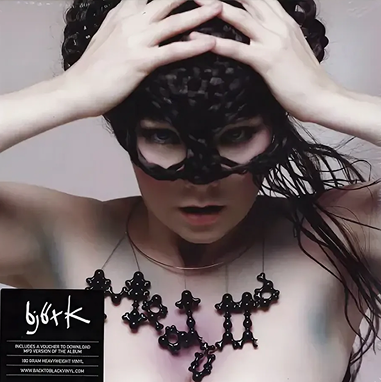
Album covers for Björk’s «Medúlla» and «Vespertine»
- Sound Poetry Hugo Ball and Kurt Schwitters worked to create vocal pieces intentionally devoid of traditional meaning. Their method involved deconstructing language, transforming words into pure matter—a composition of noise, rhythmic structures, and sonic vibrations.
Direct connection to Björk: In the context of contemporary music, a clear lineage to Björk’s work is evident: the albums Medúlla and Vespertine demonstrate experimental use of vocal textures, an emphasis on rhythmic breathing, and spontaneous sonic improvisation.
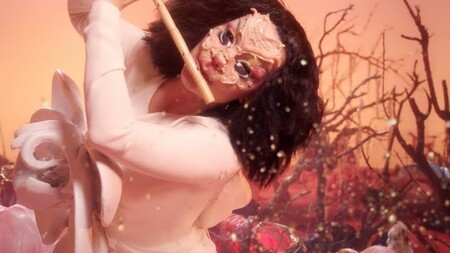

Stills from Björk’s «Utopia» music video
- Collage Dadaists utilized newspaper clippings, photographs, and various objects in their work, layering them without any hierarchy. Collage fosters polysemy—the multiplicity of meanings.
Direct Connection to Björk: In Björk’s work, one can observe: a diversity of sound tracks (for instance, on the albums «Post» and «Utopia»), the juxtaposition of the incongruous (flutes and club rhythms, whispers and industrial hum), as well as the use of digital montage.
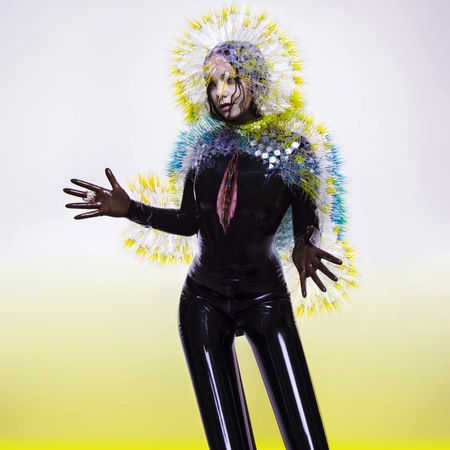
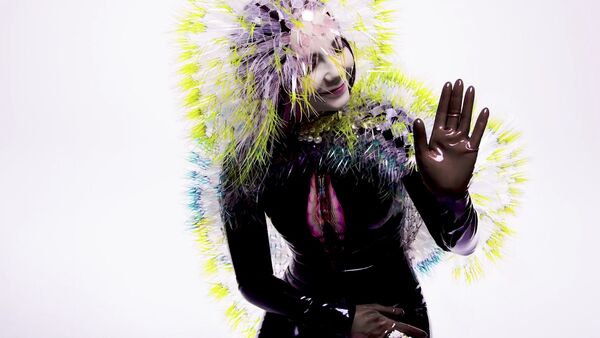
Björk and her image for the album «Vulnicura»
Björk on the set of the album «Vulnicura»
- Noise and Anti-musicality Dadaists were the first to dismantle the notion that music needed to be «beautiful» and predictable. They expanded the sonic world of art, incorporating anything previously considered noise. They began to utilize: mechanical sounds, the rustling of paper, percussive hits, guttural shouts, metallic cracks, random vocal performance «errors, ” and much more.
Direct connection to Björk: In her work, she employed clicks, crackling sounds, sharp micro-sounds, biotic textures, recorded body movements (Vespertine), and glitch as a technique (Vulnicura).
Björk in James Murray’s Works
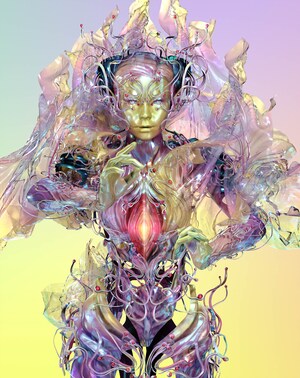

Björk in the Works of James Merry
- Theatricality, Masks, Performance Dadaists utilized the body as an open structure—masks, grotesquery, absurd movements, chaotic choreography.
Direct connection to Björk: James Murray’s masks, the body as an art object (The Gate, Notget VR, Pagan Poetry), and the performativity of her concerts.
1.3 Why Björk is the heir to Dada
Björk—not a direct inheritor of Dada, but her work enacts the same strategies.
In her work, she employs:
- Language deconstruction—the voice becomes material
- Collage—hybrid sonic structures
- Noise—musical expressiveness
- Performance—the body as a secondary instrument
- Anti-narrative—clips with non-linear structures
BJÖRK: Biography, Work, Aesthetics