Table of Contents
- Concept
- Claude Monet’s Visual World
- Gardens, Flowers, and Landscapes
- Water and Reflections: The Language of the Pond
- Time and Change: The Series Paintings
- Large-Scale Panels and Immersive Works
- Color and Atmosphere: Monet’s Palette
- Monet’s Legacy in Visual Experience
- Conclusion
Concept
Impressionist Claude Monet revolutionized both art and the interaction between the artist and the natural world. His meticulously planned and maintained garden at Giverny served as both his subject and his creative lab.
This visual research examines how Monet’s Giverny evolved into a living space where time, color, light, and nature merged to create avant-garde visual experiments.
After moving to Giverny in 1883, Monet first rented the house before purchasing it. He expanded the gardens, creating the renowned water lily pond, the Japanese bridge, and flower beds. Monet designed these areas to capture changing light, shimmering reflections, and seasonal shifts—this was far more than mere gardening. By manipulating his environment, he blurred the lines between artistic and natural creation.
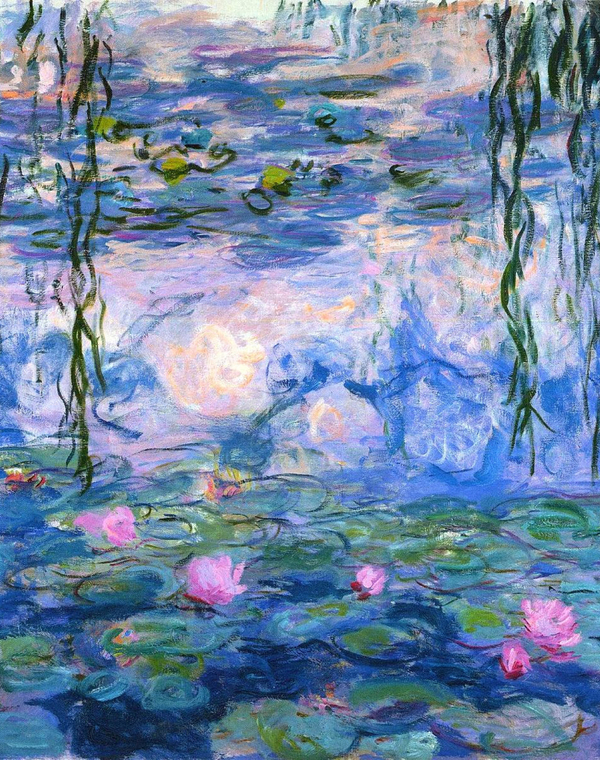
Monet’s decision to treat the garden as an active artistic collaborator is what distinguished Giverny. He established a personal visual laboratory to observe nature around the clock and in any weather, setting him apart from other Impressionists who worked outdoors. His later, most radical works—especially the large-scale Water Lilies panels—were inspired by his meticulously crafted water lily pond. These pieces generated immersive fields of color and light by dissolving fixed spatial references.
Monet’s engagement with Japanese aesthetics, optical science, and Symbolist moods were among the broader cultural influences reflected in his garden practice. His affinity for asymmetry and pattern manifested in the Japanese bridge, while his sensitivity to transient light effects complemented the contemporary scientific interest in vision and perception.
Monet also experimented with time at Giverny. The same subjects—haystacks, cathedrals, and water lilies—were depicted in his series across different times of day and under varied lighting conditions. Time functioned as both a backdrop and a shaping force, mirroring both the viewer’s shifting perspective and the ever-changing character of nature.
Even as he battled cataracts and personal tragedy in his final years, the garden remained Monet’s sanctuary and source of inspiration. His later works propelled painting into new territories, evolving into nearly abstract color fields where form dissolved into glistening pigment.
Today, Giverny stands not only as a physical garden but as a potent symbol of Monet’s artistic revolution.
By transforming his garden into a visual research space, Monet redefined the boundaries of painting, inviting us to perceive the world as a vibrant, ever-changing dance of color, light, and sensation—a true garden of colors blooming on canvas and in the imagination.
Claude Monet’s Visual World
This opening section introduces Monet’s artistic journey: his fascination with nature, his love of capturing light, and his constant search for new ways to see the world. It sets the stage for understanding how his entire career revolved around visual exploration.
Impression, Sunrise (1872)
The Seine at Argenteuil (1875)
Cliffs at Etretat (1885–86)
Snow Effect at Giverny (1893)
Gardens, Flowers, and Landscapes
Here we focus on Monet’s passion for gardens, flowers, and lush landscapes, especially the magical spaces he created at Giverny. His works burst with color, texture, and life, making nature not just a background but the true star of his paintings.
The Artist’s Garden at Vétheuil (1881)
Irises in Monet’s Garden (1900)
Springtime at Giverny (1900)
Monet’s Garden in Argenteuil (1873)
The Flowered Meadow (1876)
The Rose Walk, Giverny (1920–22)
Water and Reflections: The Language of the Pond
In this section, we delve into Monet’s mesmerizing depictions of water—particularly the lily ponds, Japanese bridges, and shimmering reflections. Water becomes a mirror, a canvas, and a source of endless visual magic in his work.
Water Lilies (series, 1897–1926)
The Water Lily Pond, Green Harmony (1899)
The Japanese Bridge (1899)
Time and Change: The Series Paintings
Monet loved to paint the same subject over and over again in different lights, weather, or seasons. Here, we explore his famous series—the Haystacks, Rouen Cathedral, and London views—where he captured the beauty of change and the passage of time.
Haystacks (series, 1890–91)
Rouen Cathedral (series, 1892–94)
Poplars (series, 1891–92)