Navigation:
- Concept
- Shadow as an Independent Entity
- The Surrounding World as a Projection of the Character’s Internal Rift
- Restraint of the «Self» and Grotesque Expression of the «Doppelgänger»
- Conclusion
Concept
The choice of this topic is dictated by its fundamental importance not only for understanding German cinema of the 1920s but also for the entire subsequent history of visual culture. German Expressionism is a unique historical phenomenon where the social upheaval following World War I, economic ruin, and the psychological trauma of an entire generation found direct expression in radical cinematic experiments. Unlike other artistic movements, Expressionism prioritized the visual distortion of reality, and the motif of duality became central to this artistic world.
Another characteristic of German Expressionism, as written by Ginzburg, is that German directors do not think in terms of frame-by-frame sequences, but rather in holistic compositions («exemplary frames»), within which the drama unfolds. Editing serves not to narrate, but to create «impacts”—psychological accents.
The distinguishing feature of this research is that it focuses on the cinematic methods of embodying this motif. If in literature the doppelgänger existed as a metaphor or a plot device, in cinema it is portrayed through specific visual techniques. For instance, a shadow ceases to be merely an absence of light—it becomes an active character endowed with its own will and dramatic function.
The relevance of this topic is determined by several factors:
First, it allows for an examination of the genesis of many visual techniques that later became common to global cinema, particularly those employed in horror and psychological drama genres.
Second, the study of mechanisms for visualizing mental processes remains highly sought after in an era of growing interest in identity issues. There were specific principles governing the organization of visual space to express complex psychological states.
Five key films from German Expressionism have been selected for this study because they most comprehensively explore the motif of duality in its visual representation:
- Robert Wiene’s «The Cabinet of Dr. Caligari» (1920)—an example where duality permeates the entire film, from the sets to the acting.
- F.W. Murnau’s «Nosferatu: A Symphony of Horror» (1922)—where the vampire’s shadow gains a sinister autonomy and acts independently of its host.
- Paul Wegener’s «The Prague Student» (1926)—as the most consistent embodiment of the doppelgänger theme.
- Fritz Lang’s «Dr. Mabuse, the Gambler» (1922)—demonstrating the motif of duality through the multiplicity of masks and identities.
- Fritz Lang’s «M» (1931)—showing the evolution of the motif in sound cinema.
This selection allows for a tracing of the motif’s development throughout the entire period of Expressionism in film—from early experiments to later works, where Expressionist aesthetics begin to interact with other stylistic techniques.
The primary research method will be comparative visual analysis, allowing us to identify common patterns and unique characteristics in how the theme of duality is manifested across different films. Each thesis will be supported by specific examples drawn from the visual material.
The theoretical foundation will be provided by the work of film historians and theorists who have studied German Expressionism—most notably Siegfried Kracauer and Lotte Eisner. Their concepts will be examined as the starting point for this independent research.
Key Question
What visual techniques and cinematographic means did directors of German Expressionism employ to transform the motif of doppelgänger into a concrete visual reality?
Hypothesis
The core hypothesis is that German Expressionism developed new, distinct visual strategies and approaches—departing from prior conventions—to explore the theme of duality and address the issue of identity in the postwar era.
Shadow is an independent entity
In the postwar period, directors lacked sufficient budget to use high-quality set design for the background in films. Because of this, shadow became an active participant in the narrative, serving both the practical purpose of filling the frame and a deeper one. However, for this concept to be realized, there needed to be a fundamental premise: the shadow had to be portrayed in cinema as a living entity, capable of altering the space around the characters.
In Lang’s film Dr. Mabuse, the Gambler, the shadow reveals Mabuse’s true, hidden nature as a manipulator and puppeteer. It is the visualization of his hypnotic, psychic power, which operates independently of his physical body. Mabuse’s influence is manifested only through his shadow self.

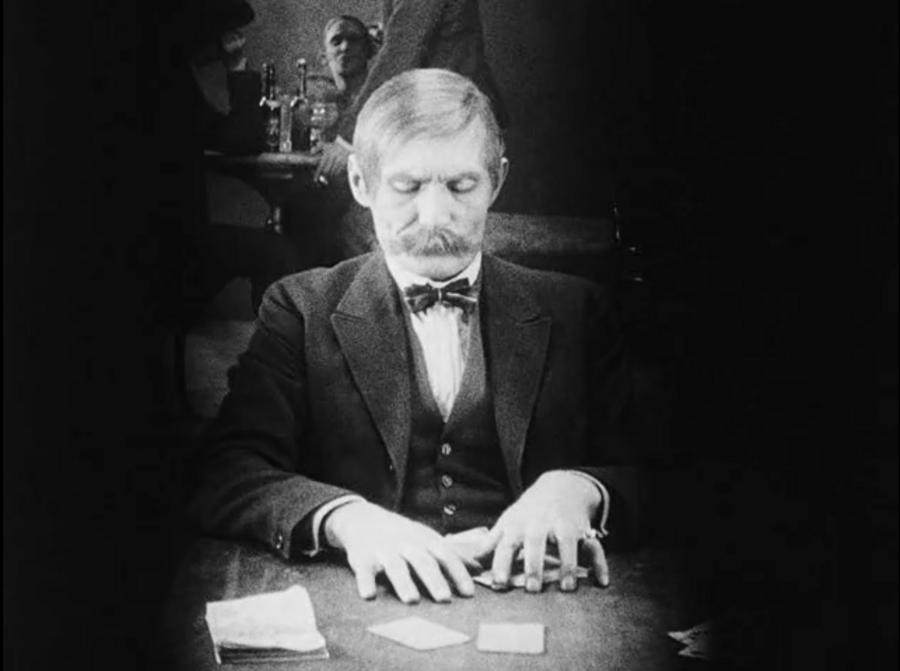
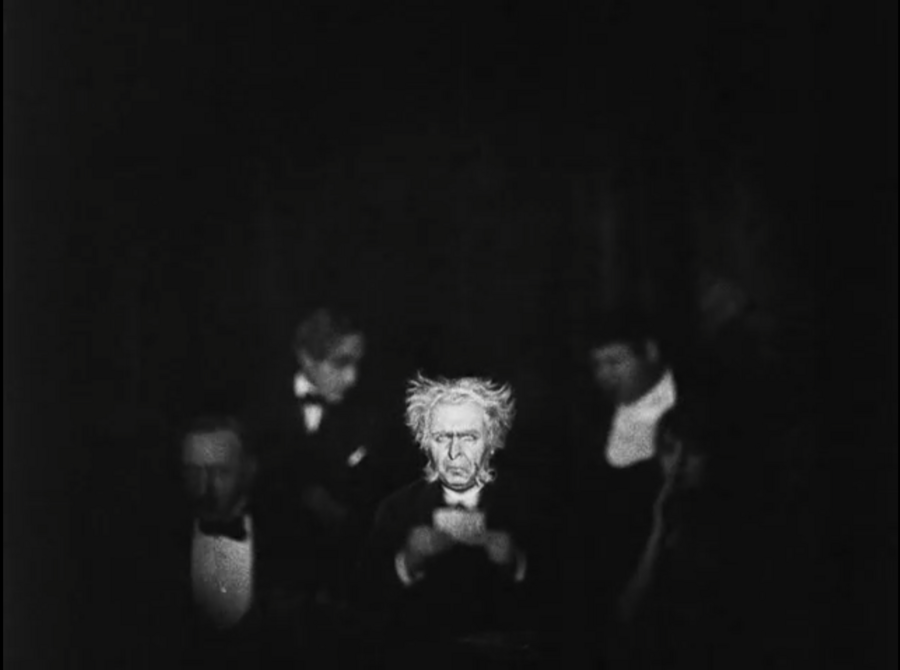
In Fritz Lang’s film Dr. Mabuse, the Gambler, shadow becomes the symbol of the demon’s presence.
Shadow is depicted as the demon’s attribute. When it appears, the viewer begins to understand that the world is coming under the influence of Mabuse’s shadowy side—a tyrant. For example, at the beginning of the hypnosis scene, the director darkens the frame on either side of the victim and gradually zooms the camera in on the doctor. The space around them blurs, becoming invisible and insignificant. Mabuse takes control of the victim’s reality. Anger, cunning, and madness are evident in his eyes and facial expressions.
Sigfried Kracauer wrote that Mabuse in this frame becomes a product of darkness, devouring the world subject to him [2].
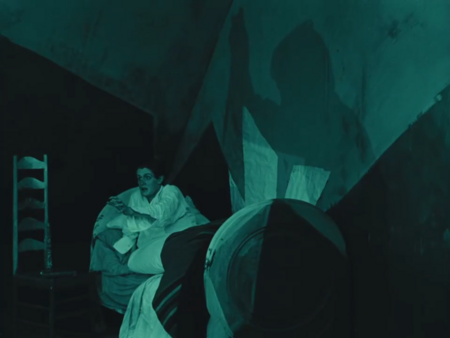

Cesare’s shadow from the film «The Cabinet of Dr. Caligari» determines the hero’s fate in bed
In Robert Wiene’s film The Cabinet of Dr. Caligari, we witness how the shadow becomes a symbol of an invisible threat: in two frames, Cesare appears as a dark blotch in the background, actively gesturing and attempting murder. If the person in the bed is still visible in the first frame, in the second he, too, becomes a shadow—which may suggest a thought of another world from which he can no longer escape.
Thus, the director emphasizes that the shadow can penetrate anywhere, and the real danger is not the person himself, but his shadowlike, elusive manifestation.
Lotta Eisner notes that in German cinema, as in literature, the shadow plays the role of a harbinger of fate—from which no one can escape [1].
Another film where the shadow foretells death is F. W. Murnau’s «Nosferatu: A Symphony of Horror.» Graf Orlok ascends the staircase of the house across the street, but his shadow moves ahead of its host—it independently crawls up the steps and through the door into Ellen’s room. The closer the shadow gets to the heroine, the more grotesque details it assumes, such as lengthening claws and increased size.
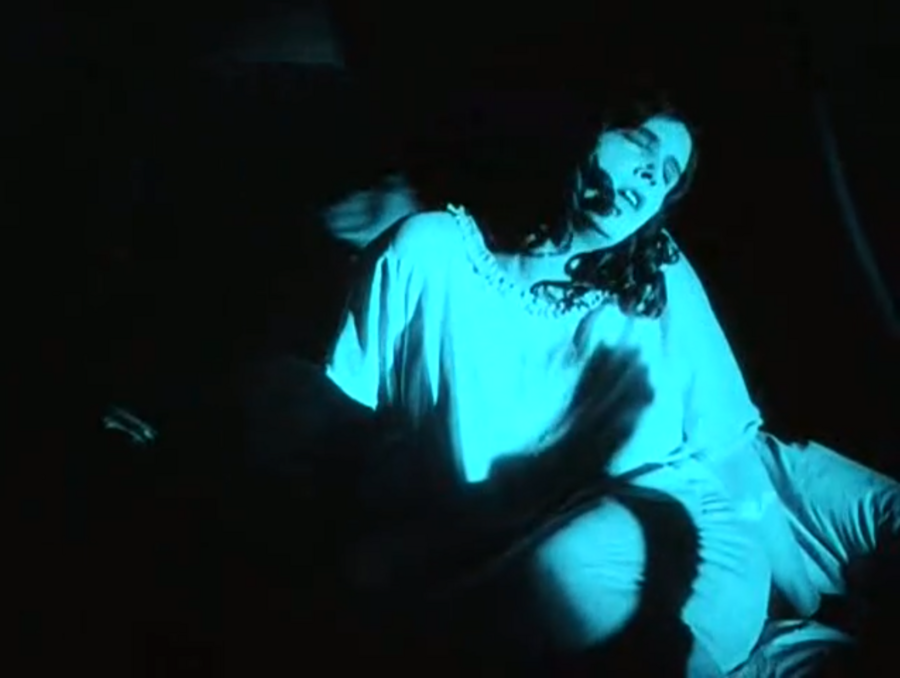
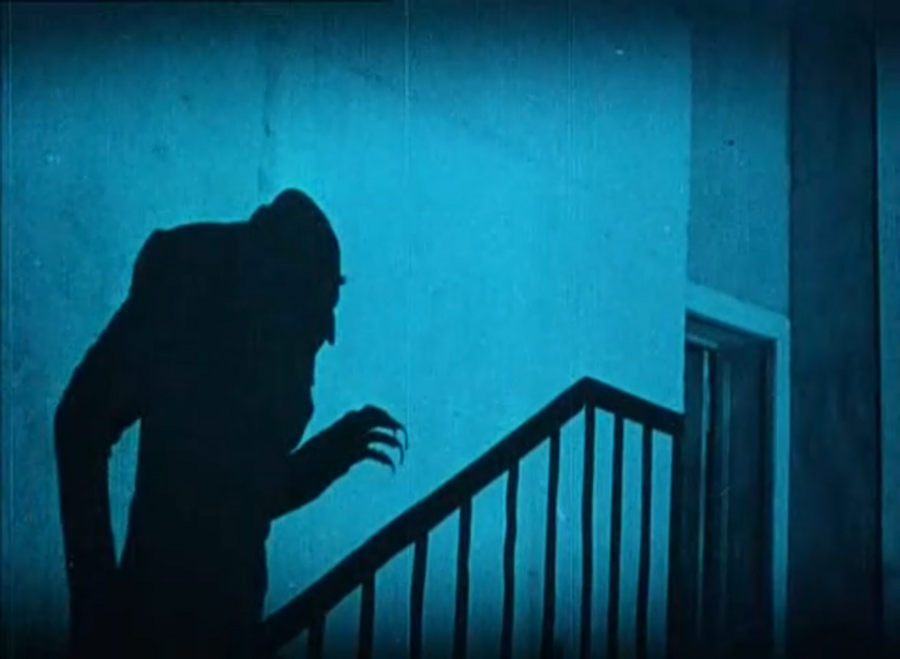
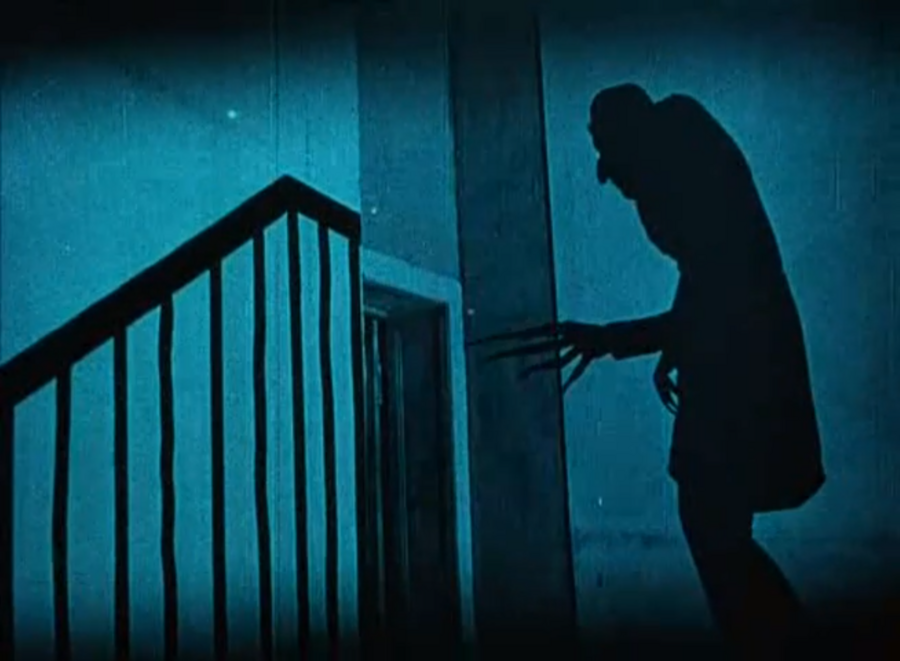
«Nosferatu: Symphony of Horror» by F.V. Murnau, 1922
In the final scene, the vampire is in Ellen’s room. His shadow on the wall beside the bed raises a hand, and we see the shadow hand clench over Ellen’s chest just as she dies of a heart attack.
The use of chiaroscuro lends the shadow a physical, almost tangible mass, transforming it from a mere shadow into a suffocating entity that performs a physical, fatal action. The shadow gains will and destructive power, definitively confirming its status as an independent demonic entity.
Director Henrik Galen explores the motif of doppelganger not through shadow, but through reflection, in his film «The Prague Student.» They differ in execution but share the same principle of operation.
Student Baldwin sells his reflection in a mirror to the sinister Scapinelli. Subsequently, his double materializes, literally emerging from the mirrored surface.
«Prague Student» Paul Wegener, 1926
«Prague Student» Paul Wegener, 1926
In the finale, Baldwin shoots his reflection in the mirror, anxiously checking to see if he truly sees himself. Initial joy sharply gives way to the realization the moment he notices the bullet in his heart, just like his double. By killing the copy, he kills himself. The director emphasizes this: one cannot escape their alter ego.
In «M, ” in contrast to the aforementioned films, the shadow indicts the protagonist, continuing to remain a part of him.
Fritz Lang «M», 1931
We see the shadow of the maniac cast across the poster, which warns of his manhunt and danger. The stain shifts to the left, illuminating the word «killer, ” which immediately reveals the essence of the main character, and it points toward the girl, as if warning us of his next victim. The shadow literally „marks“ him, exposing him and pointing at him. It functions as his doom.