Research Concept
In New Attic comedy, the mask was not merely a part of the costume, but a crucial instrument for visually defining the character. Age, social standing, temperament, and dramatic role were conveyed through established features of appearance: face shape, wrinkles, hairstyle, and the expression of the eyebrows and mouth.
Research Objective: To determine what visual cues were used to denote the age and social types of characters and how the combination of these features formed recognizable theatrical personas.
Research Question: How did the physical characteristics of the masks allow the audience to distinguish between characters in New Attic Comedy even before they began speaking?
Hypothesis: The masks of New Attic Comedy formed a system of visual codes where individual elements of appearance signified not only the character’s age but also their social role, personality, and position within the play’s dramatic structure.
The research focuses on the New Attic comedy of the late 4th–3rd centuries BCE, primarily on the tradition associated with Ménander’s work. Later ancient depictions and mask reproductions that reflect the evolution of this theatrical tradition are also used for analysis. These are examined while obligatorily considering their dating and provenance.
1. The Mask as a System of Visual Signs
New Attic Comedy emerged in the late 4th century BCE. Unlike ancient comedy, which heavily featured political satire and fantastical plots, New Comedy primarily focused on private life: family conflicts, romantic relationships, property issues, and social contradictions. Certain character types regularly appeared in its narratives: stern fathers, in love young men, clever slaves, hetairai, and others.The recurrence of these roles helped form stable visual archetypes. The mask served to signify a character’s belonging to a specific type, and its appearance interacted with the actor’s costume, movement, and speech.The ancient author Julius Pollux, in the 2nd century CE, described 44 types of comic masks, classifying them into five groups. His classification belongs to a later period, but it remains one of the most important written testimonies regarding the mask tradition of New Comedy.
The classification itself already indicates that age and social status were the primary principles organizing the character system. However, these factors did not exist in isolation from one another. Among the young men, various personalities emerged; among the slaves, different behavioral roles existed; and among the female characters, distinctions in social standing were present.
The mask, therefore, served as a visual signifier not of a specific person, but of a certain type.
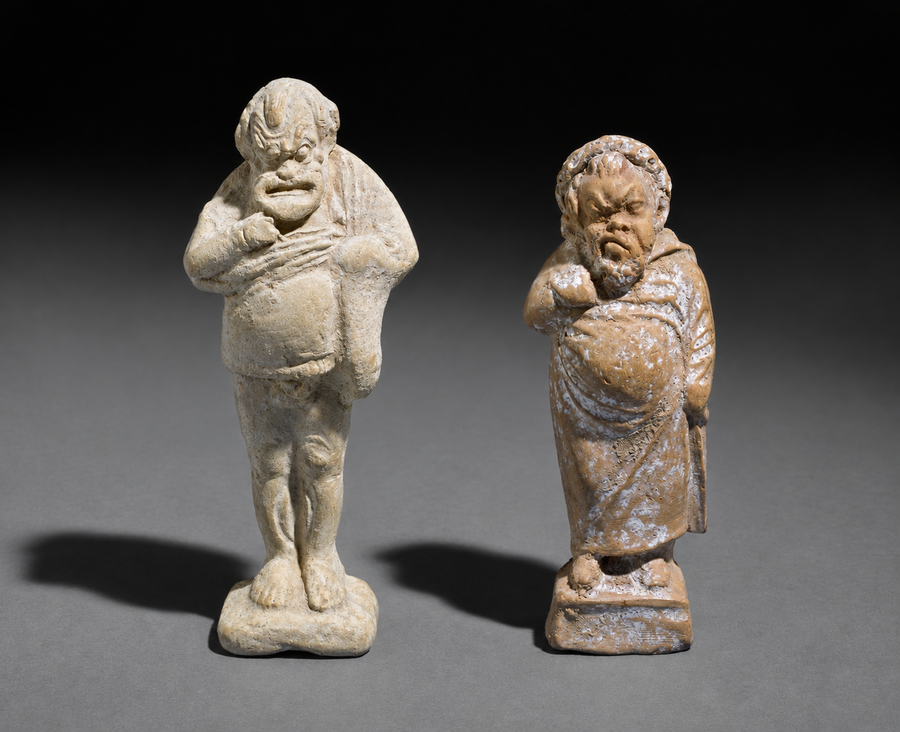
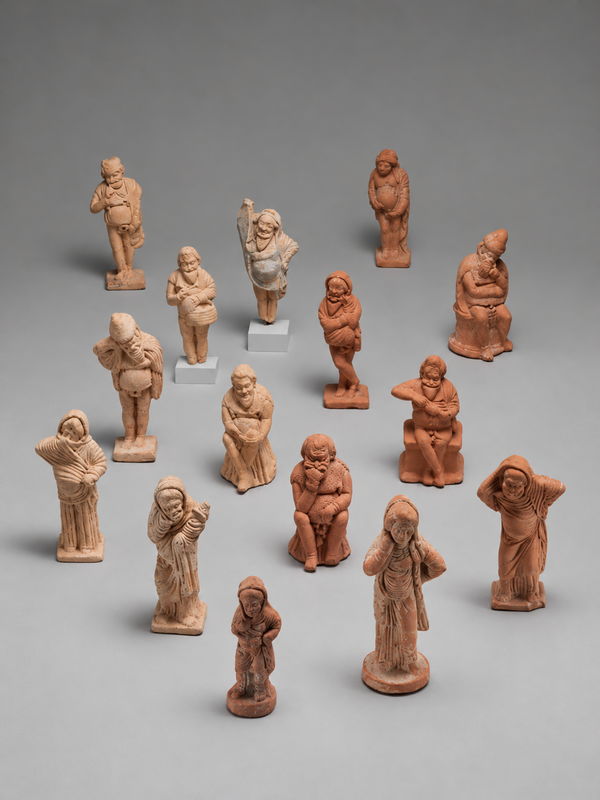
«Group of fifteen terracotta figurines of comedic actors, ” late 5th–early 4th century BCE, Metropolitan Museum of Art, New York
In early depictions of comic actors, characterization encompassed not just the face, but the entire body. Exaggerated volumes in the abdomen and buttocks, distinctive gaits, headwear, and beards shaped the recognizable silhouette of the character.
It is particularly important that individual traits work together. For example, age might be indicated by a beard and wrinkles, but it is further emphasized by posture, costume, and gesture. The audience receives information about the character through a cohesive image, not from a single detail.
This foreshadows the development of a more sophisticated system of masks in New Comedy: the character’s appearance gradually evolves into a set of recurring visual signifiers.
Interim Conclusion: Ancient theatrical typification was based on a combination of several physical elements. The mask was central, but not the only means of creating a recognizable persona.
2. Age as a Visual Characteristic
One of the most obvious ways to differentiate characters was age. However, within the comedic mask, this was conveyed not only through wrinkles or hair color but also through the overall facial structure.
2.1. Seniors: Age through Relief
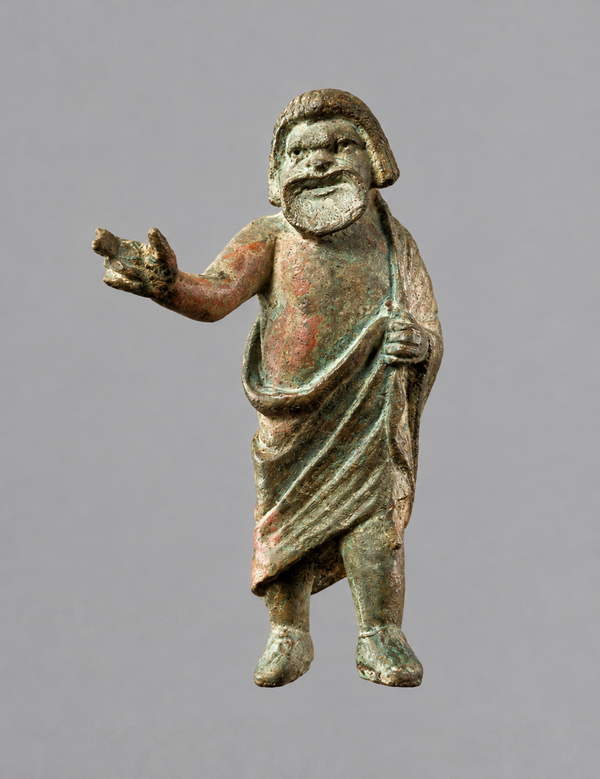
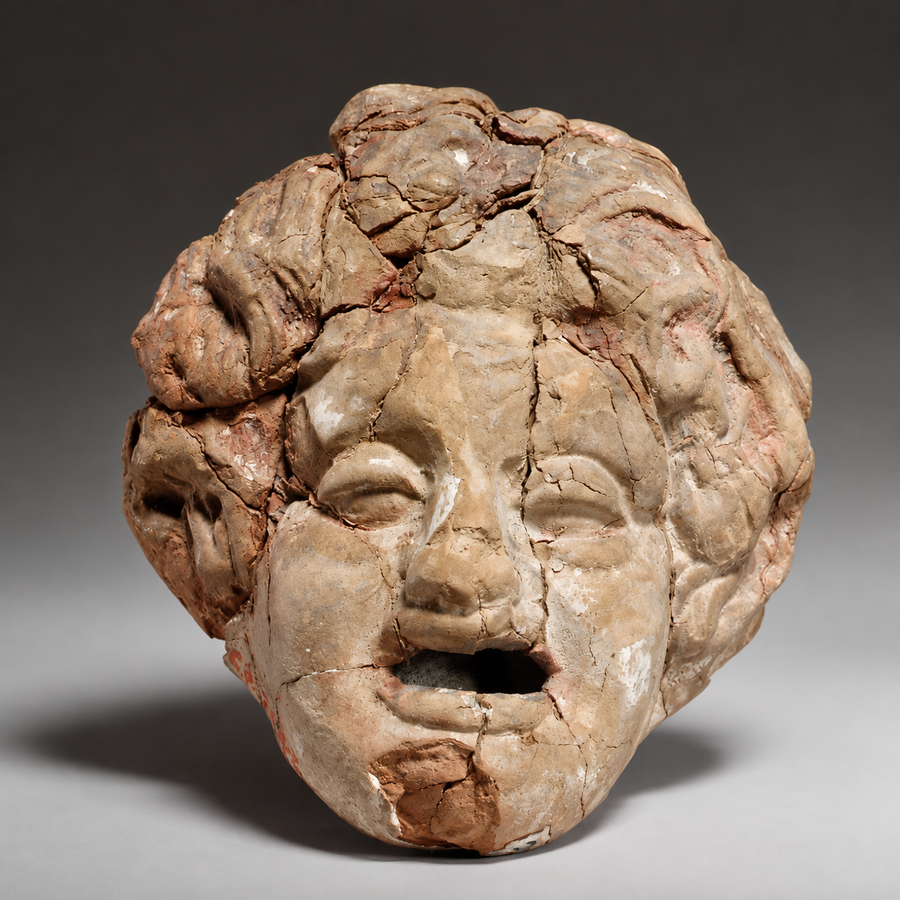
Comedic actor as an enraged father, Roman bronze statuette, 1st century CE / Ancient Greek theatrical mask, terracotta, c. 200 BCE.
The masks of the old men were distinguished by a pronounced plastic rendering of the face. Age was indicated by wrinkles, the character of the hair, the beard, and changes in proportions.
In the statuette of the enraged father from the Getty Museum collection, not only the mask but also the posture of the figure is important. The actor is depicted in motion, with an active hand gesture. The beard and expressive mask denote the type of elderly man, while the pose adds the characteristic of his behavior. The museum associates the figurine with the enduring comedic type of an irritable father.
Visually, two levels of characterization can be identified here: relatively permanent signs of age and changeable signs of temperament.
The beard itself does not imply quick temper, nor does the gesture define age. But together, they create a recognizable image of an elderly character involved in a conflict.
Conclusion: the old man’s mask symbolized age, and its specific plastic interpretation and interaction with the actor’s body helped refine the character’s personality.
2.2. Young Men: Youth through Form Refinement
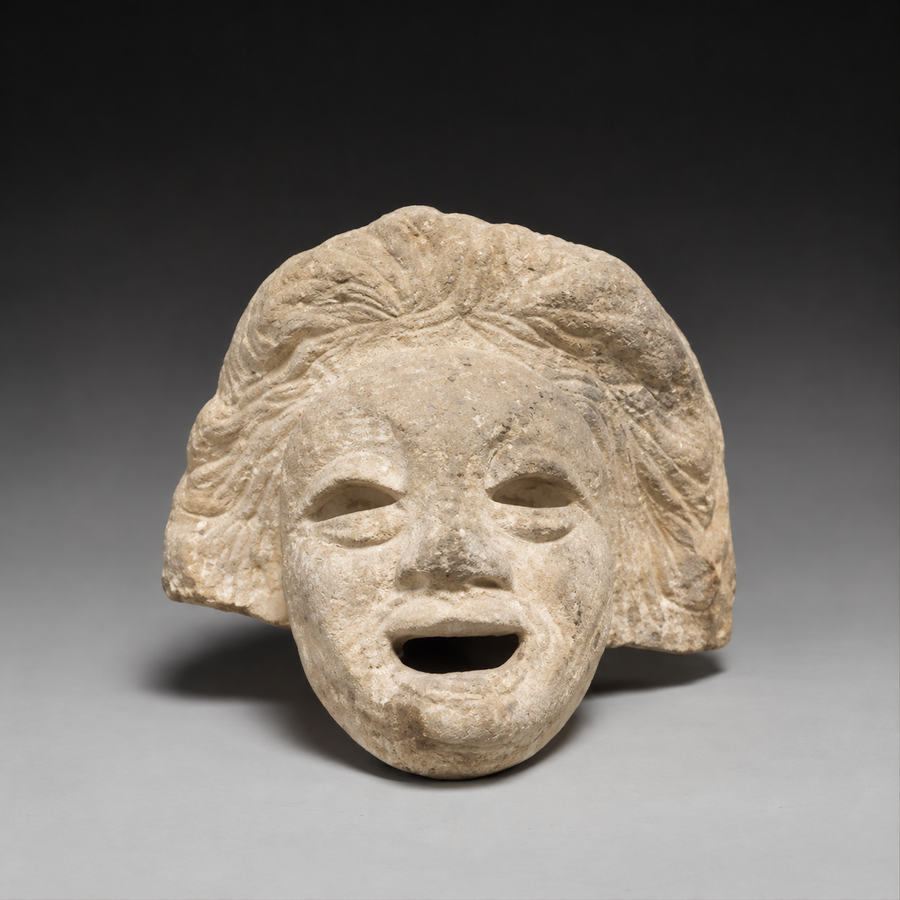
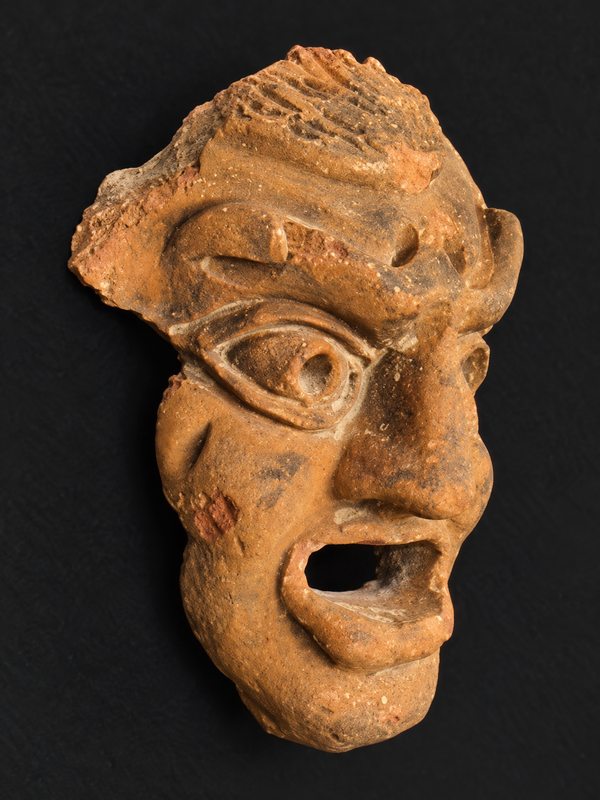
Terracotta comedic mask of a youth, late 4th–early 3rd century BCE, The Metropolitan Museum of Art, No. 74.51.1520 / Mask, presumably depicting a flatterer or parasite, 1st century BCE–1st century CE, British Museum, No. 1868.1-10.713
Unlike the old men’s masks, the young types could feature smoother facial surfaces, less pronounced wrinkles, and the absence of a long beard.
The terracotta mask from the Metropolitan Museum is particularly valuable for research due to its dating, which aligns with the early period of Commedia dell’arte. The museum attributes it directly to one of the youthful types of this theatrical tradition.
However, youth did not imply a lack of individual characteristics. Different youthful masks could denote a lover, an overconfident character, a simpleton, or a flatterer.
The second object is illustrative—researchers associate it with the type of the flatterer or parasite. Its exact identification remains a subject of debate: several types from Pollux’s classification have been proposed. This ambiguity is significant because it demonstrates that similar plastic features could be employed in different roles.
Conclusion: In the young masks, the absence of aging signs formed the basis of the age portrait, while the shape of the eyebrows, mouth, and general mimetic structure allowed for the differentiation of characters.
Comparison of Age Characteristics
This table summarizes the historical typology; it does not assert that every surviving object possesses all the listed characteristics.
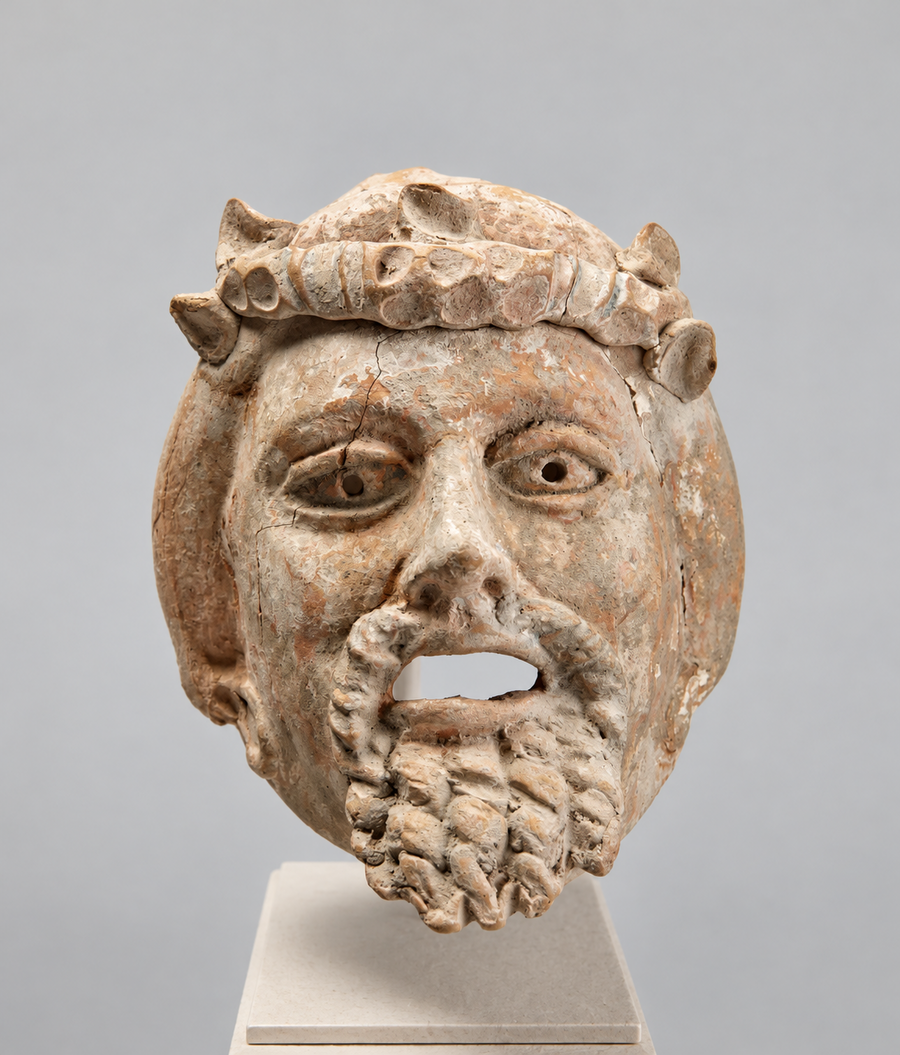
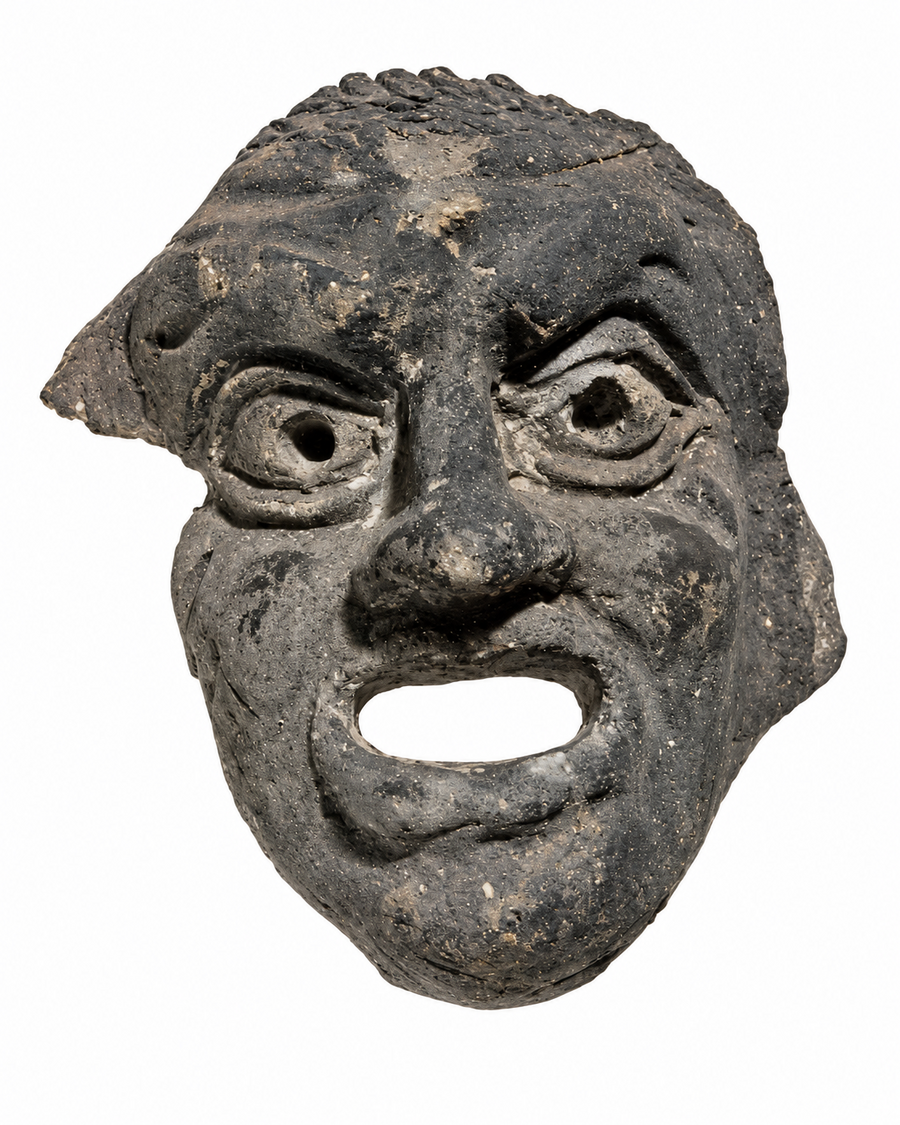
Old Man Mask, 2nd century BCE, terracotta. Princeton Museum of Art, No. y1952-84. / Comedic Mask, 2nd–1st centuries BCE, terracotta. British Museum, No. 1868,0110.713.
The visual distinction between the provided masks is primarily based on the character of the hair and the plasticity of the face. In the old man’s portrayal, the beard complicates the lower contour of the head, making it more massive and accentuating the character’s age. In the beardless character, the lower part of the face appears more open, and the overall silhouette is compact. Both masks utilize exaggerated features typical of comedic typology. Age is conveyed not through portrait resemblance, but through a combination of recognizable external characteristics.
3. Social Status as a Visual Code
Where age was predominantly indicated by physiognomic traits, social status required a more complex system of distinctions. The masks of slaves, free youths, and courtesans differed not only in facial structure but also in hairstyles, the character of expression, and occasionally in color and decorative elements. At the same time, social status could not always be determined by a single physical feature. Instead, the combination of traits, codified by theatrical tradition, held significance.
3.1. Subject: Exaggeration and active facial expression
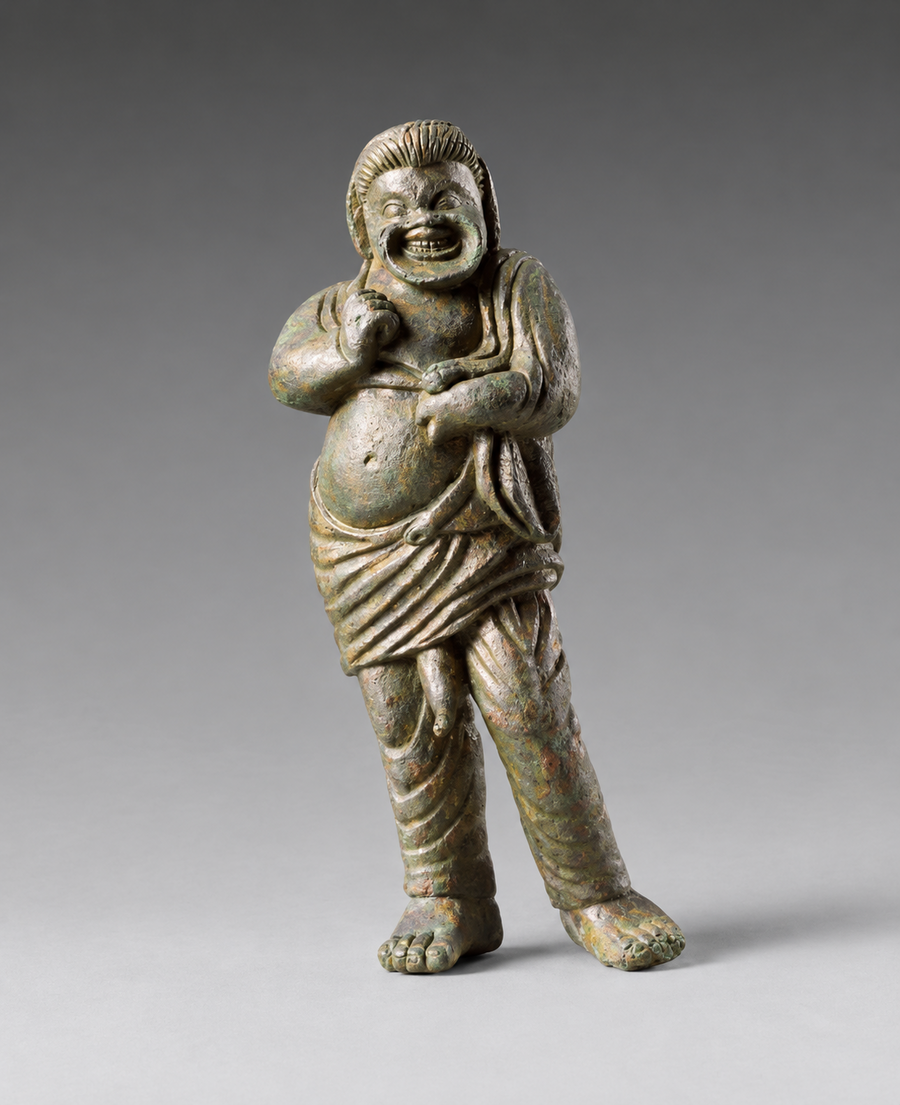
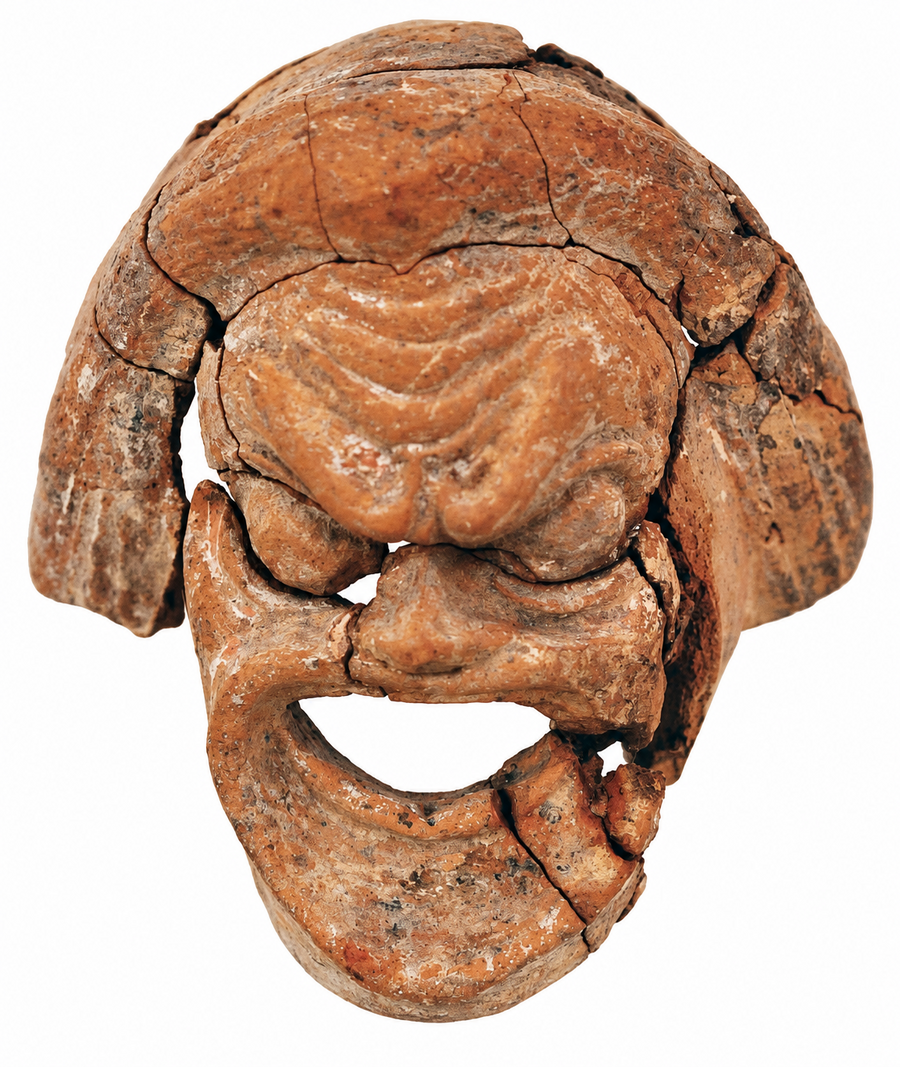
«Statue of a Standing Comedian Actor, ” 2nd–1st century BCE, bronze, Getty Museum, No. 96.AB.155. / Mask of a Leading Slave (Hegemon Therapon). Specimen from the collection of the University of Giessen, T I-19.