…if you install an antenna and receiver, you can hear them; they sound simply magnificent. That is everything I did—I just gave people the opportunity to hear them.
Sound is something that can penetrate space and, essentially, spread throughout it like ivy. The study of sound is difficult and fraught with challenges because it exists as a transient, vanishing phenomenon that is hard to capture in a stable form. Another difficulty lies in the subjectivity of the recording process: it is impossible to fully fix sound or noise because it is almost always linked to the body, space, and reproduction technologies. Researchers are forced to consider both the physical and social aspects simultaneously. Sound studies, as an interdisciplinary field, faces the necessity of connecting acoustics, philosophy, media, and cultural analysis in order to approach sound and the act of listening itself.
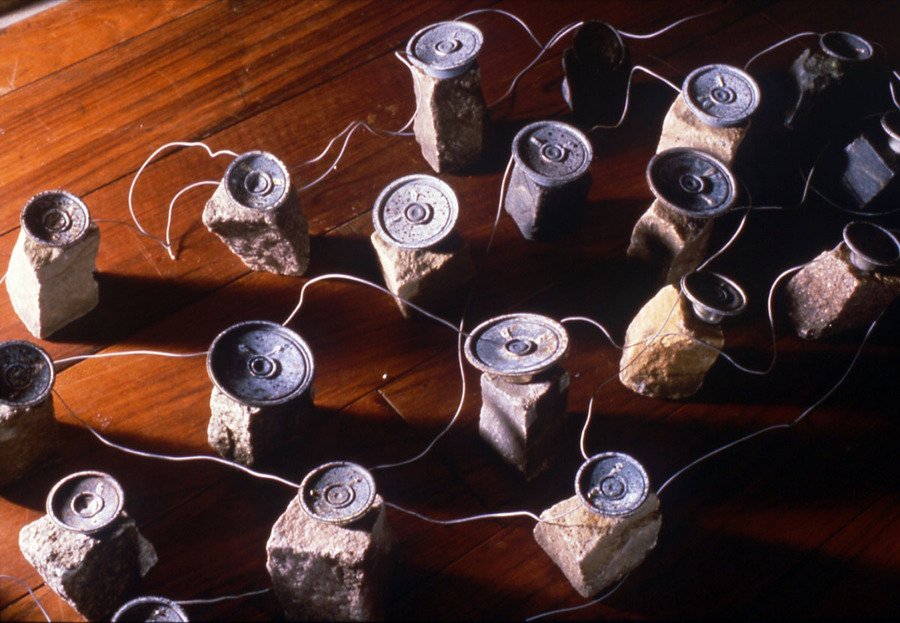
Sound Installation Series No. 1 Rolf Julius: «Wind» 1991
In response to this, a transduction approach was developed, which has become the key method for obtaining information about sound and what comes from it. Transduction, as a concept, is the conversion of energy from one form to another—for example, sound waves are converted into electrical signals. In sound research, this is not merely a technical process but also a cultural artifact that creates a sense of presence and links the physical world of sound to its meanings and values.Furthermore, transduction can also distort sound, meaning the final product may differ from the original sound. I view this as a schematic where transduction plays the role of an unreliable intermediary that can distort the original message. There are three points: the first emits the sound, the third receives it, and the second is the intermediate stage where it is unclear whether the sound will come out as normal or altered. Many devices become this middle link.
For example, when people listen to an old record with crackles—that is a technical defect. The record became a transducer through which the sound was altered. But for the audiophile, this so-called «warm tube sound» creates a feeling of presence and authenticity, transporting them back in time. The crackle becomes a cultural symbol, not just noise. Furthermore, the sound on the record has been modified and enriched with artifacts.
Bill Fontana Cologne/San Francisco Sound Bridge 1987
This raises the question: what is transduction, and how exactly does it work? The goal of my research is to structure transduction into its various types and provide a clear understanding of its operation, based on its properties: its influence on sound, its transformation, information transmission, and energy transfer. Furthermore, I aim to delve into the state of sound when this method is employed.
devices
The main transducers are various devices, such as microphones, speakers, radios, and most technologies that transmit sound.Through these devices, sound can be altered in everything from volume to texture (artifacts and noise). The devices can also transmit non-human sounds.
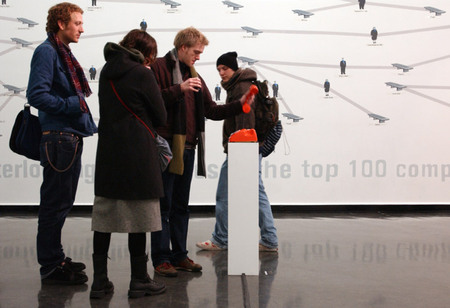
Bjørn Habbestad — Telart
2001–2010Bjørn Habbestad is a sound artist working at the intersection of contemporary classical music, electroacoustics, noise, and free improvisation. His work emphasizes sound itself, the acoustics of space, and communication technologies.The piece «Telart» explores telecommunications and sound. The installation utilized telephones, voicemail systems, and various technical apparatus for audio recording and transmission. Participants left voice messages that became part of the sound installation and were disseminated through the telephone infrastructure.Transduction functioned here as the transformation of the human voice into an electrical and digital signal, which was transmitted through the network and subsequently converted back into sound. As a result, the voice altered its quality and context, and the act of information transfer itself became an artistic process and part of a collective composition.
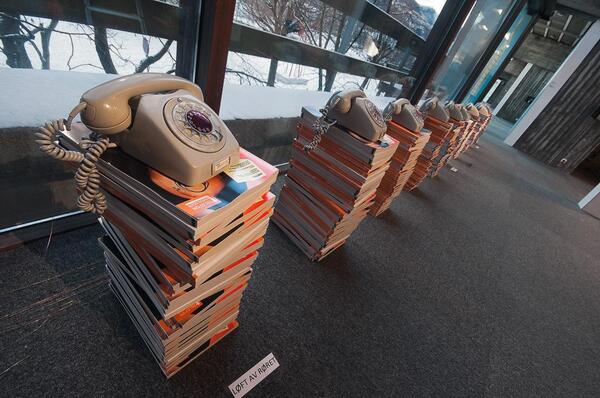
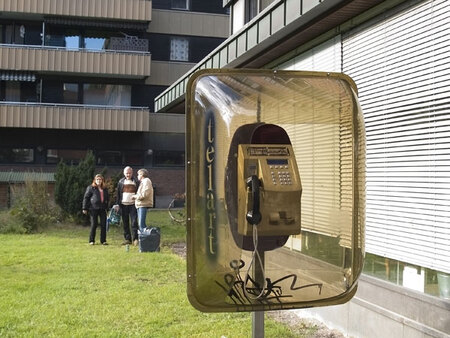
Bjørn Habbestad TeLart 2001–2010
Bjørn Habbestad Telart 2001–2010
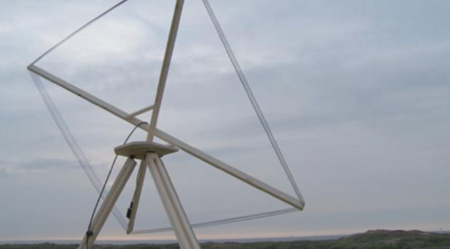
Elvin Lysse — Sveriks
1981Elvin Lysse is one of the pioneers of sound art. His works emphasize the physical nature of sound: the acoustics of space, resonances, beats, as well as «unusual» sources.In the sound piece Sveriks, electromagnetic phenomena of the atmosphere are used to create sound. These are electromagnetic impulses arising from lightning, the ionosphere, solar activity, and other atmospheric processes.
Elvin Luise Sveriks 1981
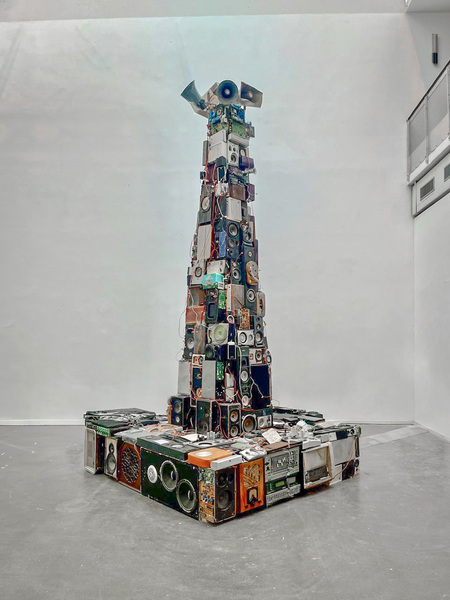
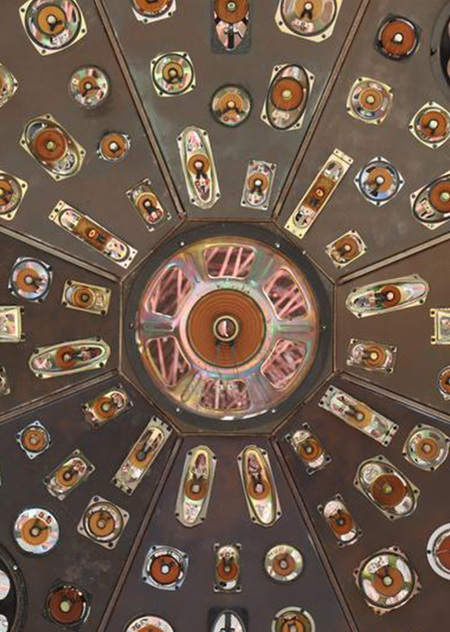
Benoît Mobre — Dynamic Sculptures
1987–2015Benoît Mobre is primarily a contemporary artist. His works emphasize interactivity and public participation.In this series of works, people connect via phone, Bluetooth, microphone, or audio input, and their voice is broadcast through the entire structure.
Benoît Morbier Dynamic Sculptures 1987–2015
[ii] computer
By «computers,» I mean the entire digital space: AI, social media, and computing devices. These elements function as transducers. However, unlike conventional technologies, a computer can extract and process images and data, transforming them into sound installations and aural compositions. Alternatively, it can extract and process images and data to create sound installations. Social media operates as a mechanism, but this also raises issues regarding the mediation of voice and its essence in connection with the source. Artificial intelligence expands the possibilities of sound art by enabling the generation of novel acoustic environments.

Holly Herndon — Eternity 2019
Holly Herndon is an American composer and artist working at the intersection of electronic music and artificial intelligence.
The project explores the interaction between humans and artificial intelligence in music. A central part of the project is the Spawn neural network, which was trained on the voices of singers and choral improvisations. The AI does not replace the musicians here; rather, it becomes a participant in the creative process—it analyzes human voices, transforms them, and generates new sonic forms. This represents the translation of the human voice into a digital form.
Holly Herdon Eternity 2019
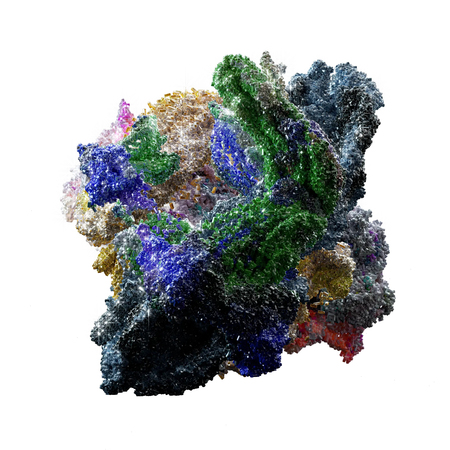
Harry Jeff — Voice Pearls
2018–…Harry Jeff himself is a researcher working in the fields of voice and artificial intelligence.In Voice Pearls, the voice of a human or animal is transformed into digital and physical sculptures. The system records the sound and analyzes its characteristics: timbre, pitch, rhythm, and emotional nuances. Then, algorithms convert the audio signal into a data array and create a unique three-dimensional form resembling a gemstone.
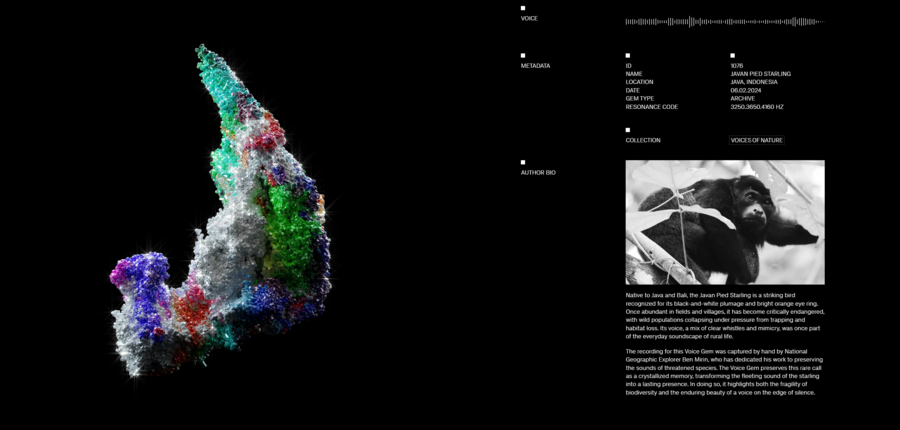
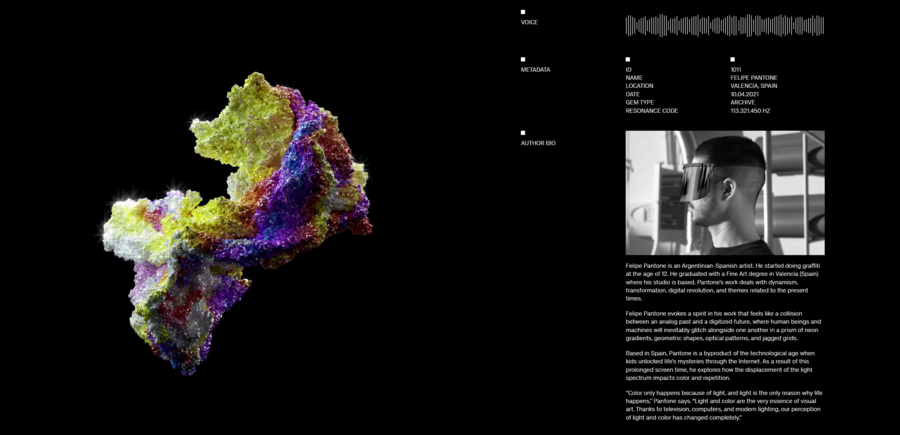
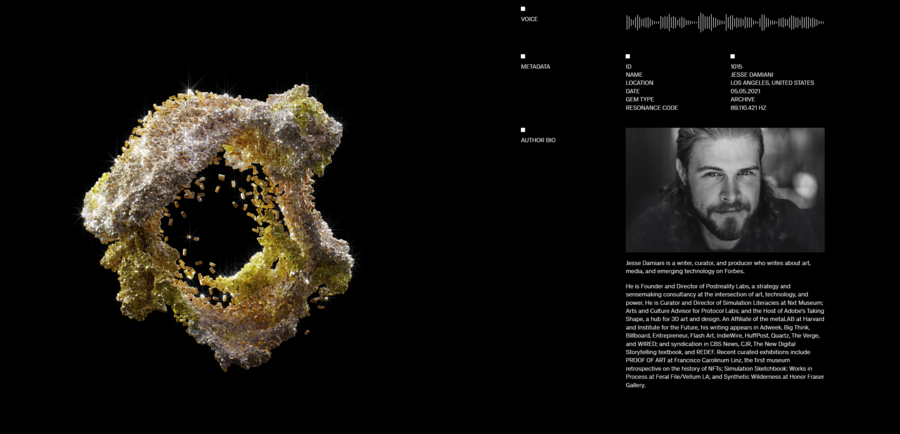
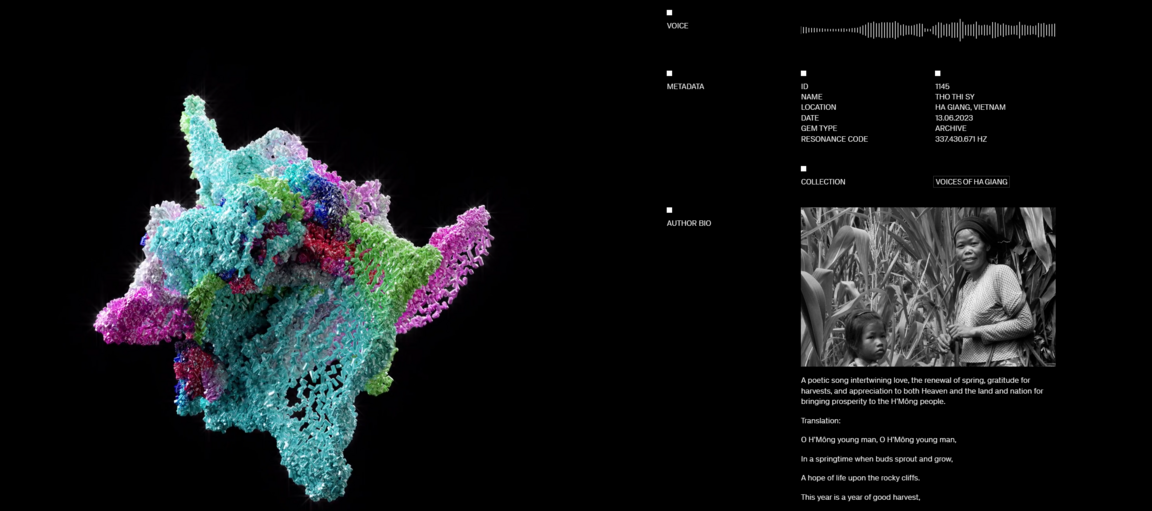
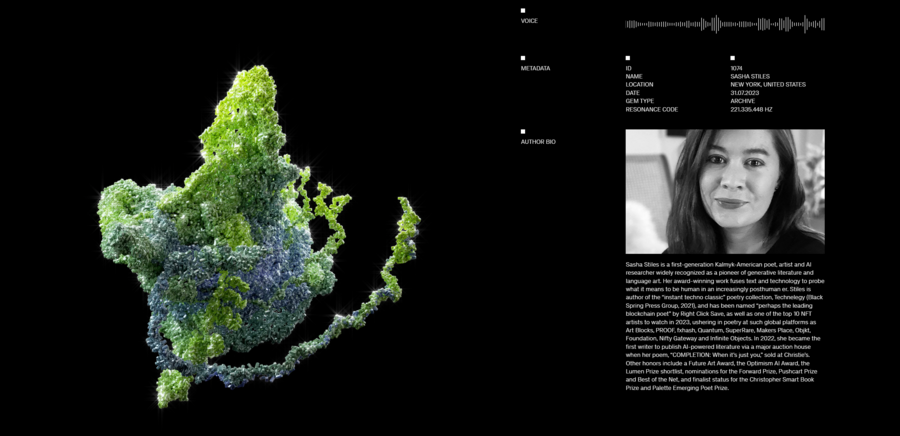
Harry Jeff Voice Jewels 2018–…
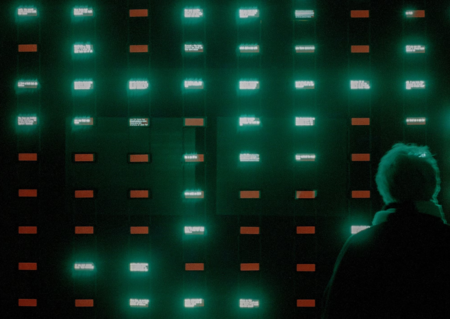
Ben Rubin and Mark Hansen — Listening Post
2001The duo of Ben Rubin and Mark Hansen operates on a principle of role division. One functions as the media artist, while the other is a statistician responsible for data collection.The media installation transforms textual streams from the internet into sound and visual imagery. The system collects public messages in real time from online sources, such as chats and forums, and then analyzes them using text processing algorithms.Phrases are grouped by theme, and characteristic messages are selected from each cluster. These fragments are simultaneously displayed on multiple small screens and vocalized by a synthesized voice, creating the effect of a collective «chorus» of the network. The viewer hears not individual people, but the aggregated voice of the digital environment.