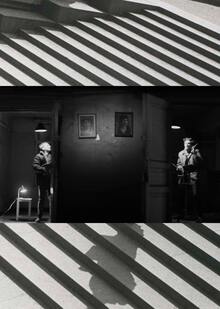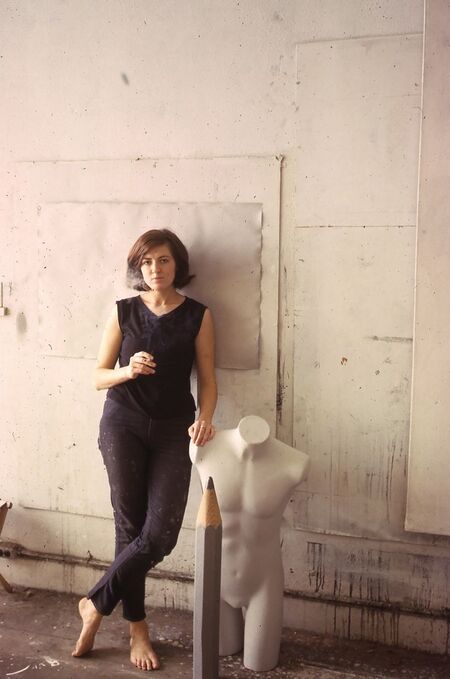
Contemporary image perception is rapidly evolving: the gaze glides across surfaces without lingering. In this context, Vie Celminsh’s practice rings out almost like an ethical statement—not loud, but profoundly accurate. She doesn’t strive to impress with scale or color. Her strength lies in the pause, in how she compels the viewer to look longer.
INDEX
Silence in which you can hear graphite
Chapter 1. The Journey. How movement became its method Chapter 2. The Experience of Representational Overload Chapter 3. Shades of Gray Chapter 4. Without a Center. The Importance of Every Movement Chapter 5. Time That Can Be Seen Chapter 6. The Play of Scale That Changes Perspective Conclusion
Bibliography Appendix: Visualization Sources
Silence in which you can hear the graphite
«I don’t want people to glance at my work. I want them to really look at it.»
This phrase is the key to the entire logic of her practice. Celminsh does not propose a «spectacular» display. She offers a way of seeing: slow, tactile, attentive to the barely perceptible. Just take a half-step closer, and you will see how one line transforms into a wave, a stone into an entire universe, and empty space into a meaningful caesura.
The goal of this research is to demonstrate that the relevance of Celminsch today is not tied to the minimalist trend, but rather to the type of attention it invites. In a world oversaturated with imagery, the ability to hold one’s gaze on a single motif and return to it again and again becomes almost a radical gesture.
Chapter 1. The Journey. How Movement Became Her Method
Via Celminš's path is inherently driven by movement. Born in Latvia in 1938, she left the country with her family in 1944, spending time in camps in Germany before moving to the United States in 1951. This was not merely a sequence of relocations—it was a constant loss of «home,» necessitating the perpetual reassembly of her world out of fragments.
Movement becomes a structural aspect of practice. The absence of a fixed place generates a particular kind of gaze—intense, fixating, almost documentary. This informs the artist’s core technique: not to create something new, but to capture the ephemeral through repeated returns to the same motif.
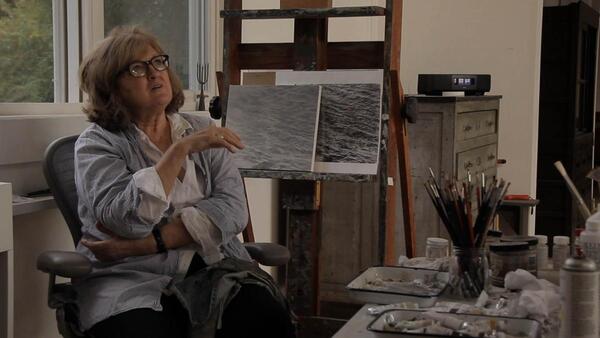
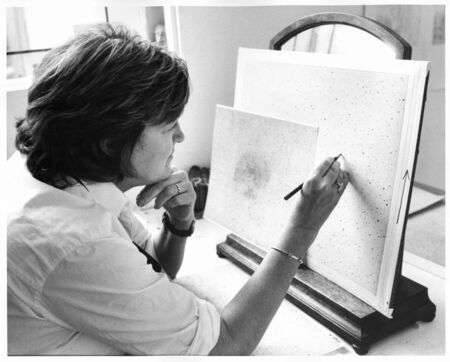
Vija Celmins—the workshop
The key work establishing this starting point is Lamp #1 (1964). It depicts an ordinary lamp with near-photographic accuracy, yet it is devoid of light. This is not a still life in the traditional sense, but rather a moment of optical decision—the artist chooses to observe for a long, attentive period. The lamp functions as a fixed point in a changing world—a beacon that does not illuminate, but remains in place.
Vija Celmins, Lamp #1, 1964.
It is in this work that the strategy of intense observation becomes clearly apparent for the first time. It is important to emphasize that this is not an «early experience, ” but a formulation of a methodology: intensity, fixation, and a refusal of ornamentation.
Chapter 2. The Experience of Re-representation
The term «redescription» precisely captures Celmins’s approach: she repeatedly «retells» the same motif—the ocean, the stone, the night sky. This is not typical seriality, but rather an attempt to sustain the movement of reality through recurring actions.
The Ocean Surface series (versions 1968–1970) is built upon the repeated return to the water’s surface. Each variation differs in the density of the line work, the rhythm of the waves, and tonal nuances, yet it retains the overall structure. These are not different «views» of the ocean, but different ways of «articulating» it—as if the same sentence were being delivered with varying inflection.
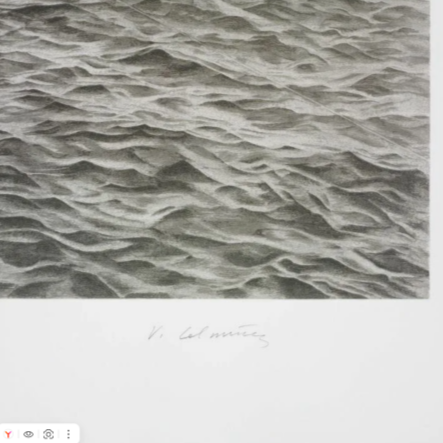
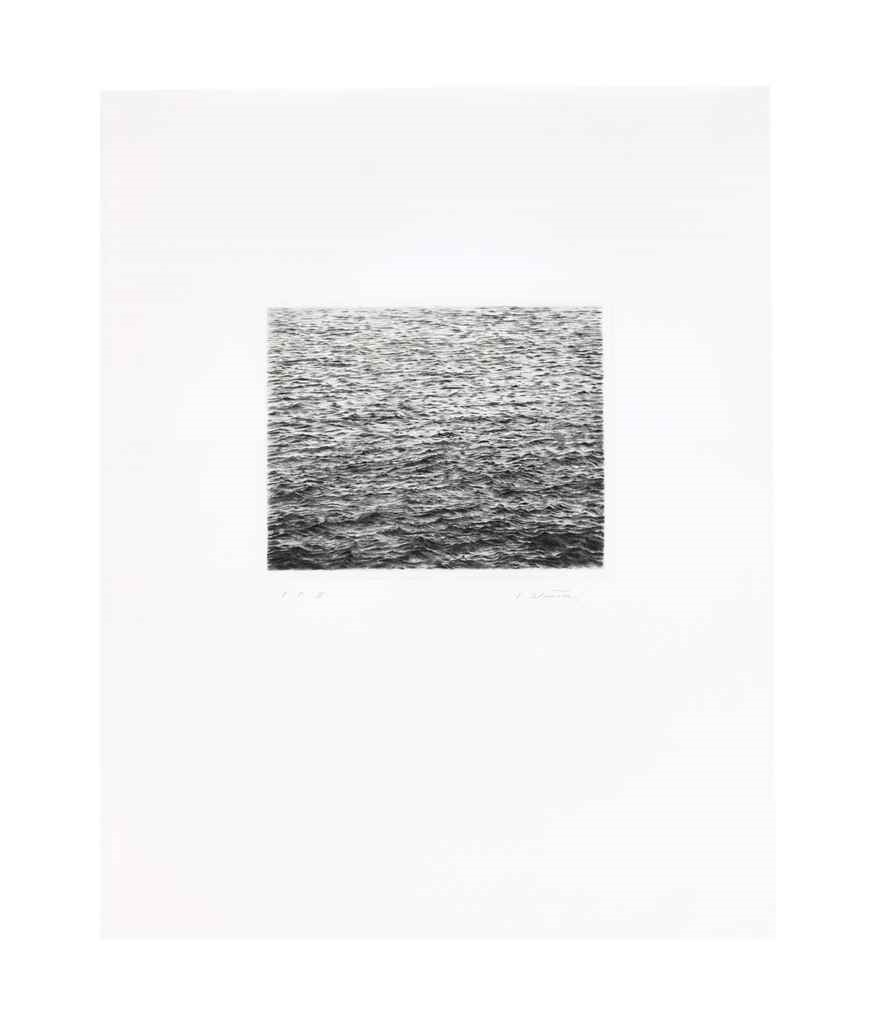
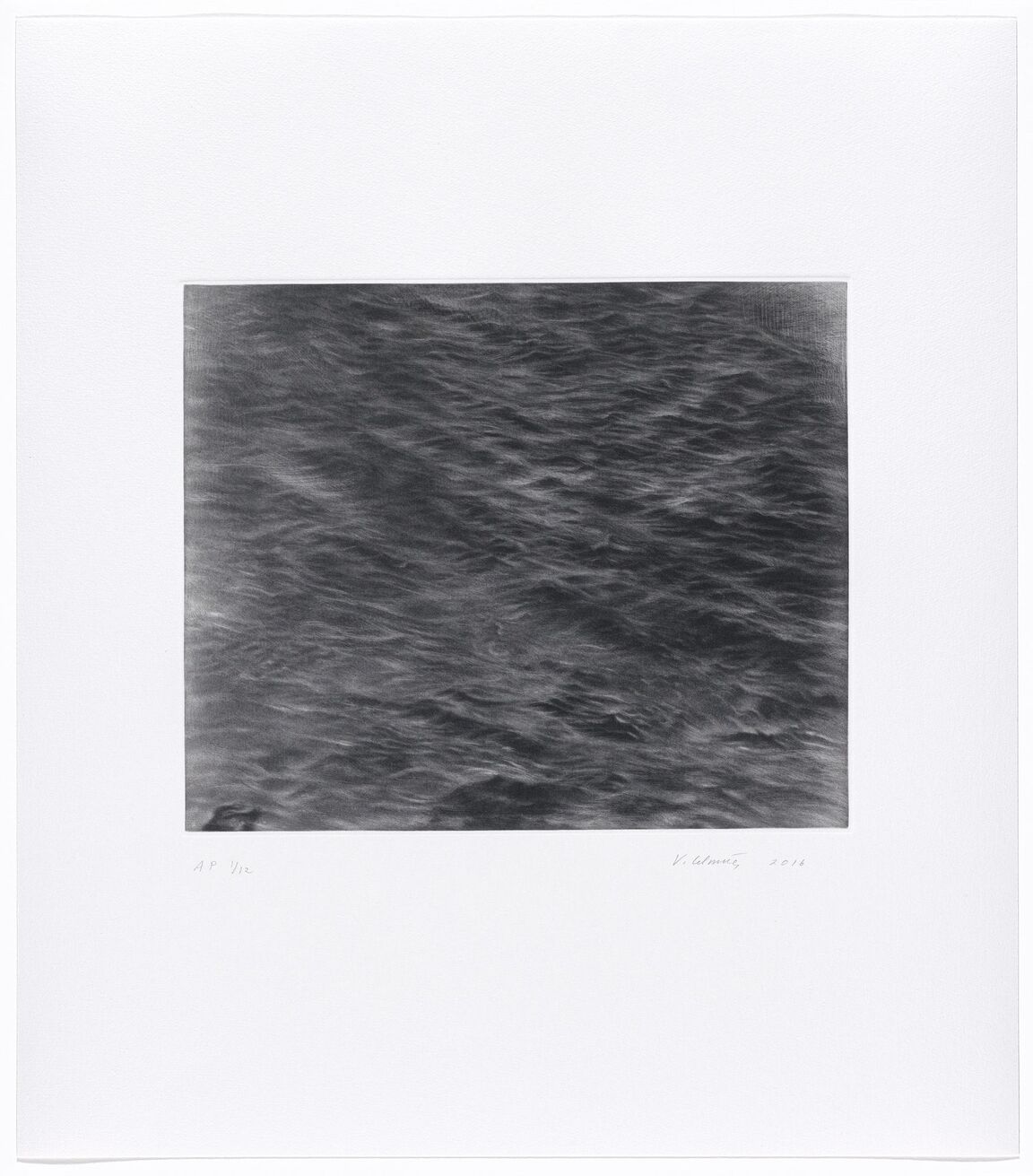
Another example is Rock #2 (bronze, 1976). Here, the repetition extends beyond the drawing: the stone is cast in bronze, and the «repetition» becomes sculptural. The material changes, but the essence remains: it is a trace, a shadow of the original, its material echo.
«Repetition is not boring. Repetition is a way to anchor reality.»
Celminsch’s method of re-presentation is not a stylistic device, but a way of engaging with memory and perception. The viewer recognizes the motifs, yet each time encounters a new technique, a new scale, a new texture.
Chapter 3. Shades of Gray
Celminsch’s monochrome is not a stylistic device, but an ethical stance. The rejection of color prevents distraction by mere decoration and avoids «beautifying» reality. Her palette consists of shades of gray, where every tonal transition is the result of diligent handwork.
Grey here becomes a form of reality transmission: it promises nothing; it suggests closer observation. It possesses a tactility—every stroke is an effort, every layer is time.
Night Sky #12 (1996) is a striking example. The starry sky is constructed from thousands of individual graphite touches. Up close, the painstaking detail is evident: the hand repeats the same motion again and again. From a distance—cosmos is born from these points.
The contrast between «near/far» is one of the central effects in Celminish’s work. This is why emphasizing the duality of perception is crucial: detail versus whole, effort versus outcome.
Chapter 4. Without a Center. The Importance of Every Movement
In Celminish’s works, hierarchy is often absent: there is no primary or secondary element, no center that draws the eye, and no empty corners that can be bypassed. The surface is filled uniformly—this is the «all-over» principle, where meaning emerges not from the composition itself, but from the details.
The Web Drawings series (1999–2005) vividly demonstrates this approach. The web is depicted as a network, where every line is part of the overall structure. Up close, the complexity of the interweaving is visible; from afar, it reads as an abstract pattern. Remove a single thread—and the entire system changes.
This principle is directly related to how the artist understands the responsibility for every line: no stroke is arbitrary. Meaning emerges from the even density of attention distributed across the entire surface of the sheet.