Topics
- Concept
- The Grid as a Deformation System
- Rhythm and Repetition as Optical Tension
- Color as a Factor of Instability
- The Viewer as a Condition of the Work
- Conclusion
Concept
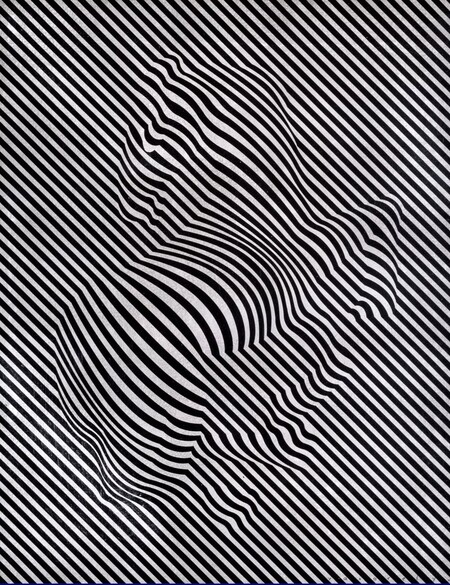
In this study, I aim to examine op-art not merely as a style linked to optical illusions, but also as a method for working with surface and visual perception. At first glance, op-art might appear quite straightforward and simple: repetitive lines, contrasting grids, circles, and geometric shapes that immediately catch the eye and carry no inherent meaning. However, it is precisely this external simplicity that interests me. Op-art frequently employs the most basic visual elements, yet the resulting effect is unstable and almost physically impacts the viewer. The plane ceases to be a passive surface upon which a composition rests. Instead, it begins to be perceived as an active field that can vibrate, bend, sink, shimmer, or transform depending on the viewing angle.
Historically, op-art reached a particularly vivid expression during the 1950s and 1960s, although its origins can be traced back to earlier experiments in geometric abstraction, constructivism, and the Bauhaus. In the post-war era, art increasingly turned toward systems, seriality, and industrial precision, moving away from the notion of a unique authorial gesture. For this reason, op-art resonated closely with the visual culture of its time—a culture that was technological, mass-produced, and increasingly tied to the screen and the consumer. Its language rapidly extended beyond painting to become a component of 1960s fashion, graphic design, and popular culture.
«The unique thing is the initial idea, not the object itself.» — Victor Vasarely [1]
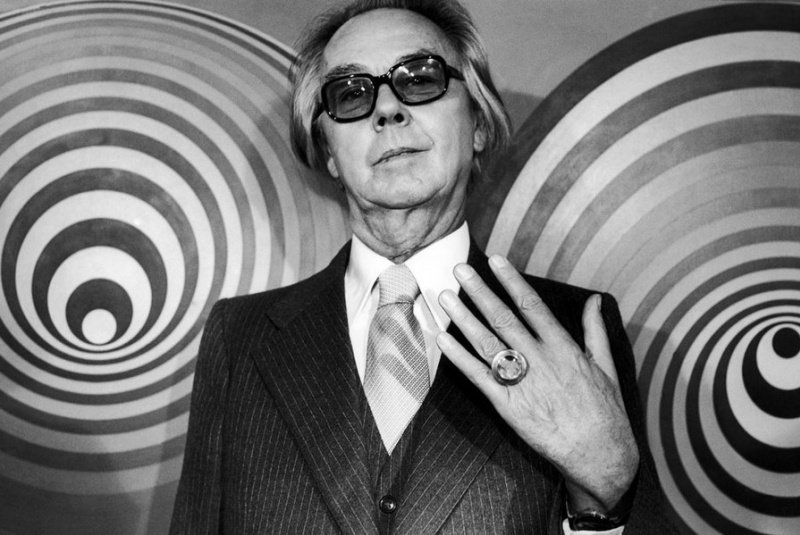
Victor Vazareli against the backdrop of his work
I am interested in why these works make such a strong impression and how artists create a sense of movement or depth without actual motion. In the traditional sense, a painting is often perceived as a representation of something external—space, an object, or a state. In Op Art, the situation changes: the work doesn’t so much depict the world as it influences the viewing process itself. The artist structures the surface so that the effect arises within the viewer’s perception. Therefore, the work exists not only as an object but also as an experience.
«We are still in a two-dimensional world, but the illusion of creating space and movement in microtime is so potent that it functions as reality.» — Victor Vasarely [2]
«The eye can travel across a surface just as it moves in nature… At one moment it seems to look at nothing, and in the next the canvas is once again filled with visual events.» — Bridget Riley. [3]
The central concept of my research is the unstable surface. I conceptualize this as a surface that physically remains stationary and flat, yet visually ceases to be perceived as stable. It can appear dynamic, volumetric, tense, vibrating, or mutable. It seems important to view this instability as the result of various artistic techniques; therefore, I intend to structure my investigation not around types of sensation, but around the mechanisms that render a surface unstable. Among these, grid deformation, rhythm and repetition, color relationships, and viewer positioning are of particular importance to me.
My interest in this topic stems from the fact that Op Art exists at the intersection of highly rational construction and almost uncontrolled visual experience. These works often lack narrative, figuration, or a pronounced authorial gesture, yet they elicit a powerful response.
The goal of my research is to trace how Op Art artists transform a flat plane into an unstable visual illusion. I want to understand what techniques allow a surface to appear dynamic or three-dimensional. Thus, the study will focus on analyzing how these effects are created and why they shift conventional perceptions of an image.
When selecting textual sources, I paid close attention to the reliability and veracity of the information presented, consulting articles dedicated to this subject.
Grid as a Deformation System
I begin my investigation with the grid because in Op Art, it often serves as the foundational structure from which the entire optical effect emerges. The grid imposes a specific order on the work—it organizes the surface and creates possibilities for creation. The artist takes a stable system and begins to compress, stretch, curve, or shift it. Because of this, the plane stops being perceived as a static surface and begins to seem convex, concave, sunken, or pulsating.
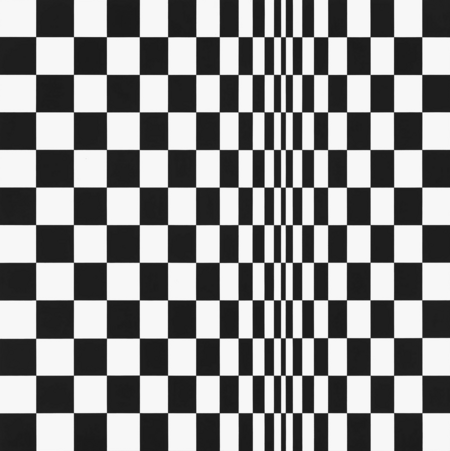
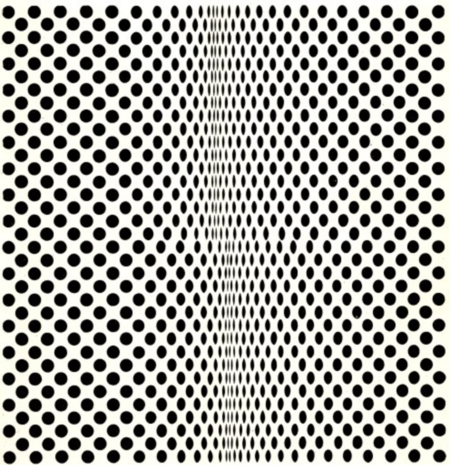
Movement in Squares, Bridget Riley, 1961; Division, Bridget Riley, 1963
In Bridget Riley’s works, the grid often maintains a strict black-and-white foundation, but it gradually loses its uniformity. In «Movement in Squares,» the typical checkerboard structure compresses toward the center, creating a feeling of being pulled inward toward the image. In «Division,» a similar principle operates even across a field of dots: the regular order begins to fragment, and the viewer perceives the surface as unstable. Riley demonstrates that even the simplest geometric system can begin to «move» if its equilibrium is disrupted.
VEGA 3, Victor Vazareli, 1957–1959
In Viktor Vasarely’s work, the grid becomes even more spatial. In his pieces, it both deforms and transforms into an illusion of volume. For example, in his work «VEGA 3, ” one can clearly trace how a grid, reminiscent of a checkerboard structure, creates an effect of immersion into the surface itself, into his space, and then inverts what is happening, pushing the viewer back. Thus, we observe a contrast between two states of a single plane.
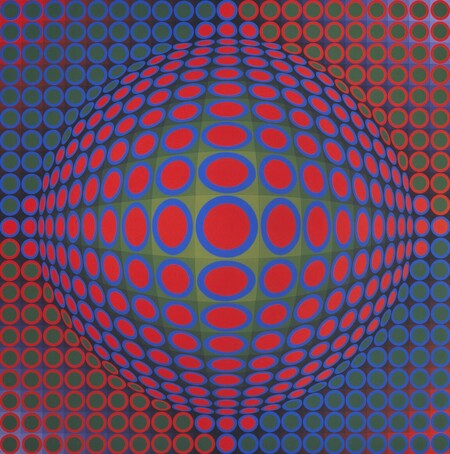
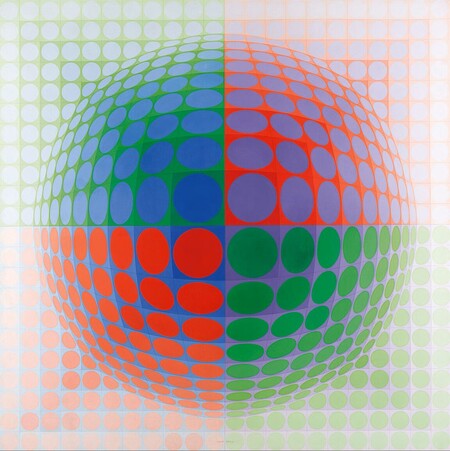
Vega 200, Viktor Vasarely, 1968; Vega-Pal, Viktor Vasarely, 1969.
Starting in the late 1960s, Vasarely developed the famous «Vega» period, where the regular modular structure begins to deform as if the plane is bending outward or, conversely, receding inward.
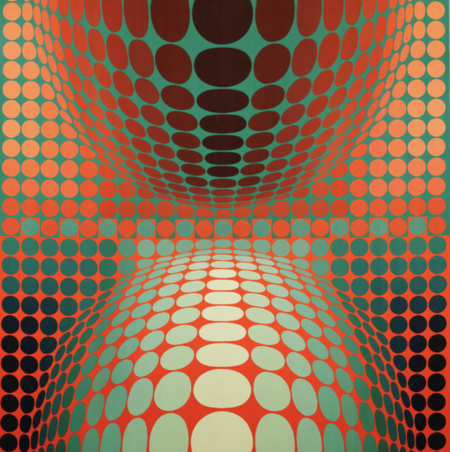
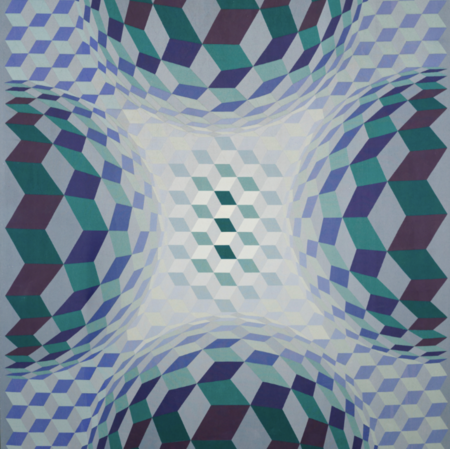
Chate-Stry, Viktor Vasarely, 1971; OND, Viktor Vasarely, 1968
In these works, Vazareli employs recurring geometric elements, varying their scale, direction, and density. The grid begins to suggest volume within a flat plane. Works such as «OND, ” „Chait-Stri, ” and other pieces from the series can be viewed as examples of how, in op art, a flat surface becomes visually convex, concave, and unstable.
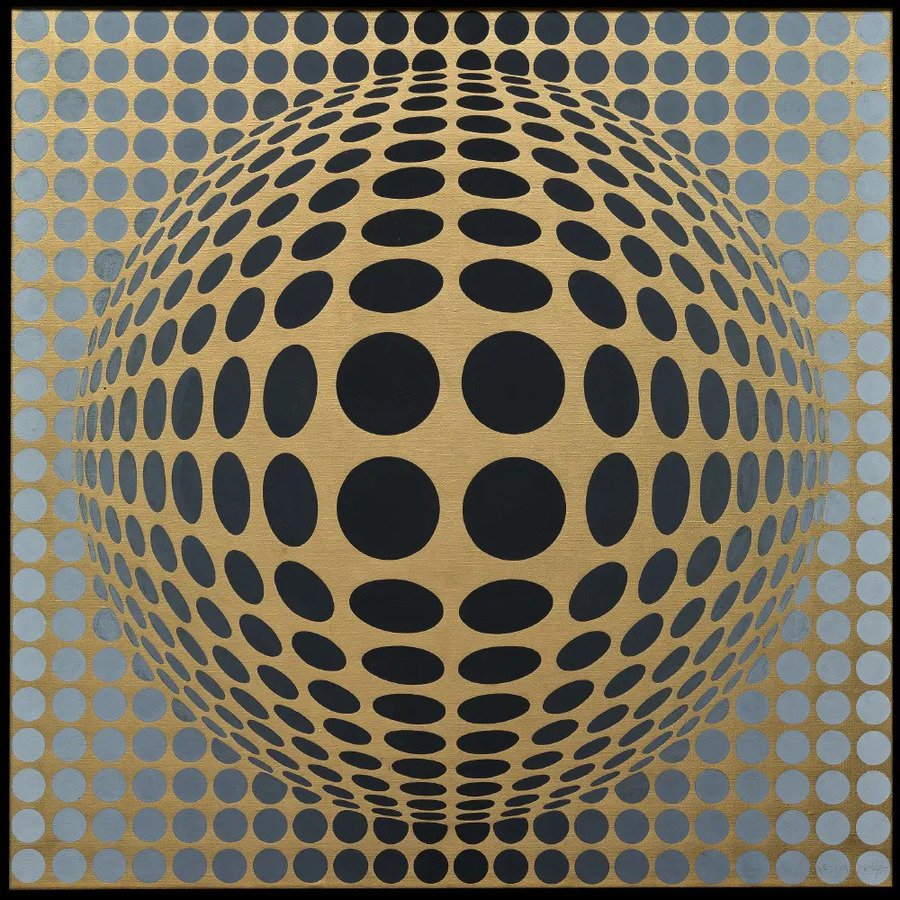
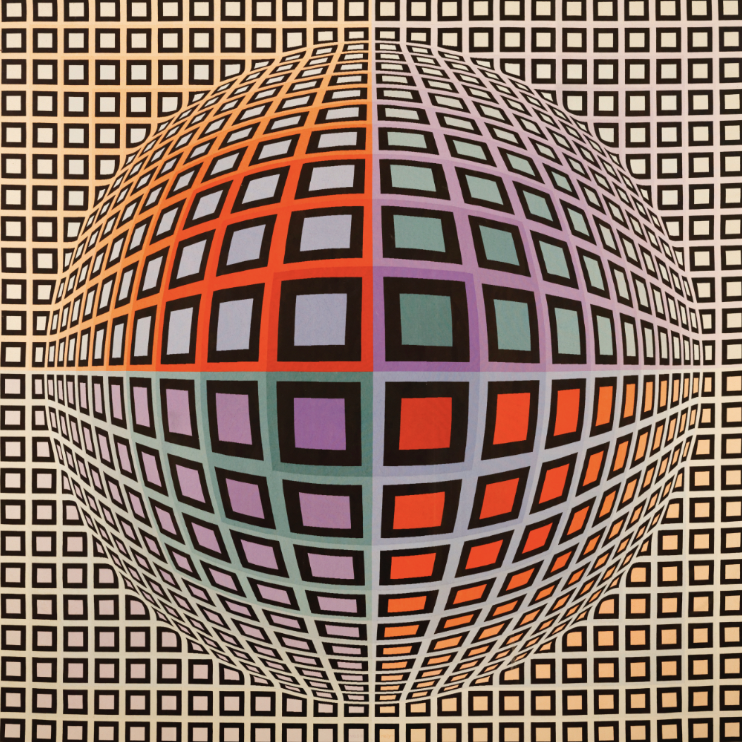
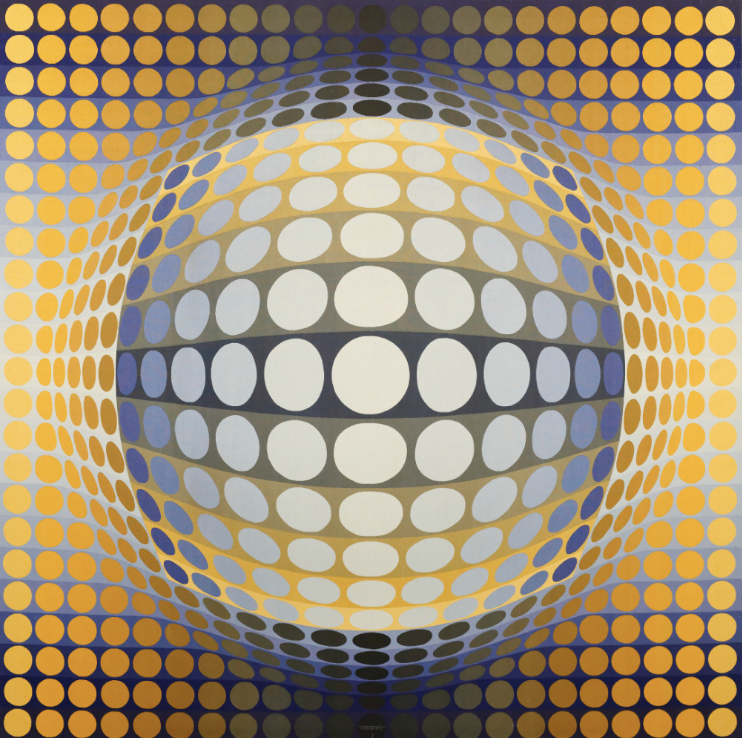
Works from the Vega series, Viktor Vazareli; Vega-Or-Va, Viktor Vazareli 1969
Upon prolonged observation of Larry Pounce’s «Informer,» the image begins to behave erratically; the eye cannot find a point of rest and starts skipping from one dot to another, causing the dots to pulsate or shift slightly. At the beginning of his work on «Informer,» Larry Pounce placed dots on a strict grid running across the entire piece. However, he later noticed that one misplaced dot could disrupt the entire order and confuse the observer. From that moment on, the dots ceased forming a pattern and instead began to form chaos.
Informers, Larry Pounce, 1962
I isolated six segments from the painting to visually demonstrate how a specific grid is disrupted by the introduction of points where they seemingly should not exist.
6 fragments of the painting «Informer»
In «Orange Crush,» this effect becomes even more pronounced. Puns intentionally removes any grid or compositional center, forcing the viewer’s gaze to constantly move across the surface. The arrangement of the dots might initially appear arbitrary, but it was meticulously calculated. Upon prolonged viewing, the dots begin to pulse, and when shifting the gaze to a white wall, a residual image of their placement may persist.
Orange Crush, Larry Pounce, 1963
This section serves as the starting point for the entire investigation. The grid demonstrates that Op Art is built upon a highly precise organization of surface. Order first emerges, followed by its disruption. It is from this tension between regularity and deformation that optical instability arises. Therefore, the grid can be viewed as the foundation from which other principles of Op Art develop.
Rhythm and Repetition as Optical Tension