Navigation
- Concept
- Perspectives
- Composition
- People
- Bibliography
- Image Sources
Concept
Shortparis—a St. Petersburg musical group formed in 2012. Currently, its members include Nikolay Komyagin, Aleksandr Ionin, Pavel Lesnikov, and Daniil Kholodkov. This collective exemplifies contemporary musician-artists whose music is a unique fusion of various styles (ranging from post-pop and pop-noir to experimental and avant-garde music infused with folkloric elements). Their live performances can be classified as performative practices that blur the boundaries between music and contemporary art.
In their work, Shortparis utilizes a wide array of expressive means: provocations, manifestos, striking imagery, subtle allusions, non-obvious metaphors, and cultural references, alongside diverse vocal techniques.
The group’s music videos are attempts to reflect upon the past and the present. The video works mirror the internal contradictions within the country and also illuminate the current social issues faced by different segments of the population, guiding the viewer toward cultural pain points.
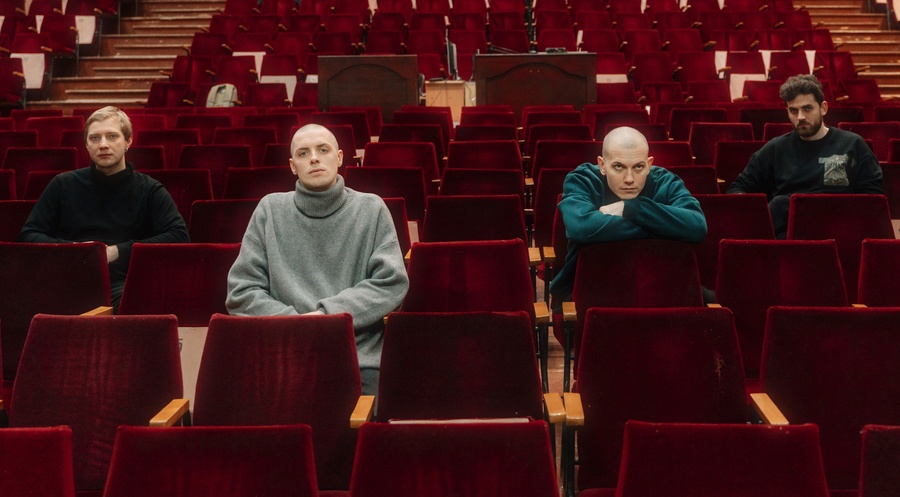
Shortparis, 2023
Alexander Mikhailovich Rodchenko (1891–1956) began photographing in 1924, at the age of thirty-two. His experimental approach subsequently defined the development of photographic art for decades to come. He shot from unconventional perspectives for the time (top-down and bottom-up), which were soon dubbed the «Rodchenko style»; he utilized diagonals and lines in composition to establish dynamism and rhythm; he captured close-ups that transformed familiar objects into abstract structures; and he applied double exposure. According to his friend Osip Brik, Rodchenko aimed «to turn a familiar object into a construction that seems never before seen”—to change how people viewed their surroundings.
Rodchenko — «I want to teach people to see the extraordinarily ordinary things.»
Anatoly Skurikhin. Alexander Rodchenko at the construction of the Belomorkanal. 1933.
At first glance, the works of Alexander Rodchenko and the musical group Shortparis, separated by time and cultural context, seem to share little in common. How does the aesthetics of a bright future, proclaimed by Rodchenko, find reflection in the somber imagery of Shortparis? Is this a mere coincidence or a deliberate reinterpretation of avant-garde heritage? Upon closer examination of the aesthetic, composition, and overall atmosphere of the St. Petersburg band, a clear echo of the visual solutions developed by the Soviet designer and photographer can be traced.
In this visual investigation, I will attempt to determine how—whether consciously or not—Shortparis transforms Constructivist aesthetics, adapting it to contemporary realities and their artistic objectives. To do this, I will divide the study into four thematic parts.
Perspectives
Shortparis, «This Night is Irreversible,» 2021
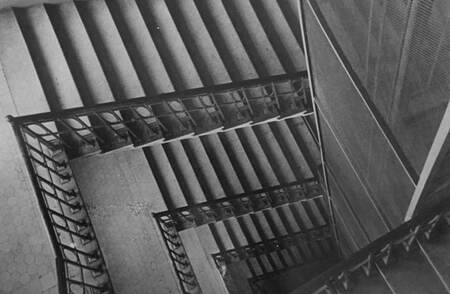
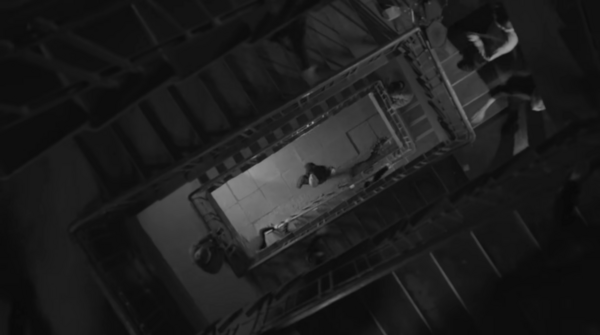
Alexander Rodchenko. Ladder from the Pravda Publishing House. 1930 / Shortparis, «This Night is Irrevocable,» 2021
In his photographs, Rodchenko rejects the conventional direct perspective inherited by photography from classical painting, which he terms a «navel shot.» In a debate with the poet Boris Kushner, who criticized Rodchenko in an open letter, the photographer explained that this tradition forces photographers to «straighten» frames, conforming them to a traditional appearance, sometimes taking this technique to absurdity. Rodchenko cites the example of shooting a 68-story building in the United States, where the photographer went to the 34th floor of a neighboring skyscraper because that is where the building’s «navel» is located. However, in real life, we view skyscrapers from below looking up, or we look down from a high floor at cars driving along the street. Rodchenko urges viewers to look at things from all angles to truly see them.
«They are searching for new subjects for shoots, but they are shooting according to old traditions. Mosquitos will be photographed ‘from the rear’ in the style of Repin’s ‘The Zaporozhians.’ But there is an opportunity to show the subject from perspectives we look at, yet cannot see.»
Alexander Rodchenko to Boris Kushner, 1929
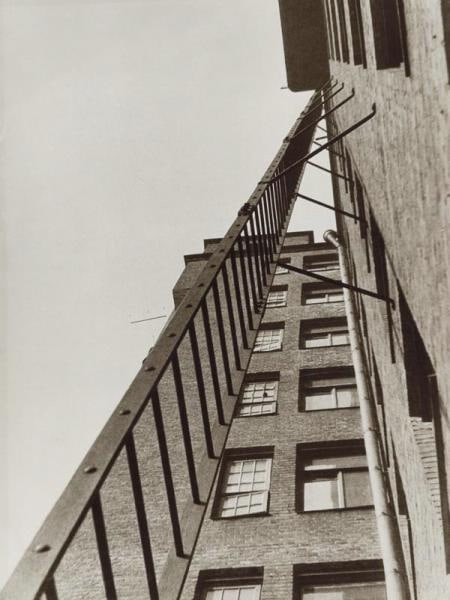
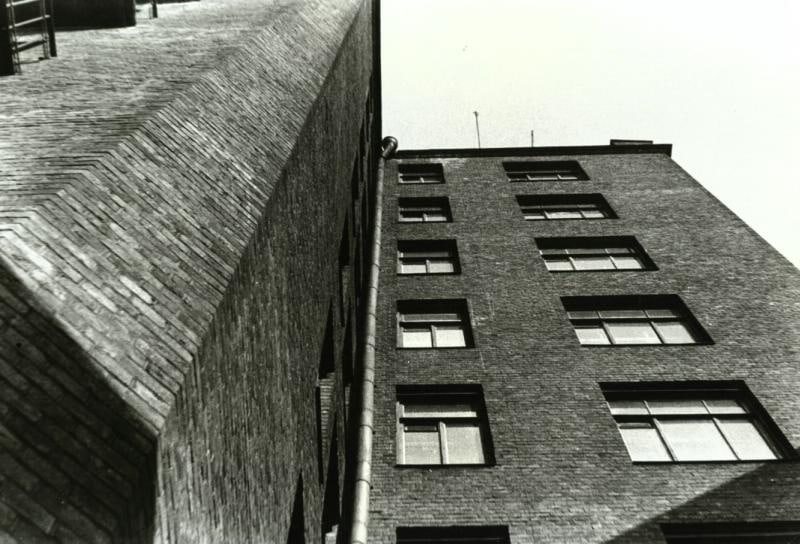
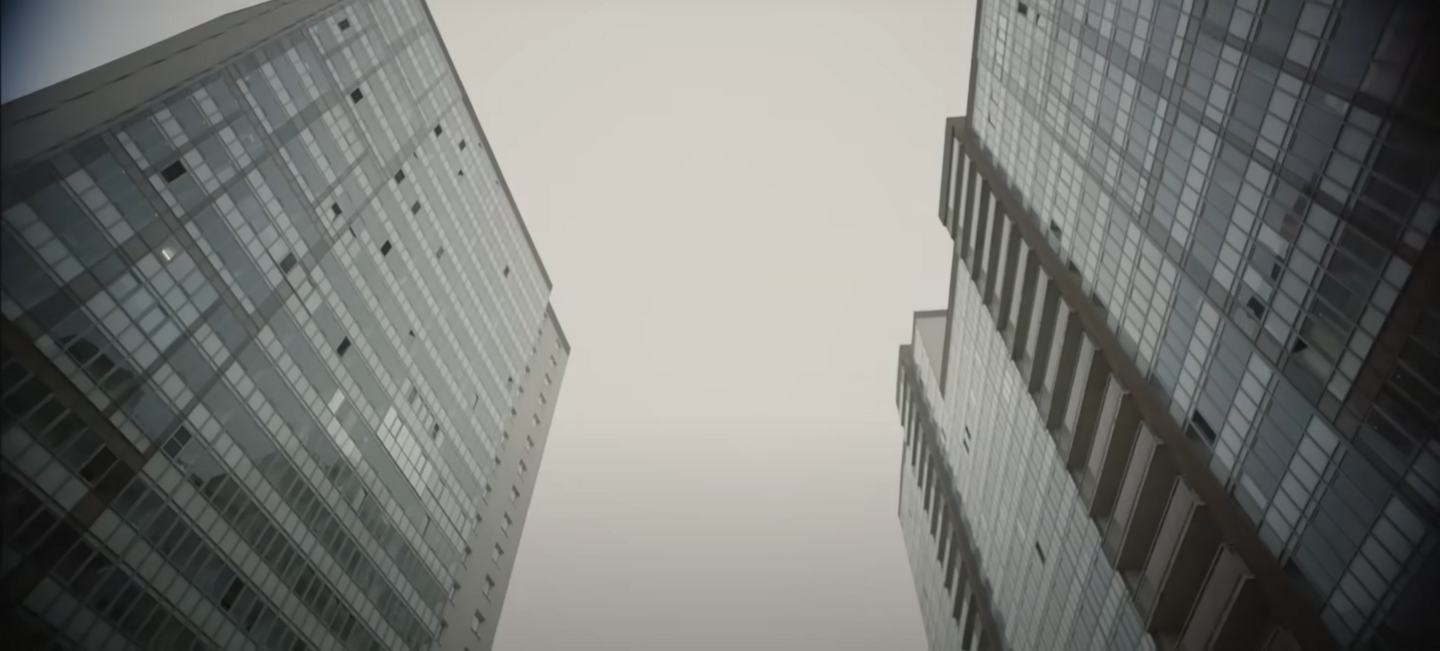
Alexander Rodchenko. Corner of a House. 1925 / Shortparis, «Scary, ” 2018 / Alexander Rodchenko. Fire Escape. 1925
Alexander Rodchenko. Shukhov Tower. 1929
Shortparis, «NEW NEW, ” 2022
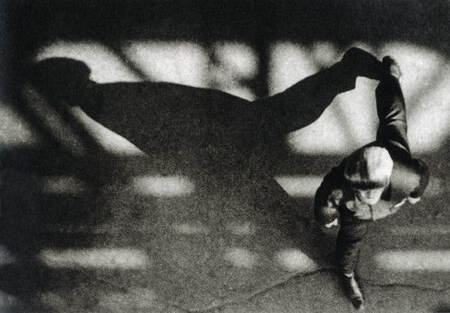
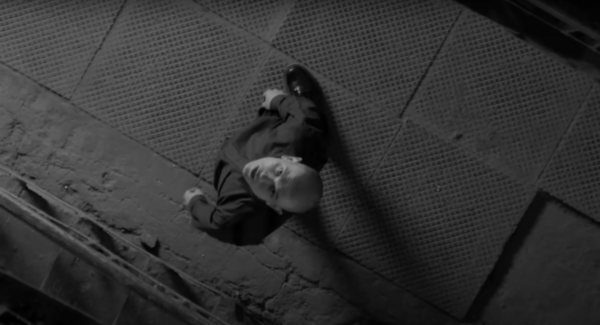
Alexander Rodchenko / Shortparis, «This Night Is Irreparable, ” 2021
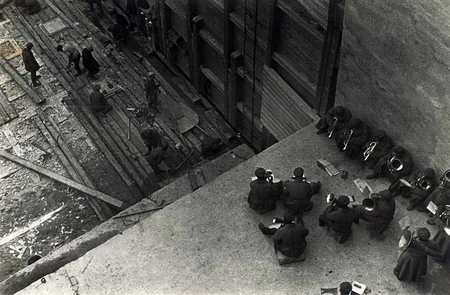
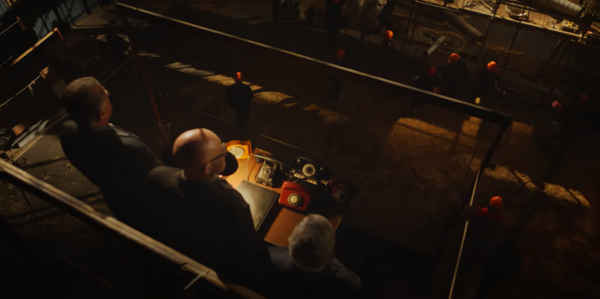
Alexander Rodchenko. Work with the Orchestra. 1933 / Shortparis, «NOVOYE NOVOYE», 2022
In the era of constructing socialism, photographers faced the task of capturing «the life of the young Soviet republic—the current, the one under construction everywhere, nearby: showing it from all sorts of angles, ” according to Rodchenko. Unusual angles not only allowed Rodchenko to present a subject matter in an original way but also helped to reveal the content of the frame more deeply. A striking example is the photograph „Working with the Orchestra, ” taken by prisoners building the Belomoro-Baltic Canal. Thanks to the contrast of black and white and the diagonal composition, the frame appears divided into two parts: on a raised platform, on a white stone slab, the orchestra of prisoners plays, and below—more prisoners are engaged in heavy physical labor, laying down planks.
Alexander Rodchenko. Assembly for a Demonstration. 1928
«Gathering for the Demonstration» was captured by Leica. The photograph shows residents of the building looking down from the balcony at the assembly of people heading to the demonstration. Rodchenko’s lens observes the entire scene. His gaze seems to double—he observes the observers.
He wrote in his manuscript «On Composition»: «The artist towers above the crowd: he always writes his groups from some elevated vantage point. His point of view is always above the crowd, so that he can see several planes.»
Shortparis, «Scary,» 2018
Composition
Alexander Rodchenko. Lines on Green. No. 92. 1919 / Construction No. 95. 1919 / Construction. 1920
In painting, Rodchenko identified the line as the foundation of any image: «The line is the first and the last, whether in painting or in any construction whatsoever.»
The line would become the principal structural element throughout his subsequent work. Rodchenko particularly favored using the diagonal, which both connects and divides parts of the composition, directs the viewer’s attention, and imparts dynamism to the image. He utilized the latter function extensively—one of his frequent techniques involved tilting the horizon line in photographs, a style he dubbed the «Dutch angle.» The balanced, static composition was another anachronism he actively fought against.
Alexander Rodchenko. Staircase. 1930
One of Rodchenko’s most famous photographs was taken on the steps of the Cathedral of Christ the Savior on Kropotkinskaya Embankment. The shot captures a woman holding a child as she ascends the steps. In the frame, everything is subordinated to conveying movement: a tilted horizon, a high-angle shot, the steps arranged diagonally, and a sharp contrast of shadow and light.
Shortparis also frequently employs this technique in their music videos.
Shortparis, «This Night is Irreversible, ” 2021
From a conceptual and atmospheric standpoint, the dynamism created by diagonal composition is an excellent technique for photographing active events—such as public parades or athletes—because in those scenarios, it is vital to convey movement and speed through the composition.