CONTENTS
CONCEPT
SHADES OF SURREALISM IN INSTITUTIONAL CRITICISM
SURREALISTS' EXHIBITIONS AND THEIR LANGUAGE INSTITUTIONAL CRITICISM A Case Study of «Exposition Internationale du Surréalisme» Paris 1938
SCENOGRAPHY AND SET DESIGN OF THE EXHIBITION The multi-sensory dreamscape
Performances.
MANNEQUINS (Le Mannequin des surréalistes) The surrealist description of man with a human replica.
Re-thinking already mades as surreal Installations and video Avant-garde art.
The Twine Installation, First papers of surrealism 1942. Installation by Duchamp
Rejiggering Films into surreal, cinema.
REFERENCES
IMAGE SOURCES

CONCEPT
As a movement by poets, surrealism blossomed as a move to allow the power of imagination and subconscious creativity to express themselves in a discipline beyond human imagination. Andre Breton, a poet and critic, fostered this notion through his «manifesto of surrealism» in Paris in 1924. « The surrealist movement and style had been formed as a move against the pre-existence of retinal art, art that is appealing to the eyes"[........] Marcel Duchamp to the art of mind and intellectual imagination through creating imagery and stories with dreamlike compositions and images. The poets of surreal art were at first not interested in engaging visual artists because of the rigidity that existed in the creation of visual art, which had been accorded by many institutions of the time as a norm of only painting, drawing, and sculpting. However, Breton and his disciples later engaged visual artists like Giorgio de Chirico, Marcel Duchamp, and Pablo Picasso whose works had proven to align perfectly with surrealism. In this study, we observe surrealism exhibitions as institutional criticism because the style had clear motives for running away from the normal way of creation to a more free way of creating work. As mined deep into the first surrealist exhibitions that were organized just after the movement was introduced in 1920 and among them was Exposition Internationale du Surréalisme which was an exhibition by the surrealists in Paris, January 17 to February 24, 1938 at Galérie Beaux-Arts and The First Papers of Surrealism exhibition, which opened on October 14, 1942 at the Whitelaw Reid Mansion in Midtown Manhattan. «Surrealism directly attacked rationalism and order in creation and public expositions of work as the claim still stood that these were reinforcing fascist and capitalist social structures in which the museums were actively promoting. Surrealists had a direct aim to target the Bourgeois whose main aim in the creative industry was to accumulate wealth by leaning against the public institutions».[........] Surrealists abandoned the aesthetic demands and the common rational principles and only paid attention to the psychic part within the art.
The movement blossomed in the 1910s-1920s as a revolution in literature by introducing automatic writing. This was to enable the work of literature, specifically poems and prose, to be more diverse and experimental in an intellectual way, to explode the power of imagination beyond the formal way. This was the exploration of dreamlike imagery and the re-creation of an imaginary universe. The surrealism movement was inaugurated by André Breton in 1924. After his constant criticism of the rational art claiming it to be just «retinal». Breton a French Poet who was exploring in the Dada period was the pioneer of the movement. Breton describes the style as «Psychic automatism in its pure state» according to his definition; SURREALISM, n. «Psychic automatism in its pure state by which one proposes to express — verbally, by means of the written word, or in any other manner, the actual functioning of thought. Dictated by thought, in the absence of any control exercised by reason, exempt from any aesthetic or moral concern» [www.khanacademy.org] And according to his definition, ''Breton portrays surrealism as a free thought without any restrictions on the principles of art that guide aesthetic expressions and any ethical standards, but just expressing the art in its raw state'' […]which he refers to as ''psychic automatism in its pure state'' […]This clearly links us back to the style of Dadaism, which cared less about the aesthetics and the moral principles but just an expression of thought and protest in any way possible. Perhaps, Dadaism still stands as a precursor of surrealism. However, Dadaism by 1924 lost its purpose following the end of World War 1 in which the style was popularized as a protest and propaganda against the war. This style later dissolved into surrealism, which had a more universal purpose and a more intellectual approach in both literature and visual art. Surrealism from its own perspective directly adapted to present themes and concepts of institutional criticism starting from the rational principles to attacking the Bourgeois (nobles) culture and values which were at a peak in these institutions. Creating without bearing any authoritative restrictions and aesthetic goals.
Andre Breton, source [Artsy]
Manifesto Of Surrealism
.
Andre Breton, 1924
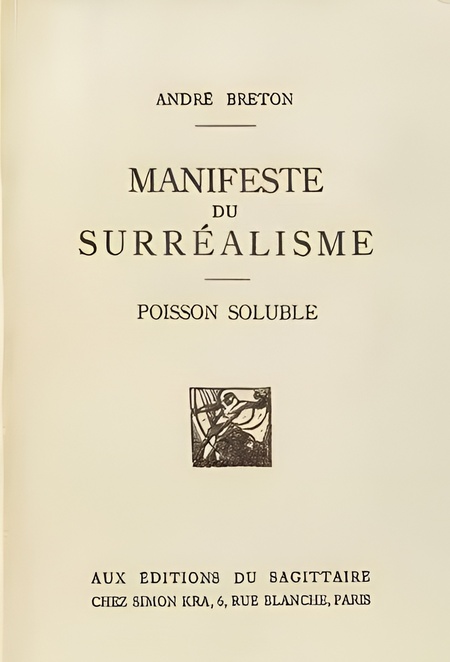
«Manifeste du surréalisme, Éditions du Sagittaire, Andre Breton October 15, 1924 » It was like a clear guidebook to the surrealism artists and those inspired by the movement. On October 15, 1924, Breton published the manifesto two weeks after Yvan Goll had published his on October 1, the same year.[.........]In his publication, Breton describes Surrealism as«Psychic automatism in its pure state, by which one proposes to express verbally by means of a written word or in any other manner, the actual functioning of thought. Dictated thought, in the absence of any control exercised by reason, is exempt from any aesthetic or moral concern.»[...........]The definition expresses a freedom of creation and expression, without restrictions or principles followed, but just following the idea and thought the way it is in its original or raw state.Paying attention to the way the surrealists create their artworks, there is a clear distinction between them not being chained to the principles of art but rather expressing their ideas in any way possible. Rational art, as opposed to surrealism, keeps artists within the boundaries of art principles with dos and don’ts, which influences the creation of highly summarized works of art, unlike surrealism, which neither follows moral concerns nor aesthetic values.In his Manifesto, Breton launches a direct attack on the concept of «Rational arts „[............] as demanded and highly supported by the institutions, besides leaving no moral concerns for the Bourgeois (nobles), [.........] by giving freedom to the surrealists to wage attacks on them and condemn anything that seemed unsatisfying in their move towards institutional criticism.
Therefore, the question of how surrealism exhibitions were used as direct tools for institutional criticism remains. This is the pivot of our study, in which we have gone back in the days of these exhibitions to investigate how they propagated institutional criticism within the spheres of creation of art, display, and innovations within a then new innovation of surrealism.
SHADES OF SURREALISM IN INSTITUTIONAL CRITICISM
Surrealism exercised several forms of institutional opposition and criticism by undermining the institutional norms of operation in the line of rational order, aesthetics, and politics. They exhibited a series of creations and exhibition arrangements that questioned the authority of bourgeois culture and rationalism. The artists in this avant-garde genre were fond of rethinking the curation of art exhibitions of this period by changing the display and actual arrangement and organization of their expositions. The surrealists went beyond paint on canvas to explore installations created by re-assembling the original objects, giving them an original look, for example, the installations at «The International surrealism exhibition in Paris in 1938 which featured artists like Andre Breton the organizer, Man ray, Marcel Duchamp and Salvador Dali. Installations and paintings exhibited at the show were critically a move that broke away from the chains of classical art and the rationalism that was embedded in the institutions by that time. Besides, the movement lacked any moral observations and a storyline in their work but just a work without leaning gainst the principles but just an imaginary composition with dreamlike illusions away from the agitated institutional expectations.
SURREALISTS' EXHIBITIONS AND THEIR LANGUAGE IN INSTITUTIONAL CRITICISM
A Case Study of «Exposition Internationale du Surréalisme» Paris 1938
Exposition Internationale du SurréalismeWas an exhibition by the surrealists in Paris from 17 January to 24 February 1938 at Galérie Beaux-Arts. The exhibition was organised by the founder of surrealism, writer and artist André Breton, and his partner Paul Éluard, a poet. The exhibition features strong minds in surrealism and innovation. Marcel Duchamp, Salvador Dali, Max Ernst, Man Ray, and Wolf Gang Paalen. This was the first surrealist exhibition in Paris, featuring a number of visual artists and performers from 14 countries, where over 60 artists showcased an array of over 229 works with great masterpieces from the main artists stated previously. All the artists blessed the exhibition with their great innovations, which gave the exhibition a vibrant atmosphere but with vivid knowledge of who meant what and what was meant by that.
Paris-surrealisterna Tristan Tzara, Paul Éluard, André Breton, Hans Arp, Salvador Dalí, Yves Tanguy, Max Ernst, René Crevel och Man Ray, Paris 1933. Photo: Anna Riwkin Source[messynessy.com]
A delegation of creative-minded, young, and ambitious artists, led by André Breton, was present. Salvador Dalí, Man Ray, and Marcel Duchamp were among the artists. These were the pioneers of the surrealist style, with André Breton as the inventor of the style. However, Duchamp maintained that he was not part of any group, as he claimed in many interviews that he did not like or join any groups. However, the exhibition was an unavoidable fact for him because of the similar styles of what he loved most. Thus, he and his «creative works» were present at the exhibition.
SCENOGRAPHY AND SET DESIGN OF THE EXHIBITION
The multi-sensory dreamscape
L’exposition Internationale du Surrealisme, Exhibition set up, Image by Man Ray source www.andrebreton.fr
As said by Max Ernst, that surrealism is meant to be a combination of elements that appear alien together, but if proximity is created, these can provoke the highest poetic lighting. Source: (messynessychic.com) The exhibition was clearly an antonym of the norm of rational thinking, taking away the viewer’s imagination from reality to re-imagine and live in a surreal world without any rules of creation but just expressing one’s mind unfiltered. Perhaps the study serves to describe the details and language of the exhibition towards institutional criticism.
The exhibition featured senior artists and organisers Marcel Duchamp as the curator. Man Ray was in charge of lighting and photography. Marcel Duchamp created a ceiling installation with sacks of coal. Salvador Dalí and Max Ernst were in full charge of technical work supervision, and Wolfgang Palen took on the task of the entrance. Re-defining the exposition styles and giving a different meaning to art, going against the white wall display techniques, the exhibitors placed works in innovative ways, and the stories told in all the artworks were completely abstract in nature, not direct, but still meanings could be read by those who paid attention. The lights were dimmed, the ceiling was embedded with 1,200 coal sacks by Marcel Duchamp, and the floor was left dirty, and installations of female mannequins all over the corridors were designed in different styles. In addition, the music was inspired by German military marching songs and roasted coffee smells all over the place! The entrance was like a portal to a new world of dreams and imagination, which gave the viewers a new experience, attracting 3000 people to the Les Beaux Arts Gallery on January 17, 1938, on the opening night! The exhibition was like an initiation ceremony from the rigid society of rationalism to complete freedom of expression.
Ceiling imagined by Duchamp for the international Exhibition of surrealism at the galerie des Beaux-Arts in 1938. source: [www.andrebreton.fr] On the (Left) a random rational gallery setting.
Images of the floor by Wolfgang Paalen for the international Exhibition of surrealism at the galerie des Beaux-Arts in 1938. source: [www.andrebreton.fr] Left random Gallery Images.
The 1938 International Surrealist Exhibition shifted a lot of norms from the usual rational and formal display of works and the entire exhibition layout. In the image, we visually see a formal exhibition space and on the right, a layout of the ceiling by Marcel Duchamp, which completely ran away from what is considered normal, and criticism is definitely traced at work. The Surrealists made the exhibition ground not just a store for works but an artwork in itself, creating harmony between the works and the exhibition rooms. Using the walls, ceiling, and floors as actual canvases.
Re-installed room from Internation exhibition of surrealism, Initially designed by Wolfgang Paalen and Marcel Duchamp 1938, on display at Andrey Breton gallery. Source [www.adreybreton.fr]
This exhibition was a historical move and a landmark in the development of irrational art and the art of installations.The exhibit consisted of three arenas, each designed with a different style, such as a portal of dreams, which gave an intriguing experience to the viewers to search even deeper.The first was outside the gallery in the courtyard, where Salvador Dali had installed «Rainy taxi. A black taxi embedded with a water system and in its interior two models were placed: a driver and a passenger presented in surreal details! As described in the Chapter 7 “ Mannequins»The second arena was the a pitch-dark array of mannequins «The most beautiful streets of Paris» as it was named by the curatorial team of the exhibition! In this arena, a depiction of a street with 16 mannequins dressed in unique costumes and other objects designed by the surrealists like Yves Tanguy, Salvador Dali, Man Ray, and Andrey Masson; however, Sonia Mosse was the only female representative who designed a mannequin.The third arena was a grotto with four large beds by Wolfgang Paleen, where the performance by Helene Vanel took place. In the same room, Marcel Duchamp hung coal sucks on the ceiling, in addition to other artworks on the wall and ceiling.
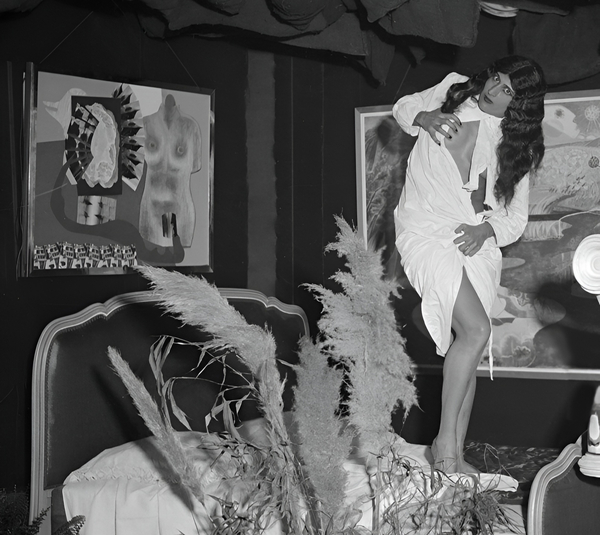
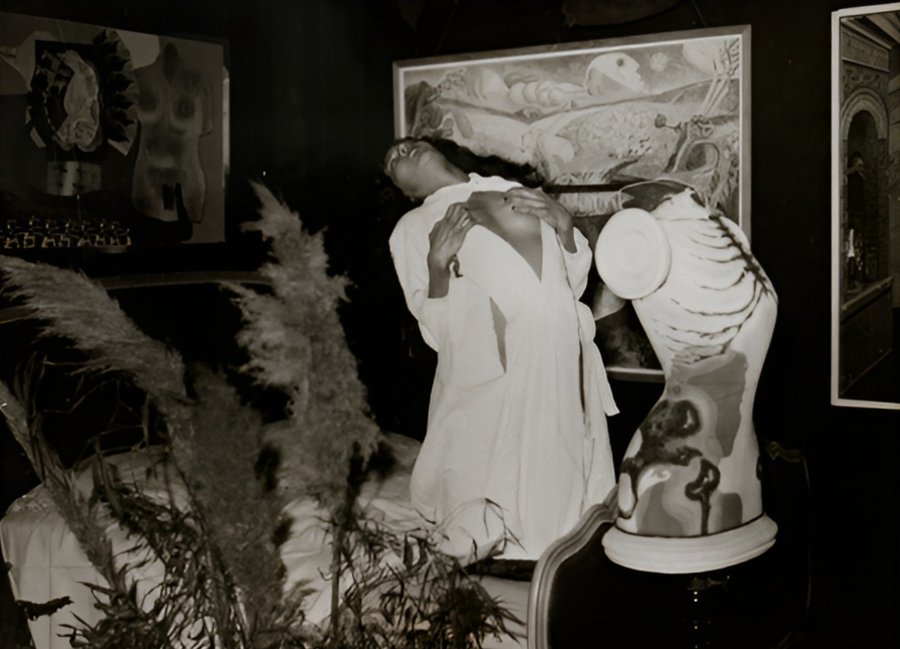
: Title L’Acte Manqué (The Acted Miss/Failed Act) images by Man Ray 1938, source: Image1 .messynessychic.com, Image2 moma
The performance «L’Acte manqué» (The Unconsummated Act) by Wolfgang Paalen, at the grand opening of the exhibition by performer Hélène Vanel, who was seen jumping from under one of the four beds set in the main exhibition hall of the Galerie Beaux-Arts Gallery, performing as if she was under a severe hysterical attack. Vanel was also seen in a scuffle with a young rooster spreading its feathers all over the bed. The performance was one of the innovations introduced by the surrealists, which was a grand opening scene, besides being a move against the calm and honourable opening of the rational exhibitions. Exhibition preambles in institutions were more formal, introducing honourable people to speak and artists giving their views but looking at this unusual exhibition was enough to notify the criticism since shock started from the opening to the closure of the exhibition. The critiques describe Vanel the performer as being nude but this as well was a new statement of freedom which was enjoyed by the new Avant-gard movement, not at all bonding with moral observations.This performance by Vanel was the first example of surrealist dance and was branded a success.
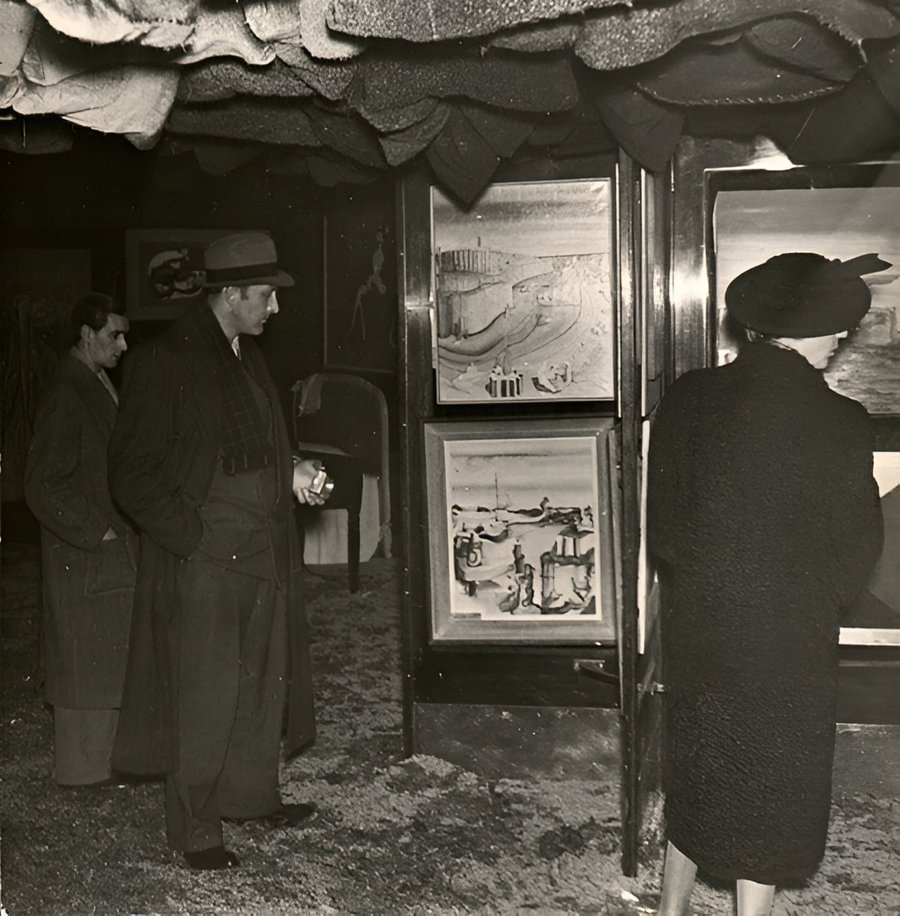
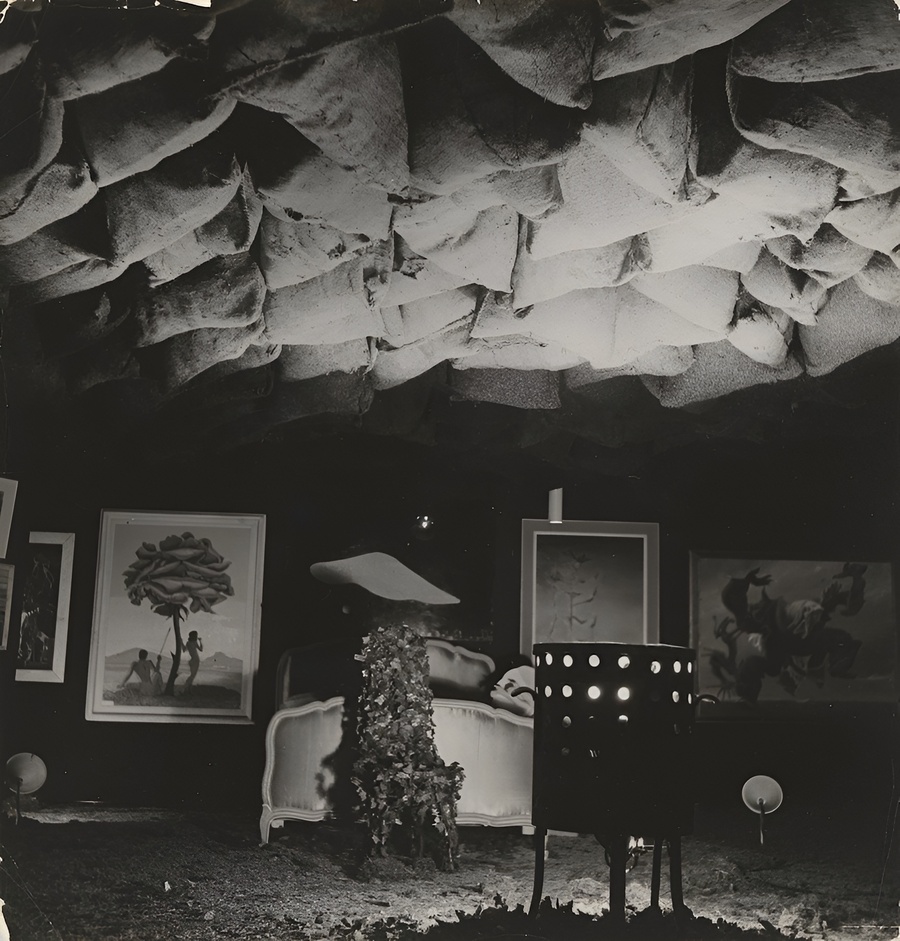
Viewers using flashlights to view the artworks Images by Man Ray
Although there still stands a battle of semantics, it was an opening night light supply failure, and others claim that it was done deliberately by Man Ray, who was in charge of lighting. However, intentional or not, the dimmed lighting gave the exhibition another innovative display. The organisers gave lighters to the guests, who had to search through dark spaces to reveal the artworks. The experience gave the guests a new taste of actively engaging in the exhibition and attaining a unique opportunity to create beams of light across each other in search of artworks. This was rather another innovation against the normal bright light halls where the participants just moved across the exhibition halls to the end, and that would be all with the exhibition.
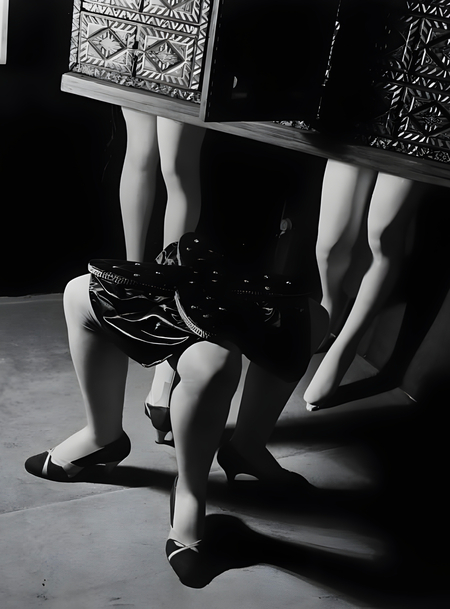
MANNEQUINS (Le Mannequin des surréalistes)
The surrealist description of a woman with a human replica.
The Most Beautiful Streets of Paris Hall, mannequins, source;[messynessy.com]