
Concept
A Telegram media channel exploring how game mechanics create doubt, tension, and a sense of control. We publish breakdowns, development notes, and mechanic comparisons. Readers discuss solutions and can participate in testing.
Editorial Cycle
One Topic—Two Weeks
We start with a clear, engaging scenario. We explain the rule, present two options, and invite readers to offer their input. If a prototype is ready, we conduct a test and publish the results.
Month 1. Introduction
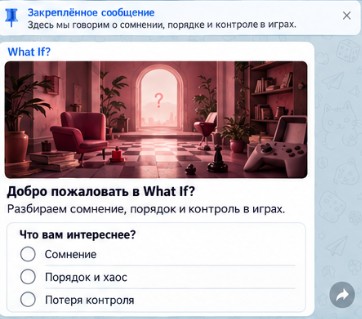
Introducing the channel and three core themes: doubt, order, and control. Through initial polls, we are learning what interests our readers.
Month 2. Doubt
We are publishing materials regarding incomplete information and re-checks. We are launching a regular comparison of two versions of the same situation.
Month 3. Order and Chaos
We are analyzing overloading, sorting, and competing tasks. We are organizing the posts into a thematic collection with navigation.
Month 4. Loss of Control
Discussing unreliable UI and the boundary between tension and irritation. When the prototype is ready, we invite readers to test it.
Month 5. Dialogue
We answer subscribers' questions and analyze their arguments. We are preparing joint content with a game author and a publication to attract readers from DTF.
Month 6. Continuation
We compile the best case studies and accessible test results. Based on audience feedback, we choose the themes and categories for the next six months.
Scenario model: 100 new visitors per month, 20% subscription conversion, zero churn. Assuming these conditions are met, the probability of reaching 100 subscribers within six months is approximately 98%. After the first month, the assumptions are replaced with actual performance metrics.
Topics
1. Why does it feel this way? A brief explanation of the experience through a game rule.
2. Two Versions A visual comparison of one situation with different conditions.
3. Your Decision A poll or a task for discussing arguments.
4. After the Test Observations and changes following a real-world test.
Ten content samples
Post + Two Door Frames: With and Without Confirmation
Why do we check again? «The door is closed, but there’s no confirmation. Would you check it one more time? What if a 'Verified' tag appears? Let’s discuss what kind of feedback helps you consider an action complete.»
Survey + Two Route Cards
What information are you missing? «Two paths are before you. You know where the first one leads, but its cost is unknown. The second one has a known cost, but its destination is hidden. What would you want to know before choosing?»
Post-Task + Set of Notes
Does order help or distract? «The notes can be sorted by color, time, or source. What organization helps you find a contradiction? Suggest your method and explain your choice.»
Survey + Task List Screen
When there are too many tasks «Five assignments appear simultaneously on the screen. What would help you start: highlighting a main task, the ability to hide the others, or free choice? Vote and tell us why.»
Post + Contradiction Image
Do you trust the counter? «Two tasks remain on the screen. In the room, you see three incomplete actions. What will you believe first: the interface or your own observation?»
Two-Option Carousel and Question
Tension or irritation? «Sometimes the tool makes a mistake. In one version, a signal warns about it; in the other, there is no warning. Does this change your perception of the error?»
Three-Option Poll
What makes a mistake acceptable? «You made the wrong decision. What is more important: the ability to detect the risk beforehand, correct the consequences, or understand the cause after the error? Choose the main point.»
Editor’s Poll + Three Covers
Which breakdown should we do next? «What interests you more: why the urge to double-check, how mess affects decision-making, or when you stop trusting an interface? We will analyze the chosen topic in the next cycle.»
Post 10: What We Heard in the Discussion
Follow-up: A reader’s question, their argument, and the author’s comment. «If an interface can make mistakes, why use it?»
Answer: «The method for detecting the error is important. We suggest comparing the tool against a verifiable constraint and the tool against random readings.»
What to continue?
We compare views and shares, participation in discussions, clicks, and test sign-ups. The first month establishes baseline metrics. We then adjust topics, frequency, and audience engagement strategies.