Navigation
- Concept
- On the Edge of the Map
- Nils Kruse
- Turning Point
- Bird
- Angel
- Key
- Lily
- Conclusion
Concept
When Sigrún Gunnarsdóttir’s brother’s wife passed away in 1995, the artist made a decision that changed her entire body of work. She stopped painting landscapes and began painting with symbols. The bird, the angel, the key, the lily, the hand in prayer—these emerged as images, as a unique language, the only way she could communicate.
This study asks: why these particular symbols? Why do they persistently drift from one canvas to the next? Why is the bird present even when it is not visible? Why does the key recur so frequently in the works of an artist living on islands in the middle of the Atlantic?
The symbolic language spoken by Sigrún Gunnarsdottir is not merely an artistic technique. It reflects a real, historically established cultural structure—one so small it is almost unheard. The Faroe Islands consist of 18 islands and house around 50,000 people. A language squeezed by Danish for centuries, an economy that collapsed in the early 90s, a tradition that existed orally for ages due to a near-total absence of written sources. In such circumstances, the symbol becomes a tool for preservation rather than mere ornamentation.
A bird that exists even when unseen—a people who exist even when unnoticed. The key is the image of accessing an identity that is easily lost. An angel is a protector for those without another defense. A lily is fragile, grows on rocks, and always remains there.
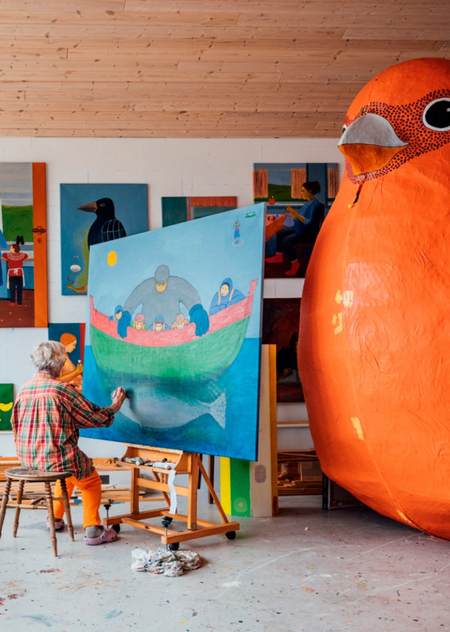
Sigrun’s creativity draws from several sources. Family—both living and deceased—is present in every work: the images of her mother, grandmother, and a grandfather artist she never met, whose paintings shaped her first understanding of painting. The place where she was born and still lives dictates not only the subject matter but also the light, air, and the inner landscape of the canvases, where the islands are depicted as ordinary, without idealization. The way prayer and the Bible live on the kitchen table brings the religious image back to where it was long forcefully removed from. Her academic education provides a foundation from which she consciously moves toward naïveté and symbolism. Inspiration arrives in various ways: sometimes it is a childhood memory, sometimes it is a moment in the kitchen when she urgently needs to jot down an idea on an envelope or a scrap of paper. Sigrun has traveled extensively with exhibitions—Tokyo, New York, Greenland—and each time she has returned with a new charge. Yet, she always works at home, on the Faroe Islands, in the natural diffused light that she considers ideal for painting.
In June 2024, King Frederik X and Queen Mary of Denmark visited the Faroe Islands during their first official foreign tour, awarding Sigrun the Knight’s Cross of the Order of Dannebrog, and visited her studio in Eide. In 2025, she was also honored with this order. Additionally, «Heartist» (the artist’s autobiographical film) received the Best International Documentary award at the DOC LA festival in Los Angeles; it was shown in New York in 2024 at Scandinavia House, and in 2025 at FARO-EXPO in Osaka. I learned about her through this film, and much of the information in this study was drawn from it.
To construct this research, I used the artist’s monologues, art criticism texts about her work, historical sources about the culture of the Faroe Islands, as well as visual analysis of specific pieces.
I structure this study as a movement from context to detail—from the history of the islands to the artist’s biography, from the creative turning point to the analysis of each symbol, from the general to the particular.
Islands on the edge of the map
Elduvík Village, Faroe Islands, June 2023
The Faroe Islands are located where the Atlantic becomes truly unforgiving—between Norway, Iceland, and northern Scotland, in a place one doesn’t reach without purpose. Eighteen islands, steep basalt cliffs, constant wind, and a sea that gives and takes away simultaneously. The population is about 50,000 people, roughly the same number living in an average Russian district center.
This geography determined everything. Isolation meant that culture developed at its own slow pace. The oldest documented examples of Faroese visual art date only to the late 19th century: ornithological illustrations of birds executed in a naturalistic style, more akin to documentation [2]. There were no artistic materials, no schools, no market, no community. Before Faroese art could emerge, the very possibility of engaging in it had to first arise.
Lunar Pigeons, Diedrich Rücker a Scarvanesi, 1840
The village of Eydi, where Sigrún Gunnarsdóttir was born in 1950, is home to about 700 residents. It is located on the northwestern tip of the island of Esturoy, the second-largest island in the archipelago. The artist has lived and worked here her entire life—she goes out to the cliffs with her dogs in the morning, returns to her studio, and paints. This is not deliberate seclusion; she simply never left this place, and it became the central subject of her paintings—not as a landscape, but as an inner landscape.
Eide Village, Faroe Islands
Nils Kruse
Ded Sigrun, Niels Kruse (1871–1953), was the first Faroese naturalist painter and one of the first Faroese painters to exhibit abroad—at the Kunsthalle Charlottenburg in Berlin [4]. The artist herself never saw him; he died tragically when she was very young. But his paintings hung on the walls of her family home and her grandmother’s—Sigrun grew up surrounded by his work.
Nils Kruse, Faroese landscape with a village, 1910s–1920s.
Nils Kruse, Faroese Coastal Landscape, 1900s–1910s.
Niels Kruse, Faroese landscape with a fjord, 1900s–1910s.
This presence of absence is one of the keys to all of Sigrun’s creativity. Her grandfather existed for her through paintings. Therefore, the idea that painting is a way to remain connected even after death frequently appears in her own work. It is no accident that Sigrun’s husband once told her, «People will remember you through your work—they will live forever.»
Sigrun’s early works similarly depicted the naturalistic scenes of the Faroe Islands landscape, fishing industry, and domestic life—a direct continuation of her grandfather’s work. Sigrun received academic training in Copenhagen at the Drawing School of the Glyptotek, and later at the Royal Danish Academy of Fine Arts, where she studied from 1973 to 1980. She still had more than ten years left before the stroke.
Breakpoint
In the early 1990s, the Faroe Islands experienced an economic collapse. The fishing industry, the backbone of the local economy, crumbled. Unemployment rose to 20%, and a third of the population emigrated. The government, which had only gained autonomy from Denmark in 1948, once again felt vulnerable and dependent. This crisis was less an economic event and more an identity crisis.
Sigrún Gunnarsdottir, «Cain,» 1990–1999
In 1995, Sigrun’s brother’s wife passed away. This death shocked the entire family. The artist recalls: the daughter-in-law was devout, praying for a recovery, and Sigrun saw herself in her. «Life is very short, and everything turned upside down, ” she describes what happened to her afterward. Following this event, the artist made two decisions—nobody could stop her; she would begin working with symbols.
When the familiar foundation crumbles, a different language is required. Naturalism describes what exists. Symbolism points to what lies beyond the visible.
Sigrún Gunnarsdóttir, «Freedom,» 1990–1999
Where there was once a precise rendition of the texture of stone and water, there are now simplified contours, large fields of color, and figures bordering on naïvism and surrealism.
Bird
Sigrún Gunnarsdóttir, «Wingspan of Grandma and Grandpa, ” 2024.
The biblical verse referenced by the birds in Sigrún Gunnarsdóttir is from Matthew:
«Are not two small birds worth a farthing? And not one of them will fall to the ground without your Father’s will.»