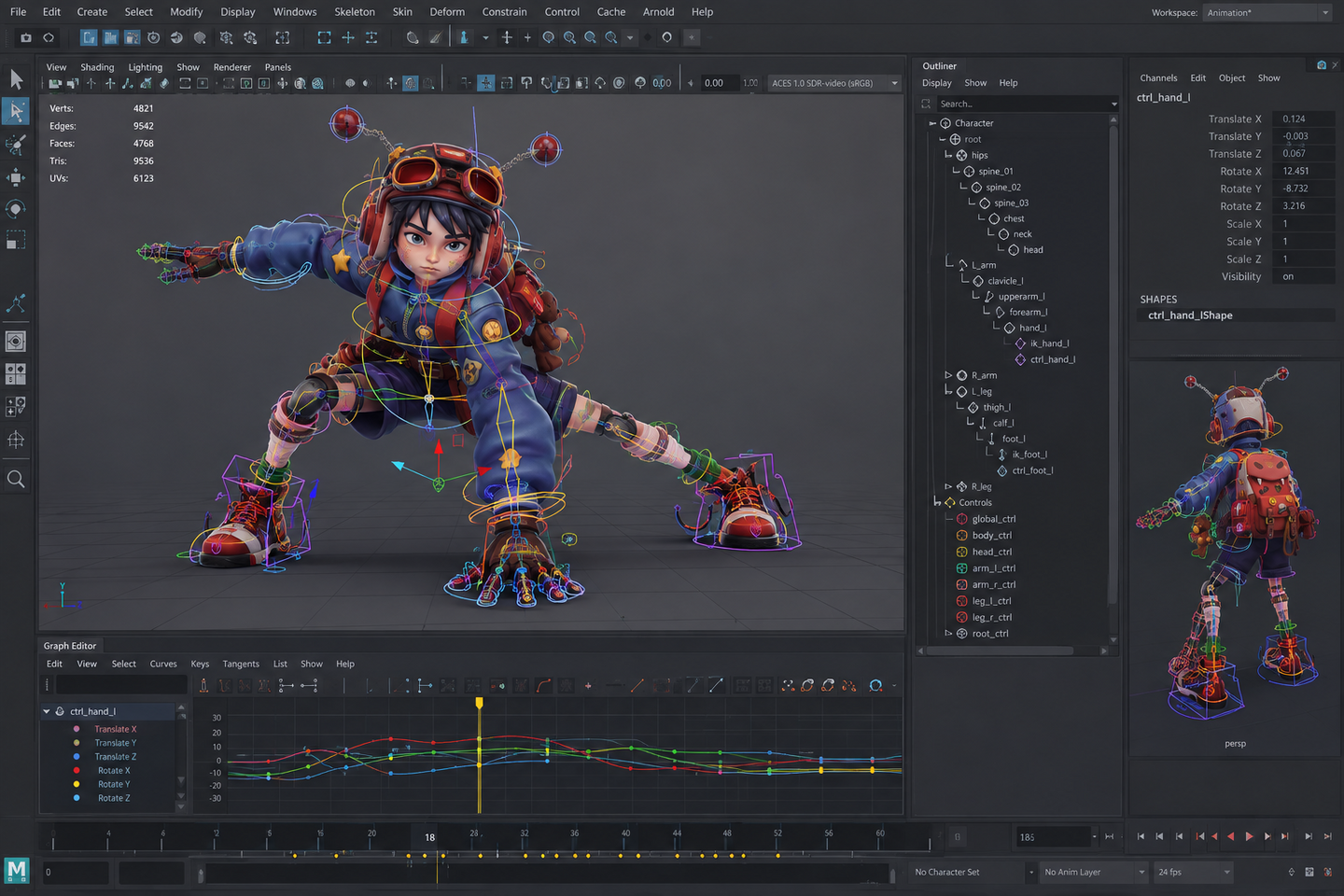
Media Goal
There is a lot of scattered information about Maya on the market, but almost no structured Russian-language resource that guides users from zero to a level sufficient for employment. Beginners spend months searching for current tutorials, encounter outdated software versions, and don’t know which skills studios actually require.
Project Goal: To create media that:
Provides a step-by-step curriculum for rigging and animation in Maya (from interface basics to portfolio readiness).
Showcases real-world studio pipelines, moving beyond abstract theory.
Fosters a community of Russian-speaking Maya artists where feedback and support can be obtained.
Aids in securing employment or initial freelance commissions.
Competitors and their analysis
I used the following services and methods:
Yandex Wordstat — for gathering high-frequency search queries: «Maya rigging, ” „Maya character animation, ” „Maya rigging courses.“
LiveDune — for analyzing competitor accounts on Instagram and VK: post frequency, engagement, hashtags, content types.
TargetHunter — for locating VK communities where the target audience congregates.
Manual searches on YouTube, Telegram, and VK using key search terms.
Competition Criteria:
Content Depth — from basic tutorials to advanced techniques.Format — video, text guides, and interactive breakdowns.Language — Russian or English.Relevance — alignment with current versions of Maya (2024–2026).Community — chat access, feedback opportunities, and work reviews.Pricing — free content, subscription, and one-time courses.
Direct Competitors









Thematic Focus of Future Media
Segment: 3D graphics, CG industry, film, VFX, AAA game development.
Niche Topic: Professional character rigging and animation in Autodesk Maya. Skeleton breakdown, IK/FK, skinning, facial rigs, 12 principles of animation, optimization for game engines.
Why this topic:
Maya is the industry standard in film and AAA games.
There is a lack of structured rigging content in Russian.
The audience is motivated and willing to pay for training and subscriptions.
The topic is highly visual and is perfect for short videos and tutorials.
Step 3. Solution
Представьте подход, метод или продукт
Formulate a solution that is simple and to the point: exactly what you are proposing and what problem it solves.
First, present the overarching idea, and then, if necessary, elaborate on the structure and operating logic.
Keep the focus on the essence—details can be reserved for supplementary slides.








Step 4. Defense
Подтвердите состоятельность решения
Support your key assertions with facts, examples, and measurable results.
Use case studies, data, demonstrations, and practical analyses—they reduce skepticism and make your solution verifiable.
If your audience might have doubts—it is better to address them here in advance.








Step 5. Action
Переведите понимание в решение
Formulate a clear next step for the audience: what exactly are they being asked to do after the presentation.
Indicate the format, stages, or conditions if they influence the decision.
A strong call-to-action slide eliminates ambiguity and channels interest into choice.








Step 6. Finale
Зафиксируйте главный смысл и оставить сильное послевкусие
Distill the central thesis of the entire presentation into a concise and memorable statement.
You can revisit the initial problem and demonstrate the new state achieved after implementing the solution.
The final screen must retain the core message and direction—even if the audience remembers nothing else.