[PROJECT CONCEPT]
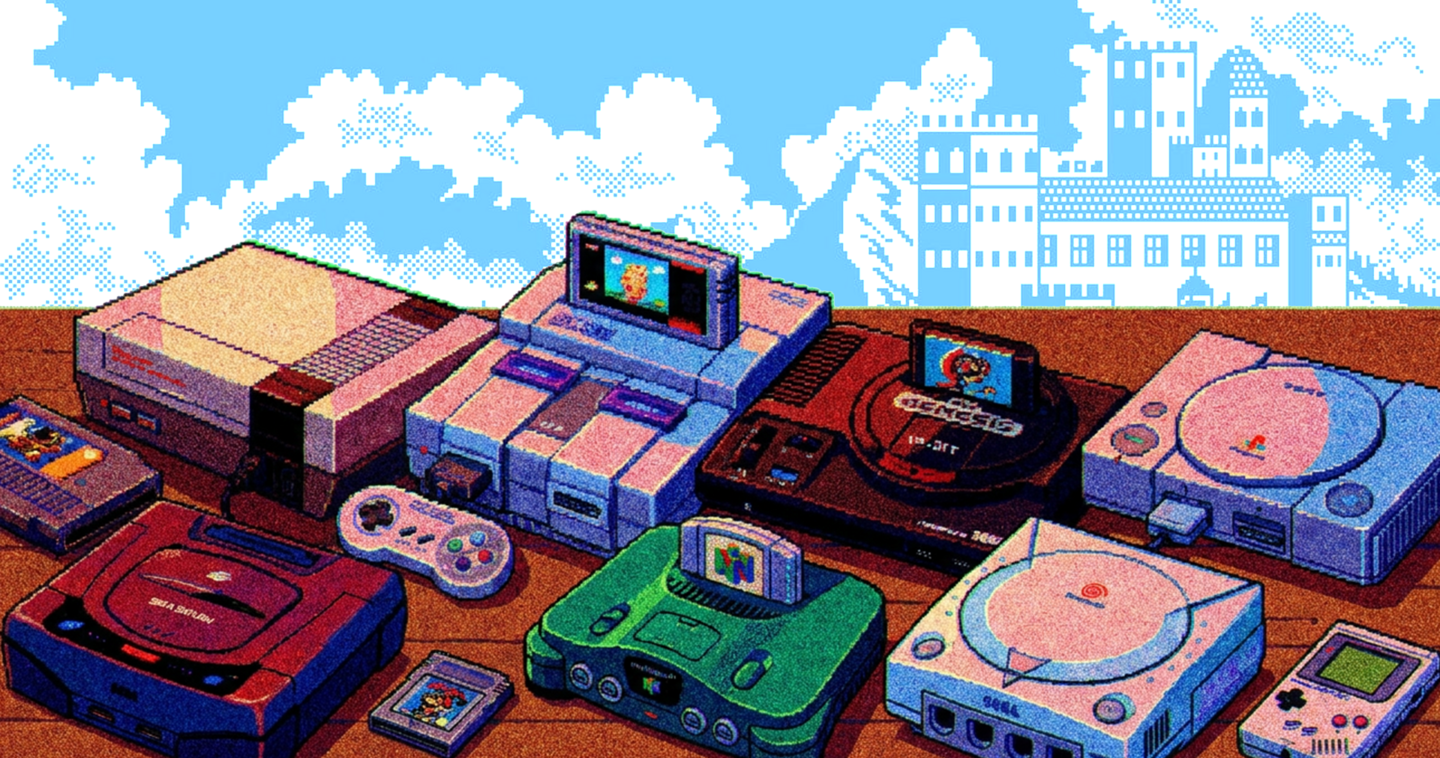
Pixel Archive is a documentary media project dedicated to the history of console retro gaming and iconic video games that shaped the industry.
Lately, many gamers have been increasingly returning to retro games, reminiscing about their childhoods and the first experiences interacting with consoles connected to old, bulky televisions.
But why is this happening? Why, in a modern world with its graphical capabilities, do people choose eight-bit pixel worlds, collect old hardware, attend themed clubs, and buy outdated cartridges?Media Pixel Archive explores this phenomenon, revealing what lies behind the feeling of nostalgia, and helping you learn more about the history of consoles and the gaming industry.
[SEMESTER THEMATIC PLAN]
Six months are divided into six mini-cycles, each dedicated to a unique theme, ensuring a smooth and maximally engaging introduction to the subject.
Month 1. Entry Point: What is retro-gaming and why have we returned to it?
Introducing the audience to the project, actively promoting the unique value proposition, and forming the initial core readership through the aesthetic of retro nostalgia.Month 2. Legendary Consoles: From Atari to PlayStation
An informative and digestible overview of console history, establishing foundational knowledge about market representatives and platforms, and launching the first themed column.Month 3. Games That Shaped the Industry
Shifting focus from hardware to software, immersing the reader in the gaming world, and introducing classic industry artifacts.Month 4. The Unique Russian Code: Dendy, Arcades, and the Grey Market
Unveiling the unique value proposition—with an emphasis on the Russian-speaking segment and the distinct gaming experience of the 90s and 00s. The most «emotional» month.Month 5. From Nostalgia to Practice
A guide to running retro consoles in modern times: practical materials, guides, addressing audience barriers, benefits, drawbacks, and pitfalls.Month 6. Community, Legacy, and Influence on Modern Culture
Building a media community, analyzing how the retro aesthetics of consoles and games are alive and represented today in music, design, and film.
Overall Strategy:
2–3 thematic posts per week on Telegram + 1–2 major long-form articles per month on DTF
[CONTENT EXAMPLES]
No. 1 Post-ManifestoPixel Archive. Why are we doing this?You too must have had that bulky TV, right? The one that hooked up to a gray plastic box with two joystick antennae. And the cartridges that you had to insert at a specific angle, blow on the contacts, and gently shake the console just to get the game to «start.»That is what we are going to talk about.Pixel Archive is a media project about the history of console retro-gaming. From 1972, when the world first saw the Magnavox Odyssey, up until the early 2000s. About Atari and Nintendo, about Dendy and the underground Sega clubs, about grey-market cartridges, and stores like «Alkor,» which felt like visiting a museum.We aren’t going to pretend this is «just old hardware.» Because it isn’t. Millions of people still return to 8-bit worlds—and believe us, they have good reasons for it.Here, we don’t just reminisce. We explain. How to connect a Famicom to a modern television? How to tell an original cartridge from a counterfeit? Where can you score rare items if you aren’t ready to splurge on them like a wing from a Boeing?Nostalgia is just the beginning. What comes next is more interesting.Subscribe if there’s something you want to remember.
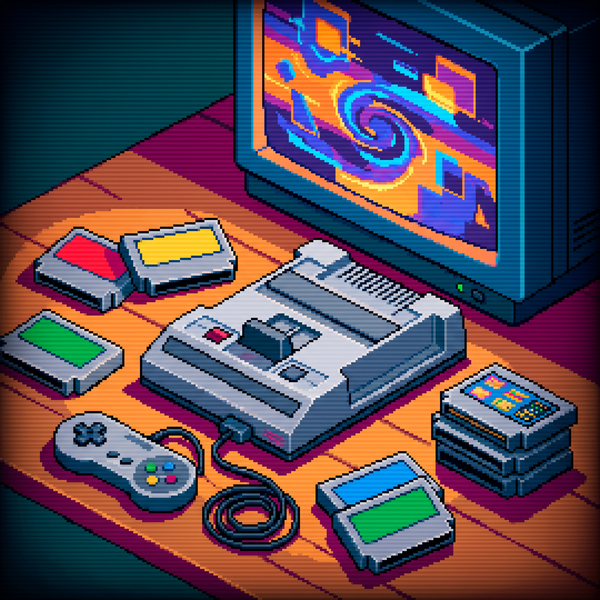
Post-Story #2Dendy is not Nintendo. And this is important to understand.If you grew up in the nineties, your first console was probably not the NES or the Famicom. It was almost certainly Dendy—a gray box with a cheerful elephant logo on the packaging. That’s the one sold in markets, with game cartridges bought from basement shops, quietly hoping that at least this time the games listed on the packaging would actually work.So, why was Dendy unrelated to Nintendo?Dendy was a Taiwanese Famicom clone that flooded the Russian market in the early nineties. The original consoles cost a fortune here and were barely officially sold, whereas the clones were very accessible to the average consumer. In essence, this is how Dendy became a cultural phenomenon: everyone knew it, from schoolchildren to grandparents who bought cartridges as holiday gifts for their grandchildren.But the most interesting thing about Dendy isn’t the hardware. The key element is the culture built around this console. The gray market for cartridges, where one game cost as much as a school lunch. Cartridges with a dozen games on a single chip—"reflashed,» as they called it then. Clubs where an hour of gameplay cost as much as a movie ticket, and the line for «Sega» started at lunchtime just to fit in a session before evening.For a Western gamer, retro is a story about Atari and Nintendo. For us, it’s about Dendy, «Sega,» basement fakes, broken cartridges, and modded hardware. It’s also part of global industry history—just ours, local, and therefore so relatable and compelling.In Pixel Archive, we won’t just discuss the global industry. We will also share our own experience. Because this is perhaps the most vibrant part of the entire story.
№ 3 Chronology
No. 3 Timeline
«Chronology of the Era: 1972–2000»
1972 — The Magnavox Odyssey is released, the first home console. They started, as they say, small.
1977 — Atari 2600. This is when consoles became mass-market, and games became home entertainment.
1983 — The video game crisis in the U.S. The industry was in its death throes: the market was oversaturated, and games were «junk.»
1985 — The NES saves the market and sets standards for the next decade.
1989 — Sega Mega Drive and the start of the «console wars.» It only got more exciting from here.
1990 — Super Mario World: platformers reach a whole new level, quite literally.
1991 — Sonic the Hedgehog. Sega responds to Nintendo—and they respond loudly. The beginning of an era of fierce rivalry.
1994 — PlayStation. Sony enters the industry and sets new standards.
1996 — Nintendo 64: the advent of 3D worlds and 3D graphics.
2000 — PlayStation 2. DVDs, the disc boom, mass gaming, and the start of a new era.
Keep this—it will be useful when you explain to friends what «retro» is and what history stands behind «just old games.»
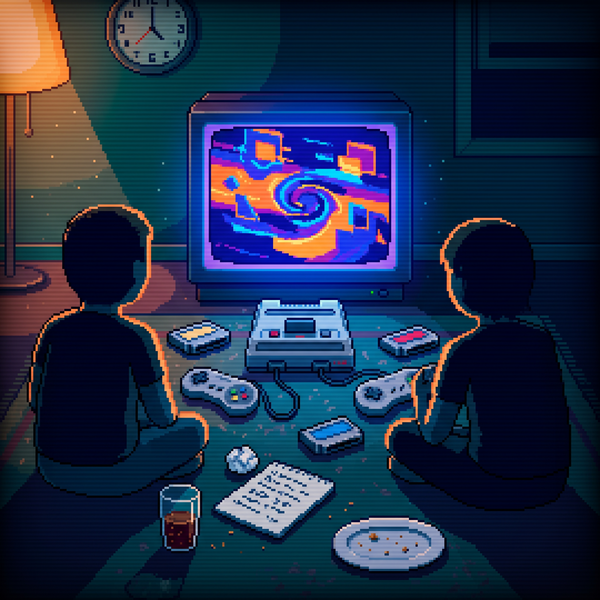
Post-Work No. 4: NostalgiaWas it better before? (Spoiler: it wasn’t always)Let’s be honest. Old-school, true, 8-bit games didn’t have saves. There was a twenty-character «password» scribbled on a piece of notebook paper—that was your «cloud save.» One mistake—and you were wrong, so you started all over. Consequently, a half-hour game could turn into an eight-hour session because some arbitrary third level simply couldn’t be beaten.And despite that, we still say, «It was better before.» Why?Psychologists call this nostalgic distortion: our complex human brain stores emotions, not details. We remember not the disappointment of losing, but the evening spent with a friend in front of the TV, trying to beat the boss before the bedtime. We remember not the poor game design, but the sweet feeling of victory when it finally happened and the set of pixels scattered across the screen.But there are also slightly more objective reasons. Old games had one simple advantage: they were shorter and more honest—pay once and get a whole game. No DLC, no microtransactions, no «buy a skin,» «buy a battle pass,» or «drop donations to pull a cat-woman and a bowl of rice.» The rules were clear from the first second: grab the joystick—and go.Plus, it was our first experience. The first joystick, the first cartridge, the first game, and the first victory.So, nostalgia isn’t about «it was better before.» It’s about how we were different then. And that’s okay.What is truly better, though, is that now we can return to those games consciously. With money, time, and an understanding of what we are doing.
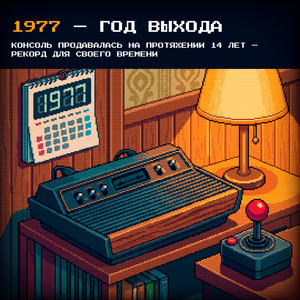
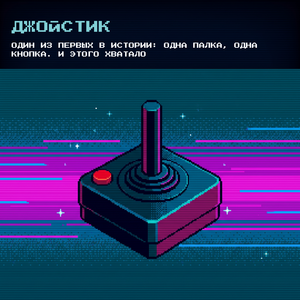
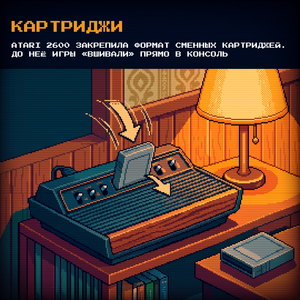
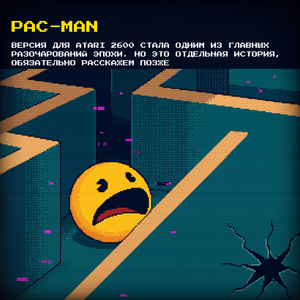
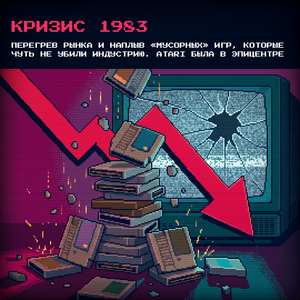
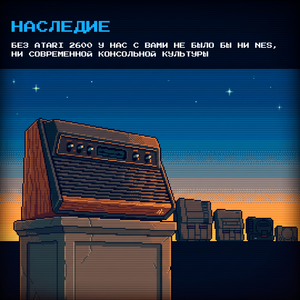
No. 5 Text + CardsAtari 2600 in 6 Facts:The Atari 2600 was the console that kicked off home gaming. Not the very first, but certainly one of the most important—it’s what allowed video games to become mainstream. We’ve compiled six facts you should know, even if you’ve never held one.
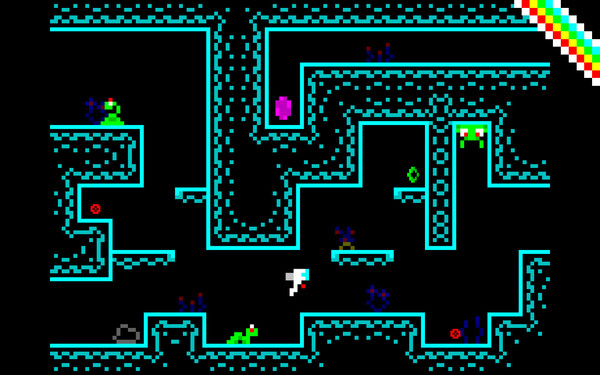
Quiz #6 InteractiveGuess the game from the screenshot #1Today it’s 8-bit, but not the most obvious one. Hint: it’s a platformer that many people couldn’t clear on the first try. And even on the third, to be completely honest.Write your answers in the comments—but no Google! The solution will be waiting for you tomorrow in the same spot.
Guide #7How to Connect a Dendy/Famicom to a Modern TV: A Step-by-Step GuideYou bought a childhood console and don’t know how to connect it to your new TV? Sounds familiar—don’t panic, it’s solvable. Here are three working methods—from simplest to most advanced.Method 1. RCA to HDMI Adapter.
This is the easiest route. The console outputs «tulips» (yellow and white), while the modern TV expects HDMI. You buy an inexpensive converter, plug it in, switch the TV to the correct input—and it works. The picture might look «blurry"—this is normal for an analog signal, so don’t worry.Method 2. Old CRT TV.
If you have the space and desire, look for a working cathode ray tube TV at a flea market. This will give you that specific look: with soft pixels and a slight glow. The downside is space and weight. A CRT is not something you can easily place on a shelf.Method 3. Upscaler.
For those who want to do everything «technically correctly.» Upscalers are specialized devices that digitize the signal with minimal latency and without any blurring. They are more expensive, but if you plan to play seriously—it’s the best option.Checklist. What to check before buying a retro console?
— Power supply (original or compatible);
— Cable (it is often not included);
— Cartridge slot functionality.Save this guide. And let us know in the comments if you need an analysis of a specific model—we’ll make a separate post.
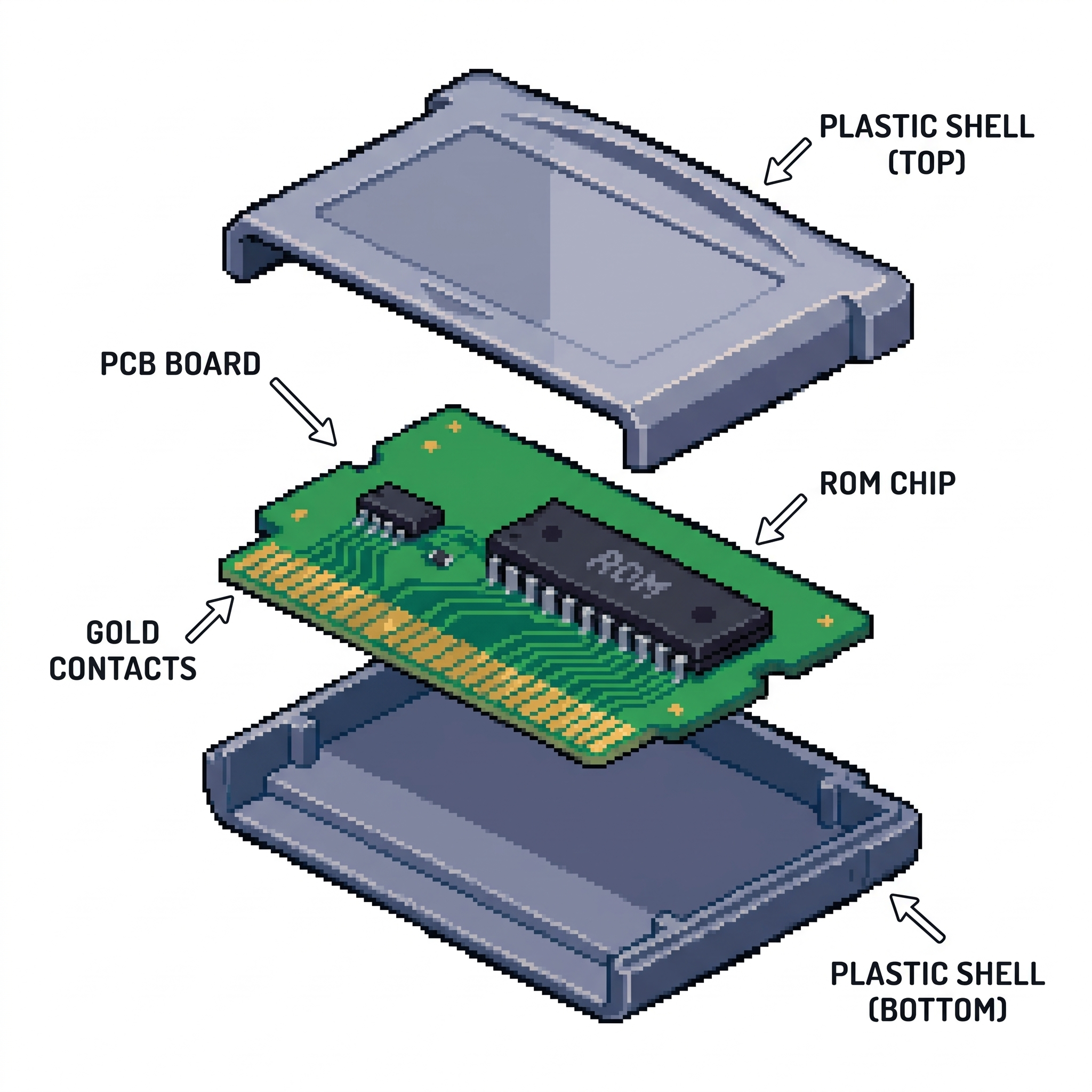
Issue #8. The Cartridge Cross-Section«The Cartridge Cross-Section» is our new feature, where we break down the hardware of retro consoles in plain English. Today, we’re dissecting the cartridge. What is inside this plastic box that opens up a new pixel world?Housing. The plastic that protects the circuit board. Different regions or manufacturers have different shapes so the cartridge won’t fit into a «foreign» console. Yes, such protection existed.Circuit Board. The core: traces, chips, and contacts. This is what connects the game to the console. Without it, the cartridge is just a plastic block.Memory Chip (ROM). This is where the game itself is stored. Essentially, it’s a super-small hard drive.Contacts. Those very «teeth» we wiped with alcohol, hoping to bring it back to life. Whether the console «sees» the game depends on them.Battery (not always). Some cartridges include one for saving progress. When it dies, the saves are lost. Such is fragile memory.
No. 9 Game Selection5 games to start exploring the retro sceneSuper Mario Bros. 3 (NES, 1988)
The quintessential platformer, still considered a gold standard for the genre. Nintendo squeezed every ounce out of the NES: it introduced a world map with branches and secret paths, and the costumes (raccoon, frog, hammer) changed not just your appearance but how you navigated the level. The difficulty ramps up gradually—the early worlds forgive mistakes—so a beginner learns without even realizing it. If you only pick one game to understand what makes an 8-bit platformer great, this is it.Sonic the Hedgehog 2 (Sega Mega Drive/Genesis, 1992)
It retains the speed of the first installment but with more respect for the player: fewer unfair pitfalls, and more moments where you genuinely feel in the zone. This is where the spin dash was introduced—a stationary burst that transformed movement from «running» into a «guided projectile.» Plus, Tails: he can be a nuisance in single-player, but the two-player cooperative experience is a completely different story. Important: get the Mega Drive version, not the 8-bit Master System one—they are different games.Tetris (Game Boy, 1989)
The most honest game on the list: no plot, no characters, just falling blocks and your brain. The rules are grasped in three seconds, but mastery takes years. The Game Boy version, with its green screen and chiptune music, is what made Tetris mainstream. Play for 10–15 minutes—it’s not a marathon; it’s a ritual. Tetris shines brightest in short sessions.Chrono Trigger (SNES, 1995)
The JRPG for those who are wary of JRPGs. The genre’s biggest flaw—grinding—is almost eradicated in Chrono Trigger: the game can be completed without mandatory farming, the pacing never lags, and random battles are removed—enemies are visible on the map and can be bypassed. Time travel genuinely impacts the narrative, and the combat system allows you to blend techniques from two or three characters. If it doesn’t hook you after two hours, the genre simply isn’t for you, and that’s perfectly fine.
Castlevania: Symphony of the Night (PlayStation, 1997)
The definitive crossover between retro and modern gaming. SotN took the formula of classic Castlevania and added extensive castle exploration, RPG elements, and abilities that unlock new paths—this is where the term «Metroidvania» originated. The castle is vast, and half the game is hidden: after the first «ending, ” you realize you have only experienced a portion of it. Do not look up the map—the first playthrough is about exploration, and it is easy to ruin.Tip: start with the one that interests you the most—and give it at least one evening to let its charm conquer you.

No. 10 Mini-Podcast ScenarioTopic: «Retro as the Aesthetics of the Future and Modernity.»
Format: 20–25 minutes, monologue + mini-interview with a guest. Goal: to conclude this month’s theme and demonstrate how retro thrives today.00:00–02:00 — Introduction.
«Hey, this is Pixel Archive. For six months, we’ve been talking about consoles, cartridges, and nineties clubs. But today, we’ll discuss why all of this hasn’t died—it’s actually come back, but in a new form.»02:00–07:00 — Segment 1: Pixel Art as a Language.
Points: Limitation breeds style; pixel art is not «bad graphics, ” but a conscious choice; examples—Celeste, Undertale, Hyper Light Drifter. „When you only have eight colors, every single pixel matters. It’s like poetry: the fewer words you have, the more precisely you have to choose them.“07:00–12:00 — Segment 2: Chiptune.
Points: NES music is not just „beeps, ” but a complete genre; chiptune lives in indie games and on concert stages; the limitation of only three sound channels taught composers how to write a melody instead of just a „wall of sound.“ „When you only have three voices, you are forced to learn how to convey the essential message.“12:00–17:00 — Segment 3: Mini-Interview with a Guest.
Questions:Why does retro music sometimes hit harder than global hits?
What does „retro“ mean to you—nostalgia or a working tool?
What would you advise those who want to try their hand at this?17:00–21:00 — Segment 4: Retro in Popular Culture.
„Stranger Things, ” vinyl, film, pixel avatars—why is culture, in general, returning to „slower“ and „limited“ formats. Thesis: limitation is a form of attention. When there are fewer options, every choice carries more weight.21:00–24:00 — Conclusion and Announcement.
„This concludes the first season of Pixel Archive. Thank you for being with us. Next season will bring more practice, more posts, and more reader stories. Write to us about what you’d like to hear. And see you on the air.“