Concept
Rationale for Topic Selection
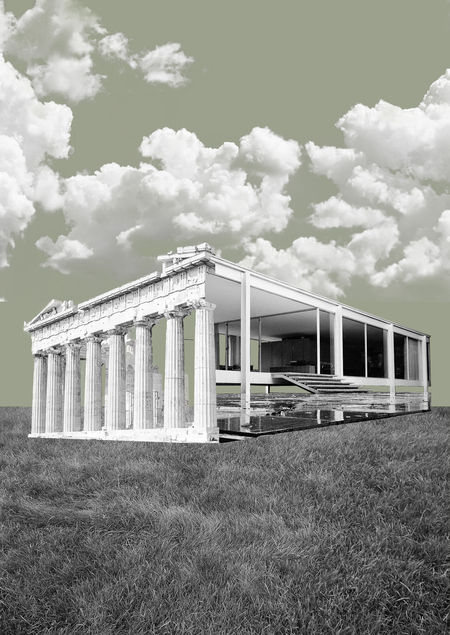
For several millennia, humanity has repeatedly returned to ancient, classical values and principles in architecture. Of particular interest is how modernist architects, who advocated for purifying architecture of ornament and historicism, nonetheless revert to the logic of the classical orders—not by directly quoting them, but by reinterpreting them through new symbols and forms. This is especially characteristic of architects who worked in countries with democratic systems during the second half of the 20th century. Their return to the classical orders is not a deviation from modernist principles; rather, it represents an attempt to express fundamental values—openness, citizenship, humanism—through architectural form. It is in this paradox—negation and simultaneous preservation—that the research intrigue of this topic resides.
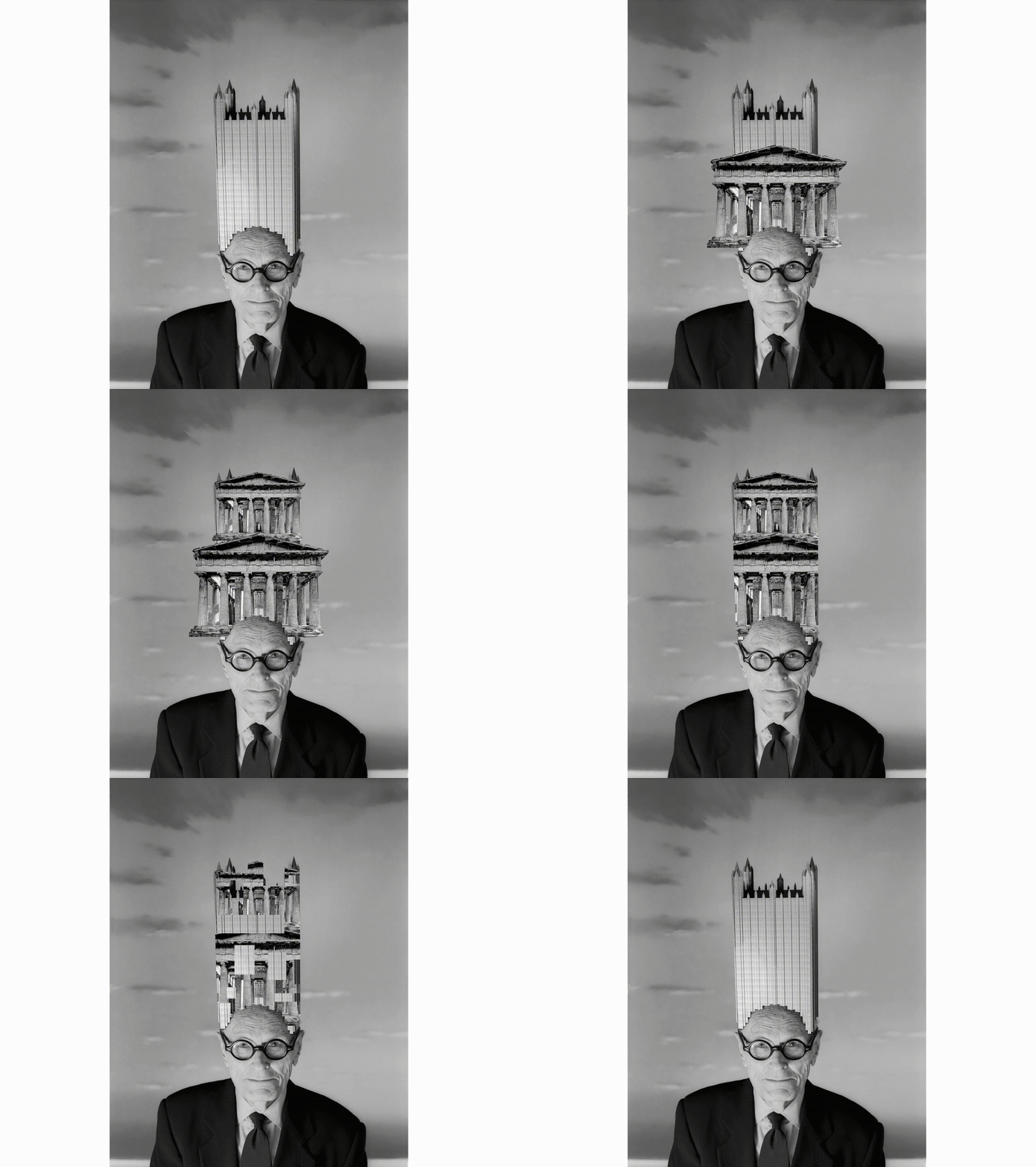
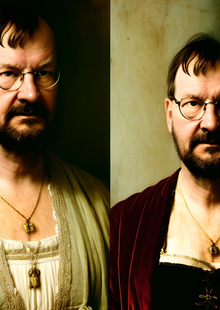
Philip Johnson with a model of the PPG Building // Temple of Hephaestus in Athens, Greece, 460–420 BCE
Material Selection Principle
The research focuses on the work of architects who were actively practicing after World War II, primarily during the 1950s–1980s, mainly in countries with democratic political systems. The main source for the visual research materials was an internet resource.
Rubrication Principle
In my research, I aim to trace the journey of the order from ancient Athens to the mid-twentieth century and analyze the reasons behind its colossal transformation—how this relates to the political regimes and the historical context of various nations.
First, I examine how the system of orders emerged and how it endured for centuries. Then, I discuss how modernism attempted to «break» with it, opting instead for technology and a future reaching upward. Following that, I explore how modernists returned to the order, but in a reinterpreted and entirely different style. Finally, I cover postmodernism, which satirizes all canons. The structure is chronological, effectively illustrating the succession of styles and how the thought, philosophy, and views of people were reflected within them.
Principle for Selecting and Analyzing Textual Sources
When selecting textual sources, I focused on their relevance and alignment with the chosen topic. Using online resources, I studied various books and articles on the subject.
Key Research Question and Hypothesis
Following World War II, in the architecture of democracies, there was not a return of the order as decoration, but an intellectual rehabilitation of it as a symbol of order, stability, and humanism. The key question is to examine precisely how modernists managed to preserve the classical order system in architecture without direct quotation, and what means they used to achieve this. The hypothesis is that modernist architects transformed the classical order by utilizing its rhythmic and proportional structure, but rendered in forms characteristic of their era—glass, steel, and reinforced concrete.
Order as the Visual Language of Power and Structure
The architectural order is a set of established forms originating in antiquity that differentiates between load-bearing and non-load-bearing elements. The strict guidelines governing the construction of buildings are intended to achieve aesthetic expression. The order is based on the most fundamental post-and-lintel structure and began developing long before monumental stone architecture. It reached its zenith in Ancient Greece during the 6th–3rd centuries BCE, particularly in public buildings and temples. However, later orders were further refined and adapted by other cultures that succeeded the Greek tradition.
Ictinus and Callicrates, Parthenon in Athens, Greece, 447 BCE
For instance, the Romans structured and expanded upon the Greek legacy. During the Roman Empire, a clear system of five main orders developed: Doric, Ionic, Corinthian, Tuscan, and Composite. The Parthenon in Athens is an example of the Doric order and high classicism.
During the Renaissance, which rekindled interest in all things ancient, numerous theorists labored to structure the system of orders. In Vignola’s The Five Orders of Architecture (1562–1570) and Palladio’s The Four Books of Architecture (1570), the theory of orders reached its most complete and coherent development. These works established a system of modules and proportions, transforming the order from a mere craft technique into a universal architectural language.[3]
In their works, Vignola and Palladio proposed generalized, ideal orders and developed a unique standard—a canon—that allowed for the creation of orders with harmonious proportions. They established specific numerical ratios for all elements of the order, based on a modular scale.[3]
The canonical orders proposed by Vignola and Palladio became a standard in European academies of art and architecture, and also a tool for practicing architects. They were widely used both during the Renaissance and in subsequent periods of architectural development—Baroque and Classicism.[3]
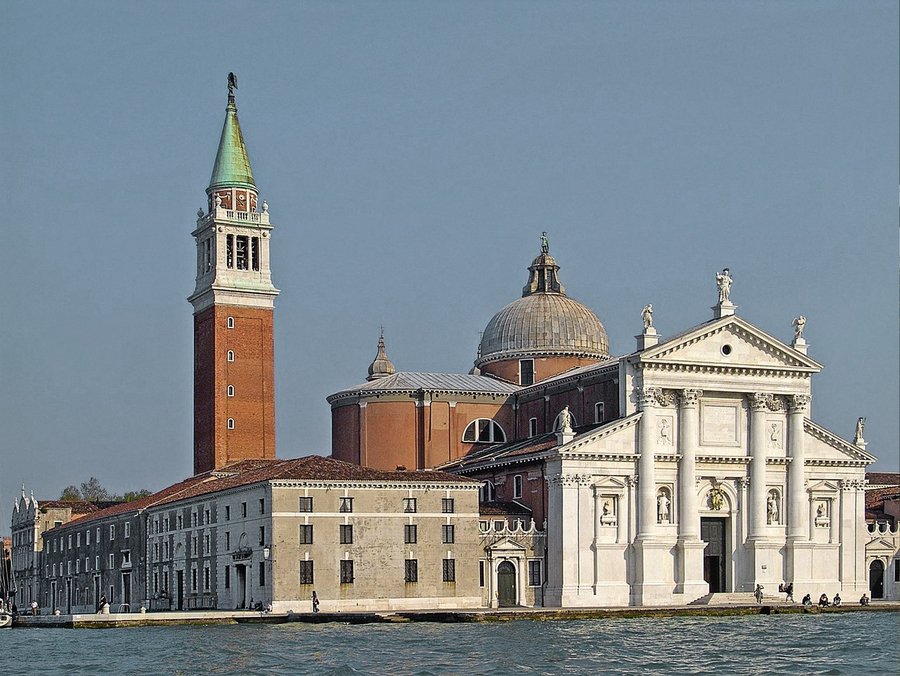
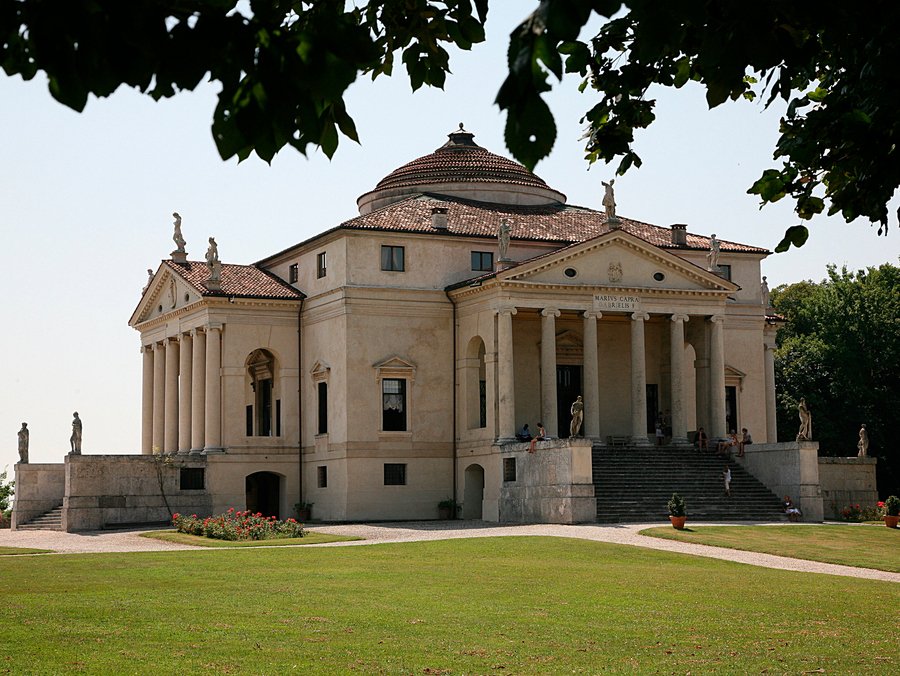
Andrea Palladio, Villa Rotonda, Italy, 1567–1605 // Andrea Palladio, Basilica di San Giorgio Maggiore, Venice, 1566–1610
Over the centuries, the order evolved from being merely a form into an ideological code. It became associated with stability, reason, and harmony—qualities that embodied power and statehood. During the era of absolutism, particularly in France and Russia, the order became a tool for visually expressing state power. Military triumphal arches, palaces, and administrative buildings were constructed in the classical order system, emphasizing continuity with Rome and the ancient tradition.
I. O. Bove, Moscow Triumphal Arch, 1829–1834 (photo: V. Ya. Libson, Arch copy, 1966–1968) // Jean-François Shallgren, Arc de Triomphe in Paris, 1806–1836
In the 20th century, the classical order was also utilized by totalitarian regimes as an instrument of power legitimation. In the architecture of Stalinist Empire style, German neoclassicism under Hitler, and Italian monumentalism under Mussolini, the classical order evolves from a mere symbol of tradition into a symbol of imperial control. Its rigid symmetry, scale, and imposing nature are used to instill obedience, glorify power, and intimidate. Thus, the classical order becomes firmly entrenched as a form of political representation, and its universality transforms into a dangerous ambiguity.
Dmitry Chechulin and Andrei Rostkovsky, Residential Building on Kotelnicheskaya Embankment, Moscow, 1938–1952.
G. V. Shchuko and E. A. Stolyarov, VDNKh Main Pavilion, 1954 // Vera Mukhina’s workshop, sculptures on the main building of Lomonosov Moscow State University, 1949–1953.
Stalinist Empire began to take shape in 1932 when the authorities established the Union of Architects and declared its primary mission to disseminate communism. This marked the end of the architectural experiments of the 1920s and established Stalinist Empire as the official style of Soviet architecture. The new style was meant to symbolize the power and might of the USSR while also demonstrating the achievements of communism. Classical ornaments were replaced by communist iconography (the hammer and sickle), and statues of workers, collective farmers, and Red Army soldiers superseded ancient gods.
Paul Ludwig Troost, Führer Residence (Führerbau), Munich, 1933–1937
E. Dell Debbio, Stadio dei Marmi, Rome, 1928
Thus, by the beginning of the 20th century, the idea that Order and Neoclassicism were the architecture of totalitarianism was firmly entrenched in people’s minds.
Breaking the Canon and Rejecting the Commission
After the First World War, architecture began a decisive break from Historicism. Modernism, forming in the 1920s, proclaimed a rejection of decoration, symbols, traditional forms, and, most importantly, the classical order. New architects aimed to express the spirit of the age—the industrial era, technological progress, functionality, and mass housing. Bauhaus architects, Constructivists, and proponents of the International Style began to utilize reinforced concrete, glass, and steel. The classical order was no longer necessary: the structural capacity of the design no longer required columns, and the aesthetic was based on rationality, minimalism, and technological purity.
Form Follows Function
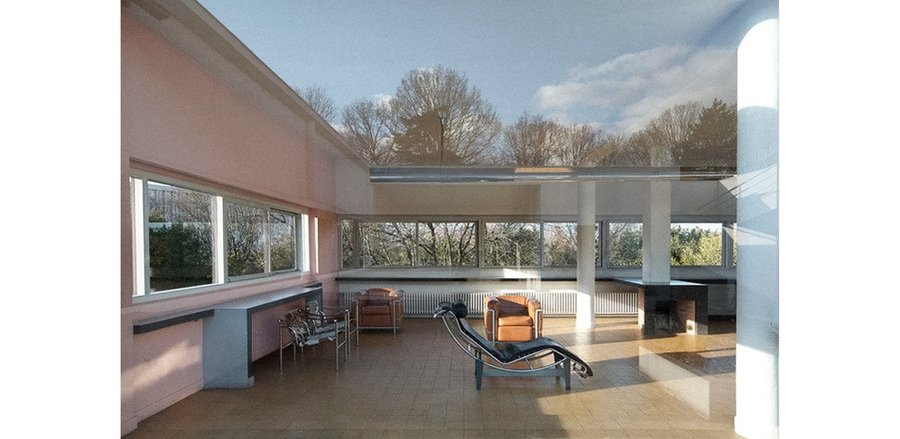
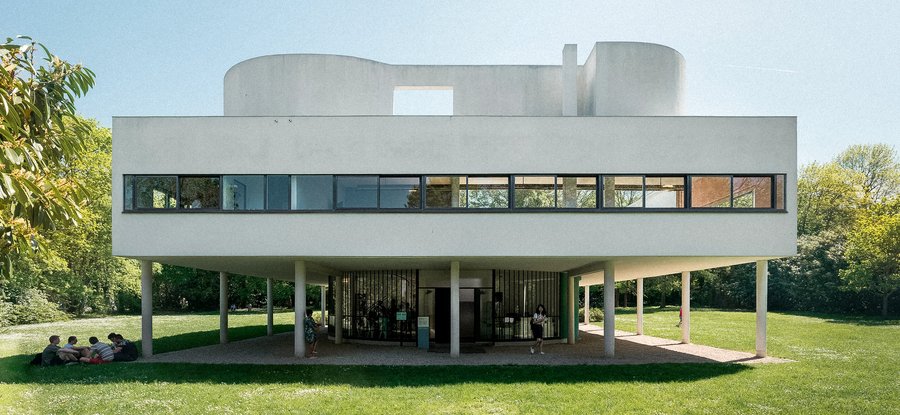
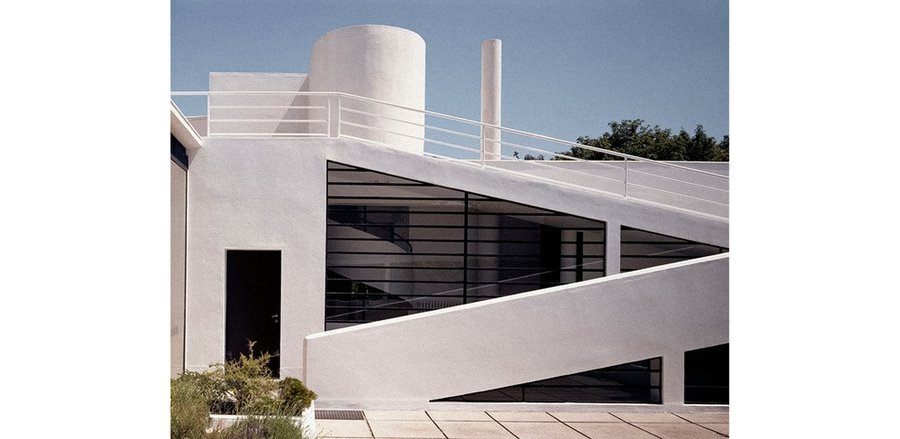
Le Corbusier, Villa Savoye, France, 1929–1930
Le Corbusier developed five architectural principles:
- Homes should be raised off the ground on columns.</b/> This frees up space for the union of civilization’s two greatest achievements: architecture and automobiles.
- There should be a flat usable roof</b/> for recreation and plants.
- Abandoning load-bearing walls in favor of columns</b/> that penetrate the entire building, which allows for a free plan.
- Ribbon windows</b/> and large windows to let in as much sun as possible.
- Since we are getting rid of load-bearing walls, the facade can look as it wants</b/>, depending on the building’s function.
All of this is embodied in the Villa Savoye.
Walter Gropius, Bauhaus Administration Building, c. 1925, Dessau
«Architecture must be of its time.»
— Ludwig Mies van der Rohe
Ludwig Mies van der Rohe, House in Weißenhof Estate, 1927
Le Corbusier, Walter Gropius, and Mies van der Rohe, in the early periods of their careers, demonstrate a radical rejection of all historical precedent. An era of abstraction arrives in architecture. Buildings become machines for living—spaces devoid of any allusion to antiquity. The classical order seems an outdated system, incapable of capturing the spirit of the 20th century.