«Cinema mutilated beauty to the brink of death and has successfully continued to mutilate ever since.»
The «Dogma 95» Manifesto, 1995.
Sometimes in films, you can notice vaguely familiar shots that turn out to be allusions to famous paintings. This technique is called «ekphrasis.» Lars von Trier uses it in his films as a characteristic feature of his auteur style.
Table of Contents
-Concept -The Past. The Antichrist -The Present. Melancholy -The Future. The House Jack Built -Conclusion -Sources
Concept
Lars von Trier is a great provocateur and profound philosopher of contemporary cinema. Once an ideologue of the «Dogme 95» movement—which championed a rejection of artificiality, bourgeois complacency, and individualism—he has become one of the brightest examples of a «nobrow» culture figure: his films are not for the masses, but everyone speaks about him.
In his recent films, Trier seeks to embrace the immeasurable, to express the inexpressible, to speak without words—which is why he employs striking, often baroque, imagery, metaphors, and reminiscences, including references to painting.
In this study, I draw pictorial parallels to scenes from the so-called «Depressive Cycle»: Antichrist (2009), Melancholia (2011), and The House That Jack Built (2018). The selected period differs stylistically from his earlier works; it is rich in imagery and aestheticism. I examine both direct quotes from the canvases and subtle allusions to them (perhaps accidental) and analyze what new meanings these bring to these films.
Antichrist, 2009
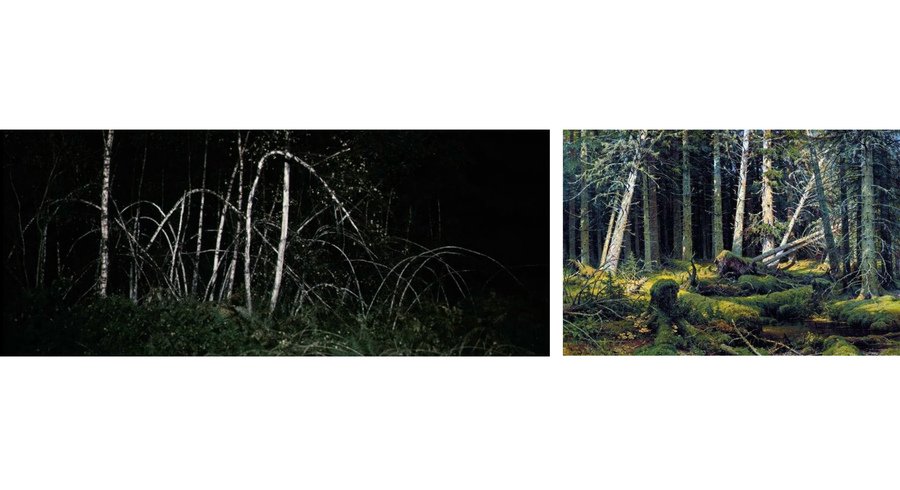
Ivan Shishkin, «Gust of Wind,» 1888
Claude Monet, «Japanese Bridge over a Pond with Lilies,» 1920
A scene where the heroine, trying to manage her anxiety, mentally merges with nature. Monet’s bridge is also barely visible.
Francis Snedders, «Still Life with Game, Monkey, Parakeet, and Dog,» 1663
Mikhail Vrubel, «The Sitting Demon,» 1890
The film scene and the painting resonate not only compositionally but also thematically: the characters in the painting appear innocent at first glance, yet they possess a demonic nature.
Peter Paul Rubens, «Lamentation of Christ,» 1620
Henri Rousseau, «Carnival Night, ” 1886
Francis Bacon, «Three Studies for a Self-Portrait (1, 2), ” 1979
Andre Derain, «Dance,» 1945
Pieter Bruegel the Elder, «Triumph of Death,» 1562
Melancholy, 2011
John Everett Millais, «Ophelia,» 1852
Trier employs a direct quote, framed as a «living painting,» paying homage to the once popular genre of tableau vivant. This technique draws a parallel between the film’s protagonist, Justine (it should be noted that her name is also a reference to the Marquis de Sade’s novel of the same name), and Shakespeare’s Ophelia. After enduring prolonged suffering, both women find peace in their own deaths.
René Magritte, «Masterpiece or Horizon Secret,» 1955
Theodor Gerica, «Riders at Epsom,» 1821
The images share a similar color palette, as well as a motif of speed and pursuit. Furthermore, the image of the horse recurs throughout the narrative of «Melancholy.»
Konstantin Makovsky, «Mermaids,» 1879
Arkhip Kuindzhi, «Moonlit Night on the Dnieper,» 1880
Pablo Picasso, «Guernica» (fragment), 1937
Arnold Böcklin, «Isle of the Dead,» 1901