Concept
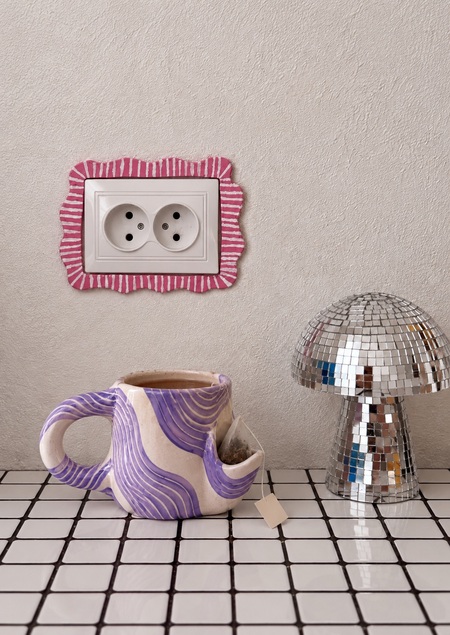
«KARMASHEK» — a project featuring a bespoke ceramic mug with an integrated compartment for used tea bags.The idea arose from a common, everyday scenario: after brewing tea, there isn’t always a convenient place to neatly set down the tea bag. The project proposes combining two functions into a single object. A small, open pocket is situated on the mug’s exterior wall, designed for temporary placement of the tea bag. Its shape flows organically from the body, rather than feeling like an added attachment.The visual character of the piece is built upon the plasticity of handmade ceramics: soft asymmetry, an uneven silhouette, undulating lines, and expressive glazing. «KARMASHEK» reimagines the conventional mug through a simple concept: every object should have its place—even a used tea bag.
Materials and Dimensions
Material: light-colored high-temperature stoneware clayTechnique: hand-built slab construction, featuring an integrated side pocket and handleGlaze: lilac underglaze painting with a clear glossy glaze, designed for functional tablewareFinished Product Dimensions:
Height — 95 mmBody Diameter — 90 mmWidth with Handle — approximately 145 mmWall Thickness — 5–6 mmPocket Depth — 35–40 mmUsable Volume — estimated 350 ml*Dimensions are preliminary and will be refined during prototype fabrication.
Manufacturing Technology
- Clay preparation and slab rolling2. Hand-forming the body and base of the mug3. Sculpting the side pocket and joining it to the body using slip4. Forming and attaching the handle5. Smoothing seams, rounding edges, and drying the piece6. First (bisque) firing at 950–1000 °C7. Applying the lilac underglaze decoration8. Coating with transparent glossy glaze9. Second (glaze) firing at 1200–1230 °C10. Inspecting the finished piece for strength, sealing, and usability*Firing temperatures are determined after selecting the specific ceramic body and glaze.
Sketch
Visualizations
Wireframe
During the pre-design development phase, a substantial prototype of a mug was created using artistic sculptural clay.The goal of the prototyping was to translate 2D sketches and digital visualizations into a physical object to assess its form and structure.
What is covered in Module 2
Developing a technical drawing with dimensions → selecting ceramic mass and molding technology → creating a prototype model → checking the pocket’s ergonomics, capacity, and airtightness → design refinement → hand-molding the mug body → manufacturing and attaching the handle and side pocket → surface finishing and smoothing → uniform drying of the item → bisque firing → applying underglaze decoration → coating with transparent glaze → glaze firing → quality control and functional testing → product photography → preparing the final presentation