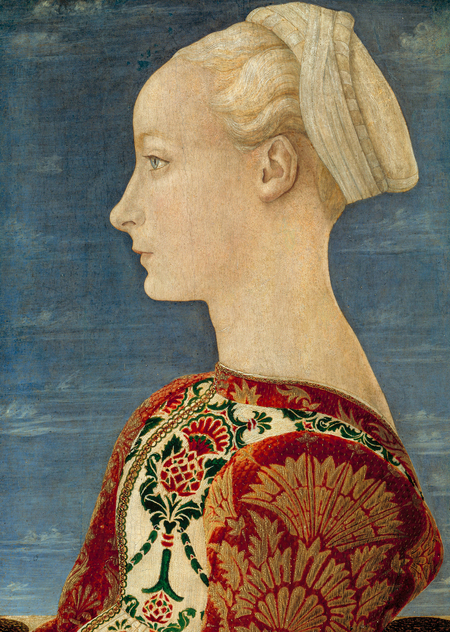
This timeline illustrates how political upheavals and social changes in Italian history gave rise to new artistic forms. We will trace the evolution from the stark realism of Roman portraiture to the spiritual quality of medieval mosaics, from the freedom of the city-states to the flourishing of the Renaissance, and from the grandeur of the Baroque to the light of the Enlightenment and the drama of national unification. Each era has left its unique mark on Italian culture, and our goal is to see in this kaleidoscope the inseparable connection between history and its visual manifestation—the eternal dialogue between power, spirit, and beauty.
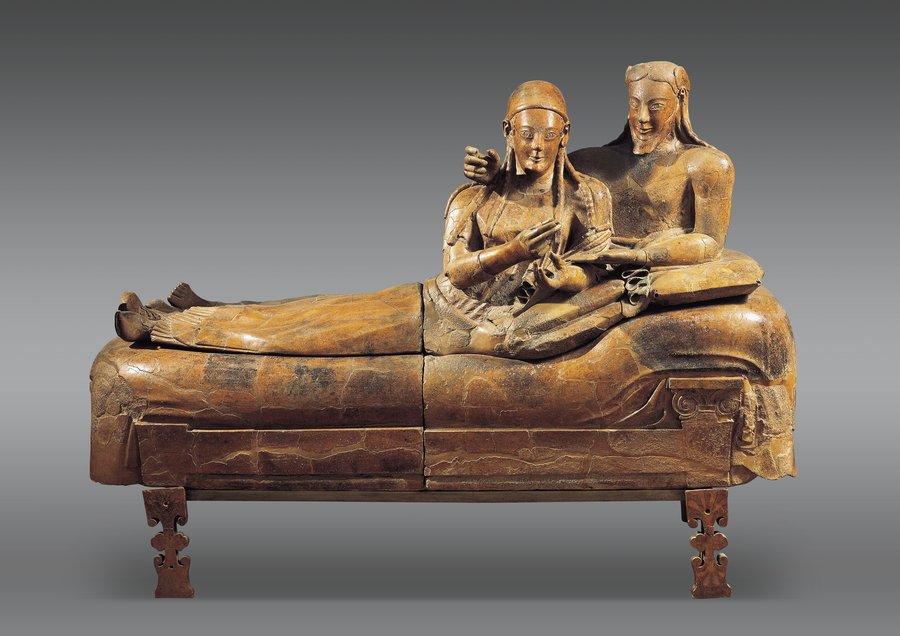
Sarcophagus of a Couple. Monumental Etruscan Urn. 520s BCE.
The Etruscans (Latin: Etrusci; self-designation: Rasenī) were an ancient civilization that existed in central Italy (Etruria, modern-day Tuscany) from the 8th to the 1st century BCE. Their origins remain a subject of debate. The civilization reached its peak between the 7th and 5th centuries BCE, when twelve city-states (Veii, Tarquinii, Caere, and others) formed a powerful alliance. By the 3rd century BCE, the Etruscans had been conquered by Rome, after which they gradually assimilated with the Romans, while simultaneously exerting a significant influence on the Republic’s culture, religion, and governmental structure.
The surviving art of the Etruscans is represented by fresco paintings in tombs (the Leopards Tomb in Tarquinia, 5th century BCE), which depict scenes of banquets, dances, and nature; bronze casting («Capitoline Wolf, ” circa 5th century BCE); and the black pottery of Bucchero. Sculpture is represented by polychrome terracotta sarcophagi („Sarcophagus of a Couple“ from Cerveteri, 6th century BCE). The architectural legacy of this people has reached us in the form of ruins of monumental temples, city walls, and burial chambers with false vaults. The Etruscans laid the foundations for temple architecture and engineering, which were later adopted by the Romans—including the construction of arches and the cloaca maxima system.
VIII век до н. э.
Foundation of Rome
Capitol Wolf. Bronze. 11th–12th centuries.
According to ancient tradition, Rome was founded on April 21, 753 BCE, by Romulus on the Palatine Hill. This period is characterized by complex processes of cultural interaction between local tribes, Etruscans, and Greek colonists.
Early Roman art is evidenced by humble votive statuettes and huts featuring geometric pottery, discovered during excavations at the Roman Forum. Of particular interest is the so-called «Black Stone» (Lapis Niger)—the oldest Latin epigraphic monument associated with early worship on the forum. These artifacts demonstrate a synthesis of local traditions with Etruscan and Greek influences, laying the foundation for future Roman art.
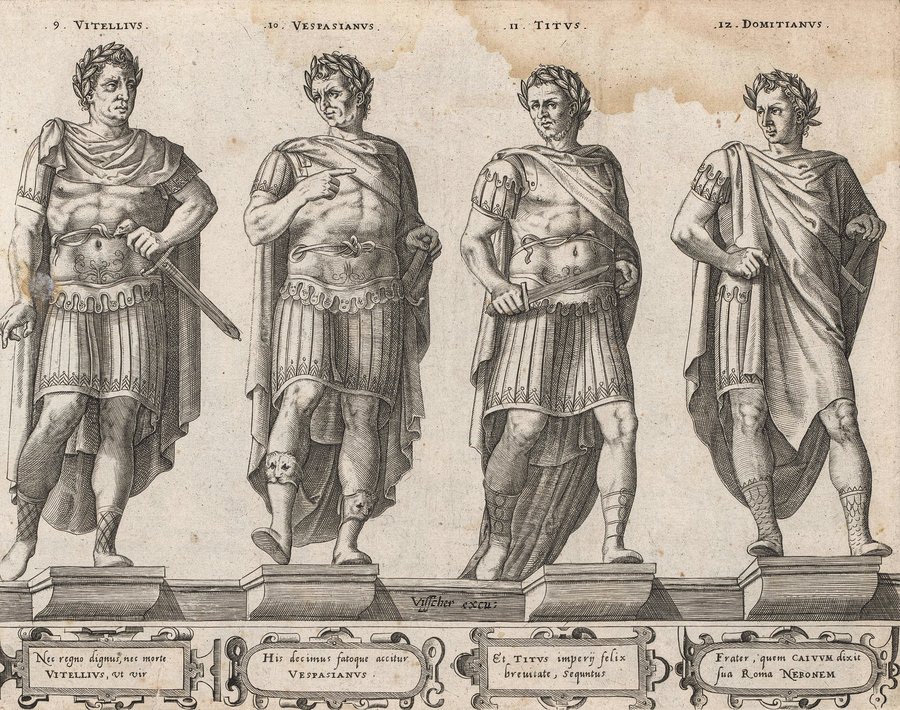
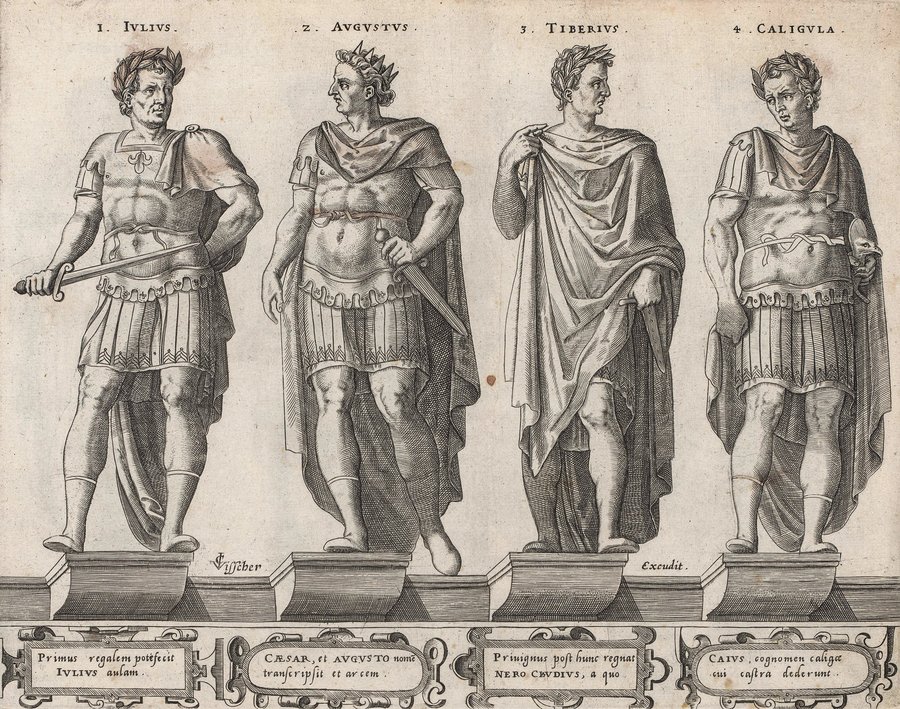
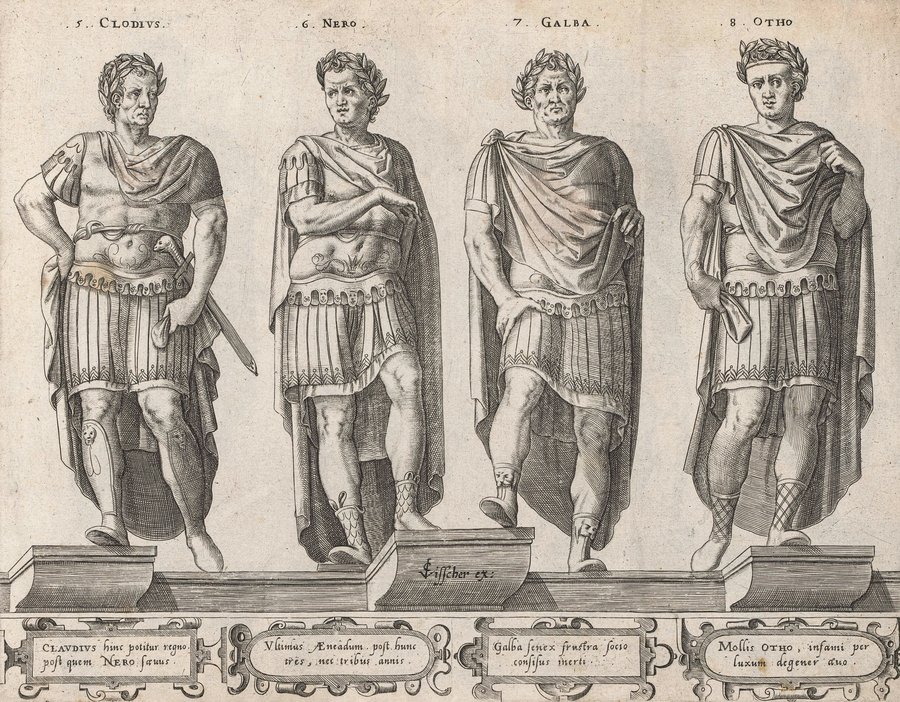
Roman Emperors: Julius Caesar, Augustus, Tiberius, Caligula. Claudius I, Nero, Galba, Otho. Vitellius, Vespasian, Titus, Domitian. 1646
From the mid-1st century BCE to the end of the 1st century CE, the Roman state transitioned into an empire. Following the assassination of Julius Caesar (44 BCE) and the civil wars, the Principate of Octavian Augustus (27 BCE — 14 CE) was established, formally preserving Republican institutions. The succession of dynasties—the Julii-Claudians (Tiberius, Caligula, Claudius, Nero) and the Flavians (Vespasian, Titus, Domitian)—was accompanied by the strengthening of imperial power, the expansion of the state’s borders, and major fires in Rome (64 CE). It was during this period that Christianity emerged.
In the Augustan period, «Augustan classicism» developed, combining Greek forms with Roman ideology (the Altar of Peace, 9 BCE, and sculptural portraits that emphasized the eternal youth of the princeps). Under the Flavian dynasty, illusionistic architecture emerged (Domitian’s palace on the Palatine, Nero’s Golden House with frescoes in the Fourth Pompeian style). The literary flourishing—including the works of Virgil, Horace, Ovid, and Suetonius, who captured the customs of rulers in the «Lives of the Twelve Caesars”—coincided with monumental construction (the triumphal arches of Titus, the Forum of Vespasian). These works laid the foundation for the imperial artistic language that influenced all of European culture.
Barbarian States
Evangelistary of Otto III. Reichenau. Circa 1000
Following the fall of the Western Roman Empire (476 AD), the Ostrogothic Kingdom, led by Theodoric the Great (493–526 AD), was established on the peninsula, which was later replaced by the Byzantine reconquest under Justinian (535–554 AD). In the mid-6th century, the invasion of the Lombards began, who established a kingdom named after them in the north, centered in Pavia, and duchies of Spoleto and Benevento in the south. In the 8th century, the Franks, led by Charlemagne, defeated the Lombards (774 AD), and in 800 AD, the first Emperor of the West was crowned in Rome. By the 10th century, the power of the Germanic emperors grew stronger, leading to Otto I’s siege of Rome in 962 AD and the creation of the Holy Roman Empire.
The art of this period is characterized by a synthesis of Late Antique, barbarian, and Byzantine traditions. In Ravenna, under Theodoric, the Roman architectural tradition persisted (Theodoric’s Mausoleum, c. 520 AD), while the Lombards developed ornamental arts (stone carving, jewelry). In religious architecture, the early Christian basilica plan dominated, gradually evolving into the Romanesque style. Monastic scriptoriums played a key role in preserving the ancient heritage, where illuminated manuscripts were created (Aunbert’s Gospel, 8th century). The Benedictine Abbey of Montecassino (founded in 529 AD) was of particular importance, becoming the central cultural hub. By the 10th century, a distinct «Ottonian» style emerged in art, blending Carolingian and Byzantine elements (Reichenau School manuscripts, church bronze doors), which paved the way for the flourishing of Romanesque art.
The Rise of City-States
Emblems of Italian city-states (from left to right): Genoa, Cremona, Florence, Milan, Venice, Pisa, Siena, Lucca
The 11th and 12th centuries marked a period of political and economic revival in Italy following the Early Middle Ages decline. The Investiture Controversy (1075–1122) between the papacy and the Holy Roman Empire weakened the power of the German emperors, creating conditions for the autonomy of the northern and central city-states—such as Milan, Florence, Bologna, and others. In the south, the Norman conquerors established the Kingdom of Sicily in 1130. Concurrently, maritime republics—Venice, Genoa, and Pisa—flourished, their fleets dominating the Mediterranean and facilitating the wealth of these cities through trade with the East. By the end of the 12th century, the Lombard League (1167) formed, successfully resisting the imperial power of Frederick Barbarossa.
The art of this period is characterized by the spread of the Romanesque style in architecture and the flourishing of Byzantine-influenced art. The construction of monumental cathedrals—such as the Pisano (1063), Modenese (1099), and Florentine San Miniato (1018)—demonstrated the growing wealth and ambition of the communes. In sculpture, Viligelmo in Modena and Bonidano in Pisa developed narrative reliefs, blending biblical themes with ancient reminiscences. In painting, Byzantine iconography predominated, though with local variations, as seen in the altarpieces by Berlinghiero Berlingieri («The Crucifixion, ” No. 20, 1210–1220). Sicilian art under the Norman rulers held particular significance, combining Byzantine, Arab, and Romanesque elements (the mosaics of the Cathedral in Monreale, 1174). These processes laid the groundwork for the subsequent emergence of proto-Renaissance art.
Duccio di Buoninsegna. The Annunciation (fragment). Early 14th century. Sienese School of Painting
In the 13th century, the conflict between the Papacy and the Holy Roman Empire (Guelphs and Ghibellines) permeated the lives of city-communes such as Florence, Siena, and Milan. Simultaneously, active maritime trade and the emergence of banking fostered economic strength, creating the material prerequisites for large-scale artistic patronage. By the end of the century, a unique urban culture had formed in Italy, one in which Byzantine traditions intertwined with a burgeoning interest in classical heritage.
The art of the Duecento is characterized by a shift from the Byzantine canon toward greater naturalism and emotional expressiveness. In painting, the Sienese School, with its refined elegance (the work of Guido da Siena), developed parallel to the more plastic Florentine style, where Cimabue began to overcome Byzantine formal rigidity («The Crucifixion» from the Basilica of San Domenico in Arezzo, circa 1268–1271). Architecture was enriched by the spread of the Gothic style, exemplified by the Basilica of St. Francis in Assisi (founded in 1228) and the Florentine church of Santa Maria Novella (begun in 1279). The work of Nicola Pisano was particularly significant, as his baptistery in Pisa (1260) demonstrates a deliberate engagement with ancient models. These innovations, alongside the poetry of the «sweet new style» and the activities of the Franciscan Order, created the spiritual and aesthetic foundation for Giotto’s revolutionary discoveries in the following Trecento.
Giotto di Bondone. The Kiss of Judas (The Arrest of Christ). Cappella Scrovegni. 1304–1306
The fourteenth century (Trecento) marked an era of profound upheaval and the birth of new cultural trends in Italy. The century was shadowed by the Black Death epidemic (1347–1351), which decimated half the population of the Italian city-states. Despite this, centers like Florence, Siena, and Venice maintained political activity, and the Papal court, based in Avignon (from 1309 to 1377), generated its own cultural momentum. The period concluded with the start of the Western Schism (1378), which significantly weakened the authority of the Papacy.
The art of the Trecento marks a transition from medieval canons to the humanism of the Proto-Renaissance. In Florence, Giotto di Bondone revolutionized painting by giving figures volume and emotional expressiveness, placing them in a believable space (frescoes in the Scrovegni Chapel in Padua, c. 1305). In Siena, Duccio di Buoninsegna and Simone Martini developed an exquisite Gothic style that blended lyricism with decorative richness («Maestà» by Duccio, 1308–1311). Concurrently, Francesco Petrarch and Giovanni Boccaccio laid the foundations of the Italian literary tradition by turning to the earthly human condition. The Florentine cathedral, Santa Maria del Fiore, crowned with the magnificent dome of Filippo Brunelleschi—construction of which began in 1296—became the architectural symbol of the era. These achievements paved the way for the flourishing of Quattrocento art.