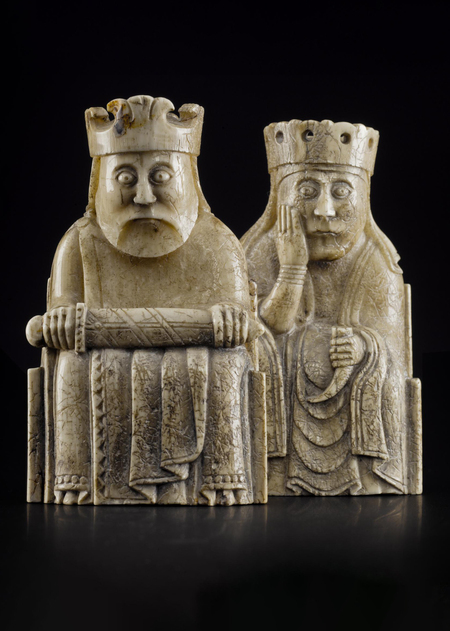
6th Century
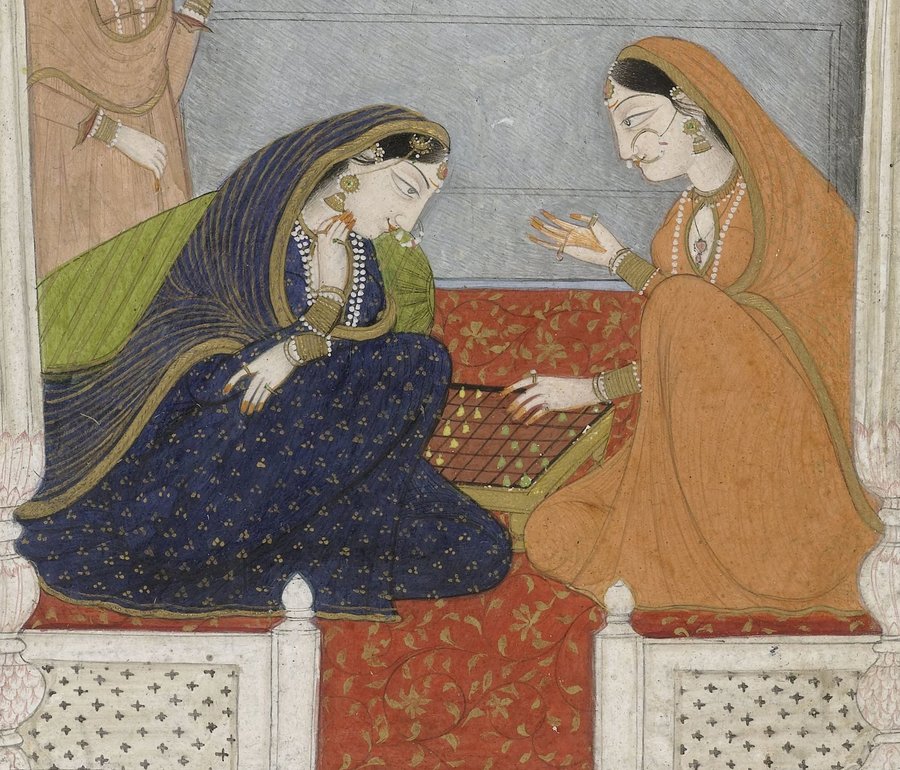
Chaturanga Game, Indian Miniature. 1805–1815
The exact date of chess’s invention is unknown, but its most recognized ancestor is Chaturanga, which developed in India around the 6th century. The name meant «four divisions of the army»: infantry, cavalry, elephants, and chariots—the precursors to pawns, knights, bishops, and rooks.
The board already featured 64 squares, yet the rules noticeably differed from modern ones, and it likely existed in several variants. Nevertheless, the core concept was already in place: the player commanded an entire army, striving to protect their ruler and defeat the opponent’s.
7th–11th Centuries
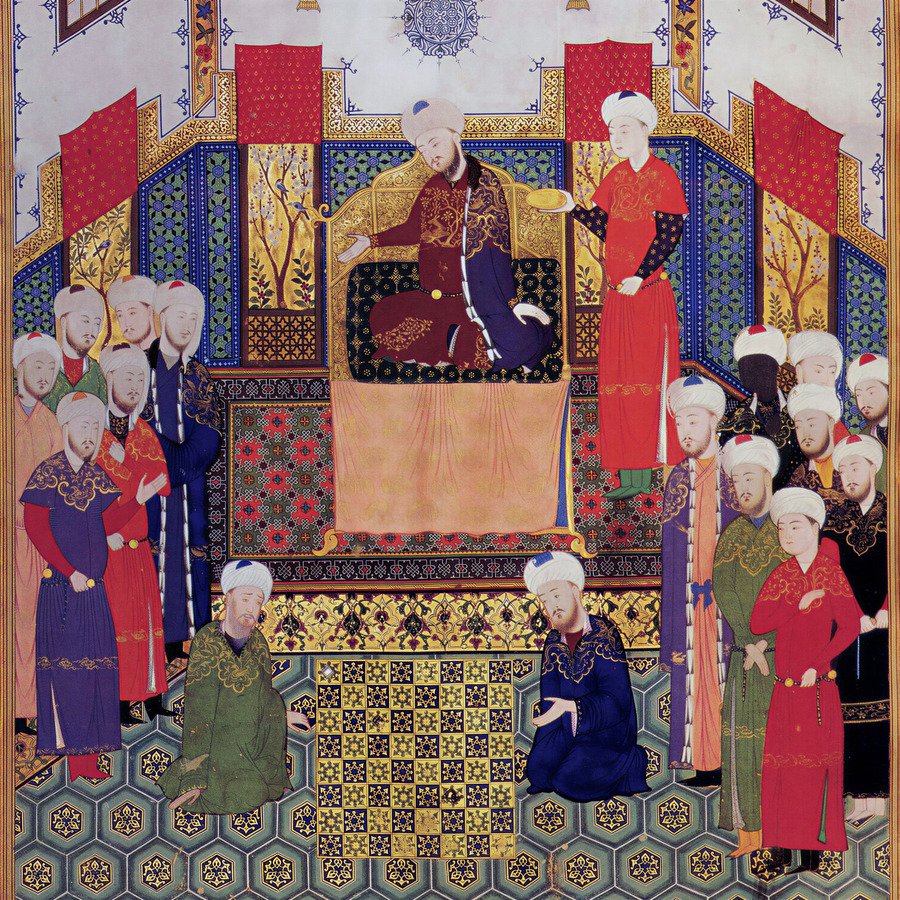
Two players in Shatranjdz. Fragment of a Persian miniature from Ferdowsi’s Shahnameh. 1430
The game arrived in Sasanian Persia from India, where its name transformed into «Chatrang, ” and following the Arab conquest, it became „Shatranj.“ Words traveled with the game as well: „Shah“ meant king, and the phrase „Shah Mat“ indicated that the ruler was immobilized and could not be saved. Shatranj was slower than modern chess: the ancestor of the queen moved only one square diagonally, and the elephant jumped exactly one square. In the Islamic world, renowned masters, problem collections, and the theory of typical opening positions—tabiyah—emerged.
Chess soon infiltrated Europe, moving through Muslim Spain, Sicily, and Mediterranean trade routes. By the 11th century, it was already known in many European countries. The rules then differed noticeably from modern ones: the queen and bishop were much weaker, and games proceeded more slowly. Along with the game, chess terminology, problems, and the first elements of theory arrived in Europe.
1575
Luigi Mussini. Chess tournament at the Spanish King’s court. 1883
The contest held at the court of the Spanish King Philip II is often called the first international tournament: at the board, the Spaniards Rui Lopez and Alfonso Serrano faced the Italians Giovanni Leonardo da Cutri and Paolo Boi.
Leonard is considered the winner, having reclaimed victory from Lopez after a previous loss. However, it was more a series of court matches than a tournament with a standard standings table and unified regulations; the first modern-style international tournament is typically cited as the London 1851 event. Roy Lopez’s debut—an Spanish game—is still alive today.
1749
Thomas Cook. Chess match in Parslows, February 23, 1794, in the presence of the Turkish ambassador. Philidor at the table with a blindfold. 1794
François-André Danican Philidor was not only the strongest chess player of his era but also a renowned opera composer. In his 1749 book, «Analysis of Chess Play, ” he proposed viewing a position as a system rather than as a series of spectacular attacks.
Philidor elevated the role of the pawns particularly high: his formula, «Pawns—the soul of chess, ” became one of the game’s most famous aphorisms. The treatise remained a standard textbook for at least a century; by 1871, it had seen approximately 70 editions and had been translated into numerous European languages.
1834
Friedrich August Moritz Retzsch. Chess Players. 1831
Chess Set. Late 18th — Early 19th Century
Percy Wenman. Illustrations from the book «One Hundred Seventy-Five Chess Masterpieces.» 1947
From June to October 1834, Louis de Labourdonne and Alexander McDonnell played six matches at the London Westminster Chess Club—an incredible 85 games. The Frenchman won four completed matches, while the Irishman won one; the sixth ended when McDonnell held the lead.
Overall series result: +45–27 = 13 in favor of Labourdonne, rather than = 18. The games were widely published and discussed across Europe, making the confrontation a precursor to a world championship match. One of the Frenchman’s victories became famous for a march of three connected passed pawns.
1859
First American Chess Congress. 1857
Paul Morphy plays eight blind chess games at the Parisian café «Régnant.» 1858
By 1859, the 21-year-old Paul Morphy was already publicly considered the world’s strongest chess player, even though an official title did not yet exist.
He won the First American Chess Congress, then traveled to Europe and conquered all the major matches of his tour; he defeated Adolf Anderssen Morphy, securing seven wins, two draws, and two losses. His games demonstrated the strength of rapid development, open lines, and precise attack; the famous «Opera Game» is still cited by beginners as a model. Soon after, Morphy almost completely abandoned serious chess.
1886
Sixteen leading world chess masters. Wilhelm Steinitz and Johannes Zukertort are featured in the center, seated at a table. 1886
The first widely recognized match for the official world championship title turned into a veritable tour: Wilhelm Steinitz and Johannes Zukertort played in New York, St. Louis, and New Orleans.