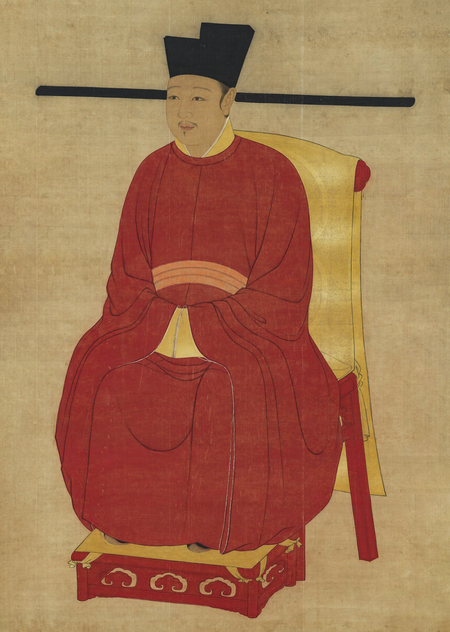
China’s history spans over four millennia of continuous cultural evolution—from Shang Dynasty ritual bronze vessels to the philosophy of Confucius and its status as a global master workshop. Art throughout this process has always been inseparable from history: ritual bronze ensured a connection to ancestors, landscape painting expressed the philosophy of scholarly officials, and imperial porcelain demonstrated technological and aesthetic superiority over barbarians. Our timeline traces the journey of the Celestial Empire from the early kingdoms to the People’s Republic, illustrating how political upheaval and cultural traditions forged its unique artistic language.
Около 2070–771 годы до н. э.
Early Dynasties of China
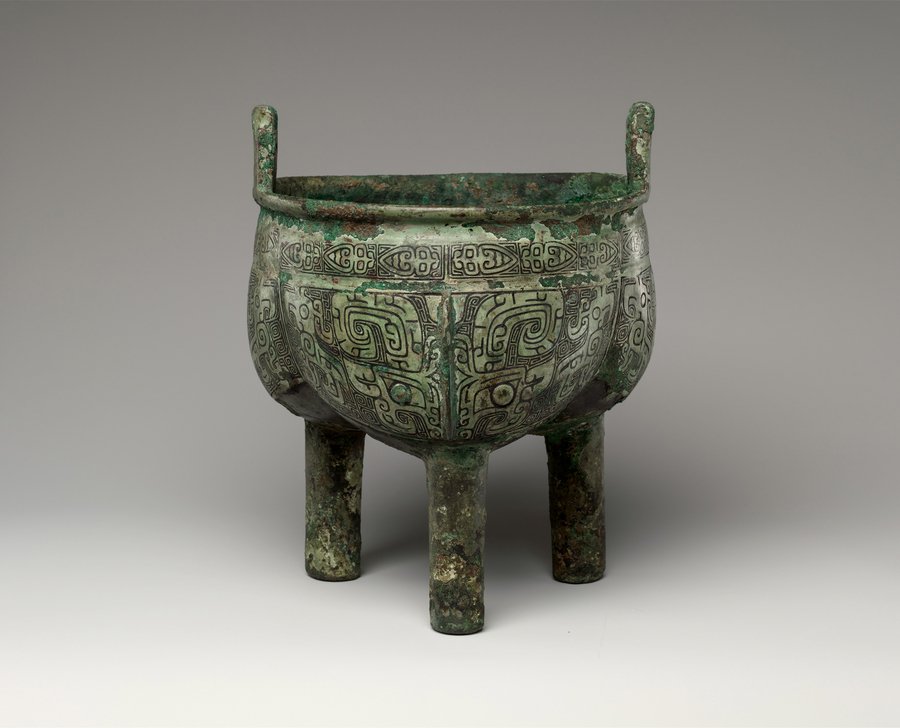
Treenager. The Pot with «Ears.» The Shan Dynasty
The earliest Chinese dynasties—Xia (c. 2070–1600 BCE), Shang (c. 1600–1046 BCE), and Western Zhou (1046–771 BCE)—belong to the Bronze Age. China entered this era around 2100 BCE: the late Xia Erlitou culture, where vessels, weapons, and casting workshops have been discovered during excavations, became the country’s earliest known Bronze Age culture. During the Shang period, the capital of Yin, near Anyang, became a major urban center, writing emerged on oracle bones, and Erlitou may have been an earlier capital of the Shang or an even more ancient settlement of the Xia.
The art of this era is represented by ritual bronze vessels used for ancestor sacrifices and which became symbols of power. Their use began during the Xia dynasty, continued under the Shang, and was preserved during the Zhou. Typical decoration of that period includes the Taotie mask and zoomorphic motifs: dragons, birds, bovine creatures, and geometric patterns, the precise meaning of which remains unknown to Shang society. Under the Zhou, the decoration shifted to linear and curved patterns, and the vessels featured longer inscriptions that recorded the owners' names and significant events.
770–221 годы до н. э.
The Seasons of Spring and Autumn. Warring Kingdoms
Bronze statue of a tiger eating its prey. Gold inlay. Spring and Autumn period.
In 771 BCE, after the capital was moved eastward, the Eastern Zhou era began in China. This era is divided into the Spring and Autumn Period (770–481/476 BCE) and the Warring States Period (475/453–221 BCE). By the end of the Spring and Autumn Period, traditional ritual art and architecture faced a crisis, and the Warring States Period became a time of forming a bureaucratic and meritocratic society in China. The authority of the Zhou vassals weakened; individual kingdoms vied for hegemony, and thinkers began to seek answers to the question: «How shall we organize the Middle Kingdom?» Among these thinkers were Confucius, Laozi, and other philosophers of the «Hundred Schools.»
In the art of this era, bronze casting gradually gave way to lacquerware. With the advancements in iron smelting, pottery, and the emergence of lacquered objects, bronze metallurgy receded into the background, gradually yielding to lacquered items, particularly in the realm of Chu. Colored ceramics and painting on silk and wood became widespread—this includes the earliest surviving examples of Chinese painting: fragments of paintings on silk, stone, and lacquerware. The introduction of iron tools allowed for more complex carving in jade, and bronze foundries adopted the lost-wax casting technique. Records were kept on bamboo slips and silk scrolls with illustrations, marking a significant stage in the development of Chinese writing.
221–206 годы до н. э.
Qin Dynasty
«Terracotta Army» statues from the tomb of Emperor Qin Shi Huang, 210 BCE.
In 221 BCE, the ruler of the Qin kingdom, who became Emperor Qin Shi Huangdi, conquered and unified rival states, ending the Warring States period and founding China’s first centralized empire. As the first emperor, he politically and culturally unified the Chinese lands by introducing a centralized bureaucracy and strict standardization of writing, measures, weights, and other cultural systems. Legalism became the state ideology, based on strict laws and severe punishments. After Qin Shi Huangdi’s death in 210 BCE, the dynasty rapidly collapsed under the pressure of rebellions, and in 206 BCE, it was replaced by the Han dynasty.
The most prominent monument of that era’s art was the Terracotta Army—a burial complex comprising thousands of clay figures designed to protect the emperor in the afterlife. Construction of the tomb began in 246 BCE, when thirteen-year-old Qin Shi Huang ascended the throne of the Qin kingdom. According to the historian Sima Qian, 700,000 mobilized laborers were involved in the project. The warriors, initially painted in various colors, are rendered life-size, complete with individual facial features and hairstyles. Furthermore, the complex’s burial pits also yielded bronze chariots and weaponry, and the emperor’s tomb is surrounded by numerous other interments, including a pit containing the remains of exotic animals and the tombs of servants executed during the burial.
202 год до н. э. — 220 год н. э.
Han Dynasty
Rider on horseback. China. Han Dynasty (206 BCE — 220 CE)
In 202 BCE, Liu Bang, who was posthumously named Gaozu, won the struggle for power that began after the collapse of the Qin Empire and established the Han Dynasty, making Chang’an its capital. The subsequent reign of the Han Dynasty was a period of political stabilization, economic prosperity, and territorial expansion into Central Asia, Korea, and Vietnam. Under Emperor Wu (141–87 BCE), the state monopoly on salt and iron was established, and Zhang Qian’s diplomatic missions opened the Silk Road, which connected China with countries in Central Asia and the Roman Empire. The state ideology, after departing from Qin Legalism, became reformed Confucianism under Dong Zhongshu, and Sima Qian’s «Records of the Grand Historian» became a classic example of historical and literary work.
Art from the Han Dynasty reflects a shift from ritual strictness toward depictions of daily life and cosmological beliefs. The most important material for understanding this era comes from funerary artifacts: in the tombs of the elite, ceramic burial figurines (mingqi) are predominant—models of residences, servants, musicians, and household animals, intended to ensure comfort in the afterlife and replacing the practice of human sacrifice. Wall paintings and reliefs on stone slabs in the burial chambers flourish, illustrating mythological narratives, including the goddess Xiwanmu, as well as scenes of daily life and historical events. In bronze work, rigid ritual forms give way to elegant incense burners (boshanlou) shaped like sacred mountains, and mirrors featuring cosmological ornaments. Lacquerware with vibrant, multi-colored painting becomes widespread, as do silk fabrics exported to the West, and funerary standards, such as the one found in Mawangdui, with detailed images of the soul’s journey to the heavens.
220–589 годы
Three Kingdoms. Era of Fragmentation
Buddha Maitreya (Milya). The largest of the early Chinese gilt-bronze sculptures known today. China. 486
The collapse of the Han Dynasty in 220 CE led to the fragmentation of China into three rival kingdoms—Wei, Shu, and Wu—and the beginning of the Three Kingdoms period. The brief unification under the Western Jin fractured under the pressure of nomadic tribes, provoking a mass migration of the elite to the south and dividing the country into Northern and Southern Dynasties. In the north, «barbarian» states emerged and succeeded each other, while Chinese ruling houses became established in the south. This political fragmentation was accompanied by an intense cultural exchange: Buddhism, which entered from Central Asia, gained state patronage, and Daoism developed into an organized religion. This era, which concluded with the reunification of the country under the Sui Dynasty in 589 CE, was a time of profound social and intellectual shifts.
The art of the Era of Fragmentation is characterized by the vigorous development of Buddhist sculpture and temple construction. Colossal stone statues of the Buddha from that era are preserved in the Yungang and Longmen cave complexes, while in Mogao, near Dunhuang, there are extensive frescoes depicting Jatakas and celestial realms. Secular painting reached maturity in the Gu Kaizhi scrolls («Admonitions of the Elder Court Lady»), which embodied the principle of «spirit transmission» through line and the expressiveness of characters. Calligraphy rose to the level of a high art form in the works of Wang Xizhi, whose «Preface to the Orchid Pavilion» became canonical. Funerary assemblages were dominated by ceramic figures of riders and warriors, which replaced Han models of homesteads, and in the southern workshops, the tradition of proto-celadon developed—ceramics with a grey-green glaze that foreshadowed porcelain.
Sui Dynasty. Tang Dynasty
Han Gan. Horse Herding. Gugong, Taipei. 8th Century
In 581, Yang Jian founded the Sui Dynasty (581–618), unifying China after three centuries of fragmentation. His son Yang Di constructed the Grand Canal, connecting the Yellow River and Yangtze River basins. The subsequent Tang Dynasty (618–907) marked a period of cultural flourishing and territorial expansion into Central Asia. The capital, Chang’an, transformed into a cosmopolitan metropolis that welcomed merchants and travelers from across the Silk Road. The Keju examination system, established under the Sui, cemented the principle of meritocracy, while religious tolerance facilitated the spread of various faiths throughout the empire. The An Lushan Rebellion (755–763) undermined the dynasty’s power, leading to the fall of the Tang in 907 and the beginning of the Five Dynasties and Ten Kingdoms period.
At the Sun and Tan Grotto Complex of Longmen, a colossal Vairocana Buddha was added, reflecting the imperial grandeur of the state. Burial figurines (sancai)—including horses, camels, and foreign merchants—established a ceramic style that subsequently spread all the way to Europe. Painting was divided into figural (Yan Liben, Zhou Fang) and landscape traditions, the latter developing the «blue-green» (Li Siyun) and monochrome (Wang Wei) styles. The calligraphy of Yan Zhengcin and Liu Gongquan reached canonical status. Brick pagodas were constructed, including the Great Wild Goose Pagoda. Applied arts were represented by bronze mirrors, gilded and silver vessels, as well as silk textiles exported to the West.
960–1279 годы
Sun Dynasty
Su Xuanchen. Knick-knack Carrier. Song Dynasty. China. 1130–1160
In 960, military leader Zhao Kuangyin ended the Five Dynasties and Ten Kingdoms period by establishing the Song Dynasty with its capital in Kaifeng. It unified most of China but lost its northern territories after the Jurchen invasion, which established the Jin Dynasty; the capital was subsequently moved to Hangzhou, initiating the Southern Song era. During this time, paper money, credit instruments, and maritime trade across the Indian Ocean became widespread throughout China. State administration relied on an advanced examination system, while neo-Confucianism, championed by Zhu Xi, formed the ideological foundation. Printing, gunpowder, and the compass were invented—three of the four great inventions (paper had been created in China as early as the 2nd century). The Song Dynasty only fell in 1279 under the assault of the Mongol Yuan Empire.
The art of the Song Dynasty is characterized by a prevalence of refined aestheticism and the establishment of landscape as the leading genre in painting. The monumental mountain landscapes of Fan Kuan and Guo Xi embodied cosmic order, while the works of the Southern Song (Ma Yuan, Xia Gui) were distinguished by their conciseness and asymmetry. Emperor Huizong established an Academy of Painting, encouraging detailed realism, and scholar-officials developed «literati painting» (wenrenhua)—the expressive art of brushwork by Su Shi and Mi Fu. Calligraphy reached a new zenith in the works of the «Four Masters of the Song.» In ceramics, monochrome glazes predominated—sky-blue jiao, restrained guanyao, and cimbai porcelain with underglaze carving. Garden and park ensembles and multi-tiered pagodas (the Iron Pagoda, for instance) combined natural elements with architectural composition, while lacquerware and jade objects were exquisitely refined.
1271–1368 годы
Yuan Dynasty