From Upper Paleolithic cave paintings to Mesopotamian brewing—our timeline chronicles the major milestones of prehistoric cultural history—from approximately 15,000 to 4,000 BCE, encompassing the end of the Ice Age, the Neolithic Revolution, the emergence of the first cities and crafts. Drawing upon archaeological and anthropological research, we illustrate how changes in subsistence and climate were reflected in artistic practices: from cave murals to ceramics and megaliths. This allows us to discover not only the continuity of eras but also our enduring aspiration for beauty across millennia.
~ 15000 до н. э.
Bison from Altamira.
Upper Paleolithic rock paintings
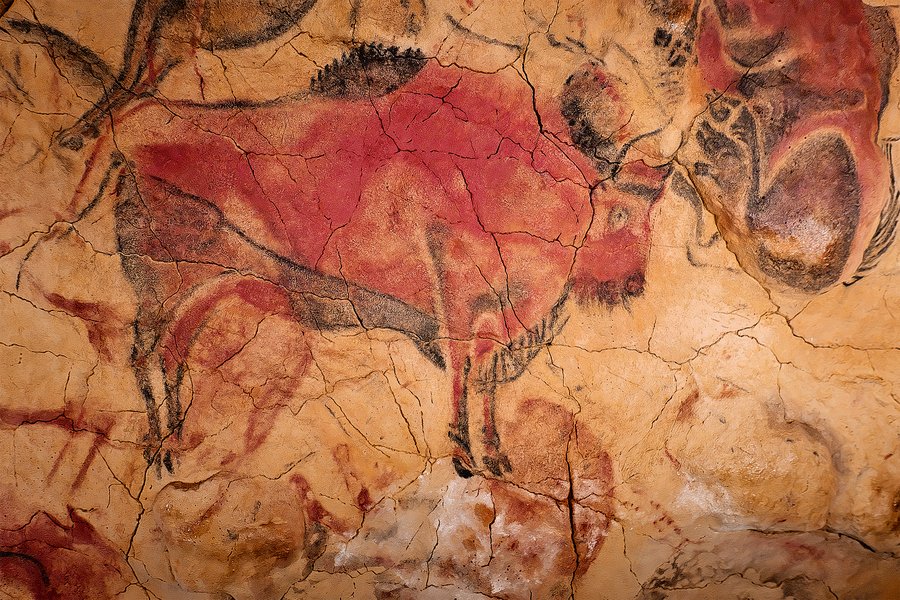
Cave painting depicting a bison from the Altamira Cave. ~16,000 BCE. Iberian Peninsula
The Altamira Cave in northern Spain was discovered in 1868, and its famous polychrome paintings depicting animals were studied between 1876 and 1879. These images date back 17–14 millennia BCE and belong to the Upper Paleolithic era, specifically the Solutrean and Magdalenian cultures. The paintings were created over at least four stages, which indicates a long-standing artistic tradition behind them. These murals are considered one of the highest achievements of Paleolithic art in Europe—Altamira is a UNESCO World Heritage Site.
The Altamira bison are painted on natural ceiling protrusions, creating an effect of movement through their relief. Upper Paleolithic masters, who did not know writing, already understood perspective, proportion, and color modeling. Pigments were made from ochre and manganese salts, and the natural irregularities of the vault were used to convey volume. However, rock art served not only as decoration but also as part of a ritual associated with hunting. In addition to Altamira, similar complexes are known in Lascaux, Chauvet, and other caves in France and Spain. These monuments prove that the aesthetic and religious experience arose in its current form long before the advent of agriculture and cities—and it was expressed in art that merges the contemplation of nature with symbolic abstraction.
~ 13000 до н. э.
Taming a Dog
Relief depicting two greyhounds from the Mereruka Mastaba. Old Kingdom, 6th Dynasty, reign of Djedefre. Circa 2345–2333 BCE.
Genetic analysis of bone remains from Cheddar Gorge Cave in the United Kingdom revealed that dog domestication occurred approximately 15,000 years ago. This is the earliest known instance of animal domestication, predating the taming of cattle, pigs, and sheep by several millennia. The dog became the first animal to take a permanent place in human daily life. Its ancestor is believed to be an extinct wolf species, and the domestication process proceeded concurrently in different regions of Eurasia. New data point to a complex genetic history involving multiple crossbreeding events. Dog domestication fundamentally altered hunting and encampment protection strategies.
The earliest rock carvings depicting dogs on leashes have been discovered in Arabian caves and date back 8,000–9,000 years. The presence of a leash indicates that humans mastered animal training significantly earlier than previously believed. In Mesolithic and Neolithic art, the dog appears alongside humans during hunting, in daily life, and in rituals. These images help reconstruct the social roles of animals and their symbolic significance. The dog became not only an assistant but also an object of artistic contemplation. Its image appeared in the myths, ornaments, and burial practices of many cultures, and the domestication of the dog marked the first step toward the cultural transformation of nature.
~ 10000 год до н. э.
The end of the last Ice Age
The Megaloceros (giant deer) depicted with a dotted line, found in the Lascaux cave. Aquitaine, Dordogne department, Montignac commune territory. France.
The last Ice Age ended around 11,700 years ago, marking the beginning of the Holocene—the modern geological epoch. During the late Pleistocene, climatic conditions favored the spread of mammoths, bison, horses, reindeer, and cave lions. The end of the Ice Age was accompanied by radical changes in the graphic and plastic forms of art. Small-scale art forms emerged—engravings on bone, antler, tusk, and stone—characterized by their exceptional delicacy of execution.
In the Amazon basin, rock art depicting mastodons and giant sloths was discovered, dating to 11,800–12,600 BCE. However, climate change led to the disappearance of megafauna and a restructuring of hunting strategies. People were compelled to explore new territories, including forests, coastlines, and river valleys. This process is reflected in art through the shift from large cave paintings to mobile forms. Geometric ornaments, schematic figures, and symbols emerged—these smaller art forms were convenient for storage and transport, aligning with a more nomadic lifestyle. These changes paved the way for the Neolithic Revolution and new artistic practices associated with pottery and settled communities.
~ 10000 до н. э.
The Neolithic Revolution
Cup painted in «white on red» depicting a Nile landscape. 36th century BCE. Egypt
Around 12,000 years ago in West Asia, a slow transition began from hunting and gathering to settled agriculture. This process, known as the Neolithic Revolution, led to the emergence of permanent settlements and the accumulation of food reserves. People began to intentionally cultivate grains and legumes, as well as domesticate livestock. The first long-term dwellings, granaries, and communal structures appeared. Population growth and the increasing complexity of social organization became consequences of this new way of life. The Neolithic Revolution radically changed human relationships with nature and laid the foundations of civilization. It also fostered the development of crafts, trade, and exchange systems between communities.
In Neolithic art, rock painting gave way to pottery and small sculpture. The emergence of pottery making became one of the primary hallmarks of the Neolithic era. Ceramics were decorated with ornamentation, and wooden utensils featured carving; schematically ornamental forms dominated the imagery. The ornamentation of Neolithic ceramics comprised a deliberate, compositionally precise design, imbued with symbolic content. Anthropomorphic and zoomorphic figurines were often associated with fertility and ancestor cults—clay female figurines found from the Balkans to Near Asia are considered the most ancient depictions of deities.
~ 9600 до н. э.
Göbekli Tepe, the oldest known megaliths
Pillar from the Göbekli Tepe Megalithic Complex. 12,000–8000 BCE. Lesser Asia
Göbekli Tepe in southeastern Anatolia is a monumental structure built by hunter-gatherer groups during the pre-ceramic Neolithic period, roughly between 9600 and 8200 BCE. These structures were likely used for mortuary rituals. Reliefs of wild animals—bulls, wild boars, foxes, lions, gazelles, snakes, and griffins—are carved into characteristic T-shaped pillars. Furthermore, there are abstract pictograms whose meaning remains unclear. Radiocarbon dating confirms that construction at Göbekli Tepe began even before the advent of agriculture in the region.
The Göbekli Tepe reliefs open up new perspectives for understanding the symbolic world of the pre-ceramic Neolithic. Constructing such a complex required the organization of large groups of people (stone pillars weighing up to twenty tons were quarried from the rock and moved without wheels) and the transmission of knowledge between generations. The absence of traces of permanent dwellings indicates the object’s ritualistic, rather than domestic, nature. Göbekli Tepe demonstrates that monumental art emerged before agriculture, altering the traditional sequence of «household first, then temple, ” which was accepted in 20th-century archaeology.
~ 8000 до н. э.
Ceramics Diffusion
Pitcher. Majiaoy Culture. China. Circa 3300–2050 BCE.
Ceramics became the first artificial material created by humans. Its emergence is considered a crucial sociocultural turning point of the Neolithic era, transforming how food was gathered, stored, and processed. The earliest ceramic pottery originated in hunter-gatherer communities across the Far East, the Japanese archipelago, and the Amur and Yangtze basins. It was produced around 12,000–10,000 BCE, prior to the advent of agriculture. By 8000 BCE, the first vessels in familiar shapes and functions began to appear.
In the Neolithic era, abstract ornamental forms of imagery emerged. Pottery was covered with geometric patterns made of spiral lines, zigzags, and dots. The ornamentation was applied using a comb, a stick, or a stamp, and it often covered the entire surface of the vessel. The shapes and decoration of the ceramics vary across archaeological cultures and regions. These differences allow scholars to reconstruct the migrations and contacts of ancient societies for whom pottery became not only a utilitarian object but also a carrier of aesthetic and symbolic information. The invention of the potter’s wheel during the Eneolithic accelerated the production of tableware and increased its quantity.
~ 8000 до н. э.
Jericho: Ancient Urban Structures
Head of an ancestral statuette. Plaster, basins, and pigments. Near East, Judean Desert, Jericho. Ceramic Neolithic. Circa 7000 BCE.
Ancient Jericho, in the Jordan Valley, is one of the world’s oldest fortified settlements. On its ruins, covering more than 2.5 hectares, round houses made of mudbrick and communal buildings have been discovered—evidence of the complex social organization and developed symbolic culture of the ancient Jerichosites. Modern Jericho exists on the same land and stands as one of the oldest continuously inhabited cities in the world.
The Art of Jericho connects ritual with the earliest experience of sculptural portraiture. Notable finds from this period include nine skulls featuring realistic sculptural portraits. They were fashioned from unfired clay and coated with a layer of lime. These skulls are apparently linked to ancestor worship. In general, the Jericho people often separated the skull from the mandible and kept them in their homes—more than ten such remains had modeled facial features and inlaid cowrie shells in the eye sockets. These discoveries indicate that a complex relationship with death and memory existed even in the pre-ceramic Neolithic.
~ 6000 до н. э.
The Emergence of Winemaking