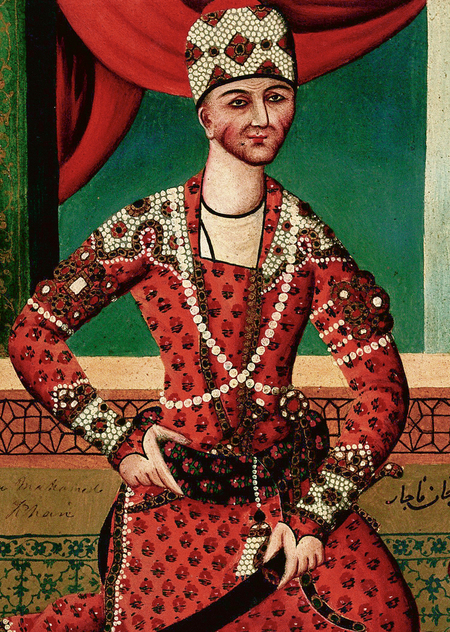
From the clay tablets of Sus to the frescoes of Isfahan, from the enigmatic priests of Elam who invented writing to the Aryans of Media who established the imperial canon—the history of Iran resembles a multi-layered Persian carpet, where every knot is an event and every pattern is an epoch. In our timeline, we will show how Achaemenid reliefs at Persepolis glorified the «King of Kings, ” and how Parthian coinage merged the Hellenic profile with the Iranian horseman. Sasanian silks and Seljuk star-patterned bricks, Safavid miniatures, and Qajar lacquer portraits—before you is not just a chronicle of wars and empires, but the history of the ancient Iranian spirit.
Около 2700–639 годы до н. э.
Elamite and Doric Civilizations
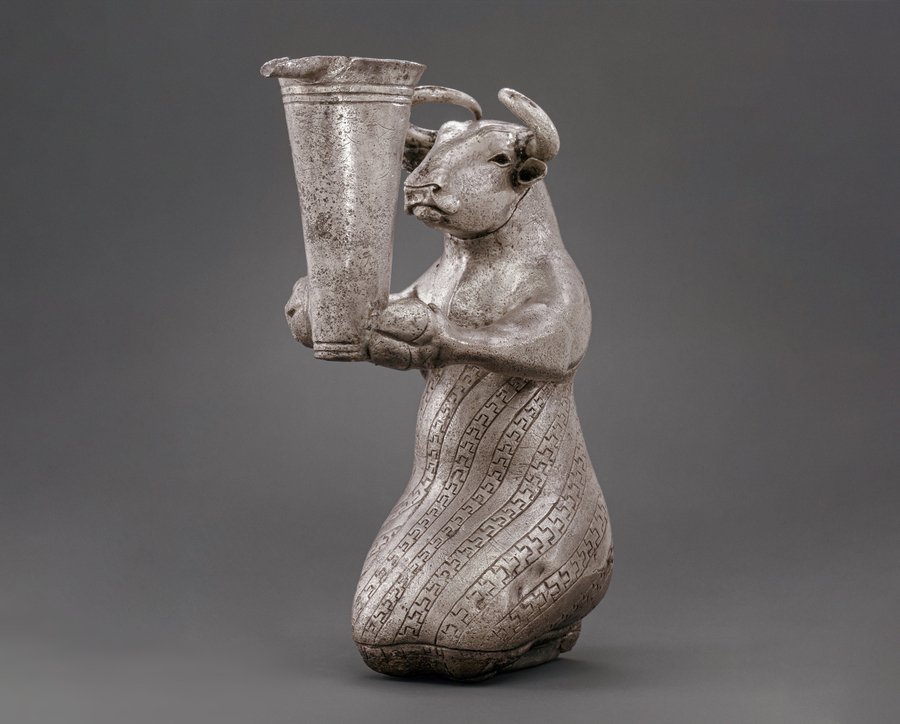
Kneeling bull holding a vessel with a snout. Silver. The city of Susa in southwestern Iran. Proto-Elamite period. Circa 3100–2900 BCE.
In the southwestern Iranian Plateau, in the valleys of the Karun and Karkheh rivers, around 2700 BCE, the Elamite state emerged with its capital in the city of Susa. This was preceded by the Proto-Elamite culture (c. 3100–2700 BCE), which created one of the oldest writing systems—Proto-Elamite—which remains undeciphered to this day. The Elamites, a people of non-Indo-European origin, fought equally against Akkad and Babylon. In the 13th century BCE, they sacked Isin (another wealthy Mesopotamian city-state), but around 639 BCE, they fell under the attacks of the Assyrian king Ashurbanipal.
Elamite art was powerfully influenced by Mesopotamia while remaining remarkably distinct. A masterpiece of Elamite bronze sculpture is the statue of Queen Napirasu (c. 1350–1300 BCE), weighing 1,750 kg and cast using the lost-wax method. The architectural gem of Elam is the Zigguart of Chogha Zanbil (Dur-Untash), built by King Untash-Napirisha around 1250 BCE. Unlike Mesopotamian ziggurats, its four levels share a common base rather than being stacked one upon the other. This ziggurat is the oldest UNESCO World Heritage site in modern-day Iran.
670–550 годы до н. э.
The Kingdom of Mydius
Adrian Coller. Kir, King of Persia. Engraving. 1590s
The Median Kingdom was an ancient Iranian state with its capital in Ecbatana, located in the territory of modern-day Hamadan. In 612 BCE, the Median King Cyaxares, in alliance with Babylon, crushed the Assyrian Empire, destroying Nineveh. Subsequently, Media became a power that controlled almost the entire Iranian Plateau and part of Armenia. In 550 BCE, Cyrus the Great, a vassal Persian king, raised a rebellion against Media and captured Ecbatana, thereby initiating the Achaemenid Empire.
From the Midean period to the present day, unique architectural monuments have been preserved. At the Nus-i-Jang settlement (circa 750 BCE), monumental structures made of mudbrick have been excavated—a central rhomboid-shaped temple and a hall with columns—while at Godin-Tepe, a fortress with a large vaulted building and storage rooms was discovered. An example of Midean jewelry art is the hoard from Ziviye (circa 700 BCE), which contains gold and silver objects where Assyrian motifs intertwine with the Scythian «animal style»; it is because of this hoard that Midea is considered its birthplace, from where it subsequently spread across the Eurasian steppes.
559–331 годы до н. э.
Achaemenid Empire
Bas-relief from the Apadana Palace, depicting the procession of Lydians and Armenians presenting their renowned wine to King Darius. Persepolis. Iran. 5th century BCE. Fragment.
The Achaemenid Empire was the first global superpower in history. In 559 BCE, Cyrus the Great united the Persian tribes and subjugated Media, subsequently conquering Lydia and Babylon. Under Darius I (522–486 BCE), the empire reached its zenith, stretching from the Indus to the Aegean Sea, and from Egypt to Central Asia. To govern this empire, the king divided it into 20 satrapies, introduced a unified tax system, and established the Royal Road. Aramaic became the administrative language, and Zoroastrianism served as the religious foundation. In 331–330 BCE, the army of Alexander the Great defeated the Persians and burned Persepolis, concluding the Achaemenid era.
Achaemenid art is an eclectic synthesis of the traditions of conquered peoples, which gave rise to a monumental imperial style. Its zenith is the ceremonial complex of Persepolis (c. 518 BCE), erected on an artificial platform 12 meters high and spanning over 12,000 square meters. Darius I’s main reception hall (apadana) featured 36 columns and could accommodate thousands of guests. The entrance, the «Gate of All Nations» of Xerxes, was guarded by 16-meter winged bulls with human heads (shedu), borrowed from Assyria but given a stricter, more static appearance in the Persian iteration. The grand staircases were adorned with bas-reliefs depicting the 33 nations of the empire presenting gifts to the king. Finally, the royal rock-cut tombs at Naqsh-e Rostam, with their cross-shaped facades, represented an innovative fusion of Mesopotamian, Egyptian, and Aegean architecture.
312 до н. э. — 224 годы н. э.
The Seleucid and Parthian Kingdoms
Gerard Audran. Alexander the Great enters Babylon. Engraving. 1675. Fragment
Following the collapse of the empire of Alexander the Great, his general Seleucus I Nicator founded the Seleucid Empire in 312 BCE—the largest Hellenistic power, stretching from the Aegean Sea to Central Asia. However, by the mid-3rd century BCE, the eastern satrapies revolted. In 247 BCE, the Parthian nomads, led by Arshak, conquered Parthia and established a new kingdom. Under Mithridates I (c. 171–138 BCE), the Parthians recaptured Iran and Babylonia from the Seleucids, transforming into Rome’s main rival in the East. After Crassus’s defeat in 53 BCE, Parthia became an insurmountable barrier to Roman expansion into Eurasia. Nevertheless, internal strife weakened the empire, and in 224 BCE, it fell to the assault of the Persian King Ardashir I of the Sasanian dynasty.
Seleucid art is a synthesis of Hellenic and local traditions. The temples of Kangava and Hurkha, built around 200 BCE, imitate Greek orders but with crude deviations from classical canons. Bronzework figures from Nahavand and a bronze head from Shami (2nd–1st centuries BCE) from the same era survive—testaments to the high skill of local casters. Parthian art, by contrast, developed its own distinct style. Its architectural symbol was the iwan—a three-sided vaulted hall open onto a courtyard—which later transitioned into Islamic architecture. The finest example of this style is the palace in Hatre (c. 2nd century BCE), whose walls are adorned with antique reliefs. Excavations at Old Nisa (Turkmenistan)—the royal residence of the Arsacid dynasty—have unearthed dozens of ivory rhytons featuring griffin-shaped handles and scenes from Greek mythology, vividly demonstrating the cultural syncretism of the Parthian elite.
Sasanian Empire
King’s head. Carved from a solid piece of silver with chasing and relief detailing. Sasanian dynasty. Iran. Circa 4th century.
The Sasanian Empire, founded by Ardashir I in 224 AD, became the last great pre-Islamic power of Persia, viewing itself as the heir to the Achaemenids. Under Shapur I, the empire delivered a crushing defeat to Rome, during which the Emperor Valerian was captured by the Persians. The empire reached its zenith under the reign of Khosrow I Anushirwan (531–579 AD), who implemented profound military and fiscal reforms. Zoroastrianism’s influence was unshakable: it became the state religion, and the priesthood served as a vital pillar of the throne. However, by the mid-7th century, the power, torn apart by internal conflicts, fell under the onslaught of the Arab conquerors. The last Sasanian Shah, Yazdegerd III, was killed in 651, marking the end of the Sasanian era.
Sasanian art is a brilliant synthesis of monumentality and exquisite luxury. Its symbol is the gigantic ivan of the palace of Takht-e Kepar in Ctesiphon—an open, vaulted hall reaching 37 meters in height—whose construction anticipated the development of Islamic architecture. Another remarkable monument of that era’s art is the 6-meter Colossal Statue of Shapur I, carved directly from a stalactite in a cave. Scenes of royal victories, depicted on dozens of stone reliefs, such as the triumph over Rome at Naqsh-e Rustam, served as a powerful tool of propaganda. The empire gained world renown through silks featuring intricate hunting scenes and silver platters bearing portraits of warrior kings—masterpieces of metalwork that traveled from China to Britain, profoundly influencing the art of medieval Europe and the Islamic world.
VII — конец VIII века
The Rashidun, Umayyad, and Abbasid Caliphates
Caliph Umayyad Muawiya I with his advisors. Manuscript «Collection of Historical Works» by Hafiz-i Abru. 1425. Fragment
In the 7th century, the Muslim conquest descended upon Persia. By 651, the Sasanian Empire had fallen, and Zoroastrianism gradually gave way to Islam. Following a brief period of the Rashidun Caliphate (632–661), power shifted to the Umayyads (661–750), who ruled from Damascus. However, they were overthrown by the Abbasids (750–1258), who based their authority on the support of the eastern provinces, among which Persia was included. With the rise of the Abbasids, Persian influence grew sharply: Persian bureaucrats replaced the Arab aristocracy in governance, and the powerful Sasanian family of the Barmakids (Balkh) took positions as viziers. The capital was moved from Damascus to Baghdad, marking the beginning of the «Islamic Golden Age.»
Iranian heritage formed the foundation for the art of the Islamic world. In architecture, masters drew upon Sasanian traditions: centralized dome compositions and a courtyard principle with perimeter galleries. Abbasid builders developed what is known as the «slanted style» of carving and actively employed abstract geometric ornamentation—arabesque. At the peak of the Caliphate’s power, Iranian applied arts also flourished, particularly lusterware ceramics with a shimmering metallic sheen. After two centuries of relative «silence» in the 9th–10th centuries, a true Persian Renaissance began under the semi-independent Samanid dynasty (819–999).
IX–X века
Samanids, Tahirids, Saffarids
Firdausi. The epic «Shahnameh» (Book of Kings). It describes the history of Iran from ancient times until the penetration of Islam in the 7th century. The Aqunidan devil throws Rostam into the sea. 16th–17th centuries. Fragment
With the first fragmentation of the Abbasid Caliphate in the 9th century, the eastern provinces of Iran achieved de facto independence. The first Persian dynasty to attain autonomy were the Tahirids, who ruled from Nishapur. They were succeeded by the Saffarids, originating from the artisan class of Sistan, who extended their power over Khorasan and southern Iran. However, the true flourishing of Iranian statehood came under the Samanids. Under Emir Isma’il I, who established Bukhara as the capital of his state, the power became independent of Baghdad. It was in this era—dubbed the «Persian Renaissance"—that the classical New Persian language, Dari, was formed; poets Rudaki and Ferdowsi began their creative work; philosophers Avicenna and al-Farabi emerged; and architecture was enriched with masterpieces such as the Samanid Mausoleum in Bukhara.
The Tahirids and Saffarids did not leave behind major architectural monuments. The zenith of Samanid architecture was the Mausoleum of Ismail Samani in Bukhara (late 9th — early 10th century)—a square, domed building whose facades are covered with exquisite brickwork resembling woven lattices. Scholars refer to this monument as a «temple of fire in Islamic garb» due to its stylistic resemblance to pre-Islamic Zoroastrian sanctuaries. Samanid ceramics presented a completely different technique—polychrome bowls adorned with epigraphic ornamentation and rare figurative scenes. The production of this glazed ware was established in Nishapur and Samarkand, from where it was exported throughout the Middle East.
XI–XII века
Gaznavids and Seljuks