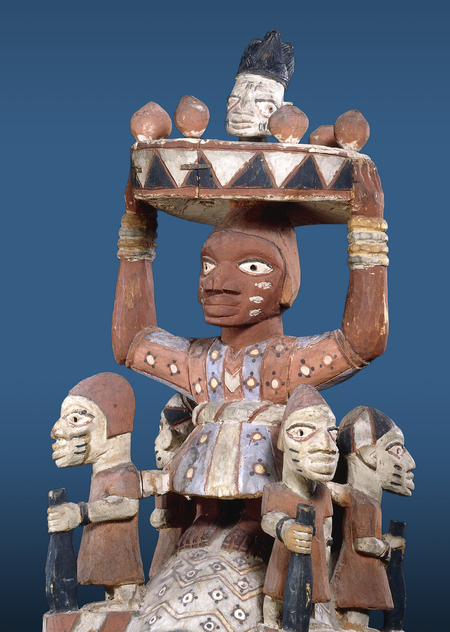
Africa—the cradle of humankind and the birthplace of ancient civilizations. Our timeline will guide you through hundreds of thousands of years of its history, from the emergence of Homo sapiens sapiens to the megacities of the 21st century. We will see how history and art are inextricably intertwined: from the sacred pyramids of Egypt to the powerful monuments of decolonization. Each era left a unique imprint on Africa—a language of power, faith, memory, and resistance.
Около 300 000 лет назад
The Emergence of Homo sapiens sapiens
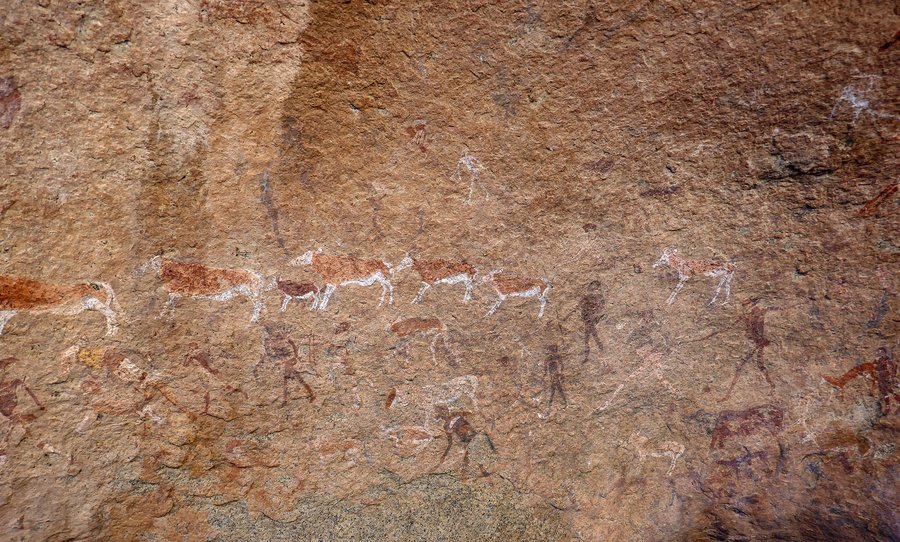
«White Lady» in the Brandberg array is an ancient rock painting from Bushmen art in the Maaka Cave in Namibia.
Homo sapiens sapiens—that is, modern humans—emerged in Africa approximately 300,000 years ago, evolving from more ancient species of Homo. They proved highly adaptable to survival across almost all of Earth’s climatic zones, sustaining themselves through hunting and gathering. Morphologically, Homo sapiens sapiens differ from their predecessors by a lighter skeletal structure, a high, vaulted cranium with an almost vertical forehead, reduced brow ridges, and a developed chin. Paleogenetic and paleoanthropological data strongly confirm the African origins of our species, while new discoveries point to a complex, polycentric model of its formation across various regions of the continent.
In Africa (south of the Sahara), the earliest evidence of cultural life for ancient Homo sapiens sapiens consists of pigments used on artifacts dating back more than 300,000 years, as well as geometric engravings on ochre made about 100,000 years ago. These artifacts are direct proof of the presence of advanced cognitive behavior—including abstract thought—in the earliest members of our species.
IV–I тысячелетия до н. э.
The Flourishing of Egypt
Papyrus «Book of the Dead for Nevni, ” sung by the goddess of Amun-Ra, who held the title „Daughter of the King.“ Third transitional period. Circa 1050 BCE.
In the 4th–1st millennia BCE, one of the world’s most ancient civilizations—Egypt—emerged and flourished in the Nile Valley. Its development was shaped by agriculture, which was only possible due to the Nile’s inundations, necessitating high levels of organization and, consequently, strong centralized authority. By the end of the 4th millennium BCE, during the Naqada III period, Upper and Lower Egypt were unified under the rule of a pharaoh, marking the beginning of the Early Kingdom (c. 3100–2686 BCE). This period established the foundations of statehood, hieroglyphic writing, and monumental art, all of which reached their zenith in the subsequent kingdoms—the Old, Middle, and New Kingdoms.
The art of ancient Egypt was closely tied to religious and cultic functions, primarily ensuring eternal life in the afterlife. The architecture was characterized by monumentality, while the sculpture and painting adhered to strict canons. Features characteristic of the ancient Egyptian style include geometric forms, the combination of different viewpoints within a single image (for example, a profile head combined with a frontal chest), and symbolism. A vivid example of early art is the Narmer Palette of the Pharaoh (c. 3000 BCE), whose reliefs, following the established canon, glorify the unification of the country.
I тысячелетие до н. э.
Spread of Bantu peoples
Terracotta sculpture of Nok culture. Nigeria. 500 BCE — 500 CE
In the first millennium BCE, a large-scale expansion of Bantu peoples began from their presumed original range on the border of Cameroon and Nigeria. This process, which spanned centuries, became one of the key events in the continent’s history. Its driving forces were the adoption of agriculture (cultivating yam, oil palm, and later grains) and iron smelting and working technologies. These innovations provided the Bantu with an advantage in conquering new territories, particularly tropical forests and savannas. The migration proceeded along two main routes: through the Congo basin and along the eastern coast toward the Great African Lakes, where the Bantu encountered local Khoisan and Nile-Saharan groups, gradually displacing them into less favorable regions of the continent.
The cultural imprint of Bantu migration is clearly discernible in archaeology. A crucial marker of their presence is the «Urewe style pottery, ” which derives its name from an archaeological site in Kenya and dates back to the 6th century CE. This pottery is characterized by its thin walls, figural rims, and complex stamped geometric ornamentation, indicating a high level of craftsmanship. Furthermore, the mastery of metallurgy not only revolutionized the creation of tools and weaponry but also led to profound social consequences. Control over metal smelting contributed to social stratification, and the iron and copper objects themselves quickly gained not only utilitarian but also prestigious, ritualistic value.
I тысячелетие до н. э. — первая половина I тысячелетия н. э.
Ancient Civilizations of North Africa
The sacred bull Apis. Egypt. Ptolemaic Dynasty period. 322–30 BCE.
The period from the first millennium BCE to the first half of the first millennium CE marked an era of integration into the Mediterranean world and the succession of powerful empires for North Africa. The beginning of this period is signaled by the establishment of Phoenician trading colonies, the largest of which was Carthage (founded in 814 BCE), which dominated the Western Mediterranean until its destruction by Rome in 146 BCE. Egypt, after being conquered by Alexander the Great, was ruled by the Hellenistic Ptolemaic dynasty. However, by the 1st century BCE, the entire region, from Egypt to Mauretania, was under the control of Rome, transforming the land of the ancient Pharaohs into the empire’s breadbasket.
The cultural and artistic development of the region during this era was defined by the synthesis of diverse traditions. Punic art represented a complex combination of Egyptian, Greek, and Near Eastern motifs, which was particularly evident in ivory carvings, metalwork, and terracotta masks. In Hellenistic Egypt, Greek artistic canons merged with ancient Egyptian forms, giving rise to unique phenomena such as the Fayum portraits. The Roman period brought about large-scale urbanization: the construction of cities (such as Timgad in Algeria), temples, theaters, and triumphal arches. The spread of Christianity by the 4th century CE laid the foundation for the development of rich ecclesiastical architecture and mosaic art. Concurrently, the traditions and cultures of local peoples (such as the Berbers) were preserved in the region. This complex interplay of civilizations created the unique artistic heritage of North Africa.
VII–XV века
The Golden Age of Medieval African States
Bronze sculptural heads. The culture of the Yoruba people. At the center is the head of a Yoruba ruler from Ife, 14th–15th century.
The period from the 7th to the 15th century was an era of flourishing powerful states in West and Central Africa, whose prosperity was built upon control of the trans-Saharan trade. Gold, ivory, and slaves were brought north across the desert, while salt, textiles, and artisan goods were carried in return. Succeeding the Ghana Empire (8th–11th centuries)—known as the «Land of Gold”—was the Mali Empire (13th–15th centuries), which reached its peak under Mansa Musa, whose pilgrimage to Mecca in 1324 astonished contemporaries with the ruler’s immense wealth. In the 15th century, the Songhai Empire, centered in the city of Gao, took the leading role in the Sahara. Simultaneously, states of the Yoruba people developed in the south (Ife, Oyo, Benin), and the civilization of Great Zimbabwe flourished in Southeast Africa.
The artistic culture of this «Golden Age» reached outstanding heights, synthesizing local traditions with external influences. Yoruba art reached its peak in Ife (12th–14th centuries), where famous terracotta and bronze heads of rulers and deities were created, distinguished by their exquisite craftsmanship. Subsequently, this tradition was adopted and developed in Benin (14th–16th centuries), where a more stylized and ceremonial aesthetic emerged: artisans cast ritual heads of kings (Oba) for ancestral altars, as well as relief plaques that adorned palaces and depicted historical events. Furthermore, the cities of West Sudan—Djenné and Timbuktu—became vital centers of Islamic scholarship and architecture, where magnificent mud-brick mosques were constructed. In Southeast Africa, the Zimbabwe civilization left behind monumental stone structures (the Great Zimbabwe Acropolis), bearing witness to the advanced level of architectural skill and social organization of this people.
С VII века
The Spread of Islam
Blue Quran. A leaf from a lavish multi-volume Quran featuring indigo-colored pages and silver bookmarks for verses. Second half of the 9th to mid-10th century.
Islam entered Africa in 615 CE—alongside the first Muslims who fled persecution in Aksum, Ethiopia. In the following decades, there was military expansion: Arab armies conquered Egypt (641 CE) and by the beginning of the 8th century, the Caliphate’s authority spread across the entire North African coast. Subsequently, Islam spread primarily through peaceful means. In West Africa, the trans-Saharan trade routes played a key role, facilitating the movement of Muslim merchants and missionaries deep into the continent. By the 10th–11th centuries, the ruling elites of Sahelian states, such as Ghana and Kanem, began adopting Islam, strengthening trade and diplomatic ties with the Muslim world. In East Africa, Islam took root along the Swahili coast due to trade connections with the Arabian Peninsula and the Persian Gulf.
The spread of Islam profoundly influenced the art, architecture, and intellectual life of Africa. Arab Islamic architecture became dominant in urban planning, most strikingly seen in the construction of mosques and palaces made of adobe brick or stone—the Great Mosque of Djenné (Mali), built in the 13th century, is an example of this architectural style. Timbuktu (Mali) became a vital center of Islamic scholarship, where the renowned Sankore Madrasah operated by the 16th century and the book trade flourished. Islam also spurred the development of written culture and historiography in local languages using Arabic script (Ajami), as evidenced by the rich local libraries. Concurrently, African Islam was often characterized by syncretism: local rulers and populations could combine Islamic practices with traditional beliefs and rituals, leading to periodic movements advocating for religious reform and «purification» (such as the Fulani jihad in the 19th century). This cultural synthesis forged a unique and diverse Islamic heritage across the African continent.
The Era of Transatlantic Slave Trade
Metal plate depicting a warrior and his retinue. Benin Court Art. 16th–17th centuries.
The transatlantic slave trade, initiated by the Portuguese in the mid-15th century, peaked in the 18th century and was officially banned by most countries only in the 19th century. During this time, an estimated 12 to 17 million Africans were forcibly transported across the Atlantic, and the total demographic losses of the continent (including those who died during capture and transport) run into tens of millions. This system, based on the «triangular trade» among Europe, Africa, and the Americas, fundamentally altered the political and economic landscape in many regions of West and Central Africa, fueling internal conflicts and violence over the capture of captives.
Despite the tragic context of the era, African artistic traditions were not only preserved but also entered into complex interactions with the outside world. Europeans who arrived on the coast became patrons for local artisans, which gave rise to unique syncretic art forms. A striking example is the exquisite ivory carvings created by the Sapi people in the territory of modern-day Côte d’Ivoire for Portuguese merchants; these pieces blended African motifs with European forms. At the same time, many classic forms of African art, such as wooden cult sculpture and ritual masks, continued to develop within their respective societies. A tragic paradox was that the mass export of African artifacts to Europe as exotic trophies in the nineteenth century—beginning after the British punitive expedition to Benin (1897)—eventually introduced the Western world to the power of African aesthetics and exerted a profound influence on the development of European modernism.