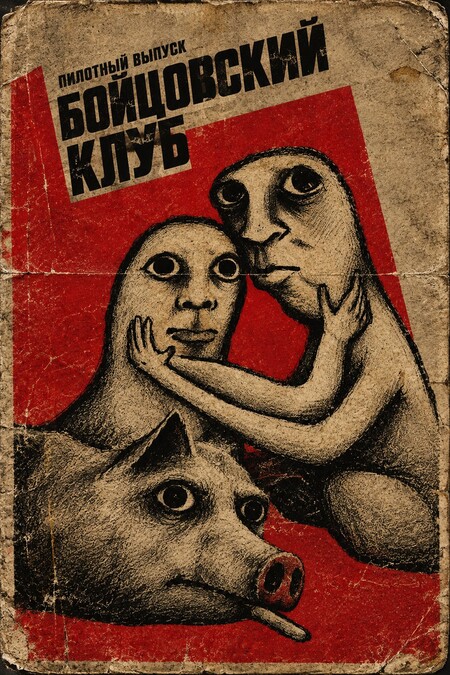
Implementation Plan for the Author’s Video Media «Alternative»: A Case Study of the Pilot Episode—Analyzing Chuck Palahniuk’s Novel «Fight Club» and David Fincher’s Adaptation. Episode Structure, Production Phases, Equipment and Budget, Workflow Organization, and Project Prospects.
1. Concept for the Pilot Episode
For the first episode, we propose examining Chuck Palahniuk’s novel *Fight Club* and David Fincher’s film adaptation. This approach will immediately establish the project’s direction and demonstrate its methodology for analyzing literature and cinema.The central theme could be the inherent contradiction between rebellion against consumer society and the transformation of that rebellion into a popular cultural commodity. However, it is crucial to analyze not only the meaning of the work but also how that meaning is conveyed through cinematic techniques and which directorial choices make it compelling or, conversely, open to ambiguous interpretation.The estimated length of the episode will be 15–20 minutes. This is sufficient time to develop the author’s argument, deconstruct several artistic devices, and compare the book to the film without turning the video into a drawn-out lecture.
2. Possible Graduation Presentation Structure
Introduction — 1–2 minutes. Introduce the work and pose the central question. Instead of a simple synopsis, you might begin with a visual contradiction: the film critiques consumer culture, yet its imagery has become part of mass culture itself.Literary Source Material — 3–4 minutes. Analyze Palnik’s authorial intent, narrative structure, imagery, and literary techniques. Here, it is crucial to define what must be preserved when transferring the work to the screen and what cinema can express differently.Directing and Adaptation — 5–7 minutes. This is the core of the presentation. Analyze the shot composition, editing, lighting, color palette, sound design, acting, and the handling of the unreliable narrator. You could examine how Fincher’s specific directorial choices shape the audience’s perception of the characters and influence the understanding of the story.
Original Interpretation — 3–4 minutes. Present your own analysis of the work, addressing its contradictions and relevance. You may also propose an alternative directorial approach for one of the scenes and explain how it could reveal Palanik’s ideas differently.
Conclusion — 1–2 minutes. Offer a final assessment of the book, the film, and the quality of the adaptation. It is important that these are three independent judgments, not a single verdict based solely on comparison.

3. The Artistic Approach: Beyond Critique to Director’s Mindset
One of the distinctive features of «The Alternative» can be the discussion of how a work might be translated onto the screen and what cinematic techniques could be used to reveal the author’s intent.For instance, when analyzing *Fight Club*, we could explore how the perception of Tyler Durden would change if the film employed different approaches to lighting, shot composition, sound design, or montage duration. Participants might propose an alternative staging of a scene, articulate its underlying meaning, and compare it to the solution the director actually chose.This process should not devolve into fault-finding or an attempt to prove that the project author could have directed the film better. The goal is to illustrate how artistic form impacts meaning—why the same character might appear as a liberator, a threat, or an object of ridicule depending on how they are presented.Consequently, the project will be able to discuss not only what the work says, but also how it says it. In doing so, the analysis of the script, dramaturgy, direction, and framing will become an organic part of the author’s commentary.

4. Implementation Stages
Research and idea development. This involves studying books and films, gathering materials, finding critical interpretations, and formulating the central thesis for the installment. During this stage, scenes that best illustrate the author’s artistic techniques of interest are also selected.Script and visual concept. This entails preparing the text, determining the sequence of arguments, and selecting visual solutions. For complex segments, storyboards or editing schematics can be drafted in advance, and for alternative takes, a personal visual example can be prepared.
Filming and editing. Recording the voiceover, filming the author on camera if necessary, creating graphics, and editing the material. Much of the video may be built upon a combination of voice, visual examples, quotes, and original insertions.
Completion and publication. This involves final adjustments to sound, color, titles, the cover, and the description. After the installment is released, the audience reaction can be assessed, and the gained experience can be used for the further development of the project.
The timeline will depend on the complexity of the script, the team’s experience, and the available equipment. The first installment will likely require more time than subsequent ones, as the workflow itself will be established concurrently with the production.
5. Equipment and Estimated Budget
At the initial stage, there is no need to create a full-scale studio. For video essays, the main elements are sound quality, editing, and thoughtful visual presentation.
Equipment and Materials — Estimated Cost
Smartphone for filming the author and additional shots — 0 ₽ if you have one. Computer for editing — 0 ₽ if you have one. USB microphone for voice recording — approx. 3,800–9,500 ₽. Tripod or smartphone holder — approx. 1,400–3,300 ₽. LED light or inexpensive lamp — approx. 1,900–5,700 ₽. Headphones for sound monitoring — 0–4,700 ₽ if needed. Editing and graphics software — 0 ₽ if using free versionsThe estimated budget for additional purchases is around ₽7,100–₽23,300 if you already own a computer and smartphone. You can start even cheaper by using existing equipment and purchasing only the essentials. The cost is approximate and depends on the models you select. The free version of DaVinci Resolve is suitable for editing if your computer meets its requirements. Otherwise, you can choose a lighter video editor. Free tools are also available for graphic design and image processing. Purchasing a separate camera is not mandatory to start. It is much wiser to first test the format on equipment you already have and invest in gear as your project develops.
6. Production Organization
I can handle the research of works, the development of the author’s perspective, the script, and the voiceover narration. Depending on my preference, I can also appear on camera.
The second phase of the work may involve visual concept development, editing, graphics, material selection, and technical production management. However, it is best to discuss the narrative and artistic decisions collaboratively—the individual language of the project can emerge at the intersection of analysis and visual thinking.
In the initial phase, involving additional participants is not necessary. If needed, people for music composition, graphics design, or shooting original scenes can be sourced separately.
7. Post-Pilot Prospects
The inaugural issue must determine how successfully it integrates literary criticism, film language analysis, and independent authorial interpretation into a single format.If this approach proves successful, it can be expanded to cover other works of counterculture, cult cinema, and alternative literature. Furthermore, each issue can feature its own artistic methodology: in one instance, the main focus might be on screenwriting and dramaturgy; in another, it could be on directing, editing, cinematography, or the specifics of literary adaptation.
The primary goal of this pilot is not to immediately create a perfect product, but rather to find a functional form for «Alternatives»: to learn how to transform textual analysis into an independent video essay that conveys not only an opinion of the book or film, but also an understanding of how art generates its own meaning.
Cover created with AI
Images are used from open internet sources and are provided strictly for illustrative purposes.