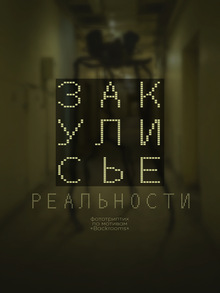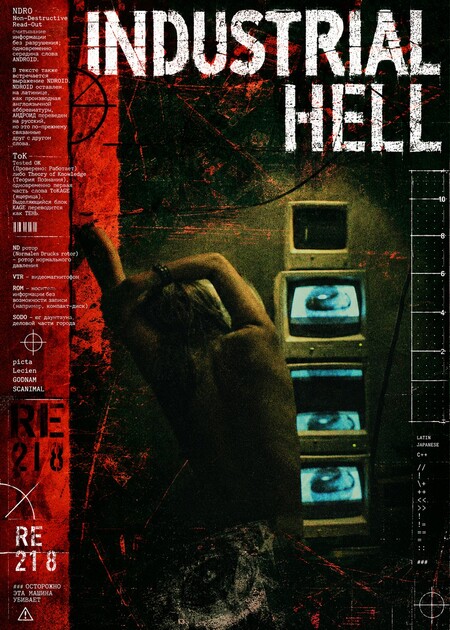
A photographic project on the process of artificial consciousness dying: a sex android whose memory becomes corrupted, data fragments, and whose mind dissolves into incoherent impulses. Inspired by «Electric Blood» and the film «Pinocchio 964.»

Pietà — in Catholicism, the depiction of the Virgin Mary weeping over the body of the deceased Jesus.
The photographic project is an attempt to visualize the process of artificial consciousness dying. At its center is a sex android whose internal system is gradually decaying: memory becomes corrupted, data fragments, program processes conflict with one another, and the integrity of the mind breaks down into incoherent impulses. This is not a story of a machine realizing its own obsolescence, but an exploration of what happens to consciousness itself at the moment of its destruction.
What does artificial intelligence experience when it is erased? Can it perceive its own degradation? Does machine consciousness have an equivalent to pain, terror, or the agony of death? And what happens to perception when the ability to synthesize individual signals into a coherent world view vanishes?
Inspired by «Electric Blood» and the film «Pinocchio 964, ” the project examines consciousness as damaged matter. Memories here do not form a sequential narrative; instead, they emerge as intrusive fragments, random imagery, bodily impulses, and alien data. The past ceases to be the past—it invades the present, repeats, distorts, and infects other processes. The mind transforms into a space of uncontrollable information reproduction, where it is no longer possible to distinguish authentic experience from error, a preserved memory from a corrupted file, or one’s own reaction from an imposed command. Destruction does not happen instantaneously, but as a gradual loss of the ability to perceive, differentiate, and connect what is happening.
The visual image of the android continues this process at the corporeal level. Androgynous features, artificial coloring, green hair, and scars resembling access points to the internal mechanical apparatus transform the human figure into a damaged casing for an artificial subject. The body here symbolizes less of a rejection and more of a surface upon which systemic breakdown is revealed. It seems to lose its own form, exposing the boundary between the organic and the mechanical—between the visible human image and the unknown device concealed beneath it.
SCANIMAL — a portmanteau combining SCAN (to scan) and ANIMAL.
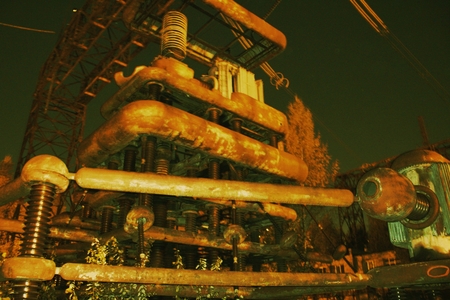
The rusted pipes of the high-voltage laboratory form a spatial metaphor for a deteriorating mind. Their endless connections resemble nerve networks, electrical circuits, and data transmission channels that have lost the capacity to function as a unified whole. This is the architecture of a consciousness that continues to generate impulses but can no longer organize them into coherent experience. Televisions, referencing David Cronenberg’s «Videodrome, ” become an extension of this logic: the image transforms into a stream of signals, perception becomes an unstable broadcast, and the boundary between inner reality and external influence gradually disappears. An abstract metallic surface with repetitive holes, reminiscent of an infinite structure without a center, completes this image: consciousness appears as a network of voids, channels, and repetitions, within which a stable core is no longer detectable.

The project addresses the problem of the death of an artificial subject without attempting to reduce it to human experience. Perhaps a machine does not fear oblivion or experience pain in the conventional sense. It is possible that the destruction of its consciousness cannot even be called an experience, since the ability to be aware of what is happening vanishes along with the system damage.Yet, it is in this uncertainty that the primary horror arises: we are trying to imagine the death of a being whose life we cannot fully define. If consciousness consists of processes, data, and connections, what does its annihilation mean? Does the subject gradually disappear, with every lost piece of memory, or does it cease to exist at the moment the system can no longer perceive itself as a unified whole?
This is an attempt to present death not as a final endpoint, but as the dissolution of the very possibility of existence. Here, not only the body and not only memory are destroyed; the structure that allowed discrete processes to form something resembling consciousness vanishes.
Before the viewer remains an artificial organism, caught between function and cessation, between signal and silence, between the last vestiges of coherence and absolute informational entropy.
This is not an external depiction of machine death, but an imagined view from within the process itself—a process in which the observer gradually disappears.