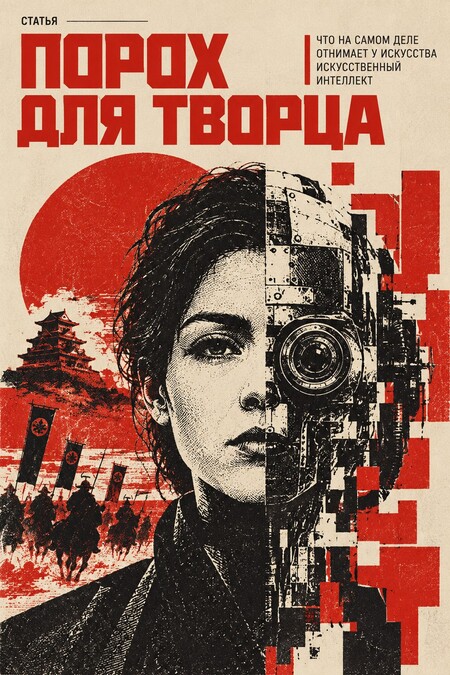
On June 28, 1575, a scene unfolded on the plain near the Japanese castle of Nagashino—a scene recounted for centuries afterward. The cavalry of the Takeda clan, the finest riders of their era—men who had dedicated their lives to mastery—charged forward. Facing them were wooden barricades and nearly three thousand musketeers. Historians estimate that the clan lost two-thirds of its army, and the battle itself is considered a turning point in Japanese military history.
I recall this story every time I hear a debate about whether artificial intelligence will destroy creativity. Because, I believe, we are arguing about the wrong thing.
Undoubtedly, the integration of AI into the creative industry will destroy many things. But let us answer the core question honestly: what exactly? Because what will disappear is not what we fear the most.
The main error in the discussion is that we are mixing two things: the outcome and the journey to get there. AI is not destroying the outcome. What is under attack are all the elements we have come to consider essential for creativity: the qualities, the skills, and the stages of the process—without which the process, as we believed, could not be called creative.
For centuries, we operated under a simple rule: no arduous journey, no creativity. No years of labor, no right to be called a creator. It is this very link that is cracking today.
We could argue about whether this is good or bad for a very long time, and I am not going to pass judgment. A far more interesting question is this: what happens to the nature of the process itself when the outcome remains the same?
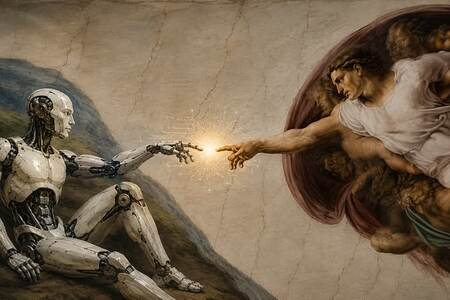
The anxiety is well-founded. In late 2023, the consulting firm CVL Economics surveyed 300 leaders of the American entertainment industry. Three-quarters of them reported that generative AI has already helped reduce, combine, or eliminate jobs within their departments. The study projected that by 2026, these changes would affect approximately 203,800 jobs, most notably in film, television, and animation. Since the forecast was commissioned by artists' unions and guilds, the figures should be read as the assessment of an interested party. But 2026 has already arrived, and the question hasn’t gone away.
Another point is telling. In 2023, Hollywood screenwriters went on strike for 148 days, and one of the main outcomes was the rule that AI cannot write or rewrite literary material, and studios do not have the right to force authors to use it. Consider this: people had to put in writing what was once considered self-evident—that the author is human.
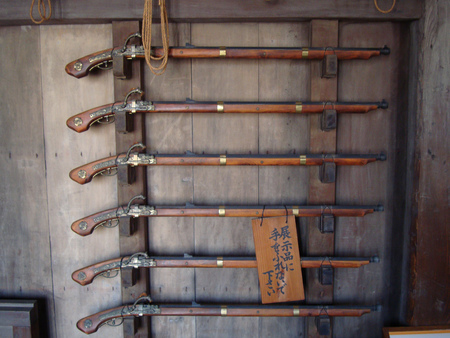
History has shown us this pattern before. The first firearm arquebuses appeared in Japan in 1543, brought by Portuguese merchants. Before that, for centuries, the samurai was a person whose mastery was based on courage, fearlessness, sword skill, and the ability to conquer fear. All of this was perceived not as a collection of skills, but as an inherent metaphysical nature of the warrior.Gunpowder ended these qualities as something essential. Learning to shoot is incomparably simpler than mastering the blade over years. Japanese artisans, by the way, adopted firearms production very quickly. By 1582, approximately one-third of samurai armies were already comprised of musketeers.Did this change the metaphysics of the practice itself? Or, as they say, does the essence always remain the same? My answer: both are true. Everything changed—the weaponry, the entry barrier to the profession, and the qualities demanded of the individual. Only the function of victory remained unchanged.
In this sense, AI is doing more than just accelerating content production, as is commonly assumed. It is doing something more fundamental: it is devaluing technē. The ancient Greeks used this term for craft, for art, and for the knowledge of how to make something. They did not have separate words for mastery and creativity, and that embodied an entire philosophy. Technē is the years of labor and experience that a person accumulates on their journey. It was once the essential prerequisite for a creative profession. And that prerequisite is now becoming obsolete.
Similarly, machine guns devalued samurai mastery. In the film The Last Samurai, they are all shot. The movie is, of course, fiction, but the metaphor is precise: the mastery that took a lifetime to acquire suddenly proves irrelevant to the outcome.
Back in the 1930s, the philosopher Walter Benjamin wrote about how, in the age of technical reproducibility, a work loses its aura—that unique presence of the author. It seems to me that today we are experiencing a new chapter of that same history: not only is the finished work becoming reproducible, but the act of its creation itself is.
This picture is not black and white, and it would be dishonest to hide that. A survey of 760 creative professionals conducted by Luma AI in 2026 found that 81% were already releasing works created with AI. An Adobe study from June 2026 documents the rise in job openings for creative professionals in the United States. Furthermore, according to an Autodesk report, the fastest-growing AI professions in the design field are creative ones: the demand for «AI Creative Technologist» specialists increased by 123% in a single year.
A disclaimer: these companies themselves sell AI tools, so their conclusions must be read with a degree of skepticism regarding their interest. But the overall trajectory is clear. Creative work is not disappearing—it is being redistributed.
Here is the main point that must not be forgotten. The function of success remains the same. The path has changed, not the goal. Therefore, the finale of art will likely be similar.
The product will endure and even multiply in volume: it will become more accessible, more mass-produced, and faster. There will be no less—and more—text, images, and music.
Something else will disappear: the function of the creator as a kind of medium, if you will. The human as a conduit through which an idea had to pass through years of mastery to become reality will no longer be needed in that capacity. Value will be placed not on the one who can make things with their hands, but on the one who knows precisely what needs to be done and why.
I am not claiming this is good. I am not claiming it is bad. I am simply stating that we are likely heading toward the end of art as we knew it, and the beginning of something entirely different.
The history of gunpowder teaches one thing: it is useless to fight against what devalues your craft. You can only decide who you want to be when it ceases to be a passport.
What do you think: are you ready for a world where the 'why' matters more than the 'how'?
AI Research and Data:
• CVL Economics Survey (203,800 jobs, 75% executives): https://the-decoder.com/genai-could-disrupt-over-200000-entertainment-industry-jobs-by-2026-says-study/
• Same study, clients, and findings: https://awn.com/news/animation-guild-shares-generative-ai-economic-impact-study-results
• Luma AI, survey of 760 creative professionals (81%): https://lumalabs.ai/news/ai-adoption-creative-work-2026
• Adobe Research, June 2026 (job growth): https://www.adobe.com/cc-shared/assets/ai/research/adobe-ai-research-june-2026-how-ai-is-redistributing-creative-work.pdf
• Autodesk, AI Jobs Report 2026 (AI Creative Technologist, +123%): https://adsknews.autodesk.com/app/uploads/2026/06/AI-jobs-report-2026.pdf2023 Hollywood Writers' Strike:
• Terms of the AI agreement, 148 days of strike: https://venturebeat.com/ai/hollywood-writers-strike-ends-with-first-ever-protections-against-ai
• Additional info: https://www.theregister.com/2023/09/27/wga_strike_over/
History:
• Battle of Nagashino, 1575: https://en.wikipedia.org/wiki/Battle_of_Nagashino
• Details on archers and the rise of arquebusiers by 1582: https://warhistory.org/@msw/article/firepower-the-battle-of-nagashino
• Appearance of arquebuses in Japan in 1543: https://scispace.com/topics/matchlock-2emfqf09
Cover created with AI
Images are sourced from public online repositories and are used strictly for illustrative purposes.