Navigation
- Concept
- Beginning the Creative Journey in Vienna
- First Work on Monumental Commissions
- Charlotte Caro and the Creative Environment in Paris
- Baroness Adele von Rothschild and American Aristocrats
- Charles Richard Crane: The Birth of the «Slavic Epic»
- The Slavic Epic
- Conclusions
Concept
Alfons Mucha is one of the key figures of European Art Nouveau at the turn of the 19th and 20th centuries. His artistic journey developed in close connection with the social, cultural, and spiritual influences of the era, as well as under the influence of numerous patrons and clients who played a significant role in shaping his style and professional destiny. Examining the artist’s biography through the lens of his relationships with clients allows for a deeper understanding of the mechanisms behind the formation of his artistic language and the conditions that determined the appearance of his most significant works.
The research material was selected based on historical authenticity and the significance of facts concerning Muhy’s interactions with his clients and their influence on the evolution of his style. A chronological principle of categorization was used for the analysis, allowing us to isolate major phases: the early Vienna period and initial commissions, patronage by the Quen-Belassi family, creative work within the Parisian environment, contact with the American elite, collaboration with Charles Richard Crane, and work on the Slavic Epic.
The sources included publicly available materials: biographical articles, online encyclopedias, and museum and exhibition catalogs. In analyzing these sources, special attention was paid to cross-referencing facts, identifying the influence of commissioners on the artist’s creative decisions, and assessing the role of patrons in shaping their artistic language.
The research topic was chosen to study the influence of social and cultural factors on the formation of Alphonse Mucha’s artistic style. The artist’s relationships with patrons and clients played a pivotal role in his professional development as a master of European Art Nouveau, determining the selection of genres, thematic motifs, and the scale of his projects.
Key research question: «How did relationships with clients and patrons influence Alphonse Mucha’s style and career?» Can it be posited that these connections were the deciding factor in shaping Mucha’s artistic direction, creating the conditions for realizing major projects, and forming the cultural and ideological context of his artistic explorations?
Early Years
Self-portrait of Alphonse Mucha in a Russian shirt in a Parisian studio, c. 1892 [1]
Alphonse Mucha was a Czech artist, illustrator, theatrical poster designer, interior designer, and jeweler who lived in France and worked in the Art Nouveau style at the turn of the 19th and 20th centuries. He was born in 1860 into the modest family of the bailiff Ondřej and the miller’s daughter Amalia. Alphonse was the eldest of six children, and every child in the family had a name beginning with the letter «A.» In his childhood, he was passionate about music; he played the cello and sang. His family could not afford his education, but thanks to his talent, he secured a spot in the choir of St. Peter and Paul’s Church. This experience made Alphonse Mucha a genuinely spiritual person and influenced his subsequent artistic career.
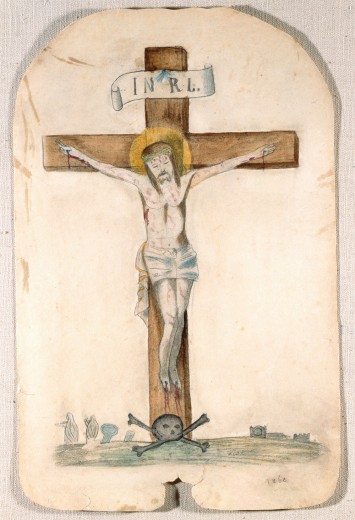
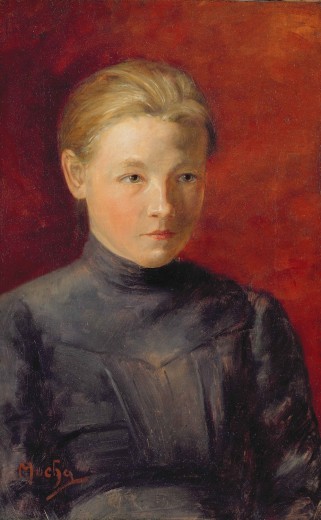
Crucifixion, Alphonse Mucha, c. 1868 [2]/Portrait of his sister, Anna, Alphonse Mucha, c. 1885 [3]
Starting the Creative Journey in Vienna
Beyond his love for music, Mukha dreamed of pursuing art. Despite an unsuccessful attempt to enroll at the Academy of Fine Arts in Prague, at the age of 19 he moved to Vienna, where he became an intern at Kautsky-Brioschi-Burghardt, a company specializing in theatrical sets. This job allowed him to attend theaters for free and draw inspiration from local productions. Since then, he has maintained a passion for theater arts.
Working on first monumental commissions
After the massive fire at one of his client’s major theaters, the artist was forced to move with his last savings, subsisting on commissioned portraits and gravestone carvings. Later, Alphonse secured his first truly major commission—a series of murals for Count Karl Quen-Bellassi and his stately Emmahof Palace. The next commission, painting the Gandegg Castle in Tyrol, came from the count’s brother.
Ring Theatre, before the fire of 1881, Vienna [4]
The Patronage of Karl Quen-Belassi
Carl Queen-Bellassi was impressed and became the artist’s patron. They traveled to exhibitions in Venice, Florence, and Milan, admiring the works of many previously unknown Alphonse artists. The count’s patronage became his support and greatly shaped the artist’s creative vision. Muhha entered the Munich Academy of Fine Arts, where he studied for two years and was an active participant in creative student communities.
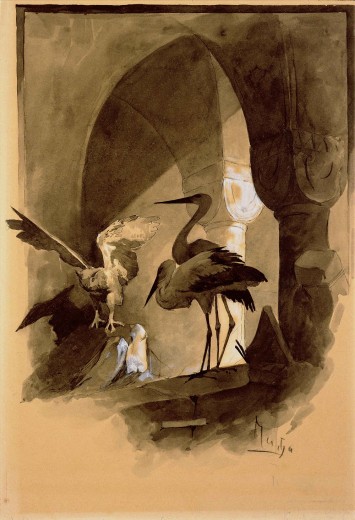
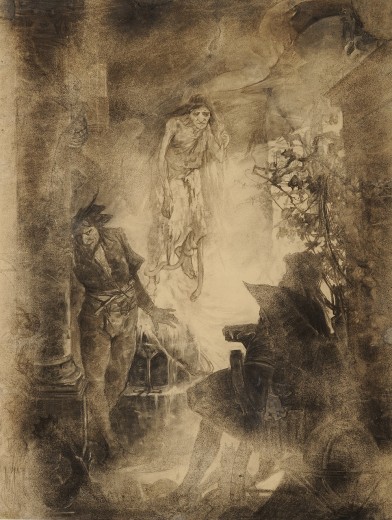
Storks, Alphonse Mucha, 1891 [5]/Illustration for the Legend of Pan Tvardovsky, Alphonse Mucha, 1887–1888 [6]
During this period, Alphonse Mucha became engrossed in occultism and Freemasonry. In 1889, Karl Kühn-Belassi ceased financing in order to foster the artist’s independence, although the friendship between their families continued for decades. From this point on, Mucha began earning a full living through illustration.
Charlotte Caron and the Creative Environment in Paris
Life drawing model in the studio in Paris [7]
A new chapter in the artist’s life began in 1890 when he met Madame Charlotte Caron, a patron, and rented a room above her small establishment, Crèmerie, in Paris. In this cramped space, impoverished young artists gathered—reflecting on culture, art, and occult symbols. Together, they experimented and inspired one another.
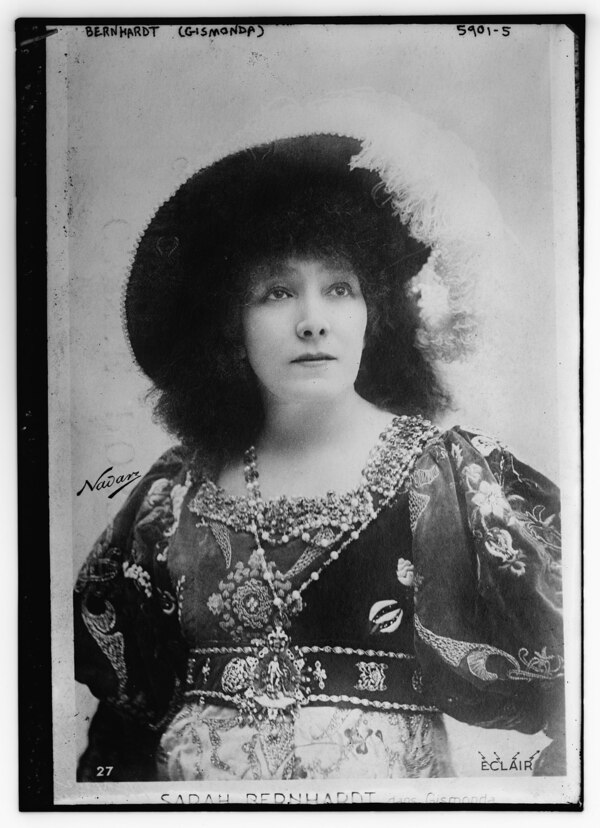
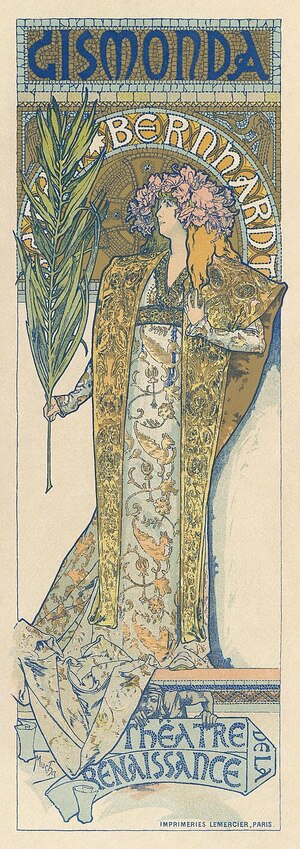
Sarah Bernhardt in a Gismonda costume, 1894 [8]/Poster for «Gismonda,» Alphonse Mucha, 1894 [9]
After four years living in Paris, Toulouse-Lautrec’s theater posters, created for actress Sarah Bernhardt, brought Alphonse Mucha international fame and renown overnight.
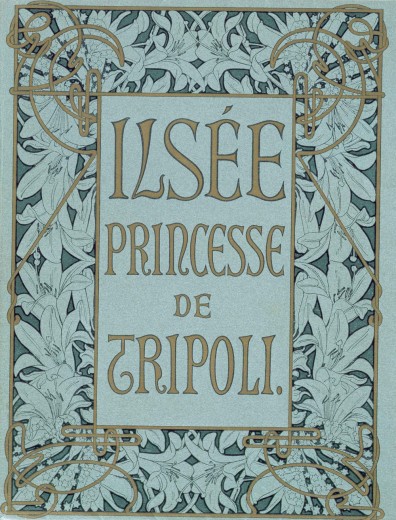
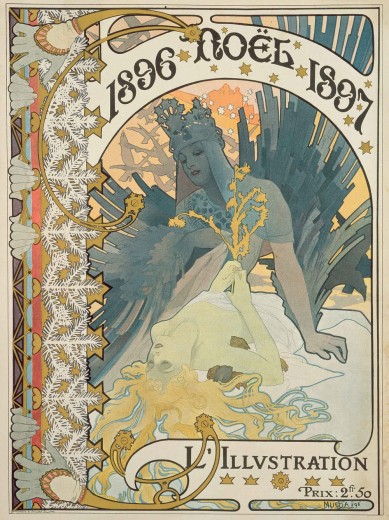
Ilse, Princess of Tripoli, Alphonse Mucha, 1897 [10]/Design for the Christmas issue of L’Illustration, Alphonse Mucha, 1896 [11]
Fly’s style is becoming very popular. He works on illustrations for books and magazines.
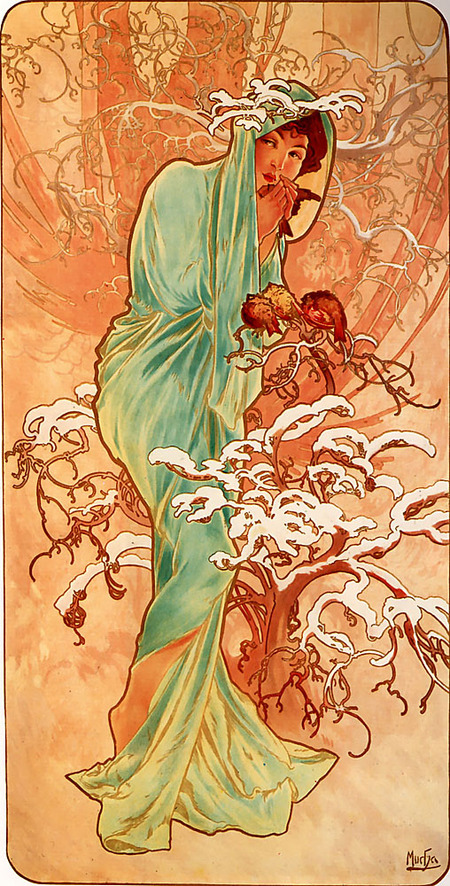
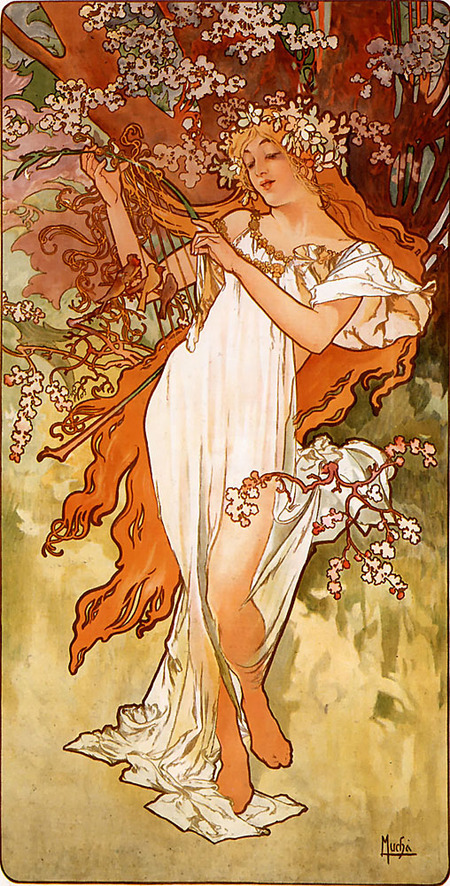
«Seasons» Series, Winter and Spring, Alphonse Mucha, 1896 [12] [13]
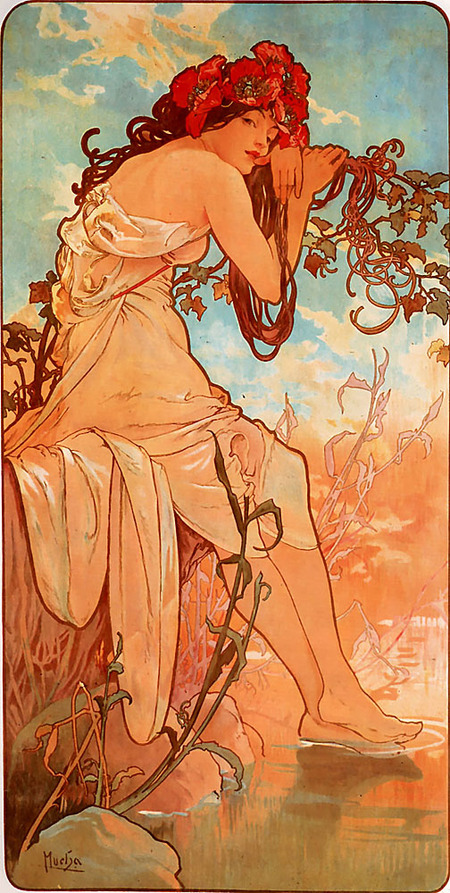
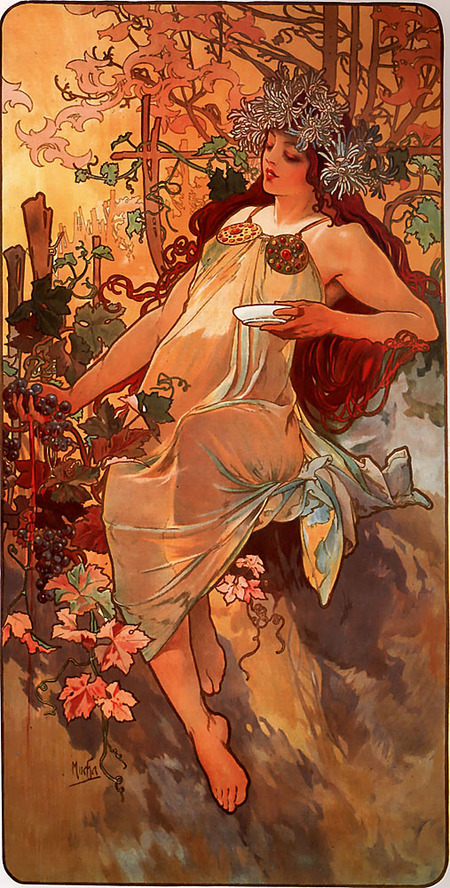
Series «Seasons,» Summer and Autumn, Alphonse Mucha, 1896 [14] [15]