Concept
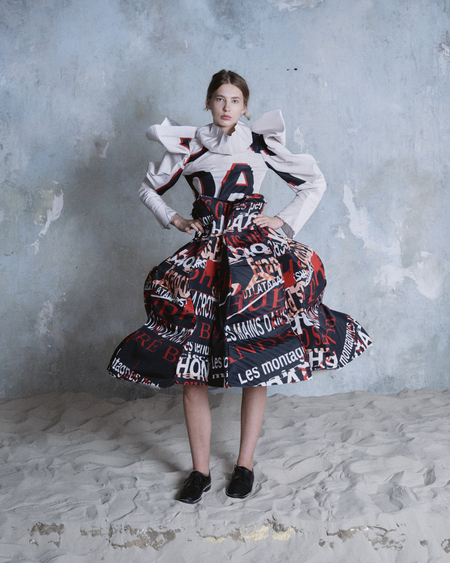
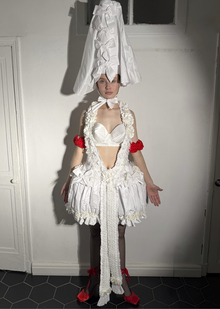
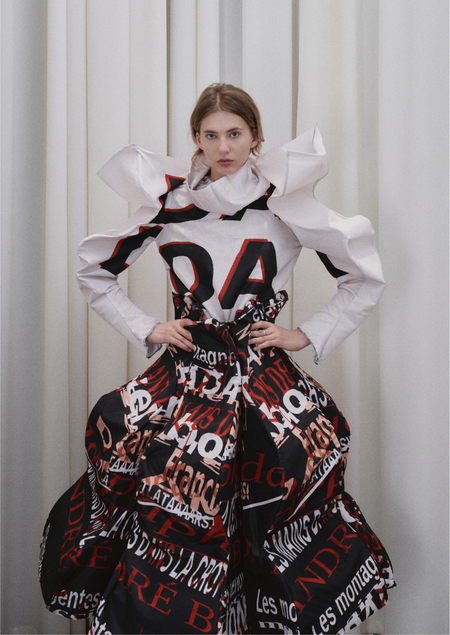
The project involves the creation of a designer skirt conceptualized as a Dadaist object—a material protest against logic, rationality, and utility. The visual language of the piece is built upon principles formulated by the Dadaists: defunctionalization, inversion, collage, and chance. The graphic print draws inspiration from the typographical collages of Kurt Schwitters and Hannah Höch—fragments of newspaper headlines, letters, and numbers chaotically organized into a single canvas. The architectural silhouette is based on the cover of the Dadaist journal «391,» No. 7, August 1917, featuring a corseted belt and voluminous structural elements. The skirt is conceived not as a piece of clothing, but as wearable sculpture, where construction and deconstruction coexist, and functionality is consciously sacrificed to the aesthetic gesture of absurdity.
In 1919, Dadaists published an announcement in the journal «The Blind Man»: a blind man invites everyone to a ball that will last until he sees the dawn. This condition is both an invitation and a sentence, as the ball cannot end because the dawn will never be seen, meaning the movement continues without purpose, finish, or meaning. Today, this situation repeats itself: news, advertising, and social media all speak contradictory messages simultaneously, and people lose the ability to distinguish truth from plausibility. Dadaism permits one not to search for logic in this—one can simply show that logic does not exist. This collection is built on that permission; absurdity becomes a way to speak about a world that has stopped adhering to its own logic.
Silhouette and fit
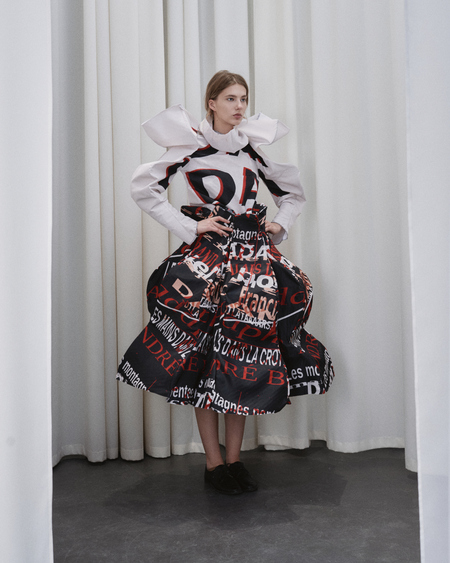
The silhouette reproduces the graphic architecture of the «391» cover: a vertical corseted waistband from which voluminous structural elements fan out. The silhouette is asymmetrical—mirroring the typographical composition of the cover, where elements are unevenly distributed.The fit features a high waist; the corseted belt tightly defines the figure. The volume is supported by structural details (not just duplication, but also structural inserts, pads, and stiffening ribs). The fit is form-fitting at the waist, but free and architectural in the volume.
Structure
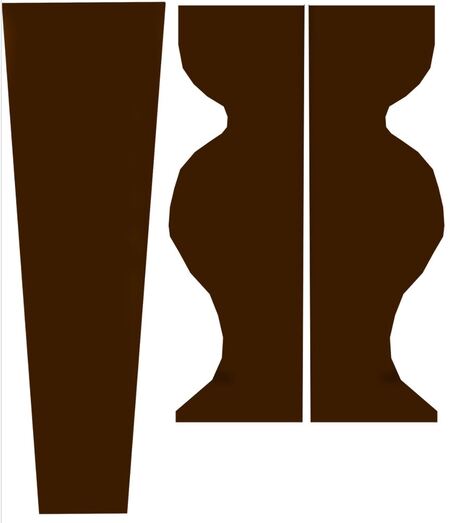
The structure is built from 6 parts, which taper toward the top and flare toward the bottom. Each part consists of 3 elements: 1 trapezoidal piece and 2 side pieces.Molding elements—duplicates, spacers, stiffeners, and structural inserts—ensure the architectural stability of the form despite the deconstruction.Assembly principle: Two side pieces are joined with the trapezoidal piece to form one of the 6 skirt elements. Each skirt element is duplicated, glued with spacers, and augmented with a whalebone extension. Next, all 6 elements are sewn together, and a lining is attached inside.
Size or size range
Base sample size is 42–44 (EU 38–40). The recommended size range is 40–48 (EU 36–44). The gradation between sizes is 2 cm in waist and hip circumference. The base height is 170–176 cm, though adjustments are possible. The body type is universal, emphasizing the waist.Important: Because functionality has been intentionally sacrificed for aesthetics, the fit may be deliberately uncomfortable. This is documented as a conceptual design choice, not a defect.
Materials and Hardware
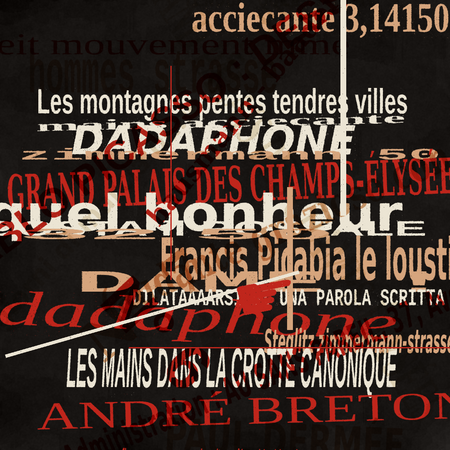
The main fabric is used for the top and bottom sections of the skirt. Dense cotton or gabardine would work—the main requirements are shape retention and density. Print: digital fabric printing, minimum resolution of 300 dpi, color reproduction according to the sample. Source—the «The Blind Man’s Ball» project on the portfolio.The lining provides comfort and fit: viscose, cupro, or polyester.
Fusible interfacing, medium or heavy density, is used across the entire main fabric.
Stabilizer (non-woven interfacing, mesh) and boning are for structure-retaining pieces.Trimmings: hooks and eyes for the corset belt (2–3 sets), polyester or cotton thread matching the main fabric color, labeling—a tag for composition and size.
Assembly and Processing Method
The assembly sequence includes twelve stages. — Pattern preparation—checking, grading, and layout. — Cutting 18 pieces of main fabric (12 + 6) with seam allowances. Cutting lining and interfacing. — Print application—either based on the layout or onto the fabric prior to cutting. — Doubling of the corset belt and structural support pieces. — Installation of stiffeners and pads. — Forming the skirt elements—folding and fixing. — Joining the skirt elements. — Belt finishing—hooks, clean finishing. — Hem finishing—deconstructive: asymmetrical hemming, raw edges, contrasting trim. — Pressing and finishing at each stage. Finalization: quality control, labeling, and packaging.
Quality control involves checking the symmetry of the drapery (or intended asymmetry), fitting on a mannequin, print quality inspection, and hardware inspection. Important: deviations from symmetry, raw edges, and functional limitations are not considered defects—they are conceptual decisions documented in the design specifications.
Physical Specimen
Production and Cost
The following parameters are used for calculation. Fabric—6 meters. Number of patterns—2 sets. Pattern Piece No. 1 details—12 pieces. Pattern Piece No. 2 details—6 pieces. Total pieces—18 pieces. Print—digital, full color.Main fabric: 6 meters at a price of 800–1,500 rubles per meter—4,800–9,000 rubles.
Digital printing: 6 meters at a price of 500–1,200 rubles per meter—3,000–7,200 rubles.
Lining: 2–3 meters at a price of 400–700 rubles per meter—800–2,100 rubles.
Trimmings: hooks, thread—300–800 rubles.
Pattern development and adaptation to sizes: 2 sets—5,000 rubles.
Sample sewing: 6 elements—8,000–20,000 rubles.
Total cost of the sample—approximately 21,900 rubles.