From scattered colonial settlements to an industrial giant and nearly the world’s sole superpower—every era in US history left its mark not only on its politics and economy but also on its culture. American literature, painting, music, theater, and cinema have always served as an arena for the struggle for identity, an instrument of propaganda, a voice of protest, and a laboratory for new forms. From Puritan sermons and portraits of colonial elites to the Western and jazz, from novels about the frontier to noir and digital installations—American art has always been interwoven with the country’s historical development. Our timeline is an attempt to trace this complex relationship.
1607–1765 годы
Thirteen Colonies
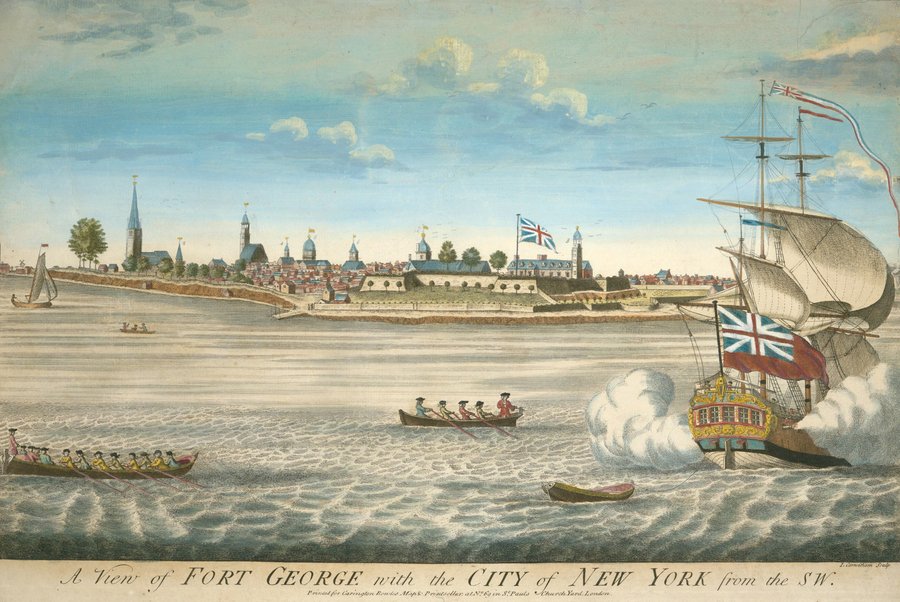
John Carvitt. View of Fort George and the city of New York from the southwest. Hand-colored engraving. 1731–1736
Established on the Atlantic coast of England, the colonies evolved into dynamic agricultural societies by the mid-18th century. By 1760, their population had reached 1.6 million people, and annual trade with the metropolis exceeded £2 million sterling. Politically, the colonies remained loyal to the Crown, yet the practice of local self-governance (assemblies in each colony, elected by landowners) and religious pluralism—ranging from Puritan New England to Quaker Pennsylvania and Catholic Maryland—fostered a persistent sense of autonomy. This sentiment later manifested in resistance to the Navigation Acts of 1651–1673 and the Stamp Act of 1765, which served as a precursor to the coming conflict.
Literature and art during the colonial period were provincial and utilitarian, closely tied to the religious and practical needs of the settlers. The first American book printed in the colonies was the psalm collection, the «Bay Psalm Book» (1640). Prose literature of that era primarily focused on travel narratives and stories of colonial life. In painting, the portrait tradition dominated—for example, John Singleton Copley (1738–1815), who created strict, detailed depictions of the colonial elite. Architecture followed the Georgian style: symmetrical facades, Palladian windows, and pediments adorned plantation manors and public buildings—such as the Capitol in Williamsburg. Decorative and applied arts—Paul Revere’s silverware, the elegant furniture of Newport and Boston—blended European aesthetics with local materials, laying the groundwork for a future national culture.
1765–1783 годы
American Revolution
John Trambull. Declaration of Independence. 1819
Following the adoption of the Charter, the «Boston Massacre» (1770)—in which British soldiers killed five citizens—and the «Boston Tea Party» (1773)—an act of protest against the East India Company’s monopoly—the conflict between the colonies and the crown escalated into war. On July 4, 1776, the Second Continental Congress adopted the Declaration of Independence, inspired by Locke’s ideas on natural rights and the social contract, as well as the works of Thomas Paine. The eight-year war concluded with the Treaty of Paris in 1783, which recognized U.S. sovereignty over territory stretching from the Atlantic to the Mississippi. During these years, republican institutions took shape: the Constitution of 1787 established a federal system with a separation of powers, and the Bill of Rights (1791) enshrined freedom of speech, religion, and assembly.
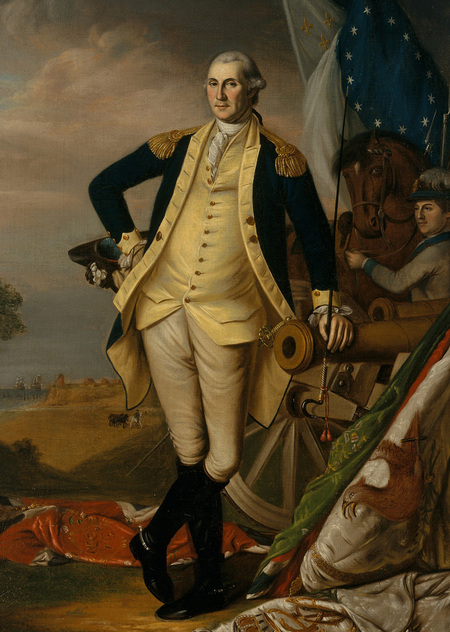
The revolutionary era gave rise to powerful political literature and visual propaganda. Thomas Paine’s pamphlet, «Common Sense» (1776), served as a manifesto of the bourgeois revolution, circulating in the hundreds of thousands of copies and playing a key role in shaping public opinion. Philip Frénon (1752–1832) was a major neoclassical poet who was influenced by the ideas of the French Revolution. In the visual arts, Charles Wilson Peele (1741–1827) created a gallery of portraits of the founding fathers, while John Trumbull (1756–1843) captured key battles and the signing of the Declaration in monumental paintings that now adorn the Capitol Rotunda. Political engravings and caricatures, particularly the works of Paul Revere (for example, «The Bloody Massacre on King Street»), disseminated revolutionary ideas among an illiterate public, turning art into an accessible tool of propaganda.
1783–1848 годы
Continental expansion to the West
Albert Bierstadt. In the Sierra Nevada mountains, California. 1868
Over the course of six decades, the territory of the United States more than tripled thanks to a series of treaties and wars: the Louisiana Purchase (1803) for $15 million doubled the country’s size, the annexation of Texas (1845), the Oregon Treaty (1846) with Great Britain, and the victory over Mexico (1848) granted California, New Mexico, and Arizona. The Lewis and Clark Expedition (1804–1806), funded by Congress, opened a overland route to the Pacific Ocean. The idea of «manifest destiny, ” according to which God ordained that Americans should possess the entire continent, justified the displacement of Native Americans from their lands and the expansion of the young republic’s conquests westward.
Literature and art of this period actively mythologized the West and shaped the image of the frontier. Washington Irving, in «Astoria» (1836), celebrated the adventures of pioneers and fur traders, while James Fenimore Cooper, in the novel «The Prairie» (1827), created one of the first literary images of the Wild West. Life on the frontier helped foster a unique type of character that would later be reflected in the works of Mark Twain. In the visual arts, the Hudson River School, led by Thomas Cole (1801–1848), transformed the American landscape into a symbol of divine providence, while Albert Bierstadt (1830–1902) created grand panoramas of Yellowstone and the Sierra Nevada. These paintings inspired migration but downplayed the forced displacement of indigenous peoples, presenting expansion as a civilizing mission.
George Peter Alexander Healy. Peacemakers. 1868. Sherman, Grant, Lincoln, and Potter are depicted from left to right discussing plans for the final weeks of the Civil War aboard the steamship «River Queen» in March 1865. The painting is currently displayed in the Oval Office dining room.
The Compromise of 1850, which included the Fugitive Slave Act and the recognition of California as a free state, as well as the Kansas-Nebraska Act of 1854, which repealed the geographic restrictions on slavery (the Mason–Dixon Line), intensified the rift between the free North and the slaveholding South. The election of Abraham Lincoln in 1860, who opposed the expansion of slavery, provoked the secession of 11 Southern states, which later formed the Confederacy. The Civil War (1861–1865) that followed claimed more than 620,000 lives—more than the United States lost in all other wars combined. The North’s victory was cemented by the Thirteenth Amendment (1865), which abolished slavery across the entire country. However, the South’s economy was devastated, and racial tension persisted for decades.
Literature and art of the Civil War became an arena for intense ideological struggle and the contemplation of national trauma. The first novel dedicated to the war was «Miss Ravenel Goes North» by John DeForest (1867); later, Stephen Crane created a psychological portrait of the war in «The Crimson Badge» (1895), and Ambrose Bierce realistically captured its horrors in a series of stories, including «The Rider in the Sky.» Photographer Matthew Brady (1823–1896) and his staff documented the battlefields, creating over 10,000 negatives that shocked the public.
Poster from the Philadelphia International Exhibition of 1876
This period was marked by efforts to integrate freed African Americans into the political and social life of the South: the Fourteenth (1868) and Fifteenth (1870) Amendments to the Constitution guaranteed citizenship and voting rights to all men regardless of race. The federal government stationed troops in the South and established the Freedmen’s Bureau, which opened over 4,000 schools and distributed about 850,000 acres to formerly enslaved people. However, by 1877, resistance from white Southerners, the resurgence of the Ku Klux Klan (founded in 1866), and economic pressure led to the enactment of «black codes» and segregation laws («Jim Crow laws»).
In literature, the Reconstruction era marked a transition from Romanticism to Realism, a shift reflected in the works of Francis Harper and other authors of the time. The Philadelphia Centennial Exhibition (1876) served as a grand demonstration of the republic’s industrial might, yet it largely ignored the recent Civil War and racial inequality. Sculptor Edmonia Lewis (1844–1907) created neoclassical works, such as «Eternal Freedom» in 1867, asserting individual dignity and challenging the prevailing stereotypes of the era.
The first oil field of Los Angeles, Toluca Street. The oil field is densely packed with approximately twenty drilling derricks. Circa 1895–1901
Over three decades, the length of railroads in the States grew from 50 to 200 thousand miles, and New York’s population surpassed 3.4 million by 1900. Magnates—Andrew Carnegie (steel), John Rockefeller (oil), John Morgan (finance)—amassed fortunes comparable to the budgets of small nations; by 1890, 1% of the U.S. population owned 51% of the national wealth. The Progressive movement, led by investigative journalists and reformers, demanded regulation of monopolies, better working conditions, and a fight against corruption; the first child labor laws (1916), antitrust acts (Sherman, 1890), and the amendment for the direct election of senators (1913) were passed.
Literature and art of the Gilded Age sharply critiqued the social sores of the era. The term «Gilded Age» itself originates from the eponymous satirical novel by Mark Twain and Charles Warner (1874), which exposed the predatory nature of capitalists and the decay of political power. Twain also created Wild West imagery in The Adventures of Tom Sawyer and Adventures of Huckleberry Finn, while Bret Hart, O. Henry, and Jack London dedicated their works to the conquest and settlement of the American West. In visual arts, the «Scrap Heap School, ” led by Robert Henri (1865–1929), challenged the Salon art by depicting the grimy alleys, bars, and slums of New York City. The Armory Show (1913) introduced Cubism, Fauvism, and Surrealism, causing a scandal and forever changing the perception of the avant-garde in America. In theater, playwright Eugene O’Neill began his career—a future Nobel laureate.
Harris and Young. President Wilson addresses Congress, announcing the severance of official relations with the German Empire on February 3, 1917.
The U.S. entry into World War I in April 1917 (following the German sinking of the Lusitania and the interception of the Zimmermann Telegram) mobilized four million soldiers and finally transformed the country from a regional power into a global arbiter. The post-war decade ushered in an era of unprecedented economic growth: Ford automobile production reached two million units annually, jazz and radio became widespread, and Prohibition (from 1920 to 1933) spawned bootlegging and gangster wars. By 1929, the Dow Jones Industrial Average had risen to 381 points, yet 60% of the country’s population lived below the poverty line. The stock market crash in October 1929 exposed the fragility of this boom and abruptly ended the Roaring Twenties.
The 1920s marked the «Golden Age» of American literature and cinema. Literature saw a flourishing of the work of Ernest Hemingway, William Faulkner, F. Scott Fitzgerald—who dubbed the era the «Jazz Age”—John Dos Passos, and Thomas Wolfe. Sherwood Anderson, in the collection Wainsburg, Ohio, created a gallery of portraits of American provincial life. In cinema, the silent film era reached its apex: Erich von Stroheim directed Greed (1923), which exposed the power of money; King Vidor created the anti-war film The Great Parade (1925); and Buster Keaton filmed his classic comedy The General (1926). In 1927, Warner Bros. released The Jazz Singer—the first sound film—which forever changed cinema.