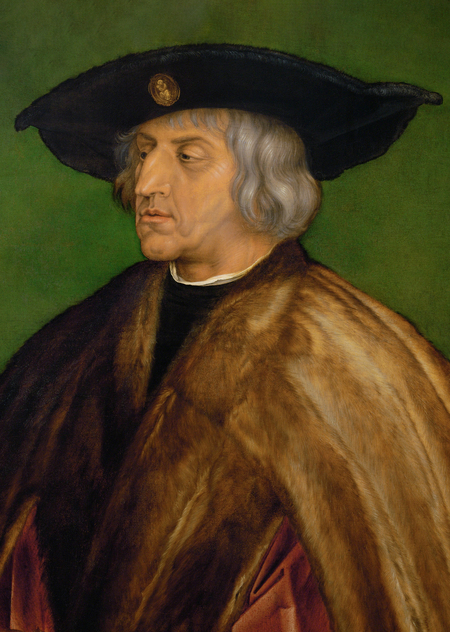
Our timeline of German history covers the formation of its statehood, pivotal and tragic moments of conflict and reform, paying special attention to the shift in artistic styles—from Romanesque and Gothic architecture through Baroque and Romanticism to Modernism. The material is structured as a sequence of nodal points that shaped German historical and cultural identity.
I тысячелетие до н. э.
Ancient Germany
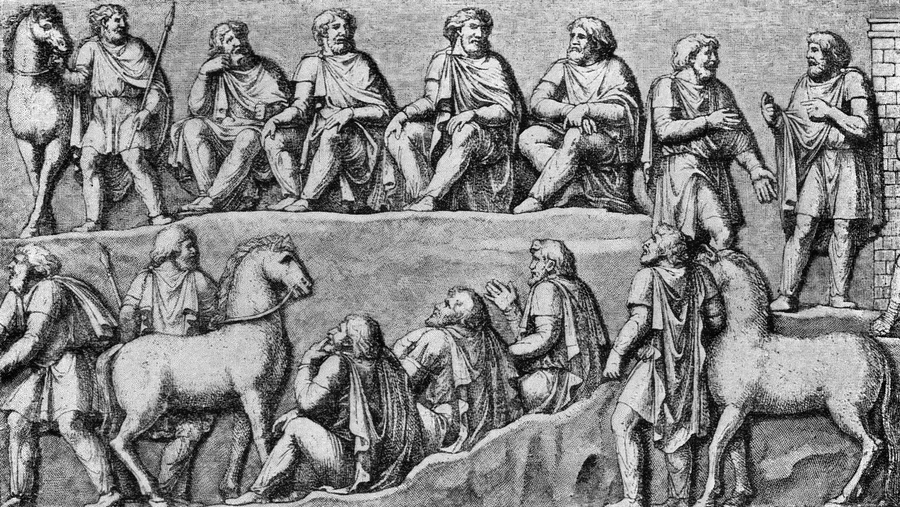
German Cathedral. Relief on the Column of Marcus Aurelius in Rome
In ancient Germany, during pre-Roman times—roughly the 1st millennium BCE—the region north of the Alps was inhabited by Germanic tribes. According to modern understanding, these groups formed a distinct ethno-linguistic community within the Indo-European family of peoples. Their society was organized into tribes, such as the Ingevons, Germinons, and Istewons, who believed they descended from Mannus, a son born of the goddess Thuisto’s earth. Their economy was based on pastoralism and agriculture, and life was deeply intertwined with nature. A significant aspect of the religion of that era’s Germanic people was the reverence for sacred groves and the worship of tribal patron gods.
The art of the ancient Germanic tribes during this period lacked a distinct decorative character; rather, it was inextricably linked to practical needs, magic, and religion. Unlike their neighboring Celts, whose art was characterized by complex and refined ornamentation, the material culture of the Germanic people was functional and stark. They achieved a high level of craftsmanship in metalworking, creating weapons and simple adornments such as fibulae and torcs. The ornamentation, often geometric or zoomorphic, was primarily applied through engraving onto metal objects, including weaponry, shields, and horse tack. These patterns, much like the animal style, held not only aesthetic but also sacred significance, functioning as protective amulets. Anthropomorphic figures were rare and crudely executed, and the primary forms of art remained oral—traditional heroic songs and bards who celebrated gods and heroes.
Great Germany and the Fall of Rome
Sarcophagus of Grand Ludwig. 3rd Century. Battle between Goths and Romans
Initially acting as opponents (at the defeat of the Varus legions in the Teutoburg Forest in 9 CE by an alliance of Germanic tribes led by Arminius), the Germanic peoples gradually began to penetrate the empire, becoming mercenaries in the Roman army. In the 4th century, the Hunnic invasion from Asia triggered the Great Migration of Peoples, forcing the Visigoths, Vandals, and other tribes inhabiting Magna Germania to move into the lands of the Roman state. The battle of Adrianople in 378, where the Roman army was crushed by the Goths, clearly revealed the decline of Roman military power. In 476, the Germanic warlord Odoacer deposed the last emperor of the Western Roman Empire, Romulus Augustulus, which symbolically marked the end of the ancient era in Europe and the beginning of the Middle Ages.
The art of the Germanic peoples during this «great» period is known almost exclusively through archaeological finds, primarily from burials. It represents a synthesis of traditional elements and Roman influences. The polychrome style reached its peak, wherein cells made of granular material or partitions were applied to gold or silver objects (fibulae, buckles, weapon fittings) and filled with colored almandine or glass. The animal style remained dominant, evolving into more complex and abstract forms. Animal figures were broken down into geometric elements, interlaced in intricate patterns, creating dynamic and taut compositions, as seen, for instance, in the famous treasure from the Golden Horn of Gallerus. During this same period, runic script began to spread, used for brief inscriptions on memorial stones and artifacts.
Barbarian Kingdoms and the Holy Roman Empire
Evangeliary of Otto III. Reichenau. Circa 1000
Following the fall of the Western Roman Empire, so-called «barbarian kingdoms» formed on its former territories, established by Germanic tribes: the Merovingian Frankish kingdom, the Ostrogothic kingdom in Italy, and the Visigothic kingdom in Spain. The Frankish kingdom proved to be the strongest among them, where the Carolingian dynasty eventually came to power. Its peak of might was the reign of Charlemagne, who was crowned Emperor of the West by Pope Leo III on Christmas Day in 800. This title was subsequently inherited by the East Frankish kingdom, whose ruler, Otto I, was crowned Emperor in Rome in 962. Thus was founded the Holy Roman Empire, which became the central political entity of the German lands for many centuries.
The art of this period went through two key stages. The Carolingian Renaissance (late 8th–9th centuries) consciously referenced antique and early Christian models, aiming to restore the grandeur of Rome. At the court of Charlemagne, chapels were built (such as in Aachen), magnificent illuminated manuscripts were created (the Utrecht Psalter), and monumental painting and sculpture developed. The next period, the Ottonian era (10th–first half of 11th centuries), became a time for the consolidation of imperial art. It is characterized by powerful abbeys with monumental architecture, emotionally rich book miniatures (the Otto III Gospel), and the development of liturgical sculpture, the most famous example of which is the «Crucifixion of Hero» in Cologne Cathedral—a monumental wooden cross that newly portrays Christ’s human suffering. This art combined barbaric energy, Roman heritage, and Christian spirituality.
XI–XII века
Frederick Barbarossa
The Death of Frederick Barbarossa. Excerpt from the Saxon Chronicle
In the 11th–12th centuries, the Investiture Controversy—the conflict between the emperor and the pope over the right to appoint bishops—reached its peak under Emperor Henry IV and Pope Gregory VII, culminating in the symbolic humiliation of the emperor at Canossa in 1077. The zenith of imperial power was marked by the reign of Frederick I of Hohenstaufen, known as Barbarossa (from Italian for «Red Beard») (1152–1190). He pursued an aggressive policy to strengthen his authority in Germany and subjugate the wealthy northern Italian cities. His long struggle with the Lombard League, despite the tactical defeat at Leantono (1176), concluded with the formal recognition of his suzerainty. Barbarossa, a paragon of the chivalric emperor, drowned in Asia Minor during the Third Crusade, leaving behind the myth of the «sleeping emperor» who will return in Germany’s hour of need.
The Romanesque style dominated this era, characterized by massive forms, thick walls, and restrained yet powerful decoration. Architecture flourished in the construction of imperial cathedrals in Speyer, Worms, and Mainz, which symbolized the might of imperial power. Their appearance was defined by cylindrical and groin vaults, narrow windows, and strict geometric volumes. In the sculpture adorning the church portals (as seen in the Bamberg Cathedral), biblical scenes combined with symbolic imagery, demonstrating a transition from abstract symbolism toward more naturalistic forms. Simultaneously, book arts developed, particularly in the Saxon monasteries, where richly illuminated manuscripts were created. The art of this period reflected a synthesis of Christian doctrine, imperial grandeur, and the emerging chivalric culture.
XIII век
Teutonic Order
Saint Michael and the Dragon. Circa 1240–1250
The 13th century marked a period of massive expansion and consolidation of German territories in the east, a process in which the Teutonic Order played a key role. Having received the right to conquer Prussia in 1226 via the «Golden Bull» from Emperor Frederick II, the Order began the systematic colonization of the Baltic lands. Relying on a network of powerful brick castles (such as those in Malbork), it established a theocratic state, subjugating and Christianizing the local tribes. This expansion met resistance: in 1242, the combined forces of the Novgorodians, led by Alexander Nevsky, defeated the Order in the famous Battle on the Ice of Lake Peipus, halting its eastward advance.
In 13th-century German art, the shift from Romanesque to the Gothic style, which originated in France, marked a significant transition. This architectural revolution manifested in the replacement of massive walls with a skeletal system incorporating flying buttresses and external supports. This innovation enabled the construction of seemingly weightless cathedrals adorned with enormous stained-glass windows. The Cologne Cathedral, begun in 1248, stands as the most striking example. In sculpture, interest in realism and individuality grew, evident in the cathedral statues in Naumburg (such as the founders of the church) and Bamberg («The Rider»). The art of the Teutonic Order, more ascetic, developed in the architecture—the «order Gothic» of brick castle-monasteries—and in illuminated manuscripts that combined Christian narratives with chronicles of the Crusades.
XIV век
Golden Bull
The Intercession of the Blessed Virgin. Oak, linen covering, polychromy, gilding, and gesso. Germany. Circa 1300
The fourteenth century was a period for the Holy Roman Empire burdened by the Black Death pandemic and the growing autonomy of territorial principalities. In 1356, the so-called «Golden Bull» was published by Emperor Charles IV—the empire’s foundational law, which remained in effect until its dissolution in 1806. This document legally formalized the established practice of electing emperors, granting the right to choose the monarch to a college of seven electors (three ecclesiastical and four secular). The Golden Bull excluded papal interference in the election process, legitimized the princes' right to supreme power in their territories, and helped prevent civil wars by formalizing the empire’s political structure as a federation of independent principalities.
In the art of the 14th century, International Gothic dominated, characterized by elegance, refined lines, and attention to detail. In architecture, massiveness gave way to grace: hall churches (such as St. Elizabeth’s Church in Marburg) with slender columns and spacious, light-filled interiors became the new dominant feature of the urban landscape. In sculpture and painting, features of realism and lyricism were growing more pronounced. German sculpture developed the traditions of the «soft style,» creating spiritual and emotional figures, such as the «Beautiful Madonna» from the cathedral in Naumburg. In painting, altarpieces and illuminated manuscripts flourished, where sophistication and decorative quality merged with attempts to convey space and the individuality of the figures.
XV век
Gutenberg Bible
Folio from Johannes Gutenberg’s 42-line Bible. 1455
The Holy Roman Empire was a decentralized education system where real power resided with the Electors and free cities. It was during this period that one of the greatest inventions in human history occurred, fundamentally changing global culture. Around 1440–1450, Johannes Gutenberg from Mainz developed the printing technology using movable type. His magnum opus was the famous Gutenberg Bible, published around 1454–1455. This edition, known as the first large-format printed book in Europe, demonstrated technical brilliance and ushered in the era of mass dissemination of knowledge.
Art in 15th-century Germany developed during a transitional period from Late Gothic to the Renaissance. In painting and sculpture, there was a growing trend toward realism, careful study of nature, and the expression of human emotion. While manuscript illumination continued to thrive, Gutenberg’s invention ushered in a new form of art—printmaking. The first printed books, incunabula, deliberately copied the design of manuscripts, using gothic script (textura) and leaving spaces for the manual coloring of initials and illustrations. However, the technology of mass reproduction made books more accessible, which contributed to the standardization of knowledge and laid the groundwork for the cultural revolutions of the 16th century.
XVI век
Reformation