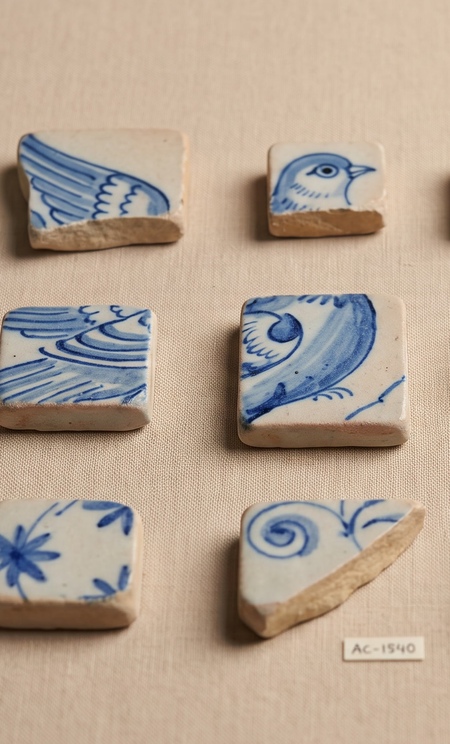
BLUE BIRD: TRACES The city transforms into a theater, and familiar spaces become living characters. We invite you to continue the story of Konstantin Stanislavsky and Maurice Maeterlinck’s «The Blue Bird”—moving it beyond the theatrical stage and into the spaces of Moscow. Instead of a literal depiction of the bird, we create a system of traces: small mosaic fragments scattered along the route, resembling archaeological finds, antique tiles, or pieces of a long-lost image. Each fragment exists independently, but together they gradually form the image of the Blue Bird. The tile becomes a crucial connecting motif here. It is simultaneously part of the architecture, a fragment of an image, and a carrier of memory; in Russian culture, it is associated with the stove, the home, and warmth. Yet, the tradition of the tile exists across different cultures, forging a unique dialogue between eras and artistic languages. Thus, the viewer becomes not merely a participant in an urban quest, but a researcher: they notice details they never saw before, encounter characters, and gradually learn to look at the familiar city in a new way. The Blue Bird is not hidden in one place—it leaves traces throughout the entire route.
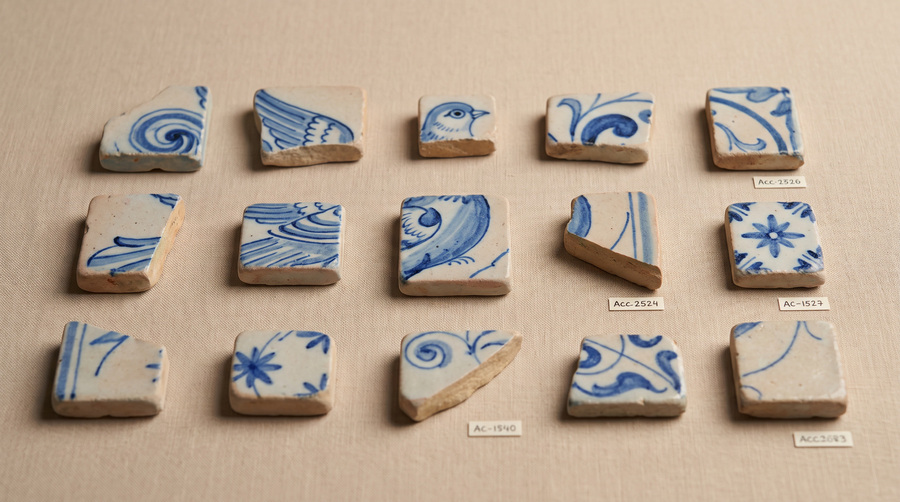
The fragments of the Blue Bird are rendered in the image of tilework—ancient ceramic elements that connect image, architecture, and memory. A tile design exists simultaneously as part of a greater whole and as an independent artifact; its history is tied to diverse cultures and artistic traditions, and in Russian culture—it is linked to the stove, domestic warmth, and the space where people gather. Therefore, the fragments appear like archaeological finds: we are not creating the complete image of the Blue Bird, but rather discovering its traces within the city. Slowly, individual details assemble into an image that cannot be grasped at a glance. Thus, the search transforms not only into a route, but also into a method for looking more closely at the surrounding world—and for finding what may have always been nearby. These fragments could also be executed using mosaic techniques—as a reference to an even more archaic culture.
Here, we are presenting not final objects, but the artistic concept for the route—a system of imagery, materials, and interactions that we look forward to developing, refining, and realizing into finished pieces with the Theater team.It is important to us to preserve a sense of handcrafted quality and childlike imagination within the project. Therefore, the primary medium is the metallic outline: it resembles the simplest figures a child might create from paperclips or wire—building an entire world literally out of nothing.But these figures are not static. We propose giving viewers the ability to interact with them—because that is what distinguishes the city’s most beloved spots. It would be wonderful if the legends associated with each character could be enriched by a personal action from city dwellers—for example, attaching small ribbons as souvenirs. In this way, each character will evolve alongside the route, and the traces of people will become part of its story. This idea can also be integrated throughout the entire navigation system, including in the application and the audio guide.
DOG: FOLLOW
The Dog meets us near the A. P. Chekhov Moscow Art Theatre—the place where the stage production of «The Blue Bird» was once born.
He does not point the way or lead us. He sniffs out a trail—the first small fragment of The Blue Bird, lost in the urban landscape.
His figure is constructed from a thin metal line: almost a drawing made three-dimensional. Over time, viewers can weave ribbons into the contour—and every person who passes by will gradually change its appearance.
The Dog suggests starting the search with the simplest act: stopping, observing closely, and following the trail.
A fragment of «The Blue Bird» will be integrated into the asphalt or a low sculptural pedestal to ensure the structure is resilient to environmental interaction and weather conditions.
CAT: OBSERVE
The cat meets us at the MHAT Artists’ Home—the apartment museum of Vl. I. Nemirovich-Danchenko.
It is not looking for anything. It has already noticed something.
Its gaze is directed toward a small fragment of the Blue Bird—another trace, almost imperceptible amidst the familiar urban environment.
In theater, it is not just about the action, but about the ability to see: the gesture, the pause, the gaze, the presence of another person.
The cat invites us to pause for a moment and look where it is looking.
TREES: EXISTING IN SPACE
In the «Hermitage» garden, characters are hidden among real trees.
Thin metal silhouettes almost blend with the branches and shadows. They aren’t immediately visible—they are discovered gradually as the familiar landscape suddenly seems slightly different.
Another small fragment of the Blue Bird is hidden nearby—almost an archaeological find within the architecture or part of the tree.
Here, the search becomes a game of vision: sometimes, to see something new, it is enough to immerse yourself more closely in the surrounding space.
Design Reference:
Construction Reference:
WHERE IS THE BLUEBIRD?Following the route, we arrive at a small theater situated inside a larger theater.Its form evokes ancient folk performances—the popular prints, the fairground theater, and the Petrushka theater: a simple, handcrafted, slightly naive world that could be assembled from almost nothing.Nearby is an empty cage holding the Bluebird. This references a real artifact from the apartment museum of V. I. Nemirovich-Danchenko—a music box with a bird, gifted by Sergey Obraztsov.But the bird is not here.Because all along, we were not searching for the bird itself, but for the traces it leaves: in the city, in the theater, in the people, and in our own perspective.And, like in Meteoric, it turns out that searching is not necessary after all.The Bluebird was nearby—we simply learned how to see it.
We would be delighted to partner with the Theater team to develop this concept and bring the city route to life—from the artistic refinement of characters and objects to the mechanics of interaction and spatial details.
Neo Mosaic Workshop is ready to contribute to the realization, material development, and production of objects. We can also collaborate on designing a special line of project merchandise: for example, magnetic mosaics featuring the route’s characters, small DIY assembly kits, and other items that extend the story beyond the route itself.
In our work, we can incorporate recycled plastics, enamels, and ceramic elements, preserving the project’s overall handcrafted quality and materiality.
We are not only interested in creating the Azure Bird—but in giving it a new life in the city alongside the Theater. Thank you for your attention!