Concept
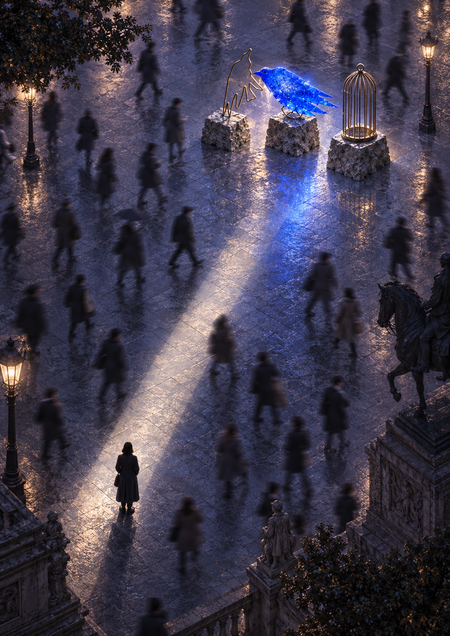
The blue bird is not hidden. The way to see it is concealed.
Every sculpture exists simultaneously in multiple dimensions. There is an indeterminate material mass—a rough cast of glass—and there is a precise line—a metallic contour. Every sculpture has its own designated vantage point. As the viewer moves around the object, they encounter scattered, conflicting fragments. When they stop at the marked point, they see how the individual elements coalesce into a complete, harmonious image.
The primary method for building the series is anamorphic art—a specially distorted image that resolves into a recognizable form only when viewed from a specific vantage point.
On stage, scenery, light, the actor, and sound are separate elements; a performance only comes to life in the spectator’s eye. Similarly, this series of sculptures is a materialization of Metterlink’s idea: the object was always before us; only the viewer’s perspective has changed.
Materials
The artistic language of the project is built upon a dialogue between two materials. Cast glass—fragile, imperfect, semi-transparent—exists as a materialized sensation. The metallic outline here is precise and graphic—it sets the boundaries for revealing the soul of all the fairytale characters.
The traditional materials of Art Nouveau decorative arts receive a modern function: instead of ornamentation, they become instruments of perception.
Combining the historical qualities of Art Nouveau with a contemporary reading of materials:
Art glass / Cast abstract mass
The capricious line of Modernism, the blow of a switch / Simplified contour line
Arts synthesis / The confluence of sculpture, environment, and viewer
Decorative integrity / Deconstructed image assembled from fragments
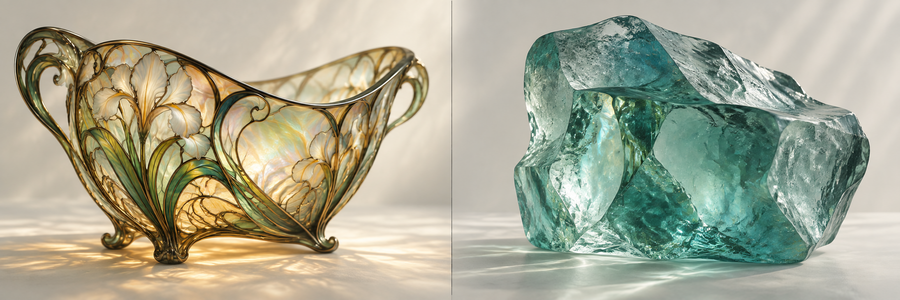
Art Glass / Cast Abstract Mass Materials generated by ChatGPT
Arts Synthesis / The convergence of sculpture, environment, and viewer. Materials generated by ChatGPT
Decorative integrity / a deconstructed image assembled from fragments. Materials generated by ChatGPT
Night
M. Kh. T. of A. P. Chekhov, Kamergersky Lane, 3
The premiere of «The Blue Bird» took place at the Moscow Art Theatre (MKhT) on September 30, 1908. The production utilized black velvet and an elaborate lighting score—darkness effectively became a material of the performance, from which the miracle emerged. The theatre itself is housed in a building redesigned by Shekhtel for MKhT in 1902; the architect designed not only the facade and interiors but also the lighting, ornamentation, and curtain.
Visualization example of the art object «Soul of the Night.» Material generated by ChatGPT based on the author’s drawings.
In Kamersky Lane, Night settled more than a century ago, when the lights first dimmed before the premiere of «The Blue Bird.» Every evening, she awaits the moment when familiar outlines dissolve into darkness and the ordinary world ceases to be the only possibility. In the fable, Night dwells in a palace with numerous locked doors, guarding that which is not yet ready to be seen. The theater itself becomes her palace. Its curtain is the first closed door, the darkness of the hall is a space of mystery, and the beginning of the performance is the permission to unravel that secret. But do not rush to find the Blue Bird. Until the viewer’s gaze is ready—and the mistress of the castle, Night, who is cold, closed off, and commanding—she impedes travelers from finding the simplest path to the blue bird, confusing them. It is as if she asks everyone who enters: are you ready to see what appears only after the familiar world has vanished? The theatrical magic happens only because of Night.
Example visualization of the art object, «Spirit of the Night.» Material generated by GPT chat based on the artist’s drawings.
At this point in the journey, the viewer is placed in a state of: «I haven’t seen anything yet.»
Soul of Light
The Moscow Art Theatre Artists' Home — the apartment museum of V. I. Nemirovich-Danchenko, Glinishchevsky Lane, 5/7From the darkness of Kamgermersky Lane, the route gradually leads us toward the light. Nemirovich-Danchenko, speaking of «The Blue Bird, ” defined the character of a performance through bright, joyful tones, humor, and touching lyricism. The apartment in Glinishchevsky Lane is a preserved personal world belonging to the man who formulated this optical approach to theater. He lived here from 1938 to 1943. The building itself was specially constructed for the artists and figures of the Moscow Art Theatre. Therefore, this is not the museum house of a single person, but literally the home of the Moscow Art Theatre milieu.
The Spirit of Light—warm, joyful, and open—accompanies people wherever they fear losing hope. Near the Nemirovich-Danchenko Theatre, it becomes the guardian of the director’s vision: giving us the ability to find hope and faith within ourselves. The Spirit of Light helps us distinguish what we might pass by without noticing something important, allowing everyone to find their blue bird.
At this point, there is a small breakthrough: «I am starting to discern.»
Example visualization of the art object «Soul of Light.» Material generated by ChatGPT based on the author’s drawings.
The Fairy of Berilun
K.S. Stanislavsky House-Museum, Leontyevsky Pereulok, 6
A single light is no longer enough. One must learn how to see… In «The Actor’s Work on Himself,» K.S. Stanislavsky compared the shift in perception to turning a magical diamond from «The Blue Bird»: after it, the eyes «begin to see differently,» the ears to listen differently, and the mind to evaluate the surroundings differently.»
Visualization example of the art object «Fairy of Berilyun.» Material generated by ChatGPT based on the author’s drawings.
In Berilyun’s play, Berilyun gives the children a magical diamond, thanks to which they begin to see the souls of things. The Stanislavski system itself is also built around the transition from external form to inner life.
In Stanislavski’s house, we meet Berilyun—the one without whom Tiltil and Mitil’s journey would never have begun. Thus, she becomes a character in the method of vision, because she leaves her diamond for the travelers. When you turn it, the familiar ceases to be conventional and empty. Character, voice, and soul are discovered in objects. This is what Stanislavski taught the actor his entire life: not to portray life, but to find it where another person sees only form. The audience is no longer shown the path. They are given the means to see.
This point on the route is marked by the phrase: «I am learning to look.»