Navigation:
1. Introduction
2. Blood as Divine Punishment
3. Martyrdom Through Blood
4. Absence of Blood in Violence Scenes (Innocent Victim)
5. Conclusion
Introduction
This visual study investigates the phenomenon of blood imagery in Biblical scenes within painting and its connection to the moment or scene of killing. The main objective is to determine the precise role that the presence of blood plays in a work and whether it relates to the characteristics of sacredness and divinity. Biblical narratives often represent a space where violence and sanctity are inextricably intertwined. Death can be considered the core of the sacred narrative. Intuitively, painting should record all the physiological details of this violence with maximum fidelity. However, in some scenes, blood literally floods the canvas, emphasizing the cruelty of the event, while in others—the most terrifying and widespread ones—it is almost absent.
I chose this topic to analyze the principles by which an artist depicts blood in various narratives, and to determine whether each depiction of blood carries a sacred or divine significance. Are there hidden meanings or intentions behind this? Is an overly naturalistic portrayal of violence sacred? To answer these questions, I put forward a hypothesis that formed the basis for this visual research.
The use of blood in paintings of biblical scenes always carries a sacred significance. Blood is not an anatomical detail but a sign of divine presence and intervention.
Research Principle
To understand the role of blood in artworks, several key characteristics were identified for the work, which allow for a multi-faceted exploration of this theme. In this visual research, I am examining several biblical narratives that feature scenes of violence. The main objective is to observe precisely how artists depict the narrative and how they choose to render blood during an act of murder. This approach will enable the identification of patterns, the drawing of conclusions, and the confirmation or refutation of the initial hypothesis.
Blood as Divine Punishment
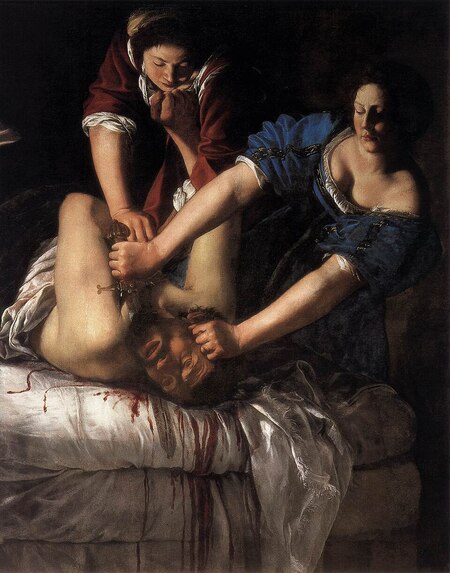
«Judith and Her Handmaiden with the Head of Holofernes, ” by Orazio Gentileschi, c. 1608–1612
This section discusses the naturalistic and abundant depiction of blood in the murder scene and the central question of how this affects sanctity. Is it perceived as something cruel, or is it the «price» of the divine?
In biblical narratives, there exists a specific category of violence that is not condemned but rather glorified. It is perceived as divine retribution, where the victim embodies evil and the perpetrator serves as an instrument of truth. In painting, such scenes are almost invariably accompanied by rich depictions of blood. However, this blood serves a fundamentally different function than in scenes of domestic violence. It often does not elicit sympathy for the victim nor a sense of injustice. On the contrary, the blood here becomes visual proof of the righteousness of the act against evil. It seems to legitimize the violence, transforming it from a crime into an action performed in the name of ultimate justice. The more physiological and copious the blood in these scenes, the more convincing the divine judgment executed by human hands appears.
«Judith and Her Handmaiden with the Head of Holofernes,» Artemisia Gentileschi, 1645–1650
To explore this idea, we can analyze works depicting the story of Judith and Holofernes—specifically, Judith’s slaying of Holofernes. This narrative has been portrayed by many artists, but the key feature is that the blood is rendered realistically and copiously in all the works. This detail suggests that Holofernes is maximally distant from the divine, as his death is depicted with maximum physical veracity. From this, one might infer that in this narrative, blood is perceived as divine punishment and will.
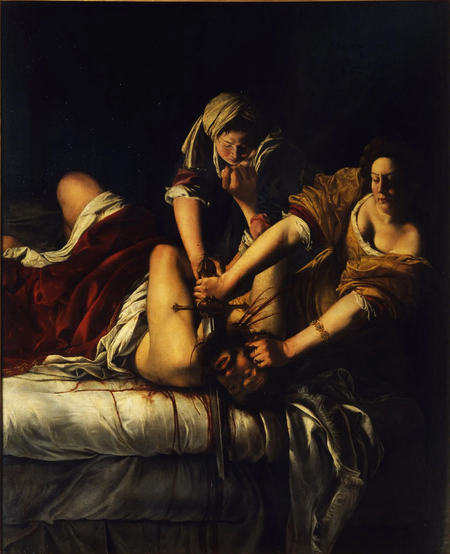
1. «Judith Beheading Holofernes, ” Artemisia Gentileschi, c. 1620 2. „Judith Beheading Holofernes, ” Artemisia Gentileschi, c. 1612–1613
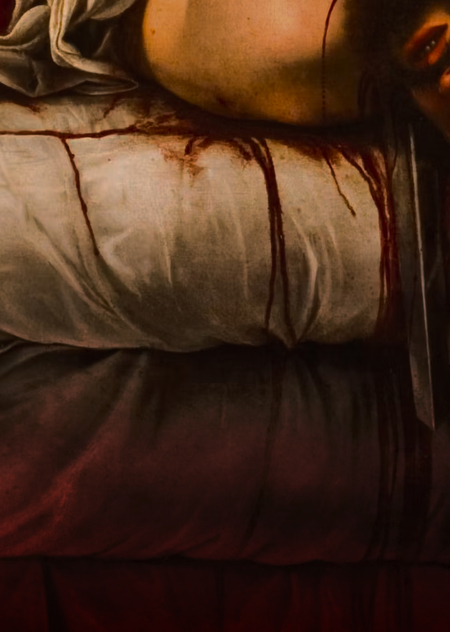
In the paintings of Artemisia Gentileschi, the process of violence and the resulting blood are rendered with particular naturalism. The sight of blood completely dominates the viewer’s gaze, and even if the viewer did not know the narrative, it is the sheer quantity and chaos of the blood that makes one feel a sense of awe toward the character of Oloferne. She is painted crudely and frighteningly, which may reflect Oloferne’s character.
«Judith and Holofernes, ” Caravaggio, circa 1599
In Caravaggio’s painting, «Judith and Holofernes,» blood streams powerfully from Holofernes' neck. This blood does not merely signify death; it represents the moment of justice triumphant. This sharp flow can also symbolize the attainment of freedom. Unlike the chaotic depiction of blood in Gentilechi’s works, here it appears to have a distinct direction, which renders the scene of the killing more rational and divinely justified.
«Illustration for the Bible: Jair kills Sisera, ” Paul Gustave Doré, 1877
This engraving also conveys the idea of naturalistic blood depiction as a sign of the deceased character’s separation from the divine, which consequently justifies the punishment. Sisara’s body is unnaturally contorted, and a puddle of blood has spread around his head. This entire image appears frightening, and most importantly, Sisara has been completely dehumanized by this pose. All we contemplate when looking at his body are the physical sufferings. But why, then, does this not evoke sympathy or reverence? The answer is that physical suffering seems to have completely possessed Sisara, and, as mentioned before, he has lost all humanity and spirituality.
The more pronounced the physical, «animalistic» suffering of a character in a work, the further they drift from spirituality.
«David with the Head of Goliath, ” Caravaggio, c. 1610
In the story of David and Goliath, blood signifies the triumph of weakness over strength, and faith over paganism. The blood on Goliath’s severed head is not merely the naturalism of execution, but a symbolic testament to the defeat of evil. In Caravaggio’s «David with the Head of Goliath, ” blood drips from the neck of the severed head that David holds in his outstretched arm. This detail creates the impression that death has just occurred—that justice was served mere minutes ago. In this narrative, the blood also does not portray Goliath as a victim; it simply registers the outcome of divine judgment.
A common thread running through all these scenes is that the blood depicted lacks tragedy. It does not elicit pity for the victim because the victim is the villain. It does not provoke revulsion because the murderer is considered a hero. Instead, the blood functions as a visual testament—a demonstration of the link between human action and divine justice. This is what validates the violence and, to some extent, makes it necessary. While the blood in such narratives may be shocking, it is also persuasive; it compels the viewer to believe that the spilled blood was the inevitable and righteous price for the triumph of good and the victory of divine will. However, the blood is not a sacred symbol; rather, it represents the outcome of that divine will.
If a work contains a significant amount of blood, this may suggest a sense of sacredness, but in that case, the blood is not the primary cause of divine will, but rather its outcome.
Martyrdom through blood
This section explores another visual approach to the scene of death and addresses the question: why does blood evoke shock in some scenes, yet reverence in others?
«Adam and Eve Find Abel’s Body,» Jean-Jacques Enner, 1858
If in scenes of righteous punishment blood served as a sign of vindication and triumph, then in scenes of martyrdom it takes on an entirely different meaning. Here, blood is not punitive but sacrificial. It can also be interpreted as an indicator of spiritual and divine power. Blood points not so much to death as it does to the sanctity of the dying. The blood of the martyr becomes visual confirmation that the sacrifice is true, and the martyr himself is holy.
«Lamentation,» Andrea Solario, 1505–1507