Categories
— Introduction: The concept of the mask and its significance as a tool for visual communication.— Early images of transformation: The painting from the Three Brothers Cave and the skull from Jericho.— Funeral facial representations of the Bronze Age: Mycenae and Egypt.— Dionysian imagery and the connection between ritual and theater.
— The Greek theatrical mask and its expressive characteristics.— Theatrical masks from the Hellenistic and Roman periods: the evolution of established character types.— Fayum portraits and the later tradition of funerary portraiture.— Comparative analysis of examples through the concept of recipient and context of use.— Conclusions: evaluating the hypothesis and the scope of the research.
Concept
I chose this topic because I am deeply passionate about theater and its various forms. I studied the acting style known as «dello arte,» where the actor transforms based on a mask. This led me to decide to explore this subject in depth through a visual investigation and to understand the origins of the mask tradition. A mask allows one to literally witness the moment of transformation. When a person puts it on, their outward appearance begins to communicate a different role to others—they might represent an animal, a deity, a deceased ancestor, or a theatrical hero. I found it fascinating to trace how the same object could participate in completely different cultural contexts. I enjoy this topic and the vast array of meanings inherent in even a simple mask.A mask is compelling not only because of its form but also because of how its meaning evolves. In some instances, it is linked to memory of the deceased or to religious rites; in others, it relates to acting and the conventions of the stage. Comparing such objects helps us understand how a visual image begins to function as a sign and how the audience learns to decode its meaning.
The work incorporates three levels of analysis. They help transition from describing individual subjects to drawing a general conclusion:
- Descriptive Analysis. First, I document what is directly observable on the object or image: material, form, facial details, scale, and context. It is crucial to separate observation from assumption.2. Comparative Analysis. Next, I compare objects and look for recurring features, such as the portraiture of funerary masks, the conventionality of theatrical types, and the ways emotions are conveyed.3. Structural-Genetic Analysis. In the concluding phase, I examine how individual characteristics relate to the mask’s intended function and how these relationships have evolved across different eras. The central concept becomes the «intended audience of the mask”—the person for whom the image is created or in whose presence it is used. This is one method for explaining differences between artifacts, not the sole cause of all changes.
Hypothesis
A crucial principle for understanding a mask is its intended audience and the context in which it is used. A funerary or cultic form may emphasize a connection to the deceased or a deity, while a theatrical mask helps the actor embody a character and be understood by the audience. This distinction can be reflected in scale, the expressiveness of the features, construction, and material. However, no single attribute definitively determines the function: the conclusion must be drawn by considering the entire context. This is interesting to explore because a mask holds many possible meanings.
Direct Analysis: What We See
For a detailed comparison, I selected two examples from different contexts: a Mycenaean funerary mask and a miniature depiction of a theatrical mask. It is important to remember that the second object is not the stage mask itself, but a reduced image of it.The so-called «Mask of Agamemnon»
• Material: thin gold leaf; the surface is treated to render the basic features of the face.• Construction: the mask was created using the repoussé technique, and individual facial details are emphasized through relief.• Size: close to the size of a human face; precise measurements should be verified against the museum catalog.• Eyes: depicted as closed; there are no slits for vision. The object was not intended for ordinary wear to the face.• Mouth: closed, with the mustache and other facial details highlighted in relief.• Features: the face appears individualized, though it should only be considered a precise portrait of a specific person with caution.
• Attachment: There are holes along the edges, intended for positioning the mask on the deceased.
• Expression: Restrained and static; it conveys a sense of solemnity.
• Context: The mask was discovered in the tomb of Circle A at Mycenae. Its function is connected to mortuary rituals and the concept of the deceased.
CONCLUSION: The object was not designed for actor movement or interaction with the audience. Its significance is primarily determined by its funerary context. The name «Mask of Agamemnon» is a later conventional designation; archaeological data does not allow us to link it to a specific hero of the Trojan War.
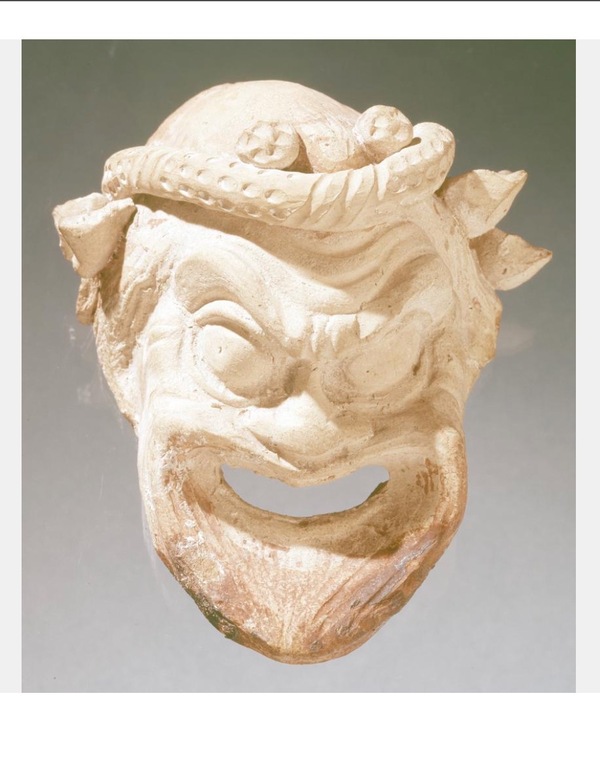
Terracotta miniature theatrical mask
• Material: Terracotta; the surface is covered with a light slip, and traces of paint remain in places.• Construction: The piece was molded, and the facial details were refined by hand.• Size: Approximately 12 cm. This is a miniature depiction of a mask, not a piece an actor could wear on stage.• Eyes: Large and expressive; on the miniature, they are rendered as part of the overall character. It is not possible to confidently determine the structure of the actual stage mask from this piece.• Mouth: Wide open and emphasized by the relief. This shape enhances emotional expressiveness, though the acoustic function of this specific object cannot be confirmed.• Features: The character is generalized and theatrically expressive; it does not aim for a portrait-like likeness to a specific individual.
• Attachment: The functional attachment is not shown in the miniature because the object was not intended to be worn.• Expression: Emotionally emphasized—the eyebrows and mouth form a recognizable tragic figure.• Context: The miniature terracotta masks may have served as dedications or objects associated with theatrical culture. The precise function of this piece should be clarified using the museum catalog.CONCLUSION: The miniature demonstrates that the theatrical mask has become a recognizable visual signifier. Even offstage, its distinctive features allowed the object to be associated with theater and a particular type of character.
Structural-genetic analysis: the core principle
Comparing examples allows us to identify the concept of the «mask’s recipient.» By this, I mean not only the person observing the object but also the context in which it gains meaning. A funerary mask is connected to concepts of death and memory; a cult mask is embedded in the relationship between a person and a deity, and a theatrical mask functions within the space of a performance, helping the audience identify the character. Therefore, the material, scale, and facial expression must be considered alongside the object’s function.Changes can be presented as several historical stages. They do not form a single sequence, as different functions of the mask continued to exist simultaneously.
The changes are not simply related to the transformation of the ritual mask into a theatrical one, but rather to the expansion of its uses. Theatre established a distinct system of visual conventions for the audience, while funerary and cultic imagery continued to exist alongside it. The development of the theatrical mask was influenced by stage design, genre, acting practices, and audience expectations.
The earliest signs of transformation. Group 1
«The Sorcerer» from the Cave of the Three Brothers
Researchers often associate this figure with a ritual or the concept of human transformation into an animal. However, to call it a depiction of a person wearing a real mask is merely speculative: before us is a drawing, not a preserved artifact. This can be considered the genesis of masks.Visual details: the figure merges the human body with animalistic traits—horns, an unusual head, and a tail. The image is rendered on a cave wall and is perceived as a single, fantastical entity.
Jericho skull with molded clay
The subject testifies to a complex relationship with the deceased and the memory of them. It can be viewed as an ancestral figure, though the precise meaning of such skulls to the residents of Jericho cannot be considered fully established.Visual Details: The human skull is covered in a layer of molded clay, which has been used to reconstruct facial features; cowrie shells are used in place of eyes. This results in a facial image created over human remains.
Group 2. Burial Mask Portrait: Crete, Mycenae, Egypt