Goal
Edward Hopper was an American painter of the 20th century and one of the most renowned representatives of Realism. He depicted the daily lives of ordinary people: city streets, cafés, hotels, and homes. A distinctive feature of his style is the combination of simple forms, crisp lines, and expressive play of light and shadow.His paintings often feature solitary figures lost in thought. Even within mundane scenes, the artist creates an atmosphere of silence, introspection, and gentle melancholy. Because of this, Hopper’s work compels the viewer to contemplate solitude, the inner world of humanity, and life in a large city.
My goal was to train a neural network to generate images in a style unequivocally recognizable as Hopper’s work. I aimed to create images that visually blended with the artist’s authentic pieces, leading viewers to believe they belonged to the American realist.
Image Library
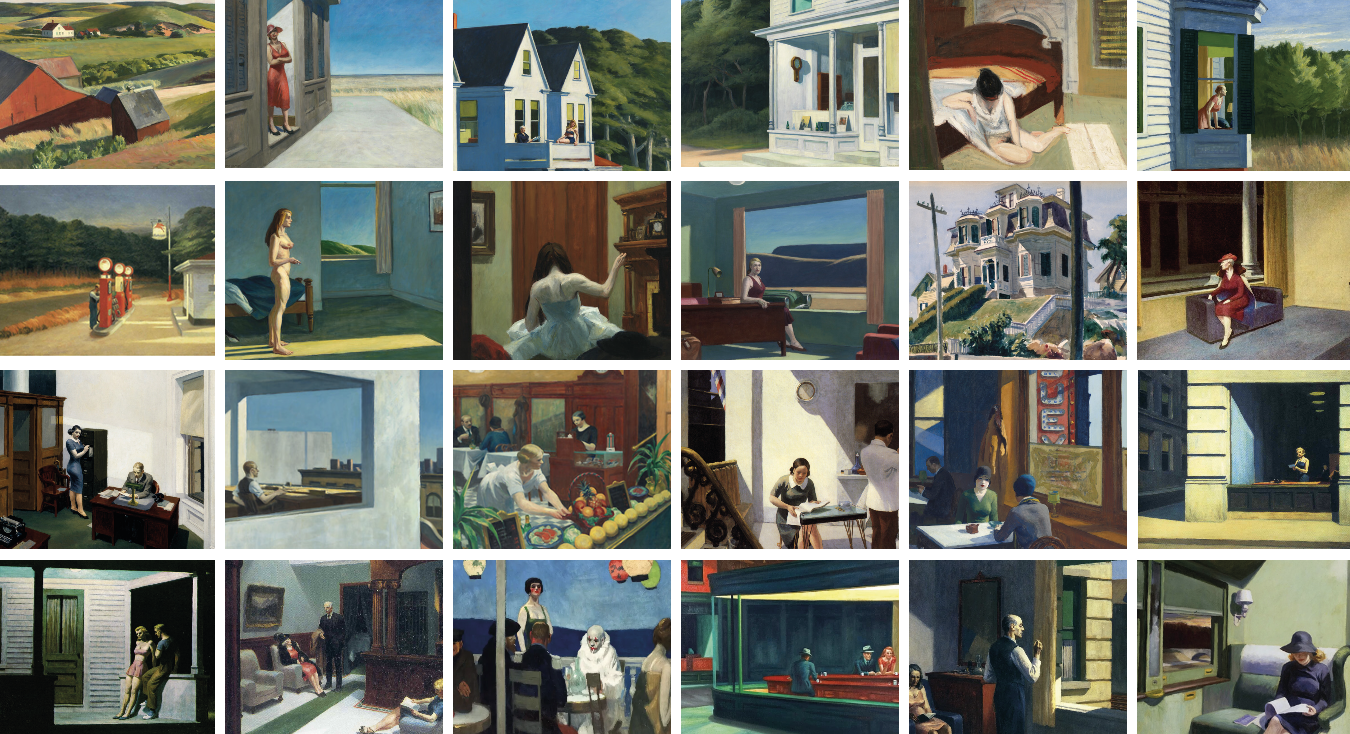
database
The dataset consists of 24 works by Hopper.
Description of the generative model application
While working on the images, I gained a deeper understanding of Stable Diffusion for training neural networks and Google Colab for writing the code to generate images.
Neural Network Training
Prompts for Generating Final Images
For a more fruitful result, I wrote out separate prompts for the generations. Below you can see the final works generated by the neural network based on these requests.
Final Images
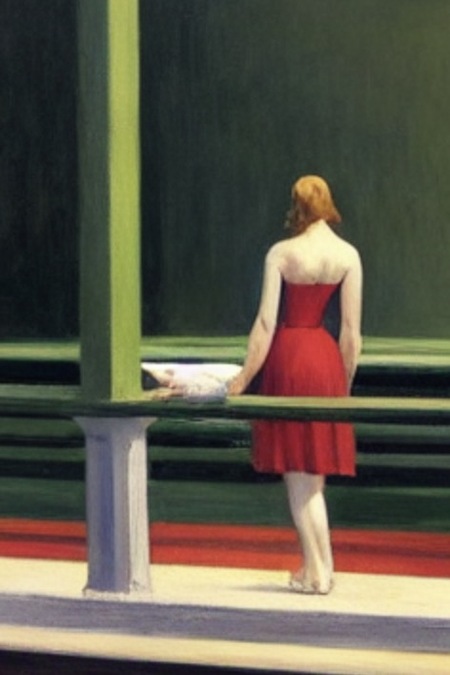
In my iterations, I aimed to replicate the color palette and atmosphere of loneliness found in Hopper’s work.
The result of the work was a series of 24 generated pieces.
Conclusion
The goal I set at the beginning was to train a neural network to replicate the recognizable style of Edward Hopper’s works, capturing his distinctive color palette and the atmosphere of solitude. Although some of the generated images turned out somewhat simplified, I believe the initial objective was met. The trained neural network successfully replicates the artist’s style to a good degree.During the process, I observed a tendency for the details to simplify and the characters' faces to blur. I hypothesize that with longer training and a greater volume of material, the neural network will be able to reproduce the stylistic nuances and subtleties with greater accuracy and success.Nevertheless, I am confident that the neural network rendered the landscapes and, particularly, the architectural structures exactly as I intended. Furthermore, it succeeded in reproducing the colors and authenticity characteristic of Edward Hopper remarkably well.