Research Concept
The mid-twentieth century was a period of significant social and cultural change, changes that are directly reflected in cinema. Perceptions of gender roles shifted, and film captured these movements, shaping new archetypes of female characters. It was during this period that the figure of the femme fatale emerged in film noir—a heroine whose presence combines allure, danger, and assertive independence.
The engagement with the femme fatale in 1940s–1950s film noir is due to its persistent presence in visual culture and its inherent interpretive complexity. The femme fatale is a central figure in noir, yet her status remains ambiguous: on one hand, she functions as an object of desire and spectacle; on the other, she is an active agent capable of influencing the narrative’s development.
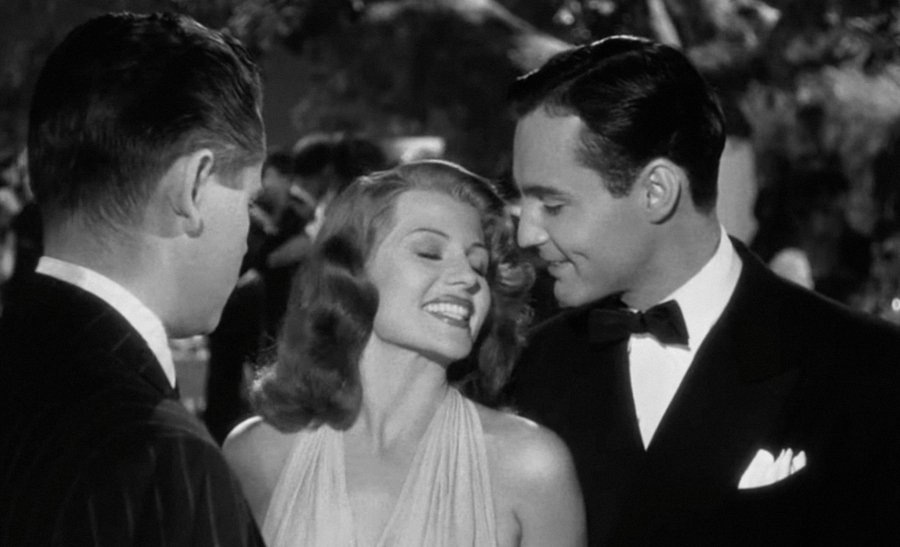
«Guild» (1946, directed by Charles Vidor)
The theoretical foundation of this research is the concept of the «male gaze, ” as proposed by Laura Mulvey. In her text, „Visual Pleasure and Narrative Cinema, ” she argues that classical cinema is structured in such a way that women become objects of visual pleasure, while men occupy the position of the viewing subject: „woman functions as image, man—as the bearer of the look“ (Mulvey, 2000, 64). In this study, this position is examined as a starting point, but not a comprehensive one: it is hypothesized that film noir demonstrates a more complex configuration in which the female image is not reduced to a passive function.
The principle for material selection is based on including films from the classical period of noir: Double Indemnity (1944), The Maltese Falcon (1941), Gypsy (1946), Lady in Shanghai (1947), Out of the Past (1947), The Postman Always Rings Twice (1946), Howell Dorset (1950), Mildred Pierce (1945), and Sunset Boulevard (1950). This selection allows for the tracing of both the canonical forms of femme fatale representation and their variations and transformations.
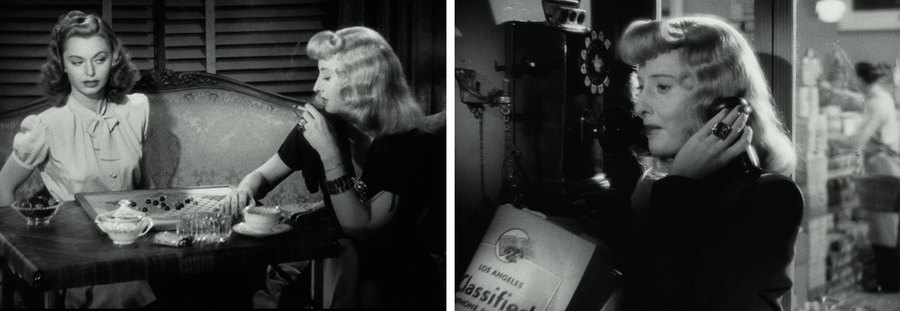
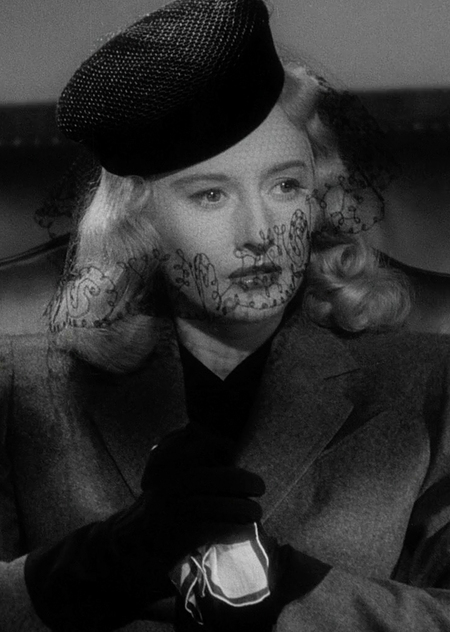
«Double Indemnity» (1944, directed by Billy Wilder)
The research’s rubrication principle centers on analyzing the visual strategies that simultaneously construct and undermine the image of the femme fatale. Initially, the techniques of objectification, through which the woman is constructed as a spectacle, are examined. Subsequently, attention shifts to the moments when this model begins to possess agency, transitioning from the position of an object to that of a subject. However, this subjectivity proves unstable. Thus, the research structure follows the logic from confirming Malvi’s theory to complicating and partially revising it, demonstrating that the visual language of noir not only adheres to the male gaze model but also contains internal mechanisms of its tension and transformation.
«Lady in Shanghai» (1947, dir. Orson Welles)
Malvi’s text serves as the primary reference with which the work enters into dialogue. Additionally, film studies focused on the perception and representation of female archetypes are incorporated to broaden the analytical perspective.
The central research question is formulated as follows: can the archetype of the fatal woman in film noir be viewed solely as an object of the male gaze, or does the visual organization of these films allow for forms of female subjectivity?
The hypothesis posits that the visual language of noir is not entirely subordinate to the logic of the male gaze: despite mechanisms of objectification, certain films display strategies that enable the female character to take an active position within the frame and influence the organization of the gaze, all while remaining part of a contradictory and unstable visual system.
Woman as Object: The Construction of the Gaze
Body Fragmentation
The objectification of women as fetishes is emphasized by focusing on specific details of their image (Novikova, 2015, p. 50). The body is assembled from fragmented details, directing the viewer’s gaze and depriving the image of its wholeness.
«The Postman Always Rings Twice» (1946, directed by Tay Garnett)
«Double Indemnity» (1944, dir. Billy Wilder)
«The Postman Always Rings Twice» (1946, directed by Tay Garnett)
Often, the fragmentation shifts to the level of the face, which is typically highlighted by soft light against a darkened background. The camera pauses, and the motion slows.
1. Double Indemnity (1944, Dir. Billy Wilder) 2. How to Marry a Millionaire (1950, Dir. Joseph H. Lewis) 3. The Postman Always Rings Twice (1946, Dir. Tay Garnett)
«Lady in Shanghai» (1947, dir. Orson Welles)
Theatricalization of the emergence
Another frequently used technique is the entrance as a spectacle. The woman doesn’t simply enter the frame; she «presents herself, ” becoming the focal point of visual attraction.
«Guild» (1946, dir. Charles Vidor)
«The Postman Always Rings Twice» (1946, dir. Tay Garnett)
Gestures, posture, and light emphasize not the action itself, but the very act of its demonstration. These episodes constitute an act of contemplation, which supports Laura Mulvey’s thesis on the dominance of the male gaze in classical cinema.
«Double Indemnity» (1944, dir. Billy Wilder)
«Lady in Shanghai» (1947, dir. Orson Welles)
«Mad About Weapons» (1950, dir. Joseph H. Lewis)
Deconstruction of the Object: Transition to the Subject
A Retrospective View
If in the male gaze the woman exists as an object of observation, here she returns the gaze, disrupting the unidirectional structure.
1. «The Man Who Shot Liberty Valance» (1950, dir. Joseph H. Lewis) 2. «Double Indemnity» (1944, dir. Billy Wilder)
The protagonists look directly at the partner or off to the side of the camera, asserting their presence as active subjects. This gaze does not merely respond; it holds and controls the visual field—the man becomes the object of their gaze.