01 · Media Concept
The core concept remains the same as in the first and second projects. I will briefly recap it because everything that follows depends on it—which sources are necessary, what can be entrusted to AI, and what cannot.
What and For Whom
This is a media outlet focused on music compressors. It views the device not as a box of parameters, but as an object with its own distinct vibe. Every compressor has a design, a mood, and a unique sound—and we seek the connections between them: why is a tube associated with warmth, metal with aggression, and a retro scale with nostalgia?
The goal is to inspire experimentation. After reading, you should feel compelled to connect the device, turn the knobs, and hear the difference for yourself. There is technical content, but presented «in plain language"—no lectures or dense manuals.
The channel is an HSE website, and the format is a long-form article featuring images and sound. There are four sections: «The Instrument’s Face,» «Seeing the Character,» «Listen Here,» and «Experiment Yourself.» We publish four times a month, and each month is dedicated to a specific type of compressor: optical, FET, VCA, vari-mu, bus compression, and plugins.
Studio and Unique Selling Proposition (USP)
The readers are four characters. Tyoma, 15, has just started mixing and wants to understand which compressor is better. Ilya, 27, has been mixing for several years and is looking for a reason to move beyond his usual settings. Marina, 38, loves music but is not a sound engineer, and she is simply curious about the boxes found in studios. Dasha, 24, is a designer who stumbled upon the content and is looking for examples where an object’s form explains its function.Unique Selling Proposition: Here, you can not only hear the compressor but also see it. While competitors explain how the equipment works, we showcase its appearance and character through the author’s personal experience, humor, and without boring textbooks or manuals.
02 · Data Sources
To publish four multimedia pieces—complete with images and sound—every month, a clear set of resources is necessary. I have divided these resources into three groups: what we create ourselves, what we acquire from manufacturers and publishers, and what we receive from readers. At the end, I will separately address what is missing from these sources and why.
What We Create Ourselves
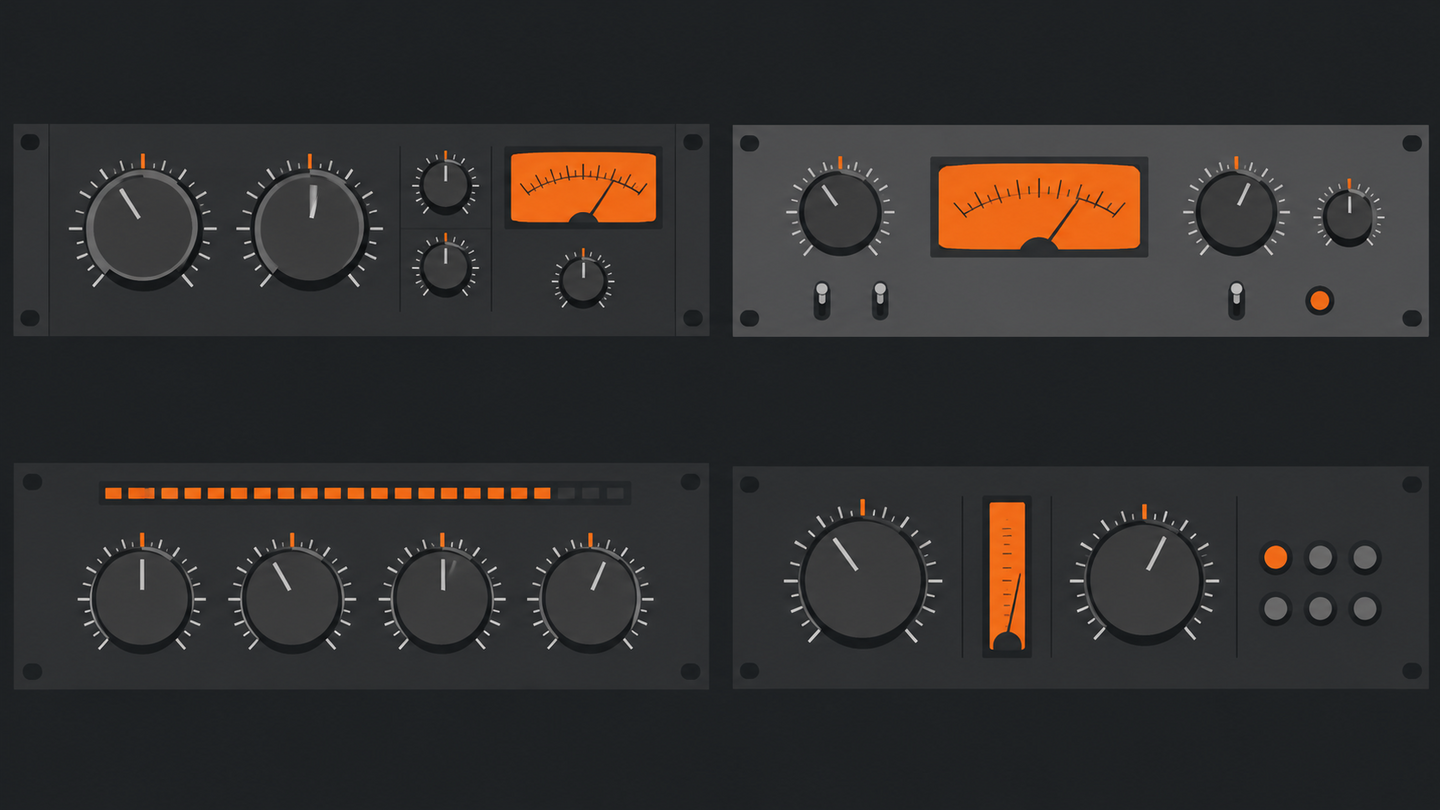
Our primary media source is our own audio recordings. For each piece of content, the same short excerpt (voice, drums, bass) is recorded in two versions: without compression and with compression. This is our unique content; we hold all the rights to it, and it is what makes our «Listen Up» and «Spin It Yourself» segments possible. Recordings are stored in WAV format.Our second original source is illustrations of the devices. We do not use photographs of real models due to licensing restrictions; instead, we generate stylized panels in a consistent design: a dark background, flat graphics, and an orange accent. The image displays a family of devices rather than a specific model.The third source is the author’s personal experience: session notes, observations, and jokes that later become the connective tissue of the texts. This is a standard txt file that is updated throughout the process.
What we take from manufacturers and publishers
Instrument facts are sourced exclusively from manufacturer documentation—user manuals and specifications. From these, we extract the control elements, their functions, and the general operating principle. These are PDF files and web pages that are uploaded as new instruments appear in the plan. When citing, the source and page number are always provided.For historical context and external impressions, we use specialized publications—Sound On Sound, Tape Op, and similar journals. We draw context from them, but we do not transcribe sound evaluations as facts: if a journal describes something as «warm,» in our text, it remains someone’s impression, not an inherent property of the instrument.A separate category includes search suggestions and query statistics (Yandex Wordstat). These are reviewed monthly to understand the terminology people use when asking about compressors, allowing us to select titles that are easily understood by our target audience.
What We Hear From Our Readers
After every publication, comments and questions are collected on the website. This is the most dynamic source: it shows what remains unclear, what equipment people want to see next, and which jokes landed well. Questions are grouped by theme and incorporated into the plan for the following month.
What the sources lack
We intentionally do not use other people’s photographs of actual equipment, audio samples, or unverified claims from forums about how a particular compressor «really» sounds. The first issue is copyright, the second is fair comparison, and the third is trust: any technical claim in the media must be supported by the manufacturer’s documentation.
03 · Data Schema: Human and Machine
I described the journey of a single piece of material from its source to publication as an eight-step conveyor belt. At each stage, it is specified who is doing the work—the machine or a human. The general rule is simple: the machine collects, summarizes, and prepares drafts; the human verifies the facts, adds experience and humor, and makes all publication decisions. The machine never publishes anything on its own at any stage.
Step 0. Concept—Human
The author feeds ideas and thoughts to the GPT, from which the AI will generate its work. This is the most crucial step, and it relies on human input.
Step 1. Gathering Sources — Machine
The script downloads guides and specifications for the list of equipment from the plan, gathers search suggestions based on the monthly theme, and exports comments from past publications. Everything is compiled into a materials folder: PDF, query spreadsheet, and a text file with comments.
Step 2. Fact Extraction — The Engine
The language model reads the documentation and compiles a table: governing body, its purpose, the device’s operating principle, and the source page number. If any information is missing from the document, the table will state: «not in source.» Nothing is inferred.
Step 3. Draft Text — Machine
Following the rubric template, the model compiles a draft: how the device is constructed, what it looks like, what to pay attention to in the sound, and an idea for an experiment. The draft relies solely on the facts table and the author’s notes. The model places subjective words about the sound in parentheses so the editor can easily spot them.
Step 4. Fact-Checking and Editing — Human
The author cross-references every technical claim with the table and document, removing or rewriting anything that isn’t supported. Then, they refine the tone—injecting personal experience, humor, and those subtle connections between design and sound. This is a creative step, and it cannot be automated.
Step 5. Audio Examples — Human and Machine