1. Media Concept
NOT YET KNOWN (NYK) — an independent digital media platform and visual archive dedicated to the young art scene. It tells the stories of artists before they achieve widespread recognition—through their work, studio practice, creative process, and initial encounter with the audience. The core concept remains from the initial phase; below are necessary refinements required to launch the media.
Goal. To make the young art scene visible: to grant the artist their first form of public profile in the shape of a complete portrait, and to allow the viewer the opportunity to discover the author before institutions and the market do.
Audience. Young artists and students in creative fields who are interested in seeing the authentic paths of other creators. A young cultural audience interested in contemporary art, photography, and design, but who does not want to wade through academic jargon.
Principle. One artist—one practice—one complete portrait. Documentary black-and-white photography featuring one accent color for navigation and quotes. The tone is observational, clear, and devoid of pretension or promises to «discover a new star.»
How NYK Selects Its Heroes
NYK does not compile a ranking of the best, but there is a selection process—and it is open. Sources for participants include the application form on the website, recommendations from curators, faculty, and past NYK contributors, the editorial team’s own research into student showcases, open calls, and independent spaces.
Selection Criteria:
1. The author must have a developed body of work, series, or project—not just an idea.
2. The author must not have a permanent representation in a commercial gallery nor have held a solo exhibition in a major institution.
3. Priority is given to those with a public engagement planned within the next 2–3 months: an exhibition, an open call, a residency, or a zine. NYK can then guide the reader to that opportunity.NYK selects not the best, but those who are on the cusp of something new.
Navigation Menu
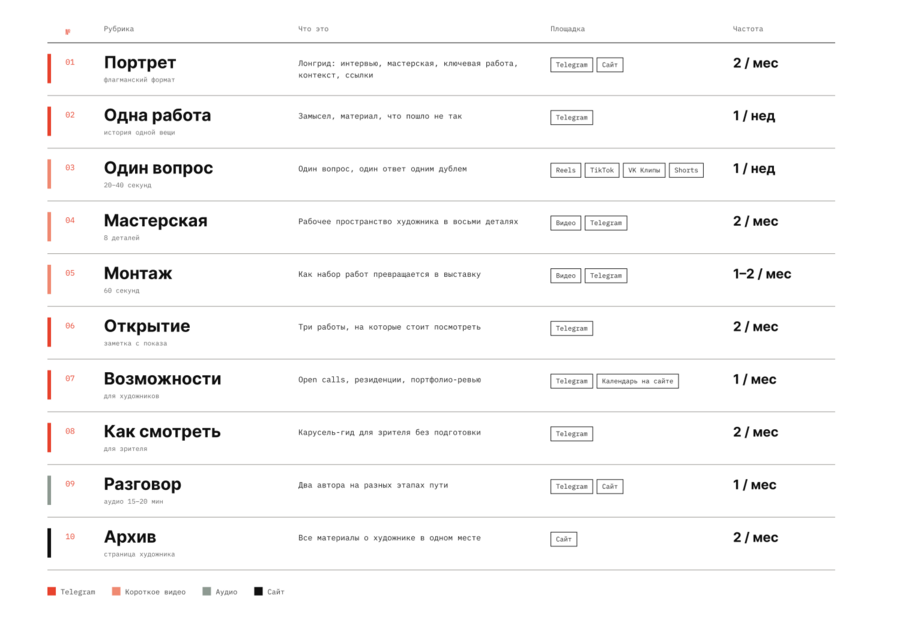
How are the platforms connected?
Short videos are the entry point, Telegram serves as the primary editorial platform, and the website functions as the long-term archive. Every featured artist follows this path: «One Question» or «Workshop» $\rightarrow$ «Portrait» on Telegram $\rightarrow$ an archived page. Three to six months later, NYK returns to the artist in the «Discovery» or «Montage» features to show the development of their practice, rather than just a single moment. Release Rhythm: Telegram—three posts per week (Mon, Wed, Fri); short videos—two per week; audio—one release per month; website—two major pages per month.
2. Thematic Plan: November 2026 — April 2027
In six months, NYK releases 148 materials. Each month, it receives a through-line theme that traces an artist’s journey—from concept to studio, to first showing, to career entry points, to material, to environment, and finally to a new season. Thus, the media itself undergoes the journey it describes over six months.
Through Characters. Four real young authors are followed across several months and columns: Kira Shilina (Nizhny Novgorod), Angelina Prokopyeva, Lena Gordeeva, and Lena Skripkina. The audience sees the character in a short video, then in a portrait, in a montage, and after six months—in the «Six Months Later» piece. This tests the core thesis of the concept: NYK documents a journey, not just a single publication.
Volume for six months (26 weeks):
How the plan is updated. Specific exhibitions, open calls, and dates are inserted one month before publication on the schedules and websites of institutions and venues. Only verified data is included in the materials. The overarching monthly themes remain, while the content is adapted to the actual season.
3. 10 Content Samples
Ten materials showcase NYK’s text, visual, and audio formats: posts, longreads, carousels, audio clips, and website pages. Short videos are integrated into the section structure and plan. Three examples (1, 2, and 10) focus on one protagonist, Kira Shilina, illustrating how a single creator moves through a developmental arc—from a short post to a Telegram portrait to an archive entry.
About the Facts. All the featured artists are real. Information about them is sourced from public records; links are provided at the end of the document. The artists' quotes are not invented: where their speech is required, there are interview questions or the notation «[Artist’s response].» Every piece is approved by the artist before publication.
Example 1. Portrait: «A Watercolor That Demands Immediacy»
«Portrait» Feature · Telegram, then the website · text + 6 photos. Flagship format: a single, cohesive feature on the author’s practice.
Watercolor: There is no room for hesitation
Kira Shilina is an artist from Nizhny Novgorod. She works with watercolor and calls it painting rather than graphic art: for her, it is a living medium that demands instantaneous response. In 2026, Kira is a resident of the «Vyksa» art residency.
Field. Kira’s childhood was spent on the edge of a field. In her work, she approaches plants as a way to feel connected to all living things. For her, plants are both fragile and strong, and she imbues them with human emotions.
Water. Kira paints in the alla prima technique—in one go, wet-on-wet, without reworking. Water, paint, pencils, and experimental materials work both with and against her. There is no going back to fix things here: the decision is made the same second the stain begins to spread.
Trace. Her works often feature imprints of objects—items the artist has personally interacted with. The imprint simultaneously generalizes the image and makes it personal: it is not «some leaf,» but a specific leaf from a specific day.
Vyksa. In 2026, Kira was selected as one of 12 participants in the «Vyksa» residency out of 277 applications. The theme of the season is water. Before the residency, the artist had never been to Vyksa and planned to study the city’s past and present.
Questions we will ask Kira (answers available after the interview)
— Has working with water changed now that it is not only a material but also a theme?
— What object did you create your first imprint from?
— What happens to the leaves that don’t work out? — What did you take away from Vyksa?
Where to look next: the artist’s personal platforms (links available by agreement) · Kira’s page in the NYK archive.
Visual. Six photographs. Five are black and white: a portrait at a desk, hands with a brush over a wet sheet, jars of water, a close-up imprint of an object, and a view of the pond in Vykhye. The sixth is a fragment of a finished piece—the only color image in the series: color only appears where art emerges.
Sample 2. «Workshop»: Eight Words on Kira Shilina’s Watercolor
«Workshop» Feature · Telegram · Text only. A concise entry point: readers familiarize themselves with the practice through eight key words before encountering the full profile.
Eight words that make up Kira Shilina’s watercolor
Water. It is the starting point of every piece: Kira paints wet-on-wet, and the water is a co-author.
A second. The alla prima technique does not allow for revision. The decision is made while the stain is spreading.
Paper. Kira refers to her watercolor as painting, not graphic art: for her, it is a living material, not a preparatory sketch.
Pencil. Along with paint, pencils and experimental materials participate in the work.
Trace. Prints of objects—things the artist has personally interacted with.
Plant. The main motif: fragility and strength simultaneously.
Field. Kira’s childhood passed on the edge of a field—this is where her botanical world comes from.
Vyksa. The 2026 residency, where water was the theme of the season.
A full portrait of Kira will be in the next post.
Sample 3. «One Question»: Lena Gordeeva
«One Question» feature · 60s audio, Telegram. The simplest and most regular format: one question, one answer, no editing.
Sound: a short NYK sting (2 seconds), followed by the host’s voice and the artist’s response in one take. No music under the voiceover.
Host (0–15s): This is «One Question» from NOT YET KNOWN. Lena Gordeeva graduated from the Journalism Faculty at HSE and worked as an editor. Later, she took an illustration course and became an artist—now she works in painting and animation. Lena, at what point did you realize you wanted to be an artist? Lena Gordeeva (15–55s): [artist’s answer—recorded in one take] Host (55–60s): Lena Gordeeva, painting and animation. Her journey from the editorial office to the studio is on Telegram NYK.