незначит
Media Concept
«Not Meaning» — a media platform dedicated to symbols and how their meaning shifts within culture. We explore familiar imagery—objects, colors, plants, and signs: their origins, what they signified across different cultures and eras, and why they continue to appear in contemporary art, fashion, design, the internet, and everyday life.
Half-Yearmatic Plan
Who this is for: readers of cultural media, students of humanities and creative fields, designers, and individuals who follow contemporary visual culture. Practical value: the ability to better recognize cultural references, find vetted resources, and engage with symbols more thoughtfully in creative work.
Channels: VK, Telegram, and additional visual platforms. A short post captures attention with a familiar image or an unexpected juxtaposition; cards convey the core narrative; long-form text, supplementary images, and source links allow for deeper exploration of the topic. Materials are adapted for each channel rather than being entirely duplicated.
Editorial Principle: A symbol is not declared to have «meaning for an entire people» without specifying its place, time, and tradition. Facts and interpretations are separated; historical claims cite museum, scholarly, or primary sources. Modern reinterpretations are not presented as a continuous ancient tradition.
Media Features
- Multiple MeaningsOne image interpreted differently across various cultures or social contexts, including potentially opposing readings.Format: a carousel of 4–6 cards.2. The Life of a SignThe origin of a symbol, the historical evolution of its meaning, function, and visual form.Format: an analysis or a short article.3. This is Now…The contemporary manifestations of symbols in fashion, design, art, digital culture, and everyday life.Format: a visual essay or a curated collection.4. Object ArchiveAn introduction to a specific artifact from a museum collection, focusing on one interesting detail.Format: a photograph with a brief commentary.5. Don’t ConfuseA comparison of symbols that are visually similar but originate from different sources. Checking common interpretations.Format: comparative cards or a short video.6. What Do You See?Polls, questions, and small visual experiments demonstrating how context influences the perception of a symbol.Format: a poll or an interactive post.
Monthly Plan
November 2026. Where Meaning Begins
Core Materials:
What transforms an image into a sign.
Why the white dress became bridal.
One color across various cultural traditions.
How context shifts image interpretation.Supplemental Materials: visual archive of wedding colors, notes on the difference between a sign and an object, «Guess the Meaning» poll.December 2026. Amulets and Protection
Core Materials:
The Egyptian Eye of Horus.
The Hamsa hand.
Amulets on the body.
What makes an image protective.Supplemental Materials: museum collection of amulets, comparison of the eye and hand symbols, an interactive feature on common talismans.January 2027. Nature as Symbol
Core Materials:
The pomegranate and Persephone.
The sacred tree in Assyrian art.
The scarab and the sun.
The lotus and renewal.Supplemental Materials: a visual series on plant forms, a note on natural cycles, a poll on images of rebirth.February 2027. Love and Belonging
Core Materials:
The history of valentines.
The heart in print culture.
The engagement ring as a sign.
How color codes emotion.Supplemental Materials: an archive of 19th-century postcards, modern heart typography, a collection of symbols of intimacy.March 2027. Body, Health, and Healing
Core Materials:
The Rod of Asclepius and the Caduceus.
The snake as an image of renewal.
Gestures and their cultural contexts.
The body as a carrier of signs.Supplemental Materials: a short video on two medical emblems, an amulet archive, a reader question about symbols on clothing.April 2027. The Second Life of a Symbol
Core Materials:
How a historical motif enters contemporary design.
What happens to a sign in an emoji.
Symbol repetition in fashion.
How to distinguish a cultural quote from a chance resemblance.Supplemental Materials: a collection of modern reinterpretations with attribution, a «Sign without Context» card, final survey.
Publication rhythm: nine pieces of content monthly—four large thematic analyses, two short notes, one archival collection, one short video or visual essay, and one interactive piece. Over six months, this amounts to about 54 independent publications. One story can be adapted for various digital channels; the number of adaptations is not included in the 54.
Reader Journey and Formats
See → Get Interested → Understand → Save → Return. The first screen hooks the viewer with a recognizable image and an unexpected question; the carousel answers it through specific cultural examples; the caption adds caveats and sources; the archive section and upcoming issues help deepen knowledge progressively. The core content will consist of post-cards and visual analyses, supplemented by short videos, articles, curated collections, and polls.
Ten Content Samples
«A sign does not have a single meaning.»
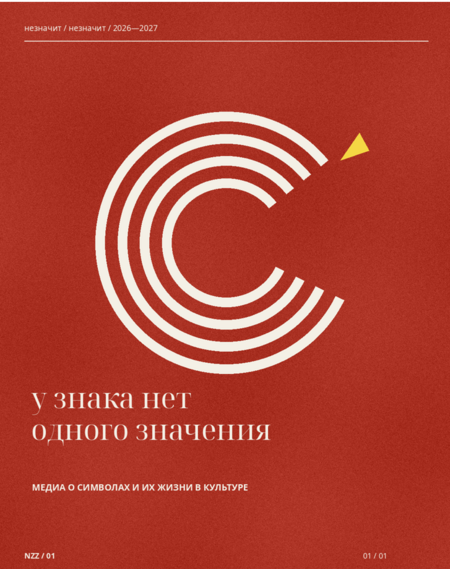
Rubric: Media Introduction.Format: Introductory post + image. Channel: VK / Telegram.Goal: To introduce the reader to our editorial perspective.Publication Text:
A snake might appear on a medical emblem. A pomegranate—in a story about the underworld. A drawn eye—on an amulet intended to protect its owner.
A symbol does not hold a single meaning across all time. Sometimes the sign itself changes, sometimes the person viewing it does.
«Neznachit» is a media outlet about these shifts. We compare images, objects, and signs from different cultures, trace their history, and seek their continuation in contemporary art, design, and everyday life.
Not to build a dictionary of ready-made answers. But to notice that familiar things tell much more than they appear to.
«White is not always a celebration»
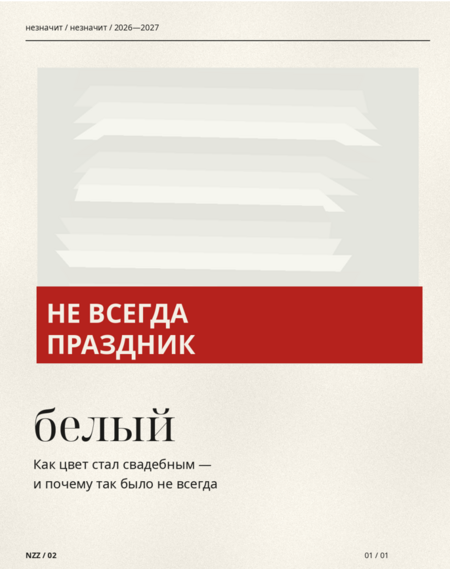
Category: «The Life of a Sign».Format: Carousel, 5 cards. Channel: VK / Visual Social Media.Objective: To demonstrate that a «natural» tradition is formed historically.Card 1. WHITE — NOT ALWAYS A CELEBRATION. Why did the wedding dress become white?Card 2. White attire existed long before the 19th century. However, in Europe, there was no single mandatory wedding color—brides walked down the aisle in a vast variety of dresses.Card 3. In 1840, Queen Victoria chose a white dress with Honiton lace for her wedding to Prince Albert. The image spread widely thanks to the press and fashion illustrations.Card 4. In the latter half of the 19th century, the white dress became increasingly associated with romance, propriety, and purity. Meanwhile, the colored wedding suit did not disappear immediately.Card 5. The symbolic «norm» seems eternal until you look into its history. People, imagery, and methods of dissemination often create meaning.Caption: The white dress was not invented in 1840. But Victoria’s wedding helped transform one dress option into the mass archetype of the perfect bride. In the history of symbols, what matters is not only the moment of appearance but also how the image circulates.Source: Victoria and Albert Museum, «The Victoria Connection»; «Wedding Colour.»
«Pomegranate: Life, Death, and a Few Seeds»
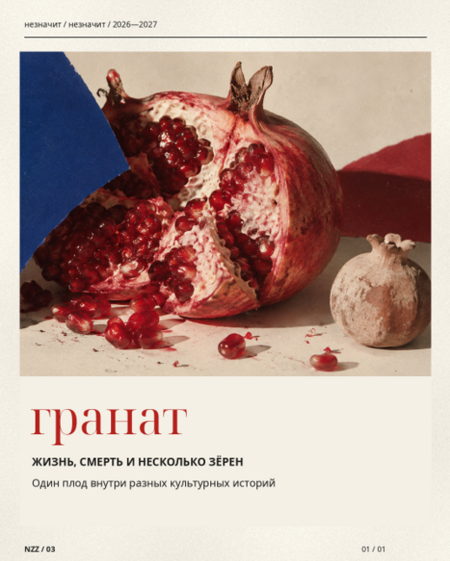
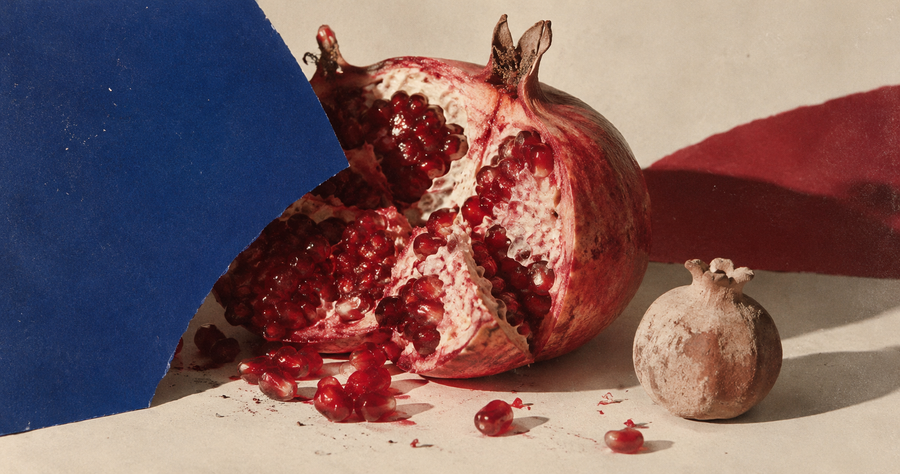
Rubric: «Not One Meaning.»Format: Carousel, 4 cards.Objective: To illustrate a semantic contradiction within a familiar image. Card 1. POMEGRANATE: FERTILITY AND THE UNDERWORLD. Card 2. In ancient art, numerous pomegranate seeds could reference fertility, desire, and marriage. Card 3. However, in the myth of Persephone, it is the consumed pomegranate seeds that connect the heroine to the realm of the dead. Thus, the fruit becomes part of a story of separation and return. Card 4. One fruit can be both a symbol of life’s continuation and a marker of the boundary between worlds. There is no contradiction—the specific narrative dictates the meaning. Caption: The form and properties of an object may suggest meaning, but they do not define it definitively. Therefore, the pomegranate in the depiction of Venus and the pomegranate in the story of Persephone must be read differently. Source: The Metropolitan Museum of Art, «Terracotta Pomegranate, ” „Food and Drink in European Painting, 1400–1800.“
«Don’t confuse these serpents»
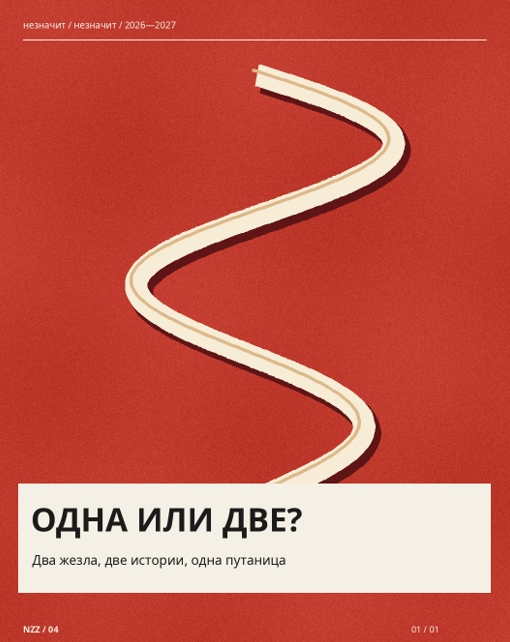
Rubric: «Don’t Mix Them Up.»Format: 45–55 second vertical video.Channel: VK Clips and other video formats.Objective: To visually illustrate the difference between two similar symbols. 00–05 sec. Close-up of two drawn emblems: a staff with one snake and a winged staff with two. Text: «These are not the same symbol.» 05–15 sec. The first emblem appears on screen. Voiceover: «One snake winding around a staff is the attribute of ancient Greek Asclepius, the god of healing. This image is specifically connected to medicine.» 15–28 sec. The second emblem appears. Voiceover: «Two snakes and wings—the caduceus, Hermes’s staff. Its historical associations are messaging, exchange, and trade.» 28–41 sec. The two images are overlaid, highlighting similarities and differences. Voiceover: «In modern times, the caduceus has also begun to be used in medicine, and the similarity of the symbols has become a source of confusion.» 41–53 sec. Side-by-side comparison. Final phrase: «Sometimes meaning changes not because of ancient mystery, but because two symbols were confused at some point.»
Caption: The medical snake has a double. Save this to avoid confusing the Staff of Asclepius and the Caduceus. Source: Wilcox & Whitham, Annals of Internal Medicine (2003); Bohigian, Missouri Medicine (2019).
«The Protecting Eye»
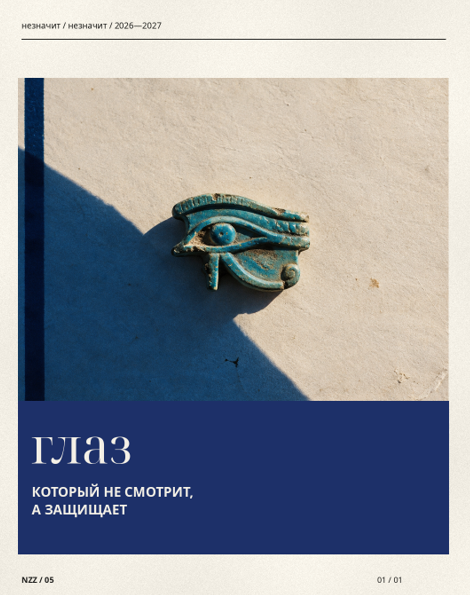
Category: «Object Archive.»Format: 4 cards + photo of a museum object.Goal: To explore meaning through a specific object.Card 1. THE EYE THAT DOESN’T LOOK, BUT PROTECTS.Card 2. The Wadjet is an ancient Egyptian symbol of the healed eye of the god Horus. It combines the features of a human eye and a falcon’s eye.Card 3. In mythology, a damaged eye was restored. Therefore, the symbol became associated with healing, integrity, and renewal.Card 4. It was worn as an amulet, placed near both the living and the dead. It was not merely ornamentation, but an object from which protection was expected.Caption: When an image transforms into an amulet, its meaning depends not only on its form but also on belief in the object’s power. A prime example: the golden Wadjet amulet from The Met collection (No. 23.2.67).Source: The Metropolitan Museum of Art, «Wedjat Eye Amulet.»
«The Tree That Isn’t There»
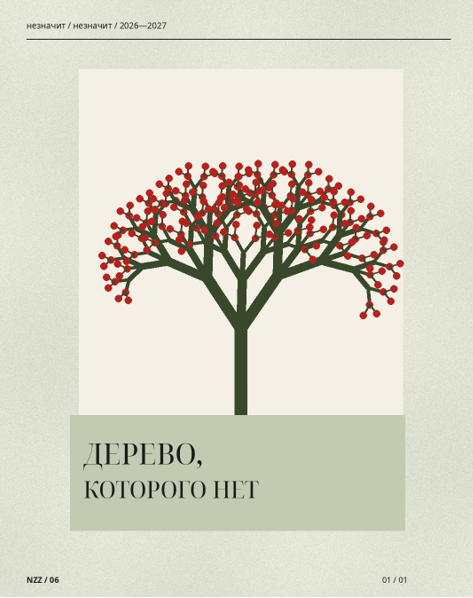
Category: «Subject Archive» / «The Life of the Sign.»Format: Visual note + archival image.
Objective: To demonstrate that a sign does not necessarily depict an existing object.Post Text:
Unusual trees appear on Assyrian palace reliefs from the 9th century BCE—perfectly organized and almost architectural, they bear resemblance to no specific plant species.
Researchers refer to it as the «sacred tree.» It was likely connected to the fertility, abundance, and prosperity of Assyria, although all details of its meaning remain unconfirmed.
Interestingly, to use this image, one did not need to copy a real tree. It was sufficient to invent a recognizable form that would be repeated and associated with specific ideas.
Sometimes a symbol begins where nature ceases to be depicted literally.Source: The Metropolitan Museum of Art, «Relief Panel, ” Assyria, Nimrud, c. 883–859 BCE, Inv. No. 17.190.2079.
«Why has the lotus become a symbol of return?»
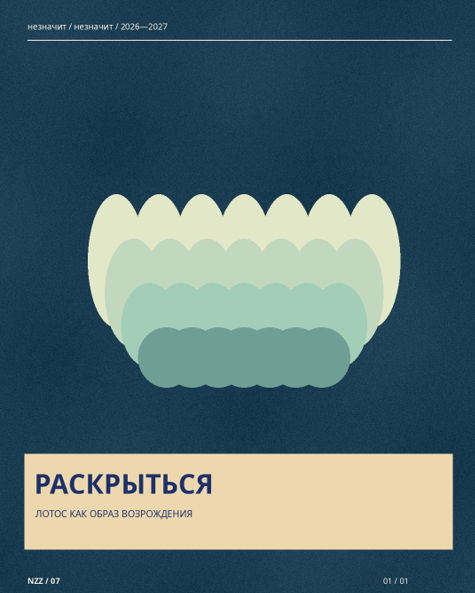
Category: «Not One Meaning» / Visual Miniature.
Format: 3 cards.
Task: To demonstrate the connection between an observed natural property and its cultural significance.
Card 1. LOTUS: EVERY DAY AS A NEW BEGINNING.
Card 2. In Ancient Egyptian symbolism, the lotus was connected to the flower’s daily opening and evening closure—a cycle resembling the path of the sun.
Card 3. Therefore, it became a symbol of renewal, rebirth, and the continuation of life. One botanical rhythm transformed into a cultural metaphor.
Caption: In this narrative, a symbol is born from observation of nature. However, a clarification is important: this refers to a specific Ancient Egyptian tradition, not all meanings of the lotus worldwide.
Source: British Museum, «Ancient Egypt: Symbols of the Pharaoh.»
«How the Heart Became a Message»