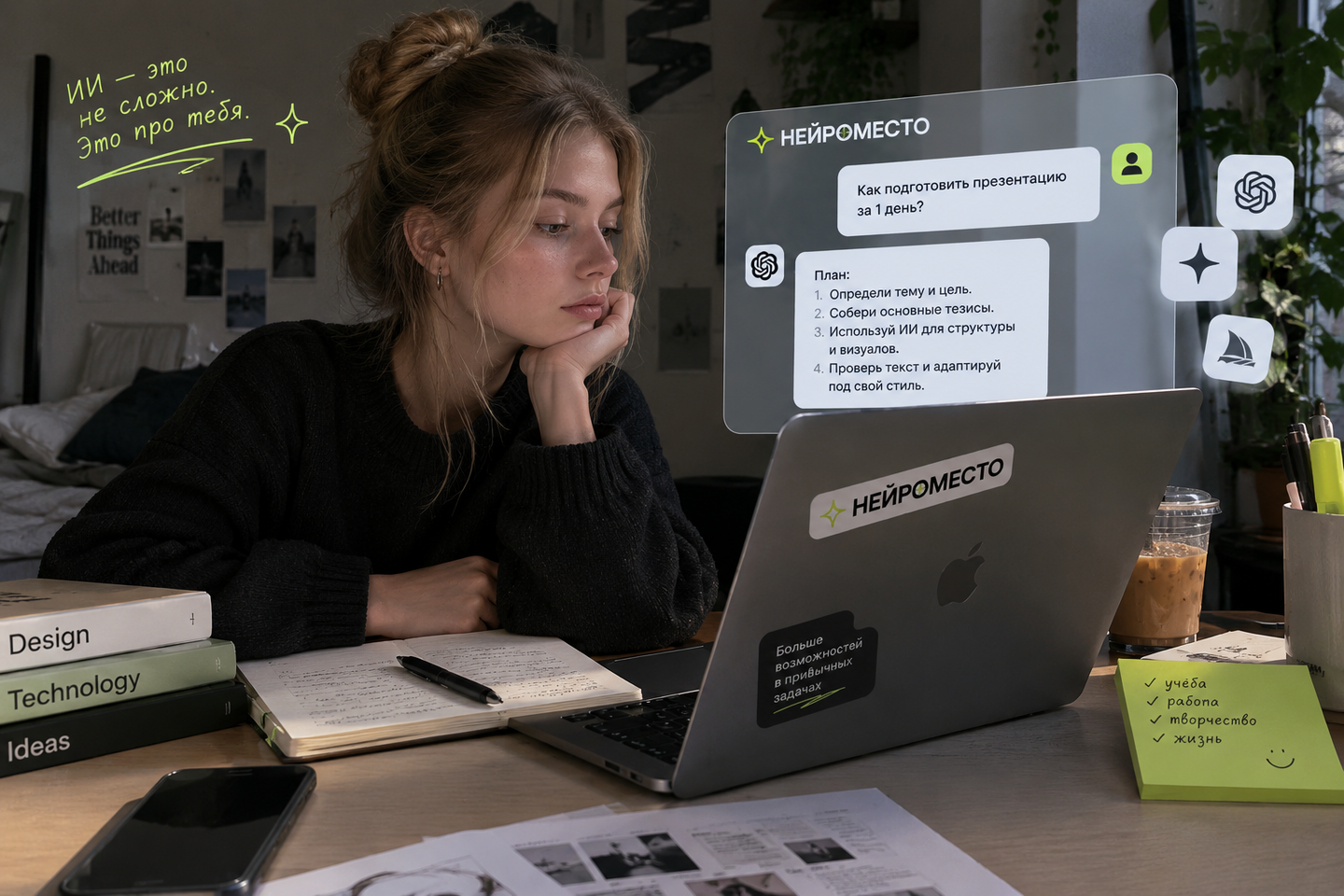
«NEUROMESTO» — media about the everyday use of artificial intelligence
What if AI could be useful not just for specialists, but for everyday life? Today, neural networks help write texts, search for information, create images, and analyze large volumes of data. But the sheer number of services often complicates the choice: it’s unclear which tool to use, how to properly frame the prompt, or whether to trust the resulting output.
«NEUROMESTO» proposes viewing AI through real-life scenarios. Instead of listing all the latest technologies, we demonstrate how to use them for specific tasks: preparing for studies, analyzing a document, brainstorming an idea, processing information, or automating repetitive work. The basis of our articles is concrete tasks: creating a presentation, summarizing a large text, developing several visual concepts, or understanding a new topic. Each breakdown illustrates the sequence of actions and explains what can be delegated to AI and what is best left to a human.









We explore the application of AI and explain how to use it in daily tasks: — which tool to select for a specific task; — how to formulate a prompt to get a useful result; — how to work with text, images, and information; — how to verify the neural network’s answers; — how to refine the result to suit your needs; — what to use as a substitute tool if one is unavailable; — when AI truly saves time, and when it is simpler to do everything yourself.
Our goal is to help the reader use AI consciously and find real-world applications for it in their life. Practical media about everyday artificial intelligence. The core of every piece is a specific problem and a clear way to solve it using AI.
Media Objective
«NEUROMESTO» demonstrates how to use AI for various situations: studying, working, creating, and organizing daily tasks. Through simple examples, the reader learns how to choose the right tool and verify the results independently. The media helps to: — find AI tools for specific tasks; — properly formulate prompts; — work with large volumes of information; — create and edit texts and images; — save time on repetitive actions; — notice the errors and limitations of neural networks; — understand which tasks should not be entirely delegated to AI. The value of the project lies in transitioning from interest in the technology to action. The reader receives clear scenarios that they can apply to their own tasks.
Segment and niche topic
Segment Practical digital media on technology, artificial intelligence, digital tools, and productivity.
Narrow Topic Using AI for daily tasks in studying, working, creating, and organizing information. The core of the project is a specific task and the opportunities AI offers to solve it: which tool to choose, how to work with it, how to verify the result, and how to tailor it to one’s own needs.
Key Media Topics:
— AI for study and work; — working with text and information; — generating and editing images; — creating presentations and documents; — idea generation and creative tasks; — automating repetitive actions; — vetting neural network results; — comparing different AI tools
Editorial Sections
Six sections help explore the capabilities of AI through specific tasks.
Task We take a common situation and demonstrate how AI can help solve it. Example: A long article that needs to be read quickly—how to use AI to create an outline and extract the main ideas.
Tool We select one service and demonstrate its capabilities using a specific task. Example: AI for image manipulation—what can be changed on a photo without a full-featured graphic editor.
Prompt We break down how to phrase a task for a neural network and why one prompt yields a weak result while another provides a more precise one. Example: How to transform a vague request like «come up with project ideas» into a clear assignment with defined constraints and criteria.
Verification We show why AI-generated answers should not always be accepted without review. Example: How to fact-check dates and sources within text generated by a neural network.
Before/After We demonstrate how the result changes after refining the task and applying human editorial work. Example: AI’s initial response—prompt refinement—error correction—final text.
Your Scenario We analyze readers’ real-life challenges and show where AI could be useful in their process. Example: A reader sends in a description of their week of studies—the editorial team demonstrates which tasks can be simplified using neural networks.
The same task can appear in different sections: first, demonstrating a tool, then analyzing the prompt, verifying the result, and compiling a complete use case. This allows for the regular creation of valuable content around familiar situations.
Competitive Analysis
The goal of this analysis is to understand where the audience is currently receiving AI information, what problems competitors are solving, and what additional value «NEUROMESTO» can offer. We are studying technological media, educational platforms, blogs about digital tools, and practical services. We are paying close attention to the journey from learning about a neural network to taking a specific action that a person can replicate independently.
Analysis CriteriaPositioning and Audience: Who is the project targeting and what problem does it aim to solve.
Topic: AI news, technology, learning, productivity, or practical application of neural networks.
Platforms: Where the content is published and how it is adapted for each channel.
Formats and Tools: Articles, cards, short videos, tutorials, quizzes, and case studies.
Visual Style: Service interfaces, screenshots, diagrams, and examples of outcomes.
Tone of Voice: How understandable the recommendations are to someone without a technical background.
Practical Value: Whether the described scenario can be replicated to achieve a similar result.
Direct Competitors
RBC Trends
Media focusing on technology and societal change, which regularly covers artificial intelligence, neural networks, and their impact on work and education. Analysis platform: website. Formats and tools: news articles, explanatory essays, research, and expert content. Visual aesthetic: high-tech, featuring illustrations and infographics. Tone of voice: expert, explanatory. Strength: a wide range of topics and access to experts. Key insight: audiences need to understand not just what has happened in technology, but how it changes life for individuals. «NEUROMESTO» applies this principle to specific, everyday challenges.
Skillbox Media
Media about learning, technologies, and digital tools. It publishes practical materials on neural networks, their capabilities, and ways to apply them. Analysis platform: website. Formats: tutorials, service reviews, educational materials, case studies. Visuals: screenshots, illustrations, and usage examples. Tone of voice: accessible, instructional. Strength: detailed explanation of tools. Key insight: complex technologies are easier to master through step-by-step actions. «NEUROMESTO» maintains this principle but emphasizes short scenarios from everyday life.
Indirect Competitors
vc.ru
A media outlet covering technology, business, and digital products, where AI regularly features in news stories, case studies, and user-generated content. Analysis platform: Website. Formats: News, case studies, personal experiences, reviews. Visuals: Varies by author, often utilizing screenshots and illustrations. Tone of voice: Conversational, professional. Strength: A large volume of real-world user case studies. Key insight: Personal experience demonstrates not only the tool’s capabilities but also its limitations. «NEUROMESTO» uses this mechanism in practical analyses.
Lifehacker
Practical media with instructions for daily life. Publishes materials on technology, productivity, and digital tools.
Analysis platform: website.
Formats: tutorials, lists, compilations, explanatory articles.
Visuals: functional, supporting the recommendations.
Tone of voice: clear, practical.
Strength: consistent explanation of actions.
Key insight: good material should help the user take the next step. For «NEUROMESTO,» that step is independently using AI.
Potential Competitors
YouTube and short videos about neural networks
Video reviews and short clips compete for the attention of an audience eager to quickly learn about a new tool or how to use it. Analysis platforms: YouTube, VK Clips, and other video platforms. Formats: reviews, screen demonstrations, short tutorials, experiments. Visuals: the service interface and a demonstration of the outcome. Tone of voice: ranging from expert to entertaining. Strength: the user immediately sees the process and the result. Key insight: AI is easier to grasp through demonstration. Therefore, «NEUROMESTO» uses the «problem → action → result» format.
Competitive Analysis — Findings
From the Task The starting point for publication is not a new neural network, but a human problem. The tool is selected only after the task is defined.
Clear Results Each piece of content must demonstrate what changed after using AI: the text became more structured, the information became clearer, and repetitive tasks became faster.
Human in the Process AI does not completely replace the user. Readers must understand what can be delegated to the neural network and what needs to be reviewed or done independently. From the analysis, we adopt clear demonstrations, short instructions, real-world case studies, and easy explanations of complex technologies. Based on these, we create a recognizable format: task → tool → action → review → result.
Audience preferences and the format’s demand will be tested through surveys, discussions, and initial publications.
Distribution Channels Each platform serves a different goal: to introduce the project, showcase AI applications, or help preserve useful scenarios. Telegram — for trying and discussing «NEUROMESTO» is the primary platform and the hub for regular communication with readers.