Concept
Thousands of wingless figures fly across the ceilings of the Mogao Caves—held aloft only by scarves and the edges of their garments. I felt an urge to understand where these celestial beings came from and how they changed en route.
Dunhuang—an oasis in northwestern China, located in the modern Gansu Province. This was the point where the desert began and the Silk Road—a network of caravan routes connecting China and the West—branched into two. Along these routes, goods, people, and ideas traveled. For merchants, Dunhuang was the last Chinese stop; for monks returning from India, it was the first. Twenty-five kilometers from the oasis, in a long cliff face, Mogao cave temples were carved from the 4th to the 14th centuries. According to legend, in 366 CE, the monk Le Xuan witnessed a radiance of a thousand Buddhas above the rock and established the first cell here [1, 2]. Today, approximately 735 caves are known, and paintings and colored sculptures are preserved in 492 of them [3, 4].
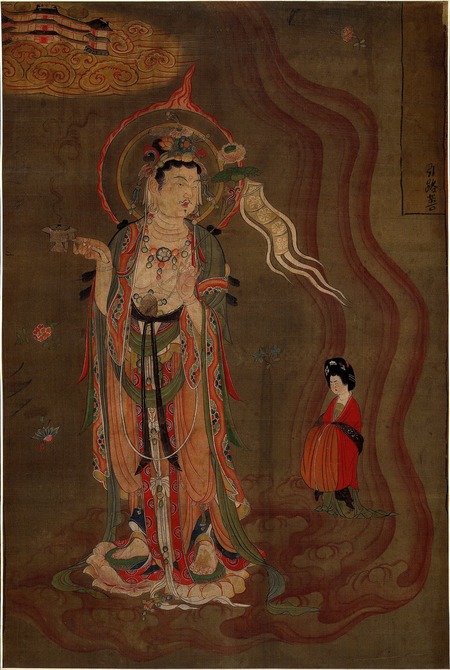
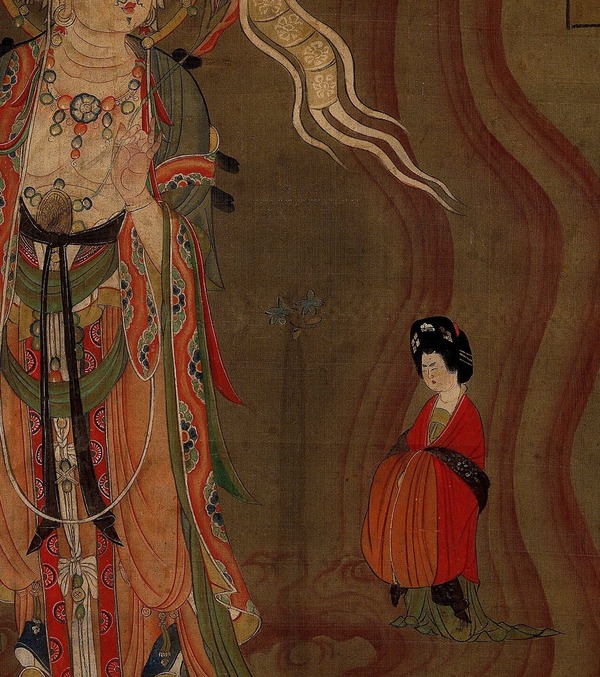
Fig. 1. Bodhisattva — guide of souls, late 9th century Fig. 2. Bodhisattva — guide of souls, detail: bodhisattva’s ornamentation and a deceased figure in court attire, late 9th century
Buddhism originated in Northern India about two and a half thousand years ago. Its founder, Prince Siddhartha Gautama, is known as the Buddha—the «Awakened One.» The teachings did not reach China directly; they first traveled through Gandhara—a region in present-day Pakistan and Afghanistan where sculptors were familiar with Greek art—and then through the oases of the Tarim Basin, a desolate basin between India and China. Each oasis added something to the image of the Buddha. In Dunhuang, this chain encountered Chinese culture—with its calligraphic line, concepts of beauty, and native gods—and the frescoes of Mogao reveal which foreign forms were adopted as is, which were adapted, and which never took hold. The title of the work can be understood in three ways. Celestial travelers are primarily apsaras, known in Chinese as feitian, or «flying heavenly beings”—celestial musicians and dancers; they appear in almost all the caves of Mogao [4]. The images themselves traveled—along with monks and merchants, they journeyed the Silk Road, changing slightly at every stop. Finally, these are the donors—people who financed the caves in the hope of reaching Buddha’s paradise after death and commissioned their portrait right at the temple entrance. The starting point was a silk painting from Cave 17 (Fig. 1). In the early 11th century, this small cave was sealed along with tens of thousands of manuscripts and paintings, and it was accidentally discovered in 1900 by the monk Wang Yuanlu [1, 3]. In the painting, a bodhisattva—a saint who attained enlightenment but remained in the world to help people—leads a small woman in a Tang Dynasty court dress on a cloud. Her body, adorned with necklaces, is rendered in the Indian style, while her companion is dressed like a noblewoman from the Chinese capital. In one piece of silk, the Indian image, the Chinese viewer, and the road between them converge.
Key Question: How did Indian Buddhist art traverse Central Asia, and how did its main motifs—the Buddha, Bodhisattvas, celestial musicians, and donors—evolve in Dunhuang from the 4th to the 14th centuries?
My hypothesis: The Indian image in Dunhuang underwent several transformations. First, the Chinese style altered the Indian body; then, during the Tang Dynasty, it began to resemble imperial court imagery, and later, Tibetans, Uyghurs, Tanguts, and Mongols introduced new forms into the grottoes. This is best observed in the flying celestial beings—how the concept of heaven changed—and in the donors—who felt entitled to enter that heavenly realm.
Material Selection Principle
The work spans the period from the first caves in the early 5th century to the 1348 stele: after the Yuan Mongol dynasty, no more caves were carved in Mogao [2, 1]. Monuments from India, Gandhara, and Kizil from the 1st–7th centuries appear only in the first chapter, serving as initial reference points on the journey. Central to the study are the paintings and sculpture of Mogao, along with silk textiles from Cave 17, and for comparison, neighboring sites such as the Yulin Caves, the Bezeklik Uyghur Monastery, and the Tarim city of Hexi Corridor.
Sources and Methodology
Many items from Dunhuang were brought out by expeditions led by Aurel Stein, Paul Pelliot, Langdon Warner, and Petr Kozlov in the early 20th century. Therefore, the images compiled here are sourced from the open collections of the British Museum, the Guimet Museum, Harvard Art Museums, the Hermitage, and Wikimedia Commons. The methodology employed is comparative: the same imagery is traced across different periods.
Glossary
Buddha — «The Awakened»: Siddhartha Gautama, the founder of Buddhism, as well as other enlightened beings—Maitreya, the future Buddha, and Amitabha, the Buddha of the Western Paradise. _________________________________________________________Bodhisattva — a holy being who has attained enlightenment but chooses to remain in the world to help others—such as Avalokiteshvara (Guanyin in China) and Manjushri. _________________________________________________________Apsara, Feitian — celestial musicians and dancers; Feitian means «flying celestial beings.» _________________________________________________________Donor — a patron who commissioned a cave, mural, or painting; they were often depicted alongside the saints. _________________________________________________________Jataka — stories about the Buddha’s past lives, in which he sacrifices himself for others. _________________________________________________________Sutra — a sacred text containing the teachings of the Buddha. Pure Land — the paradise ruled by the Buddha; in Dunhuang, this most frequently refers to Amitabha’s Western Paradise.
Who ruled Dunhuang
421–439 — Northern Liang — a small state; the age of the first caves. _________________________________________________________439–534 — Northern Wei — the dynasty of the nomadic Xianbei people. _________________________________________________________535–581 — Western Wei, followed by Northern Zhou. _________________________________________________________581–781 — Sui (581–618) and Tang (618–907) — a unified Chinese empire. _________________________________________________________781–848 — Tibetan Empire. _________________________________________________________848–11th century — Guyi — a local principality of the Zhang and Zhao clans. _________________________________________________________11th century–1227 — Western Xia — a Tangut state. _________________________________________________________1227–1368 — Mongols; the Yuan Empire began in 1271.
Navigation
Chapter 1. The Road to the East India, Gandhara, Kizi, 1st–7th Centuries _________________________________________________________Chapter 2. The First Caves Northern Liang and Northern Wei, c. 420–534 _________________________________________________________Chapter 3. The Encounter of Deities Western Wei and Northern Zhou, 535–581 _________________________________________________________Chapter 4. Paradise as Capital Buddhas and Bodhisattvas of the Sui and Tang Dynasties, 581–907
Chapter 5. Celestial Travelers Apsaras and Musicians, 5th–14th Centuries _________________________________________________________Chapter 6. Donors: Who Funded Heaven 7th–10th Centuries _________________________________________________________Chapter 7. After the Tang Uyghurs, Tanguts, and Mongols, 11th–14th Centuries _________________________________________________________Diagram. The Image’s Route and Transformation _________________________________________________________Conclusion
The chapters are chronological, except for the fifth, which lent its name to this study and spans all ten centuries. The first chapter presents the original prototypes; the second through fourth detail how Dunhuang adapted them; the sixth and seventh cover the patrons and new neighbors.
Chapter 1. The Journey East
Before arriving in Dunhuang, the image of the Buddha had taken on Greek, Indian, and Central Asian forms.
For several centuries, the Buddha was not depicted in human form; instead, he was indicated by footprints, an empty throne, or a tree. He adopted human form in the first centuries CE almost simultaneously in two locations [5, 6]. In Gandhara, masters worked based on models remaining from the Greek kingdoms after the campaigns of Alexander the Great [5], and the Buddha here resembles an ancient philosopher—wavy hair, a straight nose, and a heavy cloak with deep folds (Fig. 3). In Mathura, a city in northern India, by the 5th century under the Gupta dynasty, a different type developed: the Buddha in thin clothing, as if wet and clinging to the body (Fig. 5) [6]. Bodhisattvas were depicted as richly dressed Indian princes with necklaces and elaborate hairstyles (Fig. 4).
As painted in India itself, the murals of the Ajanta caves from the 5th century show a supple contour and chiaroscuro that gives form and volume (Fig. 6) [7]. Masters from Kuche—an oasis on the northern edge of the Tarim Basin—adopted this style. In the Kizil caves near Kuche, a series of balconies runs along the top of the wall from which celestial beings peer out with tools (Fig. 7) [8], and above the cave entrance sits Maitreya—the Buddha of the future who will come to the world after the current one (Fig. 8).
Fig. 3. Standing Buddha, 1st–2nd Century Fig. 4. Bodhisattva, seated cross-legged, 2nd–3rd Century Fig. 5. Standing Buddha dedicated to the monk Yasadina, circa 5th Century
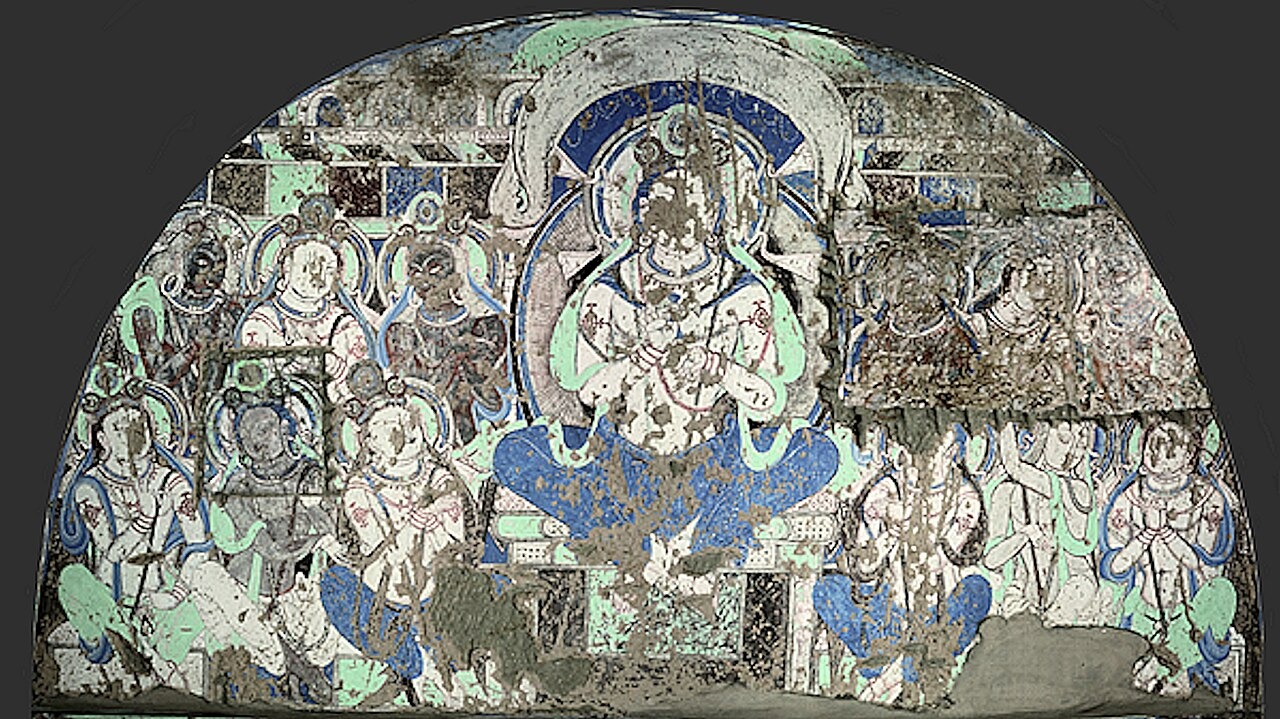
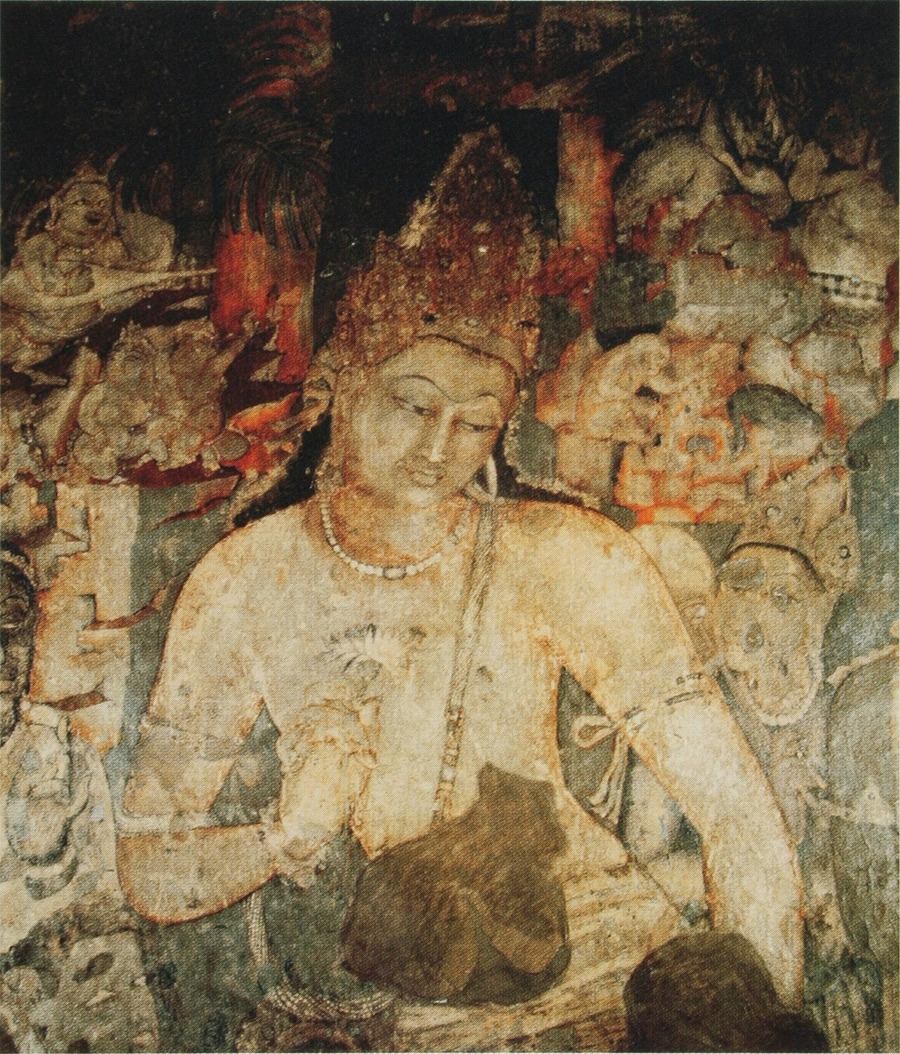
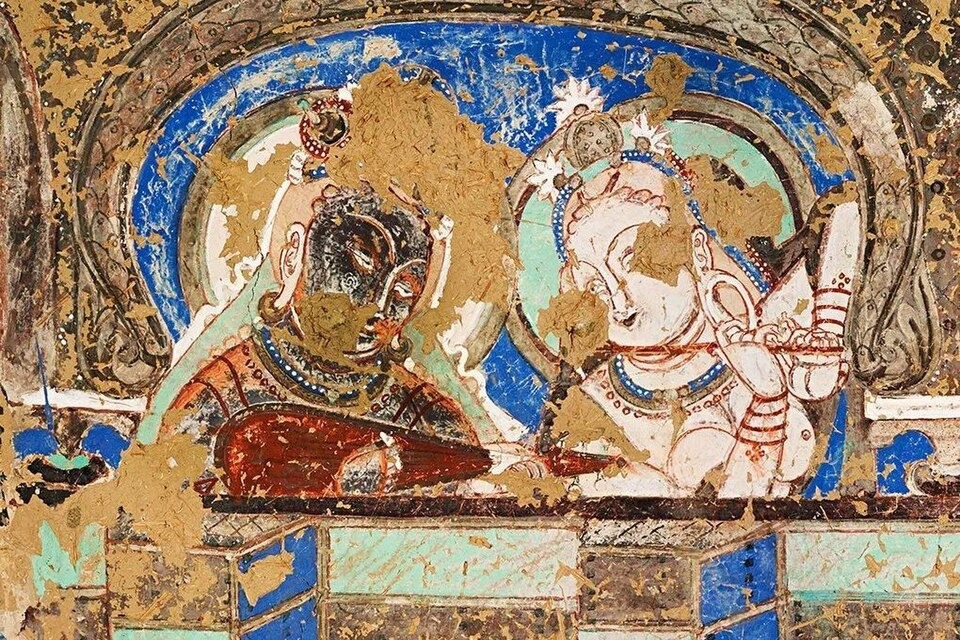
Fig. 6. Bodhisattva Padmapani, circa 450–490 Fig. 7. Heavenly Musicians on Balconies, 6th–7th Century Fig. 8. Bodhisattva Maitreya in the Tusita Heavens, 6th–7th Century
Kizil is the last major stop before Dunhuang. From here, balconies with musicians, Maitreya sitting cross-legged, and light and shadow will transition to Mogao.
Chapter 2. The First Caves
Early Mogao masters depicted Indian figures but narrated Indian stories through a distinctly Chinese lens—as if unfolding a scroll.
The Mogao Cliffs are composed of conglomerate—a compacted pebble matrix mixed with sand—and are not suitable for carving fine sculpture [9]. Therefore, the statues were molded from clay, and painting became the primary art form of Mogao (Fig. 9). The earliest caves—268, 272, and 275—appeared between 419 and 439 CE, during the period of the small Northern Liang state [9].
Fig. 9. Mogao Caves with monastic cells and cave entrances, photo from 2009
In Cave 275, Maitreya sits with crossed legs, resembling the bodhisattvas of Gandhara, flanked by two lions on his throne (Fig. 10) [10]. On the north wall are Jatakas—tales of the Buddha’s past lives where he sacrifices himself for others: the king Bhilandhili allows a thousand nails to be driven into his body so that he may hear a single verse of teaching (Fig. 11). Ochre, malachite, and white against a red background quickly became the primary pigments for Dunhuang.
Many faces in the early caves are almost black today, with white noses and eyelids. The artists modeled volume using the Indian technique by darkening the pink tone toward the edges, but the lead-based pigments darkened over time [9], and shading transformed into a graphic schema (Figs. 12, 13).
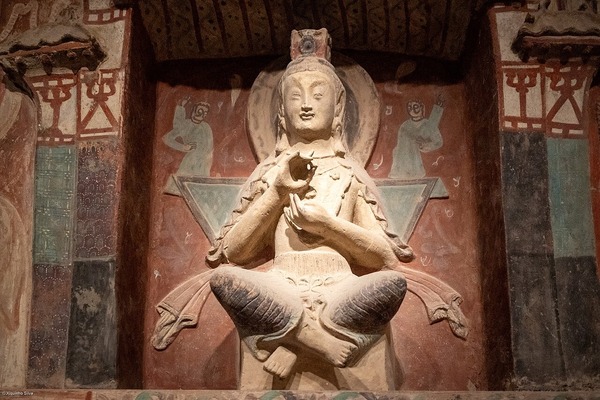
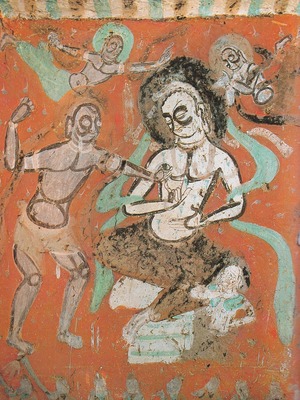
Fig. 10. Bodhisattva Maitreya with crossed ankles, 419–439 (Northern Liang) Fig. 11. Jataka Tale of King Bhilandhili, 419–439
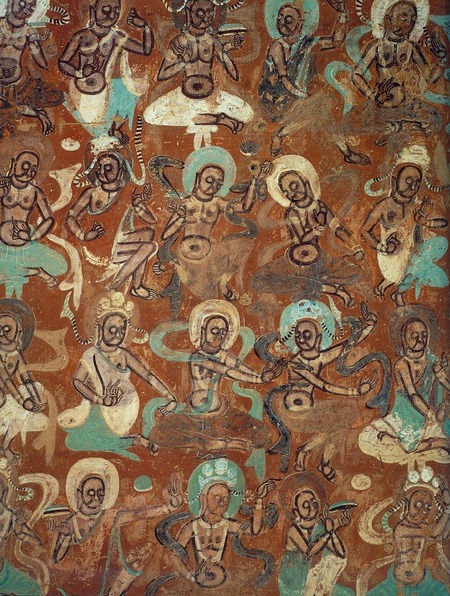
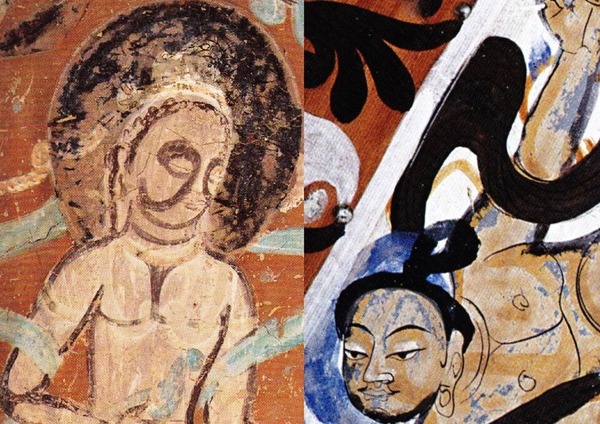
Fig. 12. Celestial Beings Attending the Sermon, 419–439 Fig. 13. Chiaroscuro Modeling: Figure from Cave 275 (Northern Liang, 419–439) and Figure from Cave 428 (Northern Zhou, 557–581)
Cave 254 (circa 475–490 CE, Northern Wei Dynasty) is structured like an Indian chaitya—a sanctuary with a central pillar that pilgrims circumambulate (Fig. 14) [9]. Its murals depict trials: Mara, the demon of passions, assaults the Buddha with an army of monstrous beings (Fig. 15); King Shibi cuts off flesh from himself to ransom a pigeon from a hawk (Fig. 16); Prince Mahasattva offers himself to a starving tigeress (Fig. 17). The figures are woven into a dense tapestry with almost no landscape, similar to those found in Kizil [9].
Alternatively, the Jataka tale of the nine-colored deer is depicted in Cave 257 (Fig. 18). The deer saves a drowning man, who reports the deer to the king in exchange for a reward, but the king, upon discovering the truth, releases the deer. The story unfolds as a long ribbon, with its episodes separated by mountainous formations—mirroring the structure of Chinese scrolls.
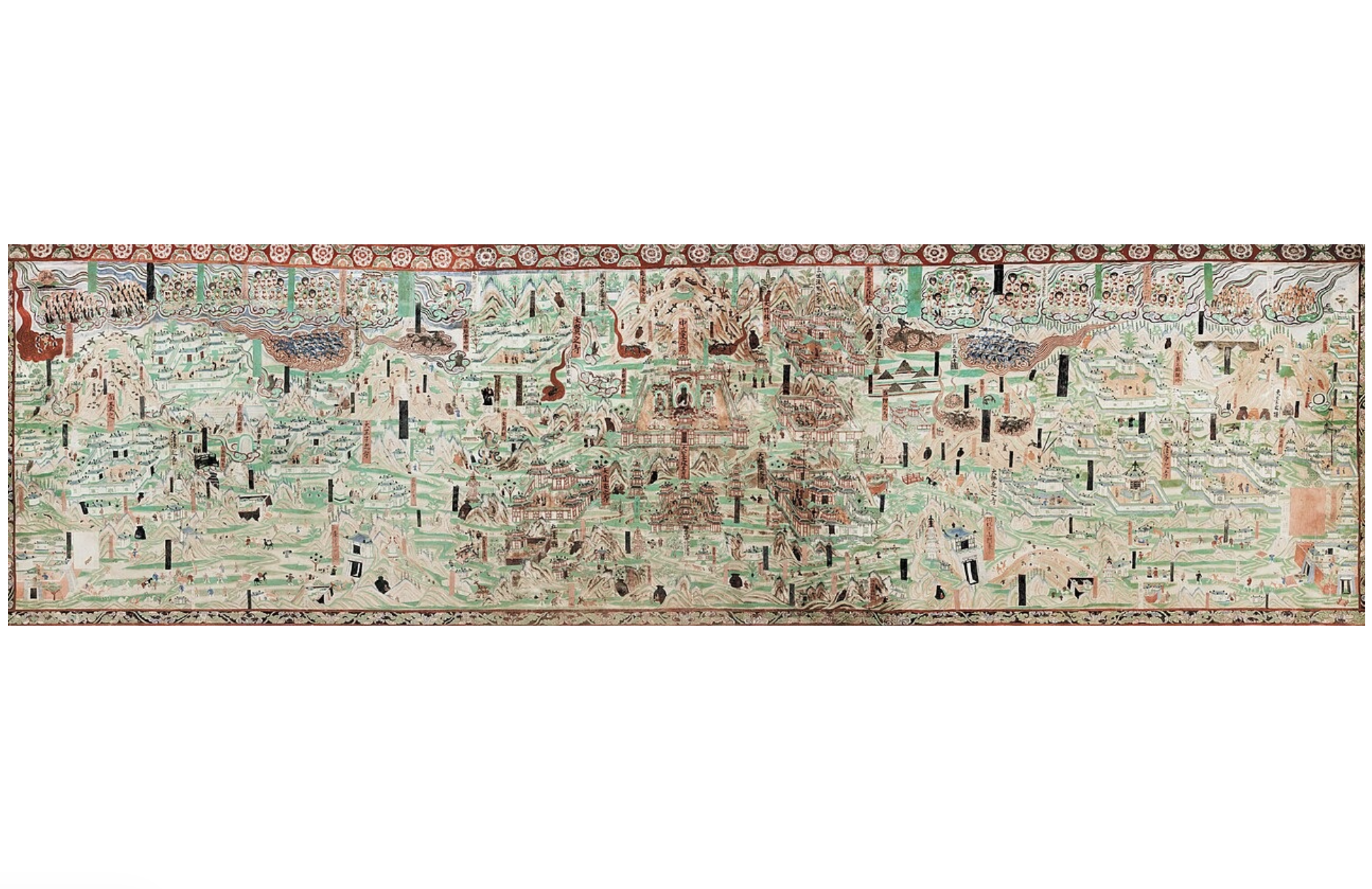
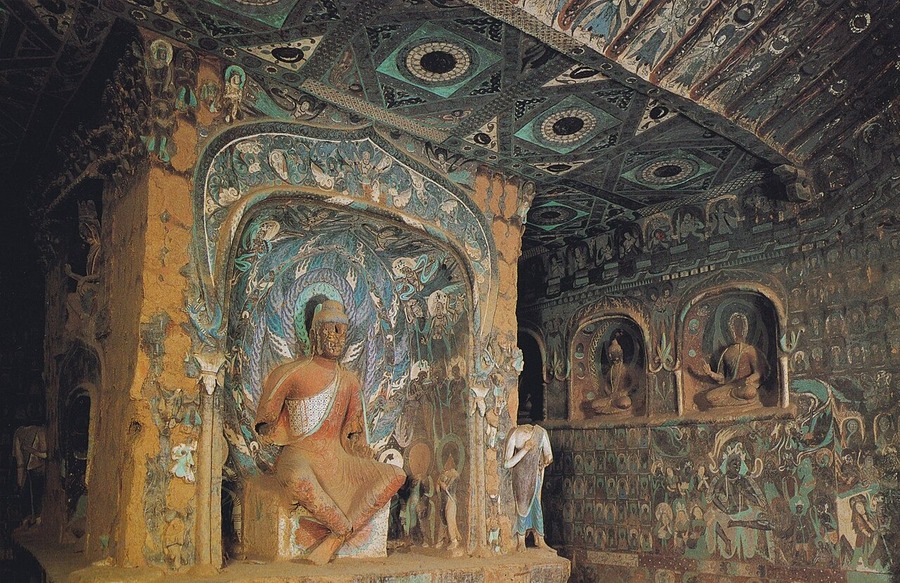
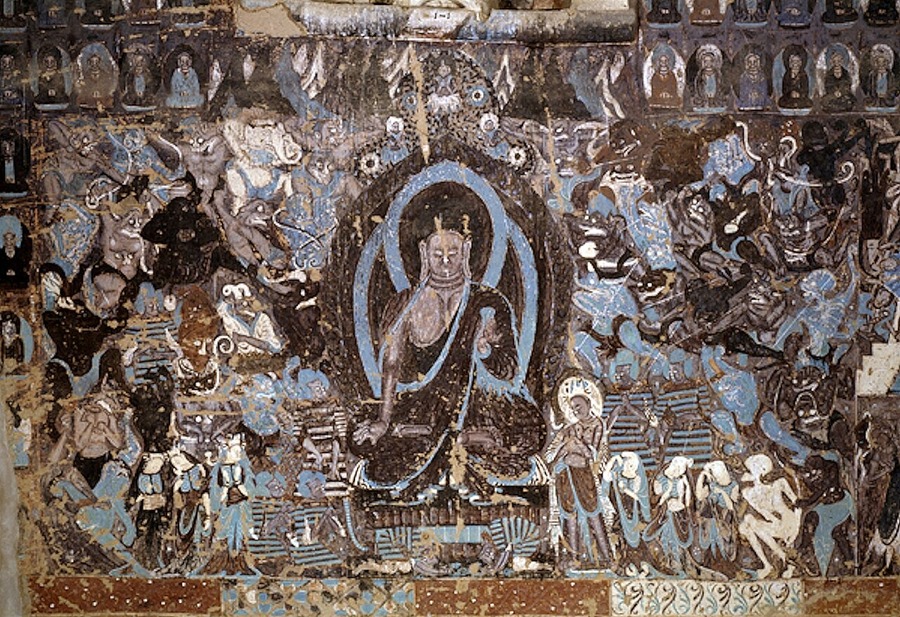
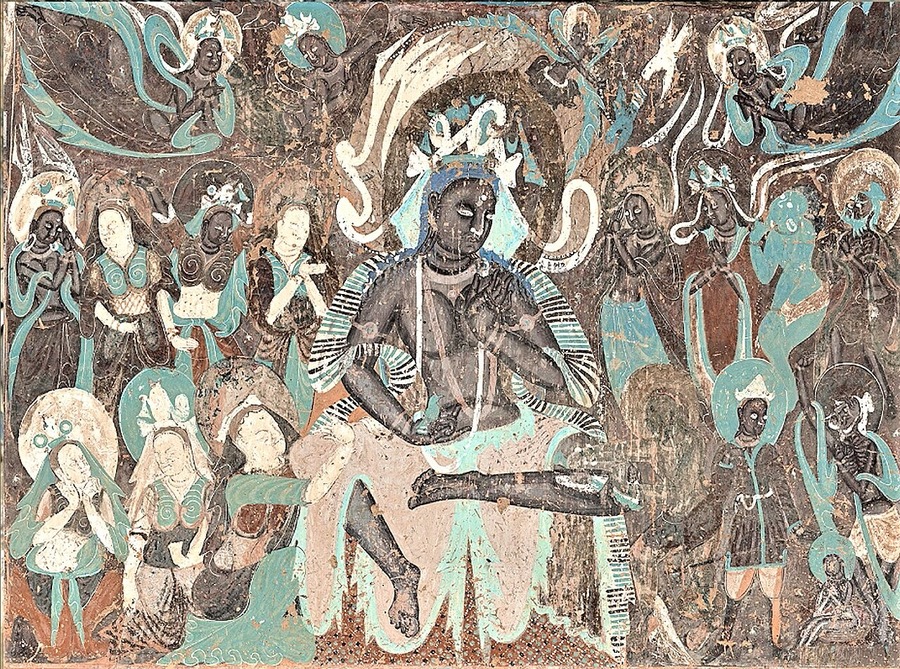
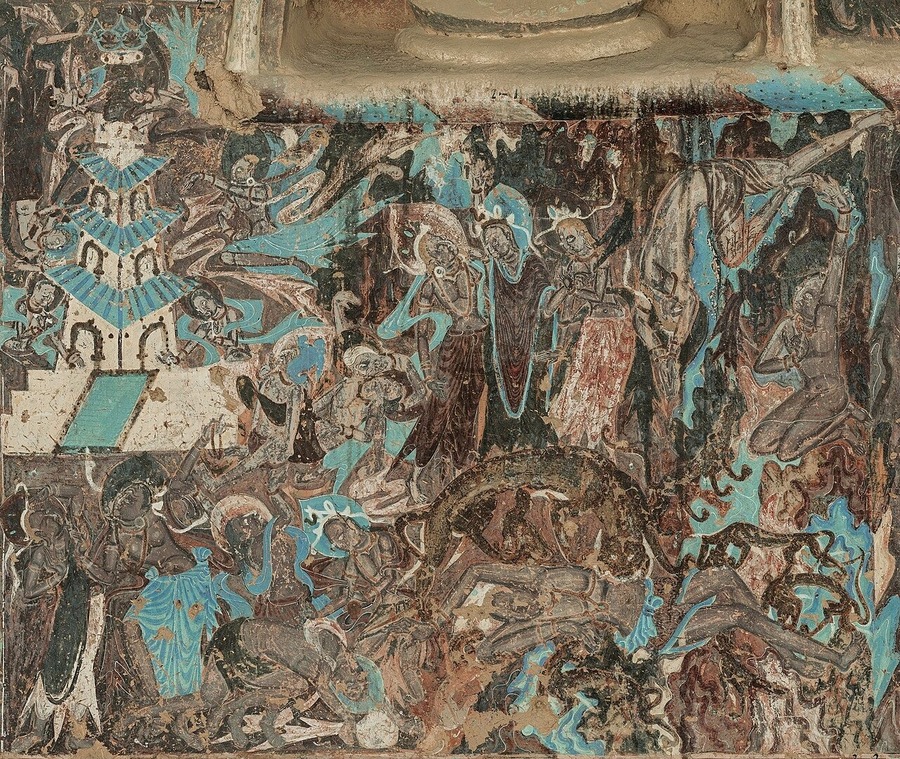
Fig. 14. Central Pillar and North Wall of Cave 254, c. 475–490 (North Wei) Fig. 15. Mara’s Assault, c. 475–490 Fig. 16. Jataka of King Śibi, c. 475–490 Fig. 17. Jataka of Prince Mahāsaṃvatī, c. 475–490
Fig. 18. Jataka of the Nine-Colored Deer, entire composition, late 5th — early 6th century (Northern Wei)
By the early 6th century, a distinct language had formed in Mogao: the physical elements originated from India and Kucha, while the narrative structure was Chinese.