Navigation 1. Introduction | Concept 2. Ax Shan | «China, China» 3. Li Xiaofeng | Form and Content 4. Giulietta Clovis | «Human Jungle» 5. Helena Hauss | «There is no rage in hell» 6. Marcel Vanders | «Porcelain Hands on Grand Piano» 7. Conclusion | Findings 8. Bibliography
Introduction | Concept
The title winks subtly at the reader. It prepares you for a dry, meticulous dive into the historical context of Ancient China, but… it plays tricks. Prepare to be amazed and captivated. The content will not leave you indifferent.
Before this research came to light, I was standing in the kitchen, steadily stirring the contents of a pot with a spatula while holding the hot part of the cookware with a towel. I fell into deep thought, studying the blue patterns on the oven mitt against the white background. I found the design charming and decided to trace the origins of the print. As it turned out, it was an imitation of Delftware with a Blue window motif. Intrigued by this discovery, I found that before reaching the Netherlands, the porcelain had traveled a long route of export and import from China, along with unique national interpretations of its themes. Thus, a simple kitchen towel gave rise to a visual study.
I took a photo of a pattern on a tea cozy and started searching for similar designs on Pinterest, but what I found was several times more interesting. The artists and sculptors decided to incorporate the effect of blue-and-white porcelain into their works, justifying the approach not only with their own ideas but also by connecting it to their national traditions. I took the sculptures I liked and organized them based on whether the artists were from Asia or Europe, because before blue-and-white porcelain made its way to 17th-century storefronts, it originated in the Ming Dynasty of China, traveled through Japan, Korea, and Vietnam, spread to the Middle Eastern countries, and then to Europe and Russia. I was struck by the fact that even Gzhel is actually a derivative of the Chinese origin. The second criterion for structuring is the porcelain I am using to compare the sculptures. The works of the first three sculptors continue the Chinese traditions, while the last two are Dutch, so I divided them for comparison with Ming Dynasty vases and Delftware accordingly.
Blue porcelain painting implies the use of blue pigment or cobalt. China did not have such raw materials, so the pigment was imported from Iran. During the Ming Dynasty, blue porcelain painting developed significantly. Due to political turmoil in China, Japan also began developing its ceramic production. They call this Imari—named after the city where it was manufactured. By the 17th century, porcelain began to be exported to Europe and America. It was highly valued there, and entire circles of enthusiasts gathered to show off their collections. The English, without hesitation, adapted the Asian motifs to suit their taste. In this way, English earthenware came into being. Around the same time, the East India Company brought Chinese porcelain to the Netherlands. Soon, porcelain production began in Delft. Tsar Peter the Great, inspired by the Dutch masters, ordered the construction of a similar factory in the city of Gzhel.
Ah Xian | «China, China»
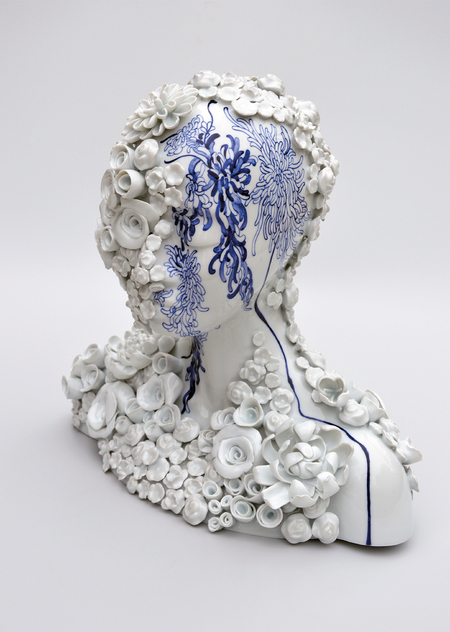
Ah Xian, China, 2013
Born in Beijing, Ah Xian worked as a painter in his homeland for a long time, but after moving to Australia, he decided to change his career path and opened his own sculpture studio. He was overcome by homesickness—not for a geographical place, but for human acceptance, love, and kindness.
Aksian, China, 2013 | Chinese vase, artist unknown, 1368–1644
Ah, Xian expertly captures the multi-layered nature of the painting, much like his predecessors.
Aksian, China, 2013 |Chinese vase, artist unknown, 1368–1644
Ah Xian, China, 2013 | Chinese vase, unknown artist, 1368–1644
Ah Xian, China, 2013
Initial creative attempts were not particularly successful, but as Ah Xian became accustomed to various materials and forms, he created a hybrid of European and Asian cultures—figures depicting people adorned with Chinese ornamentation. The sculptor incorporates materials known since antiquity, such as porcelain, bronze, and ox bone inlay, alongside concrete, fiberglass, and latex. Each piece bears the imprint of a real person close to the artist.
Ah Xian, China, China, 2013 | Chinese vase, unknown artist, 1368–1644
Aksia herself allows viewers the freedom to interpret the meaning of her sculptures, but she maintains that she intended to convey the diversity of the human spirit.
I took advantage of this freedom to find Ming dynasty vases with analogous or similar motifs to understand what elements Ah Xian connected in his sculptures.
Ah Xian, China, China, 2013
Analysis of elements from left to right.
Chinese vase, artist unknown, 1368–1644
Look closely, and you will see cumulus clouds on the ancient vases and the first statue. Perhaps this person was dear to Ah Xianyu because of his passion for freedom—a quality as elemental as a natural phenomenon? In the art of ancient China, starting from the Eastern Zhou period, clouds already held a sacred, benevolent meaning.
Chinese vase, unknown artist, 1368–1644
Here, the features of an elderly person are clearly discernible. The relief quality is highly symbolic—referencing the craft that has brought fame to Zhejiang province—Dongyang wood carving, as well as the wrinkles, history sealed onto the face of an ordinary Chinese grandfather.
In Akh Syanya’s eyes, the elderly man is structured, strong, and seasoned by time, like an endless ocean.
Chinese vase, unknown artist, 1368–1644
The third sculpture—a typical reference to traditional landscapes. There are very few preserved vases from the Ming Dynasty in the public domain with such a subject matter, but I did not want to compare the statue to paintings, of which there are many more preserved; therefore, the vessels shown possess features and motifs of a landscape sketch.
Chinese vase, artist unknown, 1368–1644
Chinese vase, unknown artist, 1368–1644
The lotus on the girl’s shoulder symbolizes divine beginning and fertility. In the category of Ming vases, a similar design can often be found.