Contents
Concept I. Cell, Contour, Limit II. Home, Daily Life, and Rhythm III. Cycle and Labyrinth Conclusion
Bibliography Image Sources
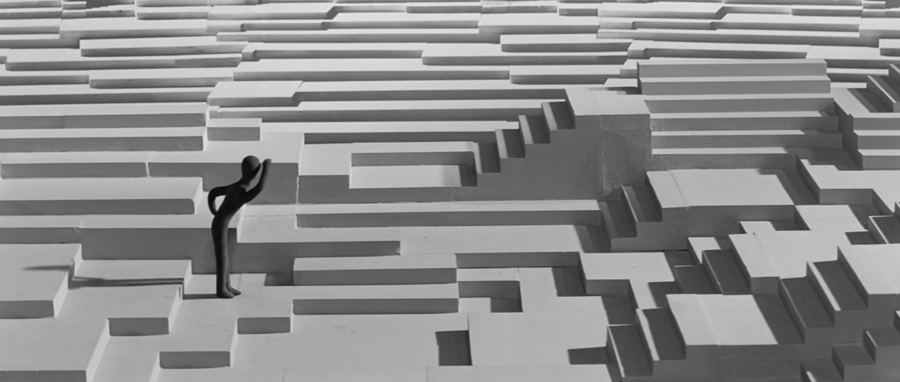
Staircase, designed by Stefan Schabenbeck, 1968
Concept
Animation from Eastern Bloc countries in the 1960s–1980s holds a distinct place in the history of world cinema. Under conditions of censorship and limitations, animation often became a space for indirect commentary, allowing artists to address themes of power, alienation, violence, and the loss of subjectivity through allegory, metaphor, and absurdism. Unlike feature films, animation possessed the unique ability to literally transform body and space, making hidden mechanisms of control visible.
Whether it’s a cage, a room, or a labyrinth—the environment in the animation of these years functions not merely as a background, but as a model of social relationships, an embodied form of unfreedom.
From a neutral environment, the space transitions into an active force that defines the boundaries, rhythm, and character of the character’s movement, ultimately determining the very possibility of its existence. The body, in turn, becomes a deformable, fragmented, and mechanized object, trapped in an endless cycle of repetition.
Darkness/Light/Darkness (Darkness, light, darkness), dir. Jan Švankmajer, 1989
The animation method assumes particular significance within this system. The materiality of the doll, the fragmentation of cut-out techniques, the plasticity of clay, and the abstraction of drawn animation allow for the visualization of various forms of alienation and the characters' dependency on external circumstances. These elements not only forge a unique aesthetic and visual language for the work but also define the ways the body exists within the frame.
Stairs, directed by Stefan Schabenbeck, 1968
Despite the significant body of research dedicated to individual directors and national schools, the issue of the interplay between the body, space, and animation technique as a unified system for representing unfreedom remains underexplored. The relevance of my research lies in the need to examine Eastern European animation not only as a form of political allegory but also as a distinct way of representing the subject’s crisis within a world that is ideologically and socially organized.
The materials for this study include films by Jiří Trnka, Jan Lenica, Zbigniew Rybczynski, Marcel Jankovic, Dušan Vukotić, Harry Bardin, Jan Schwankmaier, and other directors of Eastern European animation.
The research subject is the representation of relationships between the body and space in the animation of Eastern Bloc countries from the 1960s to the 1980s.
The focus is on how animation techniques shape a visual language of alienation, constraint, repetition, and disorientation.
The research methodology is based on a combination of visual and content analysis with elements of spatial and media analysis. The films are examined through the organization of screen space, the character of bodily movement, editing techniques, and the material properties of the animation medium.
The theoretical foundation draws upon the works of Michel Foucault and Gaston Bachelard, as well as studies on the history of Eastern European animation and visual culture.
The research structure progresses from object-oriented forms of enclosed space toward more abstract and cyclical models—all in order to delineate the characteristics of the poetics of limited space and its modes of interaction with the animated body.
I. Cell, Outline, Boundary
Labyrinth, Jan Lenica (1963)
In Yan Lenica’s «Labyrinth,» the protagonist first appears to the audience as a flâneur, drifting over the city space and immediately entering its closed and absurd environment.
Labyrinth, directed by Jan Lenica, 1963
The world of the film is composed of fragments of Victorian engravings, newspaper clippings, antique drawings, and collages. This patchwork space loses its familiar social and logical connections.
Labirynth, directed by Jan Lenica, 1963
Among these disintegrating images arises Auguste Rodin’s sculpture «The Thinker"—one of the key symbols of human capacity for reflection. Lena’s deconstruction of this image happens almost casually: by casually opening the hinges of the human consciousness, from which a bird—the embodiment of consciousness—easily flies out and immediately settles into the hand—a symbol of external force that claims the right to govern not just the body, but thoughts as well.
Labyrinth, directed by Jan Lenica, 1963
This dissection of the sculpture’s head acts as a kind of prelude to the protagonist’s subsequent fate. Having lost the ability to navigate within the system, he falls prey to a faceless pursuer—the figure of the lobotomist, who systematically strips a person of the capacity for autonomous perception of the world. Thus, within the space of the «Labyrinth, ” violence is committed not so much against the body as against the very possibility of independent thought and the idea of seeking meaning.
Hand, Jiří Trnka (1965)
The image of the hand, which appears briefly in «Labyrinth, ” later acquires a particularly sinister meaning in Jiří Trnka’s canonical work, „The Hand, ” where the relationship between the creator and the regime takes on a particularly painful literalism through masterful puppet animation technique.
At the center of the film is a potter-artist named Harlequin. He lives in quiet solitude in his studio, dedicating himself to his favorite pursuits—sculpting clay pots and caring for his flower. But this peaceful existence is interrupted—a giant hand breaks into his life, demanding the creation of a monument.
Ruka (Hand), directed by Jiří Trnka, 1965
Employing the carrot-and-stick method—or, to use Foucault’s terminology, applying various biopolitical techniques—the hand gradually subjugates not only the hero’s body but also the process of his creation.
The hand monument that the artist is forced to carve gradually transforms into the architectural dominant of the entire film’s space. This raises the important idea of the ambivalence of the creative act—it simultaneously becomes a manifestation of the protagonist’s inner freedom and a mechanism of his ultimate subjugation. Thus, in Trinka’s work, creativity turns out to be a boundary zone where the display of free thought and the act of complicity are two sides of the same coin, leaving a trace on the protagonist even after his death in an attempt to escape the omnipresent hand of power.
Ruka (Hand), directed by Jiří Trnka, 1965
Cells, Miroslav Kiyovych (1966)
The same duality emerges in Miroslav Kijovich’s «Cells, ” where the figure of authority first creates the space for creative exploration, and then systematically withdraws all the means of its realization—most notably, language.