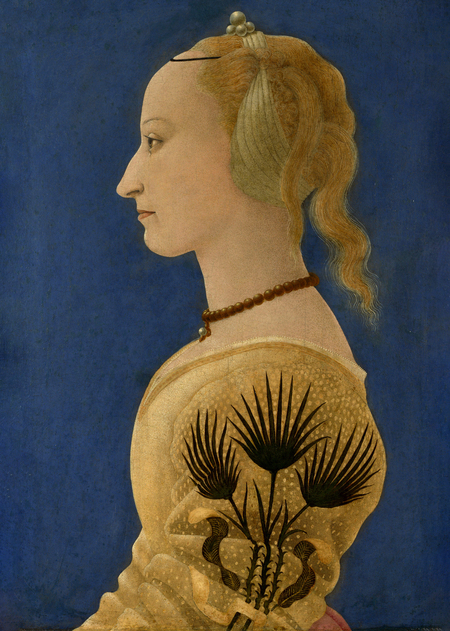
Fashion has always been and remains an integral part of the cultural and social context of its era, because clothing not only serves a utilitarian function but also acts as a vital historical document reflecting the values and moods of the time. The presented timeline offers a brief overview of the key stages of fashion’s evolution, each demonstrating how culture shaped society’s visual language—from the monumental forms of the Ancient East to the vibrant, polyphonic tapestry of postmodernism.
Около 3500–330 годы до н. э.
Ancient Near East
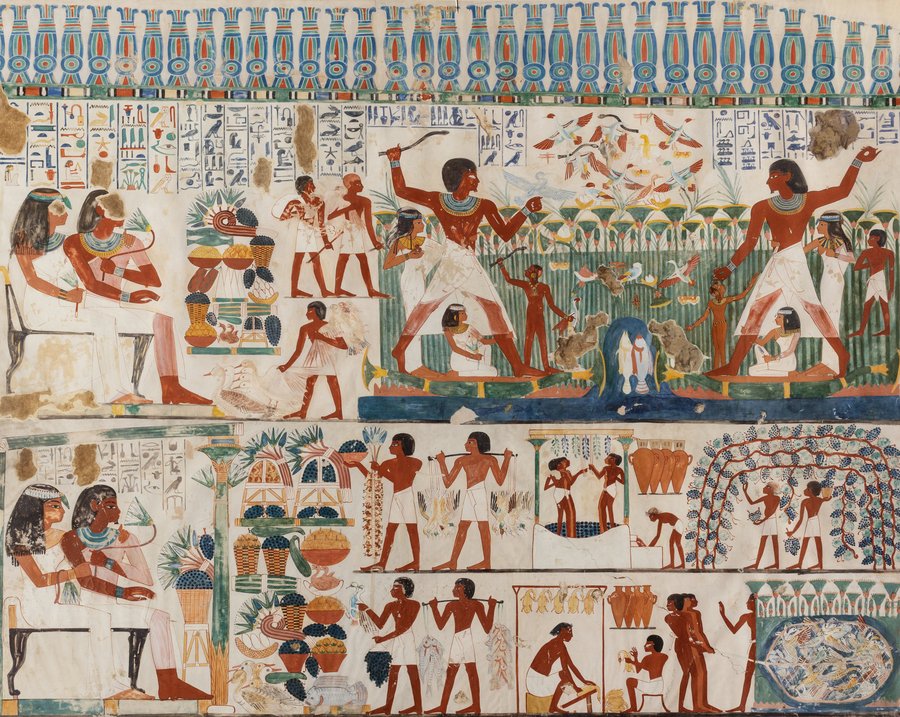
North side of the west wall of the Chapel of Offerings of Nakhta. New Kingdom. Circa 1370–1410 BCE.
This period of Eastern history spans the time of the emergence and flourishing of Mesopotamian and Egyptian civilizations. This epoch is marked by fundamental inventions that profoundly impacted the course of societal development—the advent of the wheel and the plow, and, most crucially, the genesis and development of writing, which allowed for the recording of events and economic transactions, thereby initiating literary works. Archaeological finds, including ceramics and artifacts made of stone and gold, bear witness to the formation of complex hierarchical societies and the development of artistic crafts, which laid the foundation for the subsequent flourishing of Ancient Eastern art.
Art, and particularly costume of this era, is inextricably linked to social organization and religious beliefs. The primary sources of information regarding the appearance of people from the Ancient East are artifacts of visual art—statues, reliefs, small figurines, and mosaic panels. In Ancient Egypt, the basic garment consisted of the shenti apron for men and the kalasiris tunic for women. Ornaments played a special role, serving not only decorative but also sacred and protective functions. The usekh necklace, bracelets and beads, wigs, and distinctive makeup—all these elements complemented and shaped the specific, recognizable look of an Ancient Egyptian resident. The costume of Mesopotamia is equally interesting, where the loincloth or skirt made of long-haired sheepskin from the Sumerian period evolved into the kandin tunic, richly adorned with fringe during the Assyrian and Babylonian eras. The appearance of rulers was further enhanced by the konos cloak, also heavily embellished with fringe. The color palette was rich, and the fabric ornamentation was highly decorative. Goldsmiths worked with gold, silver, and semi-precious stones, creating exquisite jewelry and inlays that were subsequently incorporated into the costumes of the elite.
Fresco depicting a woman playing a kithara.Villa of P. Funnius Sinistor. Boscoreal. Italy. Circa 50–40 BCE.
Antiquity, covering the history of Ancient Greece and Rome from the 8th century BCE to the 5th century CE, laid the foundation for all of modern European civilization. This period is traditionally divided into the Archaic period (8th–6th centuries BCE), the Classical period (5th–4th centuries BCE), the Hellenistic period (4th–1st centuries BCE), and the Roman Imperial Age (1st century BCE — 5th century CE). It was during this time that democracy, philosophy, science, and theater emerged. A key characteristic of the worldview was the shift «from myth to logos”—the rational understanding of the world, the laws of nature, and society—which fundamentally distinguished antiquity from the despotisms of the Ancient Near East and determined the vector of artistic development.
Costume art in antiquity was inextricably linked to the architecture of the body and the art of draping. The foundation of the Greek wardrobe consisted of rectangular pieces of fabric that were not sewn together but were fastened with fibulae (brooches) at the shoulders and cinched with belts. This formed unsewn shirts called chitons or peploi. Men wore a chiton (short or long) and the himation cloak, as well as the chlamys—a short cloak for riders and travelers. Women’s attire, despite the modesty of the cut variations, was diverse: the Doric peplos made of dense wool and the lighter Ionic chiton made of linen created a complex play of folds that emphasized the figure’s natural grace. Decorative flaps on the chiton—the diploides—along with the drape over the waist—the colpos—enhanced the richness of women’s clothing. The Romans, having conquered Greece, adopted its culture but introduced strict regulation and symbolism to their dress: only a Roman citizen had the right to wear the toga—a massive piece of white wool fabric draped in complex folds. The tunic served as undergarment and was the Roman’s everyday wear. Women wore the stola over the tunic—a symbol of marriage and the status of a matron—and the palla (a type of covering draped over the head). The color of clothing held sacred and social significance: for instance, purple was a privilege reserved exclusively for emperors and triumphant generals.
Rogier van der Weyden. Jean Vaquelin presents «The Chronicles of Eno» to Philip Dobry. Miniature from a manuscript. 1447
The Middle Ages—a millennium in European history beginning with the fall of the Western Roman Empire and concluding on the eve of the Renaissance and the Age of Discovery. Historians divide the Middle Ages into three stages: early (5th–10th centuries)—a time of feudalism’s establishment and the dominance of monastic culture; high (11th–13th centuries)—the flourishing of knighthood, the Crusades, and the birth of Gothic architecture; and late (14th–15th centuries)—a period marked by crises, warfare, and the prelude to humanism. The worldview was defined by theocentrism: God was the foundation and ultimate purpose of creation, and earthly life was merely a prelude to the afterlife. The class division into «those who pray, those who fight, and those who labor» cemented a rigid social hierarchy.
The art of costume in the Middle Ages evolved from simplicity to sophisticated decoration, governed by social class regulations. In the early period, clothing was characterized by archaic forms: men and women wore long woolen or linen tunics (both upper and lower garments), over which they draped cloak-like mantles. In the men’s attire of this period, lower breeches called braies and hose called chausses, fastened at the waist, emerged. From the 11th century, with the development of knightly culture, costume grew more complex. In the 12th century, the bliaw appeared—a garment reaching to the knee in the male version and longer in the female version—worn over an undergarment (camise). By the 13th century, the costume became two-component: the cotta—an underdress with sleeves—and over it, the surcoat, an upper garment either sleeveless or with detached sleeves that allowed the wealth of the undergarments to be displayed. In the 14th century, the art of tailoring arose; clothing acquired darts and structural lines, enabling the garment to fit the human figure and shape the desired silhouette. This period also saw the birth of the concept of fashion in the modern sense: young aristocrats began enthusiastically embellishing their costumes with details that reflected their taste. The costume became increasingly varied and intricately tailored.
Overall, men’s attire became radically shorter. Tight gippons or doublets (short jackets comparable to a modern vest) appeared, and the narrow chausses—the hose—were fastened directly to them. At the beginning of the period, cotardes appeared (a more complexly tailored variation of clothing for both men and women). While the female cotarde resembled a closely fitted dress, the male cotarde was a short jacket. Furthermore, adult men, and everyone else on formal occasions, wore long, voluminous houppelandes (wide, long garments with voluminous sleeves). Later, short jackets with tubular pleats and basques—voluminous sleeves—emerged as the outer layer. The height of late medieval extravagance was the ennens—conical head coverings up to a meter tall—and pulens, shoes with noses whose length was regulated by the owner’s nobility. Clothing color also carried symbolic meaning, indicating the owner’s status: nobility wore bright colors (purple, blue, green), townspeople wore more modest colors, and peasants were prescribed gray and brown tones.
XIV–XVI века
Renaissance
Benedetto Ghizzoli. Procession of the Magi. Fresco Fragment. Palazzo Medici-Riccardi, Chapel. Florence, Italy. 1459–1460
Originating in Italy, where a close connection to the ancient heritage was maintained, the Renaissance (or Rebirth) subsequently spread to other countries. The key characteristic of its worldview was humanism—the assertion of the dignity of the individual, their right to free development, and creative activity—which replaced the medieval theocentrism. Historians divide the era into Pre-Renaissance (13th–14th centuries), Early Renaissance (15th century), High Renaissance (late 15th–early 16th centuries), and Late Renaissance (before the end of the 16th century). This was a time of the Great Geographical Discoveries, the printing press, and the triumph of art that glorified human beauty and harmony.
The Renaissance costume reflected the era’s new ideals, weaving together ancient harmony and Christian spirituality while also acknowledging the wearer’s social status. Up until the first third of the 16th century, the fashion of European courts drew inspiration from the softness of Italian forms. The basis of men’s attire was the camicia (shirt) and calzoni (tight hose), over which they wore the sottoveste (a narrow under-jacket functioning like a modern vest) and the giornea (outer garment with drop sleeves). Young dandies with good figures often opted for small, sleeveless jackets instead of the giornea—a pettina (capelet) that accentuated their slim physique. More established gentlemen chose voluminous and long upper garments (sopraveste).
Women’s costume consisted of a base camicia shirt, a lower gown with long sleeves and a modest neckline, which was often complemented by an overgown—the simara (a garment cut at a raised waistline, where the upper portion hugged the figure and the lower portion cascaded in soft, pliable folds).
Hair styles and headwear were distinguished by their complexity: women arranged their hair in combinations of braids and curls and utilized veils. Men wore berets and brimmed hats.
From the mid-16th century onward, Spain dictated fashion across Europe. The costume became more rigid and structurally complex, and the softness of Italian silhouettes faded into history. Men’s attire of this period consisted of a base camisa shirt with a ruff collar and cuffs, over which they wore a tight vest called a corpetto. The calces (the Spanish term for hose) during this period were divided into two parts—the lower ones remained the same detachable stockings/leggings as in the earlier period, tailored precisely to the shape of the leg and fastened to the corpetto vest with laces. Concurrently, upper calces emerged—short, wide trousers that, by the middle of the century, began to be stuffed with horsehair or down, giving them a spherical shape. The width and length of the upper trousers varied depending on the current trend. The next upper and primary layer of clothing was the hubon, a stiff-shaped jacket with a fitted bodice and a characteristic pouch over the stomach (pança), often featuring a small peplum. A common embellishment on the fabric of these garments was cut-outs that allowed a view of the expensive underlayer. The ensemble was completed with a short, round cloak with a collar and sleeves.
XVII век
Baroque
Henri Testelin. Founder of the French Academy of Sciences and the Paris Observatory. 17th Century
Baroque—an artistic style that dominated Europe from the late 16th to the mid-18th century, though its «Golden Age» fell in the 17th century. Originating in Italy, it became a reflection of the crisis of Renaissance ideals and intensified under the influence of the Counter-Reformation: the Catholic Church required art that would captivate the imagination and affirm the greatness of the faith. The style, named after the Portuguese «perola barroca» (irregular pearl), rapidly spread across Europe, reaching its zenith at the court of the French «Sun King, ” Louis XIV, who transformed Versailles into the arbiter of European fashion.
The Baroque costume became the quintessence of luxury, theatricality, and social representation. Men’s fashion, modeled after the young Louis XIV, included a white lace shirt, a short braisier jacket, and voluminous, skirt-like breeches richly decorated with ribbons and lace. These were later succeeded by the justaucorps—a long, fitted coat with wide lapels and large buttons—which was worn with a justaucorps vest and a lace jabot (neckcloth). The wide breeches were replaced by narrow knee-length culottes, worn with stockings. Women’s dresses consisted of an underskirt (fripone) and an outer open gown (modeste), often with a train; the bodice featured a corset with a deep décolletage that exposed the shoulders. The fabrics were exceedingly refined—velvet, brocade, heavy satin with botanical ornamentation; the favored colors were rich hues of precious stones. Both men and women wore voluminous powdered wigs, heavily applied cosmetics, and adorned their faces with decorative motes, while the abundance of lace, bows, jewels, and minute details reflected the Baroque penchant for excess and splendor.
XVIII век
Rococo
François Boucher. Portrait of Madame de Pompadour. 1756. Fragment
Rococo was a style that dominated European art and fashion in the 18th century, roughly from the 1720s until the French Revolution. The name derives from the French word «rocaille» (shellwork), as it was the whimsical, shell-like forms that became the primary decorative element of the era. Rococo originated in France as a reaction against the monumental grandeur of Baroque, mirroring the hedonistic sentiments of the aristocracy of the «gallant age.» The style flourished during the reign of Louis XV and his favorite, Madame de Pompadour. In contrast to the pomposity of the preceding era, Rococo strived for lightness, elegance, intimacy, and refinement—qualities reflected in the pastel palette, exquisite ornamentation, and theatricality of court life.
The Rococo costume embodied the ideal of the statuesque woman and the dashing man, likening its wearers to porcelain dolls. Women’s gowns were constructed around the contrast between a tightly corseted bodice and an incredibly wide skirt supported by a framework—the panniers (or farthingales)—which were so broad that they had to be made hinged to pass through doorways. The contousshe was a popular style—a loose dress with large pleats down the back («Vatte pleats»), falling from the shoulder line to the floor. The men’s attire consisted of a crisp white shirt with a lace jabot, a tight-fitting waistcoat, and a tailored upper habit à la française, richly decorated with embroidery. The ensemble was completed with narrow culottes, white stockings, buckled shoes, and the perennial tricorn hat. Both men and women used cosmetics lavishly, dusted their hair and wigs, and the ladies styled intricate pouf hairstyles reaching up to a meter high, adorned with ribbons, flowers, and even small figurines. Rococo fashion, taken to its extreme by Queen Marie Antoinette, ended with the French monarchy, giving way to the stricter classicism.
Конец XVIII — начало XIX века
Neoclassicism and Empire Style
Louis-Léopold Boullée. Rain Shower. First half of the 19th Century
The late eighteenth—early nineteenth century—was an era defined by two grand styles: Neoclassicism and Empire. Both reflected the spirit of revolutionary change and imperial ambition. Originating in pre-revolutionary France, Neoclassicism served as a reaction against the frivolous Rococo, embodying the ideals of the Enlightenment through its reverence for ancient democracy and civic virtue. The excavations of Herculaneum and Pompeii marked a turning point, reintroducing the perfection of ancient forms to Europe. With the rise of Napoleon Bonaparte to power, Neoclassicism transformed into the «Imperial Style"—Empire. While early Neoclassicism called for freedom and naturalism, Empire, inspired by the grandeur of Imperial Rome, glorified state power and military victories, becoming the official style of the Napoleonic court.
The fashion of this era underwent radical changes, moving from «nude fashion» to opulent grandeur. The women’s gown of the Directory and Consulate periods—a «chemise» made of the finest white muslin with a high waistline and deep décolletage—emulated ancient tunics and was often worn without a corset. This look, popularized by fashion titans such as Joséphine Bonaparte and Pauline Bonaparte, highlighted natural beauty. However, closer to the 1820s, sheer fabrics were replaced by dense silk and velvet; the corset made a comeback, and hemlines and sleeves became lavishly decorated with gold embroidery, sequins, and ruffles. Conversely, men’s attire evolved toward strictness and uniformity: the flawless dark tailcoat, a pristine white shirt with a stiff standing collar, and a cravat tied in an elaborate knot became the standard. The look was completed with a top hat, narrow pantaloons, and boots. Accessories played a crucial role: women could not be thought of venturing out without a cashmere or lace shawl, a small reticule, and gloves, and their hairstyles—the «Greek knot» adorned with curls—were topped with bonnets or capes. In Russia, the Empire style acquired a more festive and romantic hue, becoming a symbol of victory and state power.