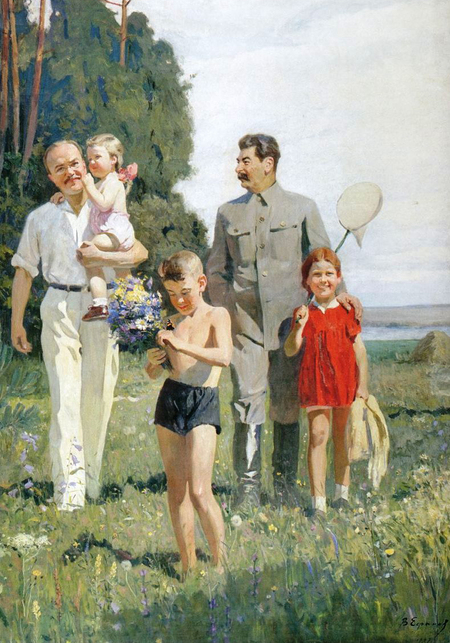

The period from 1945 to 1956 encompasses the Soviet Union’s victory in the Great Patriotic War, the final formation of the bipolar world, and the beginning of the Cold War, alongside political repression, Stalin’s death, a slight easing of the regime’s harshness after Nikita Khrushchev took power, and the start of the «thaw» following his report on the «Cult of Personality» at the 20th Congress of the CPSU (1956).
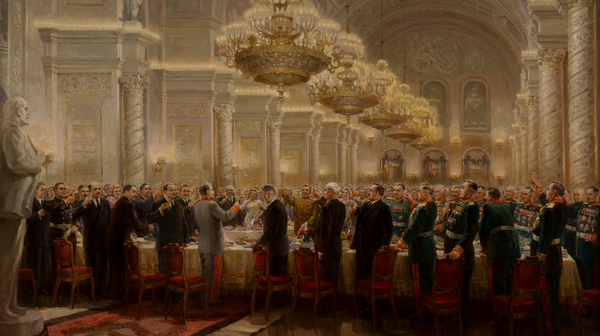
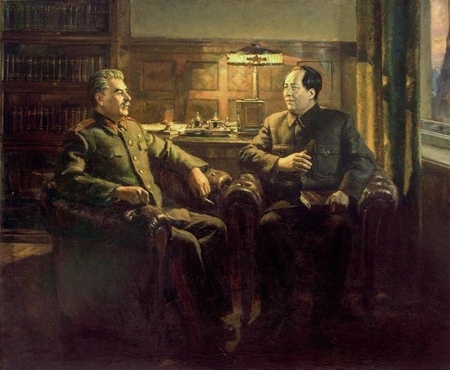
Mikhail Khmelko | «For the Great Russian People!» | canvas, oil | 1949 | GMVTS «ROSIZO» [1] | Dmitry Nalbandyan | «Great Friendship» | canvas, oil | 1950 | GMVTS «ROSIZO» [2]
On the official art stage, Socialist Realism dominated. This term was formulated by Maxim Gorky at the First Congress of the Writers' Union (1934): «…Socialist Realism, as the fundamental method of Soviet artistic literature and literary criticism, requires the artist to depict reality truthfully and in a historically specific manner within its revolutionary development.» By 1936, a specific plastic canon, a range of themes, and a system of genres had crystallized: a declarative return to traditional art forms, especially monumental thematic painting; the creation of a new iconography centered on revolutionary themes, the images of leaders, the «New Man"—a dedicated contributor and hero of labor—and the new reality—industrial achievements and the construction of a bright future.
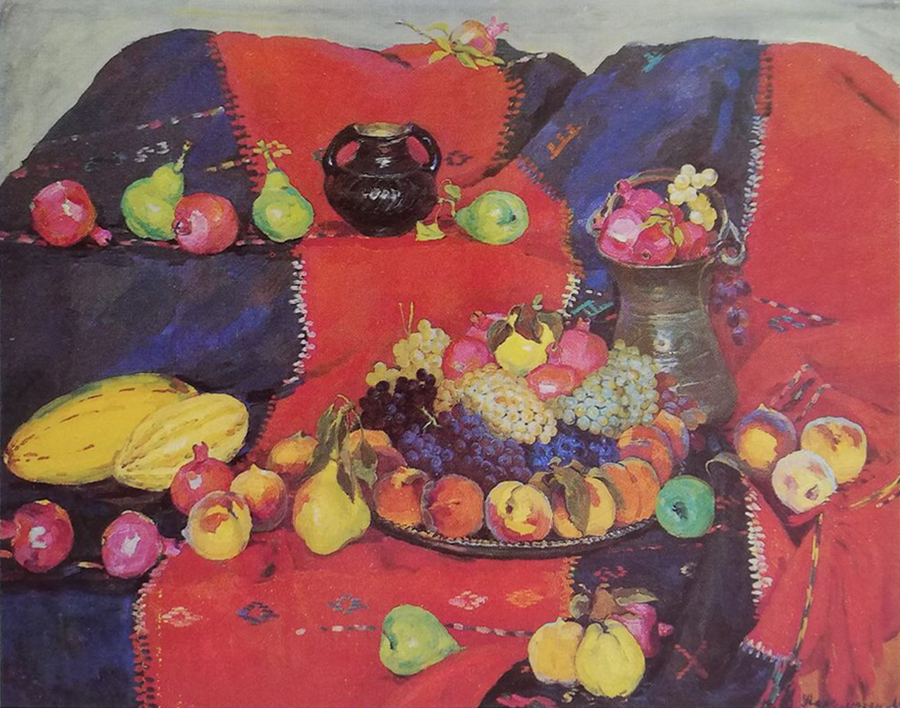
Mariam Aslamazyan | «Armenian Still Life» | canvas, oil | 1965 | State Tretyakov Gallery [3]
The Great Patriotic War, one of the major tragedies in the history of the USSR, became one of the most significant themes in Russian visual arts of the second half of the 20th century. During and after the war, numerous small works were created by witnesses of combat and the hardships of military life, as well as pieces dedicated to the long-awaited victory. This victory was depicted not in a grand, ceremonial manner, but as an event experienced by a narrow circle of people—the families of those who returned and fell, the wounded conquering soldiers, and women who served in the army. Against this backdrop, a divergence emerges between official art, which utilized the theme to glorify the leader-generalissimo and the party bureaucracy, and artists who strove to find an adequate plastic language to depict not only the heroism and triumphant victory of the people, but also the profound grief and war as a terrifying human tragedy.
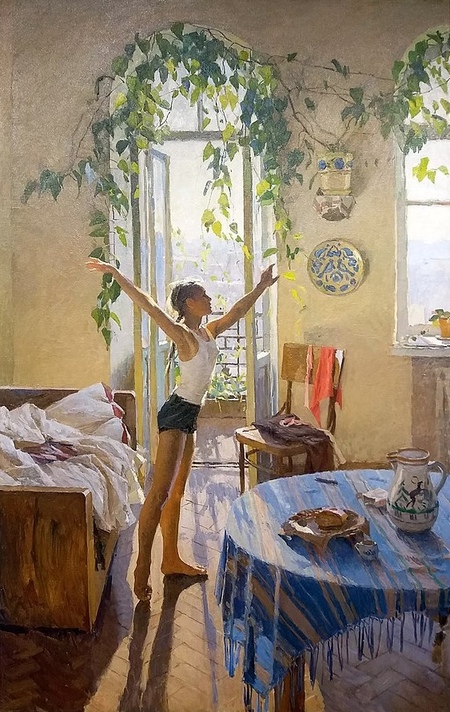
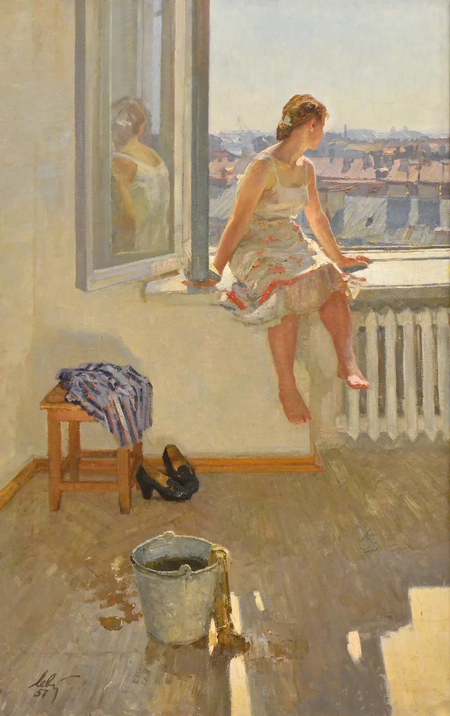
Tatiana Yablonskaya | «Morning» | canvas, oil | 1954 | State Tretyakov Gallery [4] | Anatoly Levitin | «Warm Day» | canvas, oil | 1957 | State Russian Museum [5]
In 1947, the new USSR Academy of Arts was established—an organization tasked with rigorously enforcing the Party line in the world of art. Soviet leadership declared war on «formalism, naturalism, and other manifestations of bourgeois decadent culture, ” prioritizing the depiction of universal joy and happiness. A small group of artists gained complete political and economic power over their peers: participation in exhibitions and state commissions were virtually the only ways to survive in the profession. Artists were required to intuitively grasp changing trends by observing exhibitions, canonical works by Party-favored artists, publications, and commission reviews.
Alexander Deineka | «Burnt Village» | canvas, oil | 1942 | State Russian Museum [6]
The image of Lenin is becoming increasingly mythologized; previously found pictorial formulas are mass-replicated and become commonplace ideological clichés. Images of Stalin, in every possible incarnation, eloquently bear witness to the transition toward a rigid and somber Stalinist classicism. The canonical norms of Socialist Realism were embodied in the works of Dmitry Nalbandyan, Vasily Efanov, and Alexander Gerasimov, who glorified the leader in striking monumental depictions that served leading state ideas and projects—Stalin’s role in the revolution, victory in the Great Patriotic War, the «Stalin Plan for the Transformation of Nature, ” the alliance with Mao Zedong, and so on.
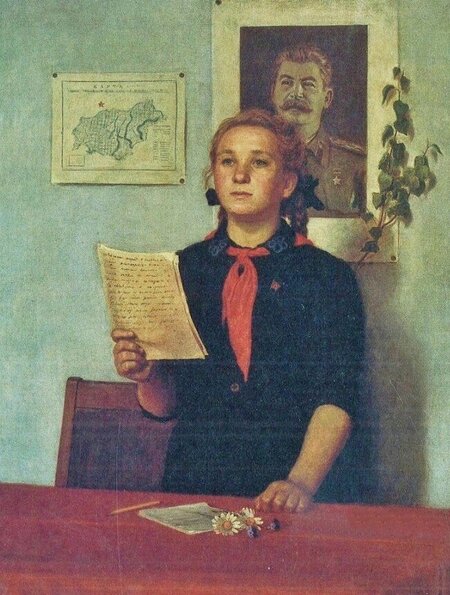
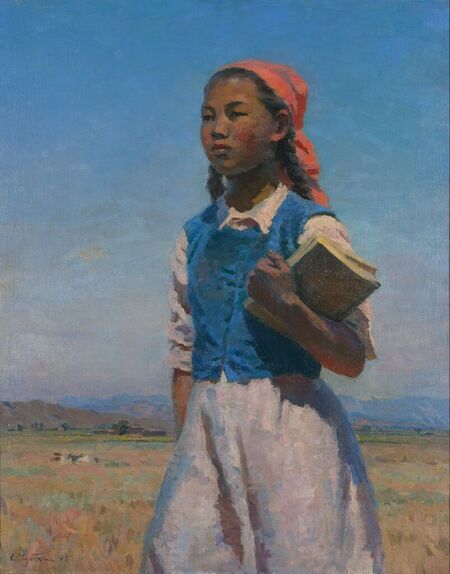
Vyacheslav Mariupolsky | «The Leader» | canvas, oil | 1950s | GMVC «ROSIZO» [7] | Semyon Chuykov | «Daughter of Soviet Kyrgyzstan» | 1948 | State Tretyakov Gallery [8]
Monumental canvases continue to depict heroes of labor (peasants and workers), Soviet women (university students, factory workers, athletes, mothers), captured in moments of heroic work or during leisure time. The rebuilding of the war-torn country and agriculture becomes one of the central themes.
Alexei Zakoldin-Mitin | «Zenitkas on the Neva (Air Raid)» | canvas, oil | 1942 | GMVC «ROSIZO» [9]
Another crucial motif is the image of childhood. Alongside typical depictions of happy Soviet infants, October children, and pioneers, moralistic narratives appear, contrasting positive and negative characters—as seen in Fyodor Reshetnikov’s famous painting, «Another D» (Op’yat' dvoyka). In the second half of the 1950s, the interpretation shifted toward greater intimacy and psychological depth, coinciding with the search for a new, concise, and relatively conventional plastic language within the emerging «Severe Style.»
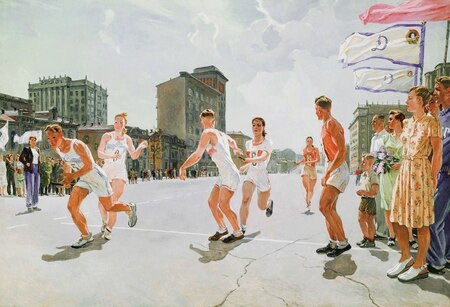
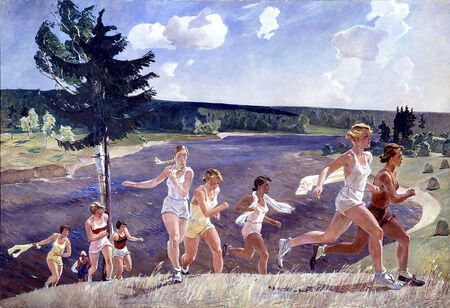
Alexander Deineka | «Relay» | canvas, oil | 1947 | State Tretyakov Gallery [10] | Alexander Deineka | «Wilderness» | 1944 | State Russian Museum [11]
The Caucasus and Central Asia remain almost the only refuges where experiments with color and form were possible—and this region was one of the most crucial evacuation centers, alongside the Urals and Western Siberia. Landscape, still life, and street scenes were less significant genres within the Soviet academic hierarchy, but they were more sensitive to manifestations of changing aesthetic paradigms and afforded greater freedom in artistic exploration. After the war, the national policy shifted to increasingly prioritize the Russian people and the proletariat, who gifted the world the October Revolution. The return to the idea of prioritizing a multinational state occurred with the rise of N.S. Khrushchev to power.
Alexander Laktionov | «Letter from the Front» | 1947 | State Tretyakov Gallery [12]
In 1953, Stalin dies. The country mourns the deceased leader, while behind the scenes, a power struggle unfolds, resulting in N.S. Khrushchev’s victory.
Tatiana Yablonskaya | «Bread» | canvas, oil | 1949 | State Tretyakov Gallery [13]
In 1956, the famous 20th Congress of the Communist Party of the Soviet Union took place, where Khrushchev delivered the report, «On the Cult of Personality and Its Consequences.» The monumental epic scope and rigid pathos of Stalinist classicism give way to formal experiments in an Impressionistic vein and a more lyrical depiction of everyday subjects. One sign of the times is the return to intimacy and human scale. Daily scenes enter art. What unfolds before the viewer is not the fate of the nation, but the private life of the family, the home, and its inhabitants. Socialist realist paintings are infused with color, light, and air, and shortly thereafter, the strict and graphic «Severe Style» (a term coined by A.A. Kamensky) emerges, appealing to the aesthetics of the OST group and the art of the late 1920s and 1930s.
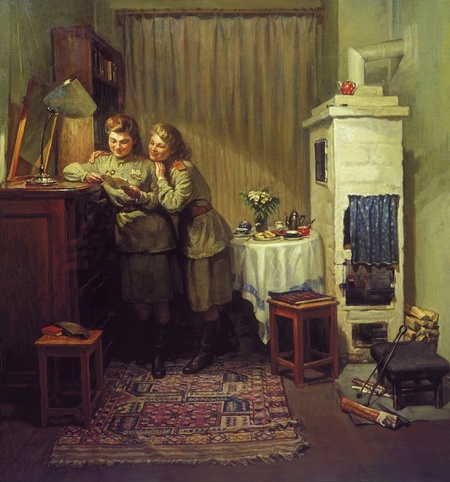
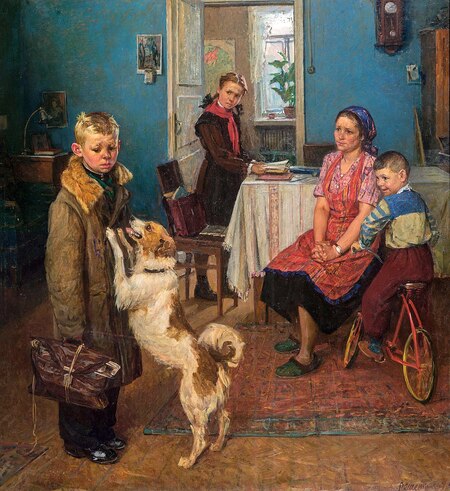
Seraphima Ryangina | «Friends» | canvas, oil | 1945 | State Tretyakov Gallery [14] | Fyodor Reshetnikov | «Again, a Two» | canvas, oil | 1952 | State Tretyakov Gallery [15]
In 1956, a Pablo Picasso exhibition was held in Moscow, marking a symbolic starting point for the formation of a parallel universe to Socialist Realism—unofficial Soviet art.
Text Author: Alexandra Kharitonova
Tair Salakhov | «After the Shift» | canvas, oil | 1957 | Museum of the History of Art at the Russian Academy of Arts, St. Petersburg [16]
Image Sources
1. Website of the State Museum and Exhibition Center «ROSIZO» [electronic resource]. Access mode: https://rosizo.ru/news/1644/?sphrase_id=25397 (Date accessed 04/01/2025) 2. VKontakte website [electronic resource]. Access mode: https://vk.com/wall-57478050_200256?z=photo-57478050_457283037%2Ff82eb91b7cf8de815c (Date accessed 04/01/2025) 3. ZVR website [electronic resource]. Access mode: https://shop.zvr.lv/magazin/item/otkrytki-hudozhestvennye/drugie-hudozhniki-armenii/mariam-aslamazjan-1987-armjanskij-natjurmort-15x105-sm-hudozhestvennaja-otk (Date accessed 04/01/2025) 4. Wikipedia website [electronic resource]. Access mode: https://ru.wikipedia.org/wikiУтро_%28картина_Яблонской%29 (Date accessed 04/01/2025) 5. Pikabu website [electronic resource]. Access mode: https://pikabu.ru/story/teplyiy_den_1957_g_avtor_levitin_anatoliy_pavlovich_10238175 (Date accessed 04/01/2025) 6. LIIM website [electronic resource]. Access mode: https://art.liim.ru/galleries/05dg/d16g/d16g_331.html (Date accessed 04/01/2025)
7. Zen.ru Website [electronic resource]. Access mode: https://dzen.ru/a/YwYtKCsVGmN-UXh8 (Date of access 04/01/2025) 8. My Tretyakov Website [electronic resource]. Access mode: https://my.tretyakov.ru/app/masterpiece/41092 (Date of access 04/01/2025) 9. Zen.ru Website [electronic resource]. Access mode: https://dzen.ru/a/YI5ja0-t43iLKWBv (Date of access 04/01/2025) 10. Wikipedia Website [electronic resource]. Access mode: https://ru.wikipedia.org/wiki/Эстафета_%28картина%29 (Date of access 04/01/2025) 11. Art-ToDays Website [electronic resource]. Access mode: https://www.art-todays.ru/articles/kartina-razdolye-1944-g-avtor-aleksandr-deyneka-udachnoe-sochetanie/1411 (Date of access 04/01/2025) 12. RG Website [electronic resource]. Access mode: https://rg.ru/2020/02/28/rodina-pisma-pobedy-na-zolotom-krylce-sideli.html (Date of access 04/01/2025)
13. Wikipedia website [electronic resource]. Access mode: https://ru.wikipedia.org/wiki/Хлеб_%28картина_Яблонской%29 (date of access 04/01/2025) 14. VKontakte website [electronic resource]. Access mode: https://vk.com/wall-39786405_21728?offset=1&reply=21867 (date of access 04/01/2025) 15. Wikipedia website [electronic resource]. Access mode: https://ru.wikipedia.org/wiki/Опять_двойка_%28картина%29 (date of access 04/01/2025) 16. Intelros website [electronic resource]. Access mode: http://www.intelros.ru/readroom/nz/126-2019/print:page,1,40598-neft-v-sovremennom-rossiyskom-iskusstve.html (date of access 04/01/2025)
Cover: Vasiliy Yefanov, «I.V. Stalin and V.M. Molotov with Children, ” 1947. „Historik“ website [electronic resource]. Access mode: https://historik.rf/picture/122 (date of access 04/01/2025)