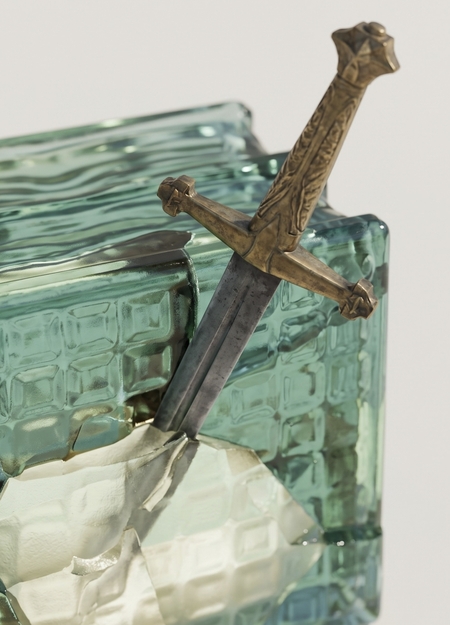
Concept
«Sword in the Glass Block» is a tabletop art object that doubles as a nightlight, pitting the classic fantasy myth of Excalibur against the aesthetic of post-Soviet industrial modernism. Instead of a moss-covered boulder, the legendary blade is embedded in a greenish industrial glass block—a signature element found in entryways, factory halls, and research institutes. Hidden within the fractured yet frozen geometric structure is the source of warm light. As light passes through the frosted facets and the internal «crystal, ” it transforms utilitarian building material into a magical artifact. The project reinterprets the familiar urban environment, finding mythology within typological architecture.
Overall View and Details
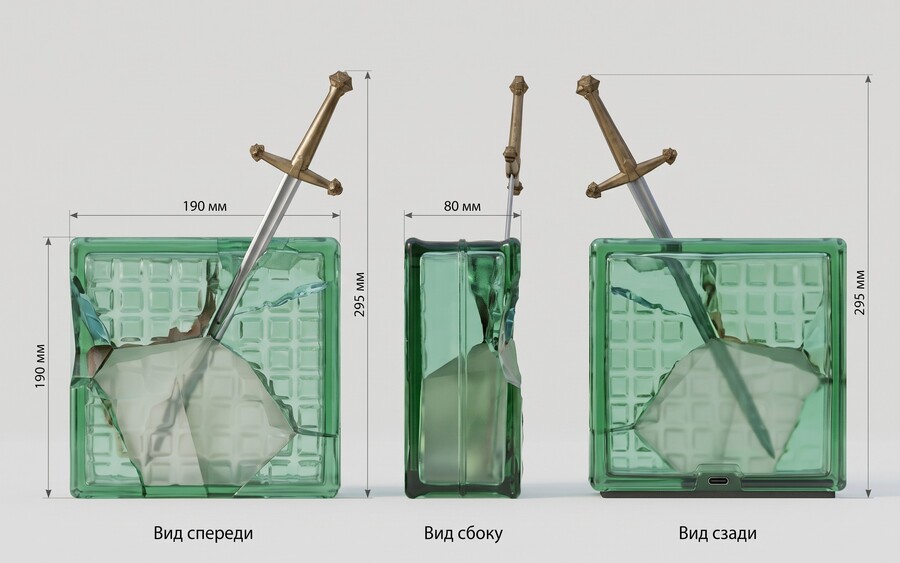
Object proportions under daylighting (visualization). The blade’s entry angle and chip geometry are shown.
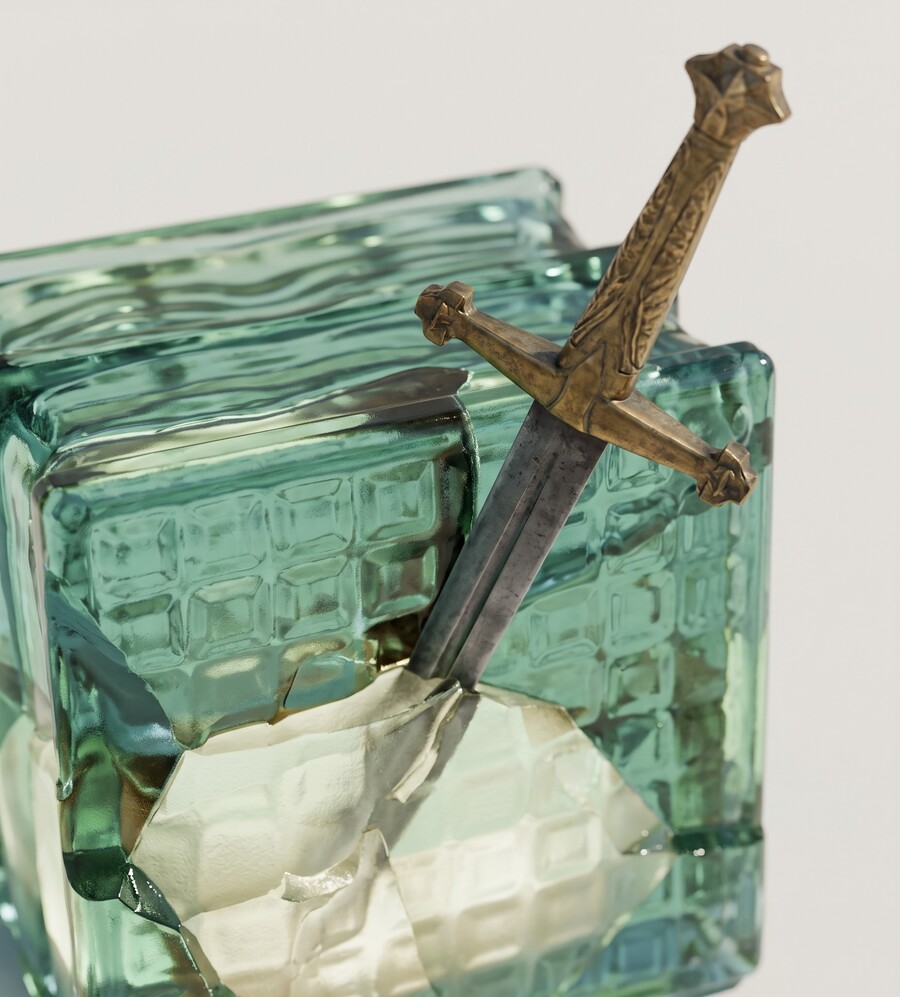
The detailing of the sword’s hilt and the contrast of textures—the cold metal of the blade, the glossy knurled glass, and the matte, glowing core.
Technical Specifications and Parameters
Format: Tabletop art object
Dimensions of the assembled piece (within the base limit of 300 mm):
Base (glass block base): 190 × 190 × 80 mm (standard industrial glass block size).
Total height (including the sword hilt): 295 mm.
Total width (including the guard projection): 240 mm.
Product weight: ~2.5–3 kg.
Materials and components:
Outer casing: Industrial glass block made of green bottle glass with an internal lattice texture («wave» / «industrial») / Alternative: solid casting from transparent epoxy compound with emerald pigment.
Internal «crystal» (core): Semi-transparent light-scattering polyurethane resin with a matte finish.
Sword: Grown via 3D printing from impact-resistant photopolymer. Blade — sanded and painted to resemble polished steel (mirror chrome); guard and pommel — painted to resemble aged brass or bronze with patina.
Construction and Manufacturing Technology
The object combines a ready-made industrial element with custom cast and printed parts (hybrid technology for small runs):
Base Preparation (Glass Block): A figurative technological window is formed in the industrial glass block using hydro-abrasive cutting (or diamond tools) to accommodate the «fracture» and a lower opening for mounting the light module. The cut edges are then sanded and polished. (Alternatively, the entire block with the fracture can be cast as one piece in a silicone mold made from optical epoxy resin, which is taken from a milled master model.)
Sword Fabrication: A master model is 3D-printed using SLA technology (photopolymer) and divided into two parts (blade and hilt) for easier processing. It is assembled on a steel pin, multiple coats of primer are applied, sanded, and coated with metallized enamels and protective varnish.
Light Core Casting: A master model of the faceted stone is 3D-printed from the model, and a silicone mold is created. Translucent plastic with a light-scattering additive and a groove for the sword’s tip is poured into it.
Final Assembly: The light element and the frosted core are installed inside the glass block. The sword tip is secured into the core’s groove using a transparent, two-component UV adhesive. The bottom of the block is covered with a thin substrate of matte black acrylic (3 mm) fitted with silicone feet (to prevent scratching the table) and a power cable exit.
Project Status: The 3D model has been developed, and the dimensions and connection points of the parts have been verified. The images show the visualization of the final object.
Project Economics
Production Partner:
Glass block material: Industrial glass block BS 190×190×80 mm, green («Wave» / «Grid») — Supplier: steklobloki.rf, Article: BS-19-G, Price: ~450 ₽/unit.
Core resin: Clear casting polyurethane Smooth-On Crystal Clear 202 (or Artline Crystal Epoxy optical epoxy resin) + white scattering pigment — Store: silicone-master.ru, ~3,200 ₽ per batch run.
Consulting specialists: Consultation with a resin casting and glass cutting technologist (Project author — Anna Lukashova: concept, 3D modeling, visualization, assembly).
Preliminary Cost Estimate:
Minimum Possible Run Size: 5 units (limited by the resource of a single silicone mold and the minimum order quantity from the contractor).
Production Timeline: 14–20 working days.
Budget (Estimated Calculation for Completion):
Production Setup and Tooling (One-time costs): Printing master models and creating silicone molds for the core / CNC setup — 15,000 ₽.
Manufacturing of the First (Signaling) Sample: 22,000 ₽ (including molds and technology refinement).
Unit Cost in the Series (for a run of 5 units):
Material preparation (glass block + hydro-abrasive cutting) — 3,500 ₽
Core casting and consumables (resin, pigments, UV adhesive) — 2,500 ₽
3D printing of the sword, sanding, and metallizing — 4,000 ₽
Hand assembly and final finishing — 2,000 ₽
Packaging (sturdy cardboard box with expanded polyethylene insert to protect the glass and exposed pommel during delivery) — 1,300 ₽
Total per unit in the series: 14,500 ₽
Total Batch Cost (5 units + tooling + delivery): 87,500 ₽
Requested Grant Amount: 87,500 ₽