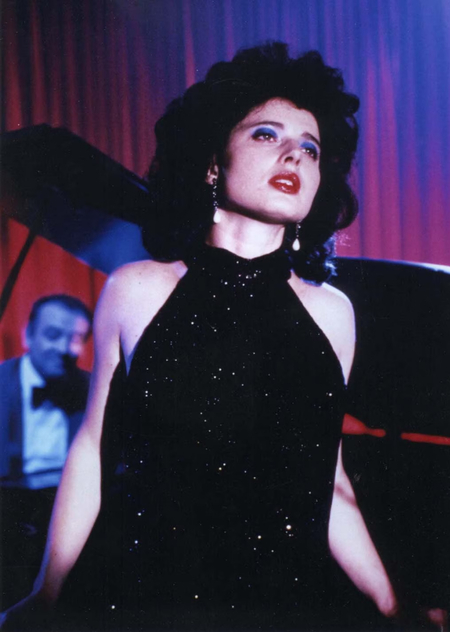
Navigation
- Costume as Facade: Ideal America and Hidden Anxiety
- The Female Image and the Fragmentation of Identity
- Theatricality, Stage, and the Artifice of Image
- Office Style and Body Discipline
Concept
David Lynch’s cinematography holds a distinct place in the history of auteur cinema due to its consistent system of visual imagery and motifs. In his films, everyday American reality emerges as a space permeated by hidden anxiety, violence, and identity instability. Costume becomes one of the key elements of this system. In Lynch’s films, clothing does more than just characterize a person; it actively contributes to forming the director’s visual language.
The research topic is examined within the context of the «Fashion and Cinema» course because costume in the Lynchian universe serves not only a decorative but also a conceptual function. Through clothing, the director constructs images of an idealized America, emphasizes the theatricality of the setting, and visualizes the internal instability of the characters. Often, the costume is built upon the tension between innocence and latent aggression.
The research draws upon the films Blue Velvet, Mulholland Drive, and Twin Peaks: Fire Walk With Me. The material selection is based on recurring visual motifs and costume types related to the theme of duality: suburban aesthetics, retro imagery, office uniformity, stage space, and the fragmentation of female identity. The study utilizes shots where costume becomes a significant element of visual storytelling.
The central hypothesis of this research is that costume in David Lynch’s films functions as a visual mechanism for constructing a normative image of reality, which ultimately reveals its own artificiality. The more stable and socially recognizable the costume code appears, the more clearly it exposes processes of identity decay and the disruption of spatial integrity.
In Lynchian cinema, costume ceases to be a way to reveal personality; rather, it becomes a mask concealing fear, trauma, and internal collapse. This is particularly evident in the female figures and the staged environments of the director’s films.
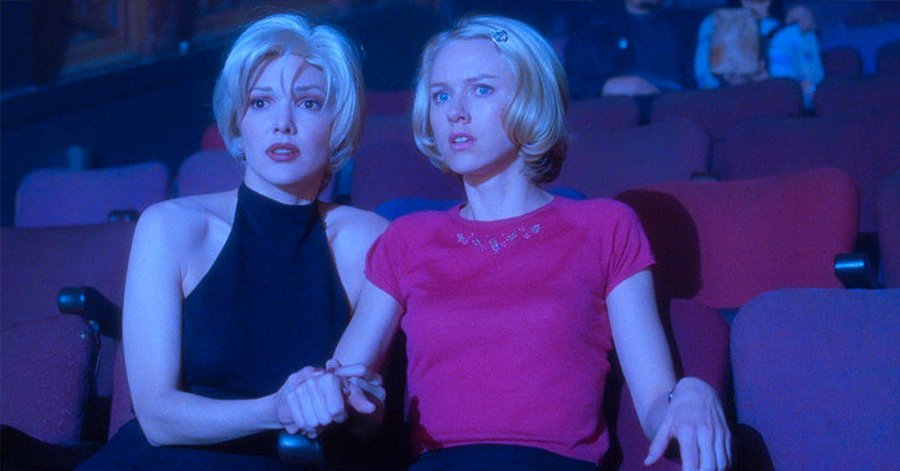
Frame from the film «Mulholland Drive.» Dir. David Lynch. 2001. [2]
The central hypothesis of this study is that in David Lynch’s films, costume functions as a visual mechanism for constructing a normative image of reality, a construction that simultaneously highlights its own artificiality. The more stable and socially recognizable the costume code appears, the more clearly it reveals processes of identity decay and spatial fragmentation.
In Lynchian cinema, costume ceases to be a means of revealing personality and instead becomes a mask concealing fear, trauma, and internal disintegration. This is particularly evident in the female figures and the staged environments of the director’s films.
The study’s structure is organized not chronologically by filmography, but by the functions of costume within Lynch’s visual system. The first section focuses on costume as a facade of normalcy and an image of idealized American everyday life. Subsequently, it examines female characters and the problem of identity bifurcation. A dedicated section addresses theatricality and the motif of performativity. The final part analyzes office wear and the standardized male suit as a form of discipline and control.
This work utilizes research pertaining to David Lynch’s auteur cinema, visual culture, costume theory, and the issue of identity in film. When selecting sources, priority was given to academic publications and texts that analyze the director’s visual language. Textual sources are employed to analyze recurring visual motifs and the functions of costume within Lynch’s dual reality.
Costume as Facade: Ideal America and Hidden Anxiety
A still from the film «Blue Velvet.» Directed by David Lynch. 1986. [1]
Still from the film «Blue Velvet.» Directed by David Lynch. 1986. [1]
A still from the film «Blue Velvet.» Dir. David Lynch. 1986. [1]
A still from the film «Blue Velvet.» Directed by David Lynch. 1986. [1]
A still from the film «Blue Velvet.» Directed by David Lynch. 1986. [1]
A still from the film «Blue Velvet.» Directed by David Lynch. 1986. [1]
In the film Blue Velvet, the pink palette and soft pastel shades construct the visual image of idealized American everyday life. Color here functions not as a decorative element, but as a code for a «safe» and socially normalized reality. The pink suit and accessories create a sense of vulnerable, yet carefully constructed, innocence—an innocence that already contains latent tension and potential aggression. At the costuming level, this visual layer operates as a mask: it fixes the character in a state of external harmony while simultaneously amplifying the contrast with the underlying anxiety and violence characteristic of the lynched world.
Still from the film «Blue Velvet.» Dir. David Lynch. 1986. [1]
A still from the film «Blue Velvet.» Directed by David Lynch. 1986. [1]
Still from the film «Blue Velvet.» Directed by David Lynch. 1986. [1]
Still from the film «Blue Velvet.» Directed by David Lynch. 1986. [1]
Still from the film «Blue Velvet.» Dir. David Lynch. 1986. [1]
A still from the film «Twin Peaks: Fire Walk with Me.» Dir. David Lynch. 1992. [3]
In the film «Twin Peaks: Fire Walk With Me,» the everyday American setting is visualized through recognizable and «proper» imagery: pastel sweaters, school uniforms, classic office suits, and retro silhouettes. This kind of aesthetic creates a sense of stability and security, yet it is precisely this emphasized normality that becomes the source of anxiety. The costume forms an artificial facade of well-being, concealing the internal decay of the characters and the setting.
A still from the film «Twin Peaks: Fire Walk with Me.» Dir. David Lynch. 1992. [3]
The brown tones of Laura Palmer’s image create a false sense of security.
Still from the film «Twin Peaks: Fire Walk with Me.» Dir. David Lynch. 1992. [3]
A scene from the film «Twin Peaks: Fire Walk with Me.» Directed by David Lynch. 1992. [3]
Red conveys a growing anxiety as the film progresses.
A still from the film «Twin Peaks: Fire Walk with Me.» Directed by David Lynch. 1992. [3]
A frame from the film «Twin Peaks: Fire Walk with Me.» Dir. David Lynch. 1992. [3]
A frame from the film «Twin Peaks: Fire Walk with Me.» Dir. David Lynch. 1992. [3]
Dark, graphic silhouettes contrast with Laura’s skin, lending the look drama and maturity.