(1)
Research Concept
The focus of this research is on the study of light and color perception and their influence on the sense of space. In 20th and 21st-century art, light and color increasingly function not merely as expressive devices but as tools capable of altering the viewer’s experience, shaping the sensation of depth, scale, and spatial boundaries. Consequently, particular interest lies in analyzing how artistic practices affect human perception and transform the way individuals interact with their environment.
The selection of the topic is driven by an interest in the phenomenon of perception and its dependence on visual and spatial factors—such as color, lighting, form, scale, and sound environment. The research focuses not only on the artistic object but also on the viewer’s experience and the conditions under which their spatial perception is formed.
The research hypothesis posits that in contemporary art, light and color function not merely as elements of artistic language, but as independent means of shaping spatial experience, thereby making the viewer an active participant in the interaction with the artistic environment.
The theoretical foundation of this research rests upon the works of Mikhail Matyushin, notably his «Color Handbook» (1932), «The Creative Path of the Artist» (2011), and his theories of «expanded looking» and organic culture, which treat perception as an active and dynamic process. Additionally, the color theory of Johannes Itten, outlined in his book «The Art of Color» (1961), is employed, analyzing the patterns of color interaction and its influence on emotional and spatial perception.
The core material of this study consists of artworks and installations from the 20th and 21st centuries, where light and color play a crucial role in shaping visual experience. Specifically, the works of Anish Kapoor are examined, focusing on how the interaction between form and reflective surface affects the perception of an object; the light installations of James Turrell, in which light serves as the primary medium for constructing space; the works of Carlos Cruz-Diez, which are based on optical effects and the illusion of movement; and the projects of Olafur Eliasson, which investigate the influence of environment on perception.
Research Structure
The research structure is organized according to a progression from theoretical foundations to their practical realization. Initially, key tenets of color theory and perception are examined; subsequently, artistic practices where light and color are employed as tools for spatial transformation are analyzed; and finally, contemporary immersive projects that require active audience participation are reviewed. When selecting textual sources, the primary focus is on works related to color theory and the problem of perception. The analysis of these sources aims to identify the link between theoretical concepts and artistic practices, as well as to interpret artworks through the lens of the viewer’s experience.
Key research question: How do light and color in contemporary installation art influence the perception of space and the role of the viewer within it?
(2)
Mikhail Matyushin
Color Theory
Mikhail Matyushin viewed color as a mutable system of perception, intimately connected to space, movement, light, and the human state. Diverging from traditional color theories that focus primarily on harmony and composition, Matyushin studied color as a psychophysiological phenomenon dependent on the peculiarities of human vision and the surrounding environment.
Matyushin paid particular attention to the impact of color on the perception of space. He noted that various color combinations are capable of inducing a sense of depth, motion, vibration, or spatial expansion. In his view, color can visually alter space and influence the viewer’s emotional and physical condition.
Color Palettes
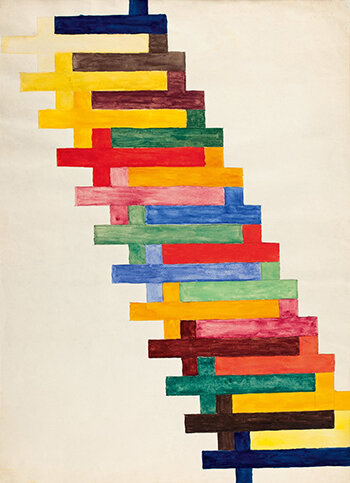
Matyushin paid close attention to research on the interaction of color and sound, discovering that when a person perceives warm colors, the sound decreases, whereas cold colors increase it. These studies allowed for the creation of specific color palettes capable of capturing the most subtle shades—the «intercolors.»
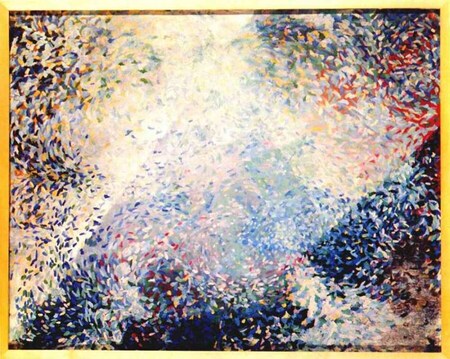
Color-Music Compositions
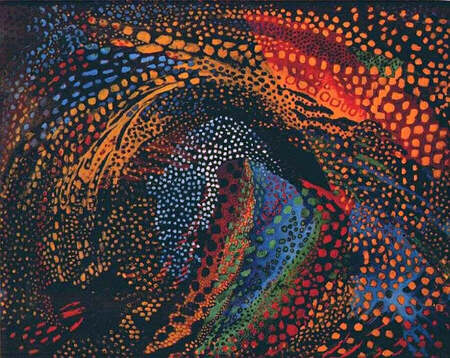
Matyushin believed that color does not exist in isolation and is never perceived uniformly. Its perception changes depending on the lighting, adjacent hues, form, and the observer’s position in space. Thus, Michael understood color not as a fixed property of an object, but as a dynamic visual environment constantly shifting in interaction with the human.
In the examples provided, the relationship is shown as color within a medium, with both colors being linked by a third element. This, to some extent, defines the quantitative relationship between colors. The medium represents the largest area, while the connection represents the smallest. However, it should be noted that the sequence proposed in space is even more significant than quantitative ratios—that is, the connecting color must be positioned between the primary color and the medium color.
Color Guide by Mikhail Matyushin
General Principles of Color and Form Variability
Color plays a formative role: warm colors «soften» and round acute forms, while cool colors sharpen rounded forms.
The alteration of color and form depending on the range of visual acuity.
The intensification of an object’s color and its environment when that object moves within that environment.
Color change over time, where a primary color plays a huge role, which in turn generates secondary, tertiary, and so on (Matyushin calls this process induced color).
The role of movement in enhancing the chromatic energy. 6. The emergence of a third color—a linking color—between the colored object and the environment into which it is placed. Discovered in nature and substantiated by experiments at GINKHUK, this color resolves complex spatial color relationships, balances them on the pictorial plane, provides volumetric expression without the use of chiaroscuro, purifies the colors, and creates an extraordinary luminescence.
Matyushin’s research focused on studying the relationship between color and perception. The artist aimed to demonstrate that the viewer’s experience is shaped not only by the object itself but also by the workings of human vision. These ideas significantly anticipated contemporary practices in immersive art and spatial installation, where light and color become tools for shaping the sensory experience of space.
Theory of «Extended Viewing»
The theory of «expanded looking, ” developed by Mikhail Matyushin, was based on the study of human vision and spatial perception. The artist believed that the traditional way of seeing was limited by a central gaze focused on a single object, whereas humans are capable of perceiving the surrounding environment far more broadly.
Matyushin believed that ordinary human visual perception is limited by a central gaze focused on a single object. In his view, this way of seeing prevents the full apprehension of space and the surrounding environment. Consequently, the artist sought to develop the human capacity to perceive the world more holistically—simultaneously sensing not only the object before them but also the space around it. He called this ability «expanded viewing.»
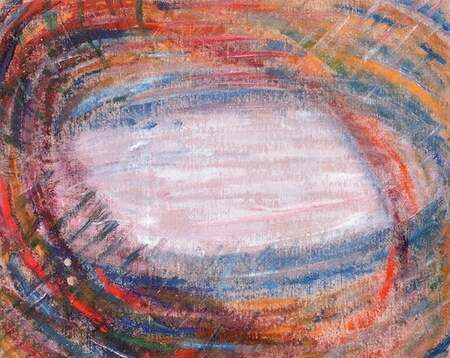
Space. 360-Degree Overview. The idea of simultaneously viewing in 360 degrees is the essence of the extended gaze concept. By proclaiming the ideal of the extended gaze, Matyushin expands the very concept of sight. We do not just see with our eyes, but ultimately—with our entire body—through «the back of the head, the crown, the temples, and even the footprints, ” with our whole being, not just with the „foremost crown.“

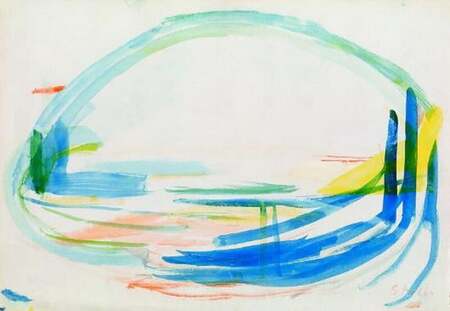
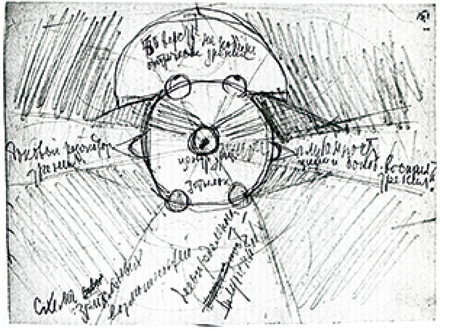
The foundation of this concept was an exploration of peripheral vision. Matyushin theorized that it is peripheral perception that allows us to feel space holistically, perceiving light, movement, and the relationships between objects. Unlike central vision, which fixes on details and form, peripheral vision creates a sense of depth and presence within the environment.
In his research, Matyushin investigated how color, light, and movement influence the perception of space. He noted that human vision perceives color not as a static property of an object, but as a changing phenomenon dependent on the surrounding environment and the observer’s position. Thus, he conceptualized space as a dynamic system of interactions rather than a fixed geometric structure. The theory of expanded vision was also linked to the concept of the unity between humans and the environment. Matyushin sought to demonstrate that the perception of space is not merely a visual process, but also a corporeal one. Light, color, rhythm, and environmental movement impact a person’s emotional and physical state, shaping a distinct experience of presence within that space.
Organic Culture
The Organic movement existed within the Russian artistic avant-garde alongside Suprematism, Constructivism, and Analytic art. Its characteristic feature was the perception of the world as a single organic structure, constructing plastic forms based on the patterns observed by artists in the interaction of natural forms, color, and sound. A common trait across all created works was the construction of organic, curvilinear, fractal geometry, typical of natural morphogenesis. 1